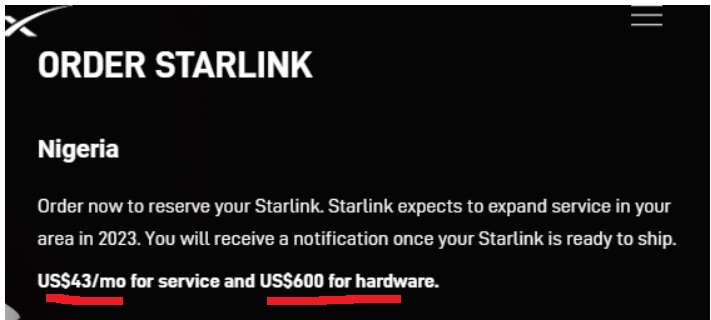
Elon Musk’s SpaceX Starlink is just about ready in Nigeria. But the price will shock many people: US$43/month service and a one-time hardware cost of $600. With that, you get a high-speed, low-latency broadband internet in remote and rural locations across the nation. In the US, the average cost for service is $110/month. So, it will be interesting to know if the bandwidth will be the same since the price in Nigeria is well lower.
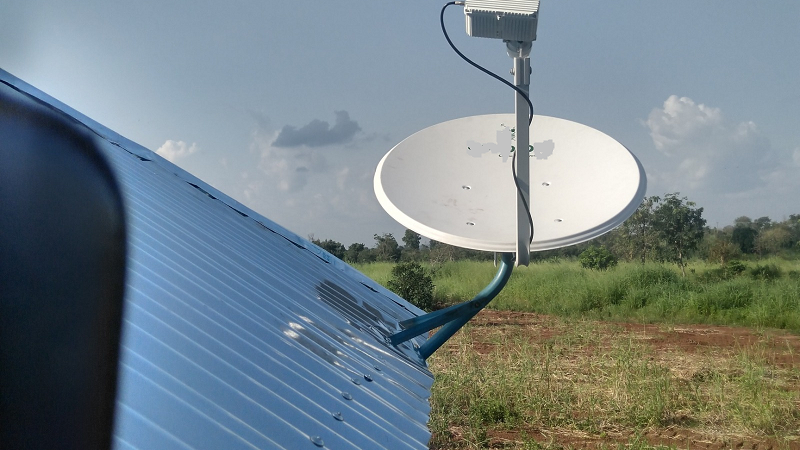
What can I write? If you have a project that needs this and you have the funds, the solution works. We have deployed it in Nigeria for months: “We have been using the SpaceX Starlink system in Nigeria for months, and the thing works. The uptime is good. We bought it in the United States and deployed it on a farm in Nigeria, to help in our agriculture business.”
No matter how you see it, the pricing does not make sense for a consumer business in Nigeria. So, it is very likely that for a long time, the focus will be companies. If that is the case, it may not be really bad.
Otherwise, the $billionaire can open the typical playbook: subsidize the hardware and make up via services. But that may be hard as Nigeria does not have a reliable credit system to build that type of business. So, it seems this service will serve the 1% before it scales to the 99% in years.
Comment on Feed
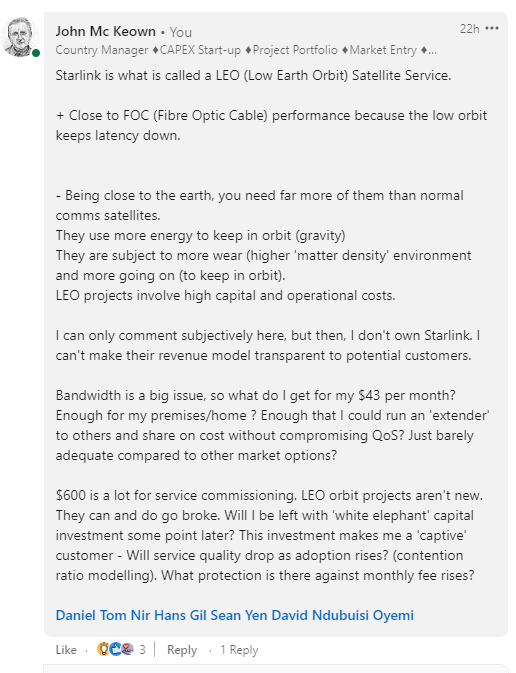
Comment 1: Hi Prof Ndubuisi, as you know through engaging with Tekedia Institute over the years, the Nigerian Market in anything to do with data transport and bandwidth provision is something I am particularly strong on.
The American market isn’t something I look at from user perspective so its enlightening to hear its $110 average in US.. Some would argue that’s just geo flexing on what different markets can bear, but there has to be a profitizing strategy for any market, and when you are talking hardware provision and core engineering from abroad, then a global providers’ profitizing route for Nigeria becomes more expensive, not cheaper.
So its either going to be about reduced QoS or ramping fees over time with the $600 as a hostage to fortune.
I already answered Tola about this yesterday, forgive the paste.
Also if anybody wants a background on Data Transport/Telecoms in Nigeria, I wrote this a few years ago. Some new developments have come since but it is still a good historical point of reference for readers:
Comment 2: Mr. Musk skimming pricing strategies looks too ambitious for an emerging market like Nigeria. No one knows the reasons for this pricing template, but one would have thought Mr Musk would have explored and exploited the historical statistics on data usage and pricing of Nigeria consumers in arriving to this prices.
Mr Musk need a critical mass to pull through and not 1% Prof. Ndubuisi Ekekwe. The 1% cannot sustain Starlink in the long run and the mass market is the ordinary Nigerian who considers close substitute and competition prices over service offerings. Do you have a data on how MTN 5g router pegged at 50k NGN is doing, even with the “amazing” service offerings?
Also, the big four grass root GSM operators ( MTN, Glo, Airtel & 9mobile) in that space would not fold their arms to allow Mr Musk to disrupt their territories.
Meanwhile, do you have a hold on the communique of the meeting these players held with NCC when Mr Musk announced the arrival of Starlink in Nigeria? I think a peep into that would provide an insight on how the market would react eventually.
…What is the stage in the industry Mr. Musk is coming to play in?
One of the most crucial aspect part of any business entering into an existing competitive market is the price. A “big picture” contextual may or not be realized, if the market rejects the products.
You may want to reference the case studies of how many wonderful products / companies died at introductory stage of the product life cycle due to pricing. We are talking about an emerging market here. Do you have insight into the empirical data? What is the total available market (TAM) of the industry?
Comment 3: One thing I have learnt from is “Never estimate the buying power of Nigerians”…
Despite the acclaimed 113M Nigerians living in poverty, the country is still a viable market for consumer goods of which Starlink will not be an exception. At the prices you stated above, I can bet you that the product will be a sellout in Nigeria. Watch and see how 3, 4, 5 families/individuals/businesses will pull resources together and buy the hardware to share. Those that can afford it will be a child’s play when compared to the poverty rate in our country. Elon Musk will make a kill here in Nigeria. Let me stop here for now!
Comment 4: Ndubuisi Ekekwe I think the pricing is based on a differential pricing model between high income and low income countries and may not necessarily have any impact on the bandwidth.
Having said that, we agree that the price is somewhat prohibitive in Nigeria / low income countries and would only serve the 1% as you have described but at the same time, the good side is that Elon Musk has shown what is possible.
As long as other players are able to come into the market in the long run, competition will drive down the price in future. We need challengers who will innovate in this field and compete head-on with Elon.