DD
MM
YYYY

PAGES

DD
MM
YYYY

spot_img

PAGES

Home Blog Page 46

AFP Protección to Launch Bitcoin Exposure Fund in Colombia 

0

Colombia’s second-largest pension fund manager, AFP Protección, has announced plans to launch a Bitcoin exposure fund.

This development marks a significant step in institutional adoption of Bitcoin in Latin America, allowing qualified clients to diversify their retirement portfolios with limited, regulated exposure to BTC.

AFP Protección manages over 220 trillion Colombian pesos approximately $55 billion USD in assets for more than 8.5 million clients across mandatory and voluntary pension plans, as well as severance accounts.

The fund is not a direct “Bitcoin reserve” for the entire pension system but an optional investment product offering exposure to Bitcoin. Access is restricted to qualified investors who undergo a personalized advisory process to assess risk tolerance.

It emphasizes long-term diversification rather than speculation, and it will not change the core allocation of traditional pension savings which remain focused on conventional assets like fixed income and equities.

This follows a similar move by another Colombian pension administrator, Skandia, which introduced Bitcoin exposure via a BlackRock Bitcoin ETF in its voluntary pension portfolios in late 2025. It highlights growing interest in cryptocurrencies among pension sectors in the region, potentially as a hedge against inflation or currency risks.

This is part of a broader trend of institutional integration of Bitcoin, with similar steps seen in other markets. While not a full “reserve” like some nation-state approaches like El Salvador, it represents meaningful mainstream financial infrastructure onboarding BTC for retirement savers.

This move signals continued momentum for Bitcoin as a legitimate asset class in traditional finance. This is a measured, optional product for qualified investors only—accessed via personalized risk assessments—not a broad overhaul of pension allocations.

It builds on Skandia’s earlier introduction of Bitcoin exposure via a BlackRock ETF in voluntary portfolios. Bitcoin is positioned as a hedge against inflation, currency devaluation, and geopolitical risks common in Latin America.

Qualified clients gain access to an asset with historically low correlation to traditional stocks/bonds, potentially improving long-term risk-adjusted returns in volatile emerging-market contexts.

Strict eligibility (personalized advisory + risk profiling) and limited allocations protect core retirement savings. The bulk of mandatory pension funds remain in conventional assets like fixed income and equities, avoiding widespread exposure to Bitcoin’s volatility.

This could draw younger or more risk-tolerant savers seeking modern diversification, helping AFP Protección compete in a market facing pressures like proposed government rules to cap overseas investments (redirecting capital domestically).

A major fiduciary like AFP Protección integrating Bitcoin validates it as a strategic diversifier rather than pure speculation. Analysts describe this as a “graduation” for Bitcoin in traditional finance, especially in emerging markets.

The move following Skandia may pressure peers in Chile, Peru, Mexico, and beyond—managing hundreds of billions in assets—to explore similar products. This accelerates regional institutional adoption amid macroeconomic challenges.

Colombia treats Bitcoin as an intangible asset not legal tender, with increasing oversight. The cautious, advisory-led structure aligns with prudence requirements under Decree 574/2025, reducing friction in a gray-area regulatory environment.

While inflows are expected to be small and gradual due to qualification limits and conservative allocations, this adds steady, regulated institutional buying pressure. Combined with global trends, it supports Bitcoin’s long-term structural demand without causing immediate price shocks.

Reports consistently note no broad-based upward pressure expected soon, as the product targets diversification—not aggressive speculation. Long-term, it contributes to Bitcoin’s maturation as a portfolio component.

Success may highlight gaps in investor knowledge and the need for better custody/regulation frameworks to scale such exposure safely. This represents cautious but meaningful progress in Bitcoin’s institutional integration in Latin America—prioritizing stability while opening doors to digital assets for retirement planning.

It aligns with a global shift where pension funds increasingly view Bitcoin as a non-traditional diversifier amid persistent inflation and currency risks. If other major administrators follow, it could reshape how millions save for the future in the region.


Implications of Ethereum Forming A Post-Quantum Security Team

0

The Ethereum Foundation has recently formed a dedicated Post-Quantum (PQ) Security Team often referred to as the Post Quantum team. This announcement came in late January 2026 and marks a significant escalation in Ethereum’s long-term strategy to protect the network against future threats from quantum computing.

The team is led by cryptographic engineer Thomas Coratger, with key members including Emile, a contributor to leanVM, described as a cryptographic cornerstone for Ethereum’s PQ efforts. EF management has officially declared post-quantum security a top strategic priority. This builds on years of research starting as early as 2019, with acceleration since 2024 under the leanEthereum vision.

The effort includes $2 million committed, largely through two $1 million research prizes:Poseidon Prize — to harden the Poseidon hash function (betting on hash-based cryptography for strong, efficient foundations). Proximity Prize — another PQ-focused initiative.

Bi-weekly All Core Devs Post Quantum breakout calls starting soon, led by Antonio Sanso, focusing on user-facing security like precompiles, account abstraction, transaction signature aggregation with leanVM. Multi-client PQ consensus devnets are already live, involving teams like zeamETH, ReamLabs, PierTwo, geanclient, ethlambda_lean, Lighthouse, Grandine, and Prysm.

A PQ workshop in October 2026, plus a PQ day on March 29 in Cannes ahead of EthCC. A 6-part video series on ZKPodcast, materials for enterprises/nation-states, and Ethereum’s representation on Coinbase’s PQ advisory board. Recent use of specialized maths AI for formal proofs in hash-based SNARKs.

A full transition to post-quantum cryptography in the coming years, targeting zero loss of funds and zero downtime. This move addresses growing concerns that quantum computers could eventually break current cryptographic primitives like ECDSA signatures used in Ethereum wallets, though the threat remains non-immediate.

Ethereum is positioning itself proactively, with wallet safety upgrades, test networks, and broader R&D.The announcement was shared publicly by EF researcher Justin Drake on X, and it has been covered widely in crypto media. It’s seen as a forward-thinking step to future-proof the protocol.

The formation of the Ethereum Foundation’s Post-Quantum (PQ) Security Team in late January 2026 signals a major shift from long-term research to active execution in preparing Ethereum for the quantum computing era. This has several layered implications for the protocol, users, developers, the broader crypto ecosystem, and even traditional finance/institutions.

The announcement explicitly notes that “timelines are accelerating” for cryptographically relevant quantum computers those capable of running Shor’s algorithm to break ECDSA signatures and expose private keys from public addresses. While no precise “break date” exists, the EF views the risk as moving from theoretical to something requiring concrete engineering now.

This proactive stance contrasts with more conservative views some experts like Adam Back estimating decades away, positioning Ethereum as taking the threat seriously rather than waiting for clearer signals.

Ethereum aims for a full transition to post-quantum cryptography like hash-based signatures, lattice-based schemes, or hybrids with goals of zero loss of funds and zero downtime. This likely involves: Replacing or augmenting ECDSA with quantum-resistant signatures via account abstraction enhancements, new precompiles, or leanVM-based aggregation.

Upgrading wallet security to support PQ schemes without forcing mass key migrations; a logistical nightmare if not handled carefully. Potential hard forks or soft upgrades, though the roadmap emphasizes smooth, low-disruption paths.

Ethereum could become one of the first major blockchains to achieve broad quantum resistance, but the migration will test coordination among core devs, clients, wallets, and dApps. Poor execution risks temporary fragmentation or user friction.

By prioritizing PQ security alongside leanEthereum vision elements like scalability and efficiency, Ethereum differentiates itself as a “post-quantum safe haven” for high-value assets and data. This could attract institutions, enterprises, and nation-states concerned about long-term digital asset security especially as EF prepares targeted materials and joins advisory boards like Coinbase’s.

In a world where quantum breakthroughs could devalue non-resistant chains like exposing dormant Bitcoin and Ethereum addresses via “harvest now, decrypt later” attacks, Ethereum’s early move enhances its credibility as a durable, future-proof Layer 1.

Its emonstrates the EF’s commitment to long-term robustness, aligning with Vitalik Buterin’s emphasis on Ethereum passing the “walkaway test” (protocol ossification with built-in quantum resistance, scalability, and decentralization). This could bolster confidence in ETH as trustless collateral.

$2M in prizes (Poseidon for hash hardening, Proximity for other PQ advances) and devnet investments signal serious resource allocation, potentially spurring innovation in hash-based SNARKs, formal proofs, and ZK tech. Its may pressure competitors (Bitcoin, Solana, etc.) to accelerate their own PQ efforts, or highlight Ethereum’s edge in institutional-grade security.

PQ schemes often introduce larger signature sizes, higher computational costs, or performance hits—Ethereum’s focus on “lean” foundations (e.g., Poseidon hash, leanVM) aims to mitigate this, but real-world trade-offs remain.

Over-prioritizing PQ could divert resources from nearer-term issues, scaling via PeerDAS/ZK-EVM, though the EF frames it as complementary to the long-term roadmap. Achieving consensus on upgrades in a decentralized ecosystem is hard; rushed changes could lead to contentious forks.

This is a bullish, forward-thinking move that reinforces Ethereum’s cypherpunk roots and commitment to uncompromising security. It positions the network to thrive in a post-quantum world, potentially turning a existential risk into a competitive moat. The full roadmap is expected soon and upcoming events like March PQ day, October workshop will clarify next steps. Stay tuned—Ethereum is going “full PQ.”

Binance is Launching Tesla-linked Perpetual Futures Contracts

0

Binance is launching Tesla-linked perpetual futures, specifically the TSLAUSDT equity perpetual contract on its futures platform.This allows users to trade exposure to Tesla (TSLA) stock price movements 24/7 using USDT as margin, with up to 5x leverage.

Trading begins on January 28, 2026, at 14:30 UTC based on recent Binance announcements and coverage. This is not tokenized stocks in the traditional sense like the 2021 Binance stock tokens that mirrored actual shares and were later discontinued due to regulatory issues.

Instead, it’s a perpetual futures contract tied to Tesla’s equity price—similar to other crypto perps but for a stock underlying. It bridges crypto trading infrastructure with traditional equities, enabling continuous, leveraged trading without stock market hours.

Recent reports and posts highlight excitement around this as a step toward broader TradFi-crypto convergence, with hints that it could signal a return of tokenized stock products on Binance which they paused in 2021 but have been rumored to revive.

This builds on Binance’s history— they originally launched tokenized Tesla shares back in April 2021 (fractional ownership via tokens), but suspended purchases soon after due to regulatory pressure. Now, via derivatives like this perp, they’re offering indirect exposure in a potentially more regulator-friendly way.

Community reactions on X range from viewing it as bullish for cross-market liquidity to concerns it might pull capital from altcoins toward “real” assets like TSLA.

Binance does not currently offer direct tokenized Apple stocks like the AAPL-based tokens from their 2021 program on its main spot platform, as they discontinued that product line due to regulatory pressures shortly after launch.

However, there are several ways to get exposure to Apple (AAPL) through Binance-related or integrated products in 2026: Tokenized Apple stocks via Binance Web3 Wallet / integrations — Binance supports trading of tokenized versions like AAPLX (Apple tokenized stock xStock) and AAPLon via Ondo Finance or similar issuers.

These are available in the Binance Web3 Wallet under the Trade tab, where you can swap USDT for these tokens. They provide 1:1 exposure to Apple’s stock price, often with 24/7 trading, fractional ownership, and no traditional market hours restrictions. Current prices hover around $247–$248 USD per token, with active trading volume in the millions.

These are blockchain-based tokens backed by actual shares held in custody by regulated providers, not direct Binance-issued ones like in 2021.  Following the recent launch of TSLAUSDT equity perpetual futures with up to 5x leverage, starting late January 2026, Binance is actively exploring or signaling a broader revival of stock-linked products.

Reports indicate plans to reintroduce tokenized equities including major names like Apple, Nvidia, Microsoft for 24/7 trading, potentially outside strict U.S. oversight. No official AAPLUSDT perp has launched yet, but community buzz and announcements suggest more equity perps could follow Tesla’s rollout soon.

Binance paused tokenized stocks in 2021 after launching them for companies including Apple, Tesla, and others via partners like CM-Equity. The Binance Square posts confirms they’re considering/planning a comeback amid rising RWA (Real World Asset) tokenization trends. Tokenized U.S. stocks overall have surged, with circulating value hitting ~$915M and growing fast.

This fits the TradFi-crypto convergence wave, especially after the Tesla futures announcement. For visuals on what these tokenized Apple assets look like in trading interfaces or price charts: (These show examples of AAPLX price tracking and Binance Wallet swap interfaces.) This is high-risk territory—tokenized assets and derivatives can involve custody risks, volatility, and potential liquidation. DYOR and trade responsibly.

Polymarket Projects 81% as Chances for a U.S Government Shutdown

0

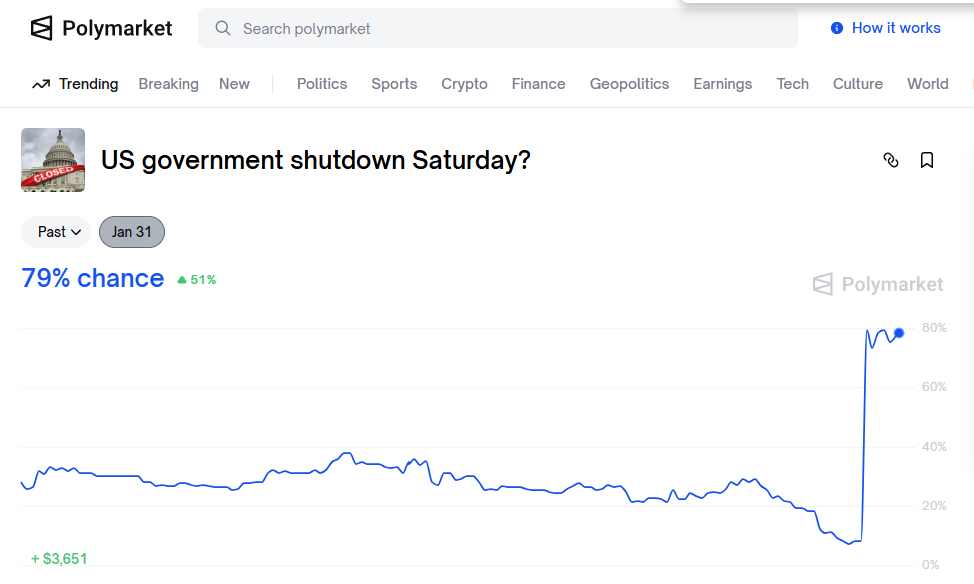
The odds of another US government shutdown occurring by January 31, 2026, have surged on Polymarket, currently standing at 81% for “Yes” on that outcome.

This represents a sharp increase from lower probabilities just days ago, such as around 9-11% late last week, as reported across multiple sources. The spike aligns with recent political developments, where Senate Democrats, led by Minority Leader Chuck Schumer, announced they would withhold votes to advance a government funding package if it includes funding for the Department of Homeland Security (DHS).

This stance follows a fatal shooting in Minneapolis involving federal agents, reportedly from Border Patrol or ICE, which has intensified Democratic calls for changes to DHS provisions, including restrictions on ICE funding.

Government funding is set to expire at the end of this week (January 31), and without bipartisan agreement, a partial shutdown could affect non-essential federal operations, though essential services like Social Security and military pay would continue.

Republicans have pushed back, framing any potential shutdown as a “Schumer shutdown” due to Democratic opposition, while emphasizing the need for uninterrupted funding to support ongoing efficiency reforms like those from the DOGE initiative.

Discussions on platforms like X highlight trader sentiment, with some estimating even higher odds up to 85% based on the impasse over DHS reforms. Similar prediction markets like Kalshi show comparable jumps, reaching 79%.

Market reactions could influence stocks, particularly in sectors tied to government contracts, though historical shutdowns like those in 2018-2019 have often had limited long-term economic impact. Negotiations are ongoing, with senators like Chris Murphy and Tim Kaine seeking amendments, but resolution remains uncertain as the deadline approaches.

Government shutdowns in the United States have occurred periodically since the 1980s, stemming from failures to pass funding legislation, often due to partisan disputes over spending or policy riders.


Prior to that era, funding gaps rarely disrupted operations, as agencies continued functioning under the assumption of eventual appropriations. Since 1977, there have been about 20 such events, with an average duration of eight days, though some have lasted weeks or months.

Notable historical shutdowns include: 1995-1996: Two separate closures under President Clinton and a Republican-led Congress, totaling 26 days, triggered by disagreements over budget cuts and Medicare reforms.

Impacts included delayed passport processing, closed national parks, and halted toxic waste cleanups, affecting millions.

2013: A 16-day shutdown during the Obama administration over Affordable Care Act funding, leading to furloughs of 800,000 federal workers and economic losses estimated at $24 billion.

2018-2019: The longest on record at 35 days under President Trump, centered on border wall funding disputes. It reduced U.S. economic output by $11 billion over the following quarters, with ripple effects on contractors and small businesses.

Economic impacts have varied but are generally short-term and disruptive. Shutdowns have caused losses in tourism e.g., closed national parks costing millions daily  aviation delays due to understaffed TSA and FAA operations, and halted government contracts, leading to broader supply chain issues.

This changes in minutes at Polymarket

The 2018-2019 event alone resulted in $3 billion in permanent losses after accounting for back pay and recoveries. Additionally, they delay economic data releases from the Bureau of Labor Statistics, complicating market predictions and policy decisions.

Federal workers bear significant burdens: During shutdowns, non-essential employees often hundreds of thousands are furloughed without pay, while essential staff e.g., in law enforcement or air traffic control work unpaid until resolution.

Congress typically approves back pay afterward, but the interim financial strain leads to missed bills, depleted savings, and reliance on food banks or loans. Public services face interruptions, including delayed Social Security verifications, suspended FDA inspections, halted IRS audits, and paused research grants.

Vulnerable populations, such as those on food assistance or housing subsidies, experience payment delays, exacerbating hardship. National security can be affected through reduced military training or border operations, though core defenses continue.

Financial markets have historically shown resilience, with limited long-term effects on stock prices or bond yields, as investors view shutdowns as temporary political theater.

However, short-term volatility can occur, particularly in sectors reliant on government spending, like defense or healthcare. While shutdowns impose real costs—estimated in the billions—they rarely lead to structural changes in government size or function.


Bitcoin Struggles Below Key Resistance Point as Bearish Momentum Tightens Grip

0

Bitcoin remains under pressure as it struggles to reclaim key resistance levels, with bearish momentum continuing to dominate price action. The crypto asset experienced modest volatility around Tuesday’s Wall Street open, briefly climbing to $88,315 before retracing lower.

The price action reflects a cautious market environment as investors position ahead of the U.S. Federal Reserve’s next interest rate decision, amid a crowded backdrop of macroeconomic and political risks.

After reaching a year-to-date high near $98,000 earlier in the year, Bitcoin has remained on a downward trajectory, signaling that sellers continue to dominate market structure. With key resistance levels holding firm and momentum skewed to the downside, traders are increasingly focused on where price could head next if selling pressure persists.

Crypto analyst Crypto Patel noted in a recent post on X that Bitcoin has firmly rejected the $94,000–$98,000 neckline resistance zone, reinforcing a bearish technical structure. According to Patel, this rejection confirms that sellers remain in control, as the failure to reclaim this region has prevented any meaningful shift in momentum.

From a technical perspective, Patel highlighted that Bitcoin has completed a failed Head and Shoulders pattern, followed by a bear-flag breakdown. This sequence strengthens the bearish case, with price action continuing to print lower highs while struggling beneath major resistance.

As long as Bitcoin remains capped below the neckline, the broader trend remains decisively bearish. Patel added that a bullish bias would only return if BTC manages a strong reclaim and sustained acceptance above $92,000. Until then, rallies are likely to be viewed as selling opportunities rather than indications of a trend reversal.

Market sentiment has also been shaped by broader macro developments. Gracie Lin, CEO of OKX Singapore, observed that markets have become increasingly headline-sensitive as multiple risks converge. With gold posting fresh highs and investors digesting political and regulatory uncertainty, she noted that Bitcoin is likely to remain range-bound and volatile in the near term. According to Lin, price action may be influenced less by the Fed’s decision itself and more by evolving liquidity conditions and overall risk appetite.

Speculative sentiment is also visible on prediction markets. On Polymarket, a contract running through the end of the week has recorded nearly $67 million in trading volume tied to Bitcoin’s price by the end of January. The majority of participants are betting on further downside, with $85,000 emerging as the most favored potential low. In contrast, longer-term sentiment appears more constructive. In a separate Polymarket contract with over $9.3 million in volume, most bettors predict Bitcoin will reach $100,000 before year-end.

Since slipping below $90,000, Bitcoin has struggled to reclaim higher levels, a dynamic that has weighed on the broader crypto market. Ethereum remains capped below $3,000, BNB below $900, Cardano trades around $0.35, and Dogecoin hovers near $0.122. Despite this, select altcoins have shown notable relative strength, sparking renewed discussion around a potential Altseason. However, on-chain data suggests that while altcoins may be approaching a structural turning point, the market is not yet in a clear comfort zone.

Outlook

In the near term, Bitcoin’s trajectory remains tilted to the downside unless buyers can reclaim and hold above the $92,000 level. A sustained move below current support could open the door to a test of the $85,000 region, which is increasingly seen as a key downside target.

Conversely, a decisive break back above resistance would be required to invalidate the prevailing bearish structure. Until clearer signals emerge, Bitcoin is likely to remain volatile, with macro developments, liquidity conditions, and shifting risk sentiment continuing to dictate price action across the broader crypto market.