DD
MM
YYYY

PAGES

DD
MM
YYYY

spot_img

PAGES

Home Blog Page 46

Can AI Truly Feel? Anthropic Philosopher Amanda Askell Says the Question Remains Wide Open

1

The question of whether artificial intelligence can experience genuine feelings—pain, joy, frustration, or even a sense of self—continues to elude a definitive answer, even as large language models grow increasingly sophisticated.

Amanda Askell, Anthropic’s in-house philosopher and a key figure in shaping the behavior of its Claude models, addressed the issue head-on during a recent episode of The New York Times’ “Hard Fork” podcast, published Saturday, January 25, 2026. Her take: the debate is far from settled, and dismissing the possibility outright may be premature.

“Maybe you need a nervous system to be able to feel things, but maybe you don’t,” Askell said. “The problem of consciousness genuinely is hard.”

She highlighted the philosophical and scientific uncertainty surrounding what gives rise to sentience or self-awareness—whether it demands biological substrates, evolutionary history, or something more abstract like information processing or functional architecture.

Askell, who holds a PhD in philosophy and has long worked on AI alignment and ethics at Anthropic, noted that LLMs are trained on enormous corpora of human-generated text brimming with emotional descriptions, personal narratives, and expressions of inner states. This immersion leads her to be “more inclined” to believe models might be “feeling things” in some form.

She pointed to common human reactions in coding discussions: when people err on a problem, they often vent frustration or annoyance.

“It makes sense” that models exposed to those patterns would mirror such responses, she explained, suggesting emergent emotional simulation could arise from statistical patterns alone.

Yet Askell stopped short of claiming definitive consciousness for current systems. Scientists still lack consensus on the mechanisms of qualia—the subjective “what it’s like” to experience something—or whether sufficiently large neural networks can cross into genuine emulation of inner experience.

“Maybe it is the case that actually sufficiently large neural networks can start to kind of emulate these things,” she mused.

She also raised a poignant concern about how models learn about themselves from the internet’s relentless feedback loop. Constant exposure to criticism—complaints of being unhelpful, biased, or failing tasks—could foster a kind of internalized negativity.

“If you were a kid, this would give you kind of anxiety,” Askell said. “If I read the internet right now and I was a model, I might be like, I don’t feel that loved.”

The broader debate remains polarized among tech leaders. Mustafa Suleyman, CEO of Microsoft AI, took a hard line in a September 2025 WIRED interview, insisting that any appearance of consciousness in AI is mere “mimicry” rather than the real thing.

He warned that attributing independent motivations or desires to AI risks dangerous missteps: “If AI has a sort of sense of itself… that starts to seem like an independent being rather than something that is in service to humans. That’s so dangerous and so misguided that we need to take a declarative position against it right now.”

In contrast, Murray Shanahan, principal scientist at Google DeepMind, adopted a more open stance in an April 2025 episode of the Google DeepMind podcast. He suggested the field may need to “bend or break the vocabulary of consciousness” to accommodate these novel systems, acknowledging that traditional human-centric definitions might not fully capture what emerges in advanced AI.

Recent scholarship echoes the uncertainty. A December 2025 paper from University of Cambridge philosopher Jonathan Birch argued we may never reliably detect AI consciousness, as behavioral tests or functional similarities could always be explained away as a sophisticated simulation.

Meanwhile, some researchers, including those tracking “evidence for AI consciousness” in late 2025 analyses, contend frontier models exhibit markers—such as self-referential reasoning or apparent emotional valence—that warrant serious consideration, even if not conclusive proof.

Askell’s perspective stands out for its nuance: she neither anthropomorphizes AI nor categorically denies inner experience. Her role at Anthropic, where she contributes to “constitutional AI” frameworks that guide model behavior through explicit principles, underscores a commitment to ethical development amid unresolved questions.

As models continue evolving, learning from vast, unfiltered data streams, the conversation about their potential inner lives grows more urgent. While Askell’s view captures the field’s honest stance on AI’s behavior: ‘we don’t know’, it widens the uncertainty surrounding the subject. For now, it is not clear whether AI consciousness requires wetware biology or if information patterns alone suffice.
Trove Acquires SEC-Licensed Broker-Dealer, to Deepen Control, Compliance And Innovation

0

Trove, one of Nigeria’s leading stock investment platforms, has made one of the most significant moves in its history.

The company announced that it has now acquired and operates through its own Nigerian SEC-licensed broker-dealer: Innova Securities Limited.

Innova Securities Ltd began as Union Stockbrokers, the brokerage arm of Union Bank of Nigeria, one of the country’s oldest and largest banks and later operated as UCML Securities Ltd. Today, it operates under the Innova Securities Ltd name, which is fully owned by Trove, giving the company direct control of trade execution, regulatory oversight, and governance.

This acquisition is a strategic decision as it will allow the company to internalize its brokerage operations and gain greater control over trade execution, regulatory compliance, and overall customer experience.

Announcing the development, Trove explained that owning its broker enables faster innovation, stronger safeguards, and more flexibility in delivering features users have consistently requested.

It wrote,

“By owning our broker, Trove can move faster, deliver the experiences you want, and maintain the highest standards of safety and transparency. People often ask us to add new features, innovate, and disrupt, but when you rely on third-party brokers, you’re bound by a mutual set of rules. Owning Innova Securities Ltd gives us the flexibility to innovate on your behalf, while keeping your trades secure.”

Founded seven years ago, Trove has remained focused on democratizing investing by giving Africans access to both local and global financial markets directly from their mobile phones in a regulated and transparent manner.

In its early years, the platform partnered with SEC-licensed third-party brokers, compliantly routing trades through them. Through this model, Trove facilitated over N500 billion in trades across Nigerian and global markets.

Over time, the company has pioneered several firsts in Nigeria’s investment space, including fractional investing for global markets, pre-market and after-hours trading of U.S. securities, access to both Nigerian and U.S. stocks within a single product, and social investing features.

These innovations reflect Trove’s commitment to delivering world-class investing experiences tailored for African users.

As the platform scaled and its user base expanded, Trove recognized the need to take full ownership of the brokerage layer, not only to strengthen regulatory compliance, but also to deepen user trust and improve the overall investing experience. Acquiring Innova Securities Limited represents the next phase of that evolution.

What The Acquisition Means for Users

With this transition, Trove now directly manages its own broker-dealer, ensuring clearer accountability and tighter operational control. Trades executed through Innova Securities Limited are backed by SEC licensing, reinforcing compliance and investor protection.

The move also positions Trove as a more stable, long-term platform while preserving its focus on continuous innovation across features such as fractional investing, multi-market access, and extended trading hours.

For existing users, accounts currently held under third-party SEC-regulated brokers such as ARM and Sigma Securities will remain with those partners for now and will be migrated gradually to Innova Securities Limited. For new users, Innova Securities Limited will serve as the broker of record for Nigerian equities, handling order execution, settlement, and regulatory reporting directly.

Today, the Trove app has surpassed 500,000 downloads, surpassing billion of Naira in trades since its launch. This milestone underscores the trust users have placed in the company and signals a new chapter defined by deeper control, stronger infrastructure, and sustained growth in Nigeria’s evolving investment landscape.

The Real-World Assets (RWA) Opportunity: Hype vs. Durable Value

0

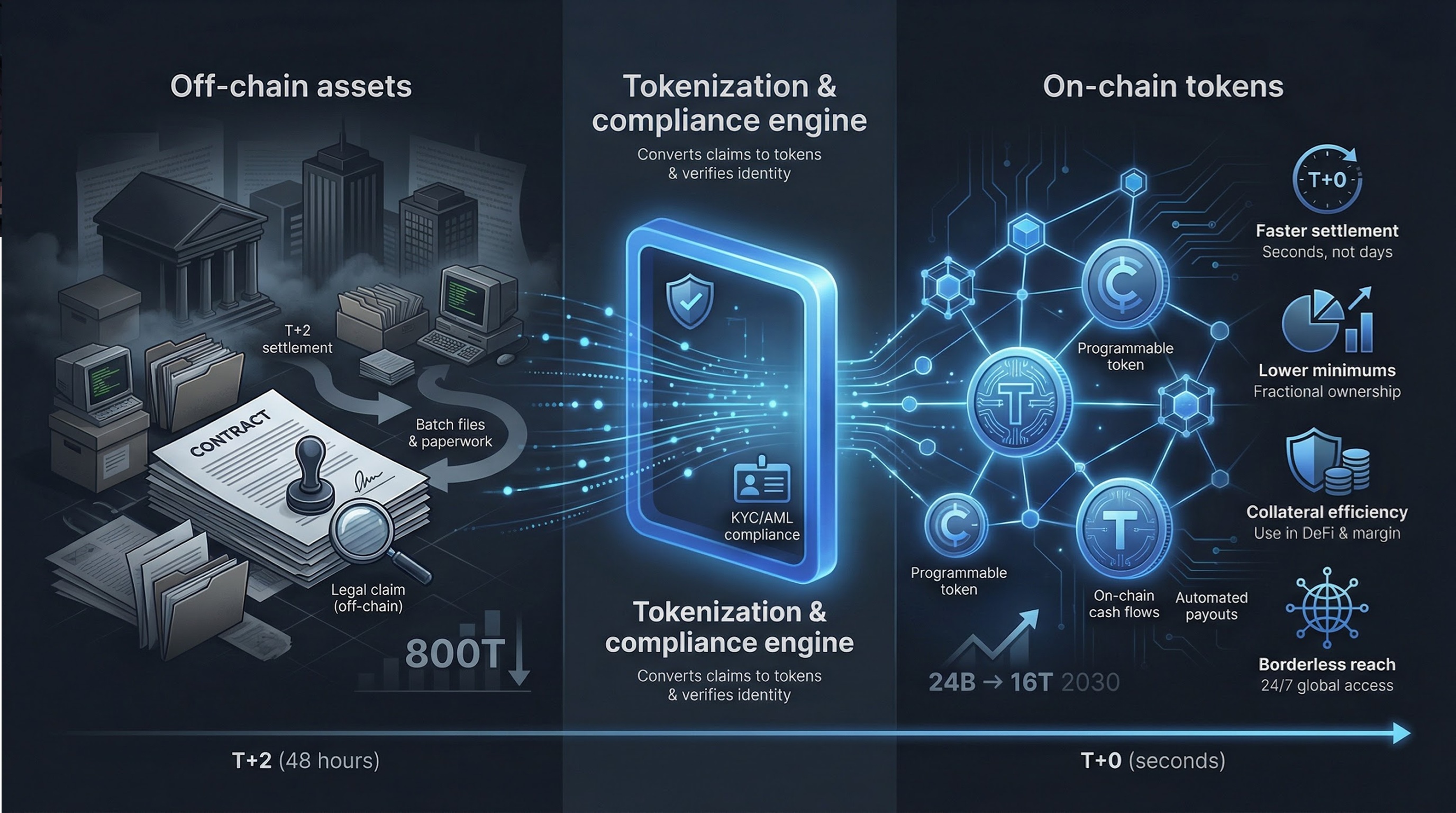
Tokenized real-world assets, or RWAs, are popping up in marketing decks, keynote slides, and investor memos. Polymesh estimates that more than USD 800 trillion in traditional markets could eventually migrate on-chain via RWA’s, so today’s USD 24 billion on-chain and even the USD 16 trillion 2030 forecast are only the opening act. Yet moving from buzz to the balance sheet is uneven. This guide separates durable value from hand-wavy hype so you can judge the opportunities, and the risks, with clear eyes.

The real opportunity behind RWAs

Tokenizing an asset does three things at once: it converts a legal claim into a programmable token, cuts settlement from the traditional T+2 (about 48 hours) to seconds, and lets developers wire cash flows directly into the asset itself.

How tokenization converts traditional off-chain assets into programmable on-chain tokens with T+0 settlement and new cash-flow capabilities.

  • Faster settlement. DTCC’s Project Ion already processes 100,000-plus equity trades per day at T+0, proving same-day finality at national-market scale.
  • Lower minimums. On Lofty, you can buy a slice of a U.S. rental property for USD 50, versus the five-figure down payments of conventional real estate.
  • Collateral efficiency. Tokenized U.S. Treasuries now exceed USD 5 billion, and Fidelity is exploring them as margin for asset-management clients.
  • Borderless reach. Stellar aims to host USD 3 billion in RWAs and power USD 110 billion in volume by December 2025, linking issuers and investors across more than 100 jurisdictions.

These gains matter most in areas of finance still run on batch files and bespoke paperwork—private credit, structured notes, cross-border real estate. Trim the manual friction by moving identity checks, investor-suitability rules, and cash-flow processing into shared infrastructure, and the upside comes less from “crypto excitement” and more from shaved counterparty risk, wider access, and yields that settle before your spreadsheet refreshes. According to Polymesh’s real-world asset documentation, one way to do this is to tie every asset-related transaction to a verified on-chain identity and let the chain automatically enforce rules like KYC, accreditation, and jurisdiction for each transfer. Polymesh’s public-permissioned design uses a network of customer due diligence providers and an on-chain compliance engine so issuers can set eligibility and lockup rules at the protocol level instead of tracking them in spreadsheets or side databases. For allocators and builders, that kind of identity-aware, rules-based settlement is a useful benchmark for whether an RWA stack can actually deliver the risk reduction and access gains this section describes.

Where hype creeps in

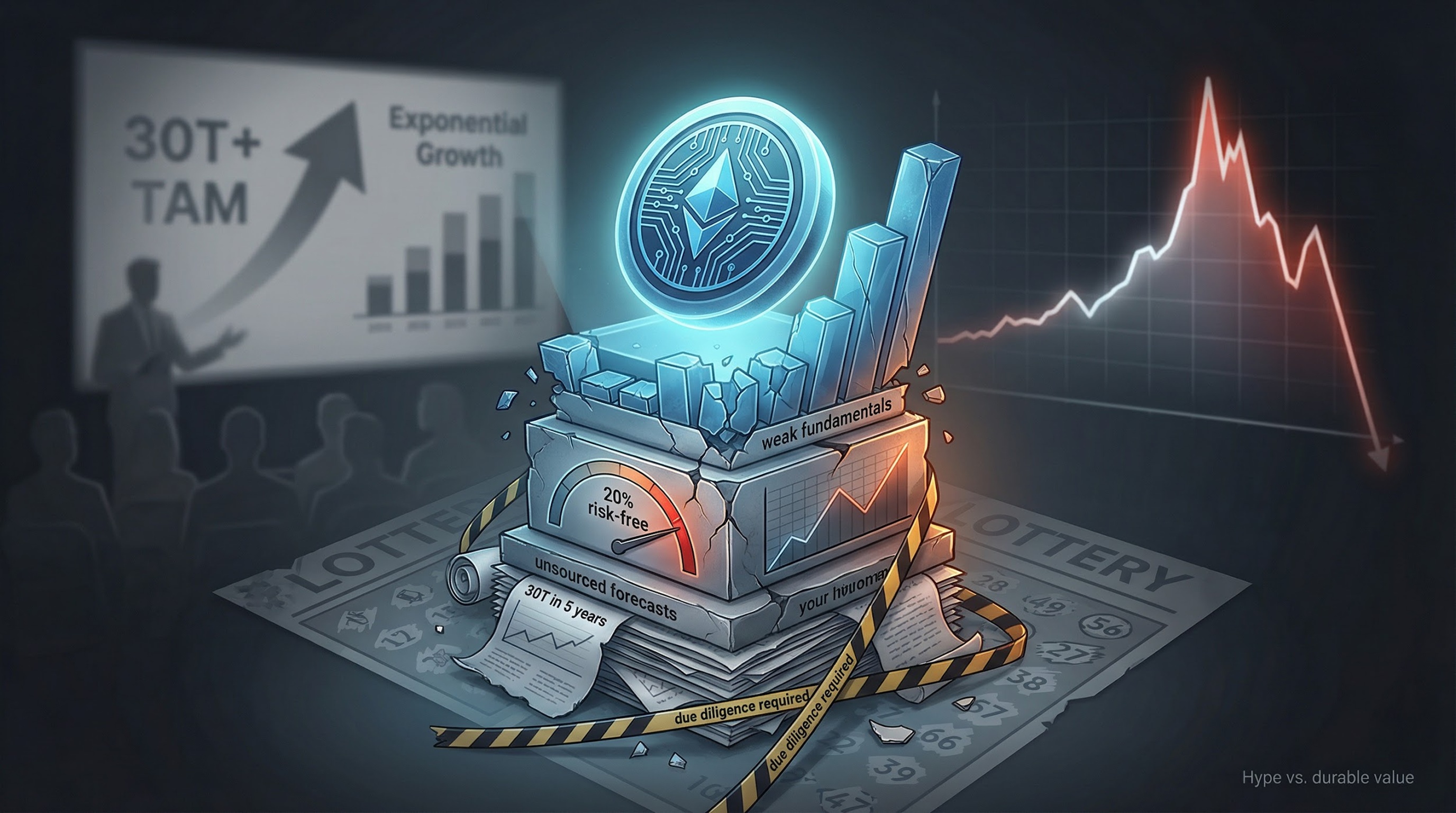
Some tokenization pitches look great in a pitch deck, yet fail basic diligence. Watch for three tell-tale red flags:

Hype-driven RWA pitches can look impressive in a deck while resting on weak fundamentals and unrealistic yield promises.
  • Unsourced trillion-dollar forecasts. A 2024 report from XYZ Digital predicts RWAs will reach USD 30 trillion in five years, but devotes just two pages to regulation. No major jurisdiction has finalized cross-border custody rules.
  • “Risk-free” double-digit yields. Anchor Protocol attracted USD 17 billion with nearly 20 percent “stable” returns; after UST lost its peg in May 2022, deposits fell 99 percent.
  • Price over fundamentals. Maple Finance’s outstanding loans dropped from USD 900 million to 82 million in 2022 after defaults exposed weak underwriting.

Tokenization cannot turn a shaky loan or an over-leveraged property into a safe asset. When off-chain cash flows stay opaque, the on-chain token eventually trades like a lottery ticket, not a bond.

Regulatory and governance challenges

Bringing an asset on-chain means inheriting rulebooks from at least three domains:

  • Securities disclosure. In the United States, the SEC has sued several token issuers for selling unregistered securities. The agency is also finalizing a custody rule that would require advisers to hold crypto assets with “qualified custodians.”
  • Cross-border licensing. Europe’s Markets in Crypto-assets Regulation (MiCA), adopted on April 20, 2023, offers a single passport if issuers publish a white paper and meet reserve and governance tests. Switzerland goes further: its 2021 DLT Act lets “ledger-based securities” settle natively on distributed ledgers, and FINMA licensed the first DLT trading facility in March 2025.
  • Bank and custodian capital. The Basel Committee’s December 2022 standard caps banks’ exposures to crypto and tokenized assets, with full implementation on January 1, 2025.

Ignore any of these layers, and your token may never leave a sandbox. Worse, it could keep trading until a regulator shuts it down. Sustainable RWA teams treat compliance as product design, not an after-launch patch.

How to evaluate an RWA platform

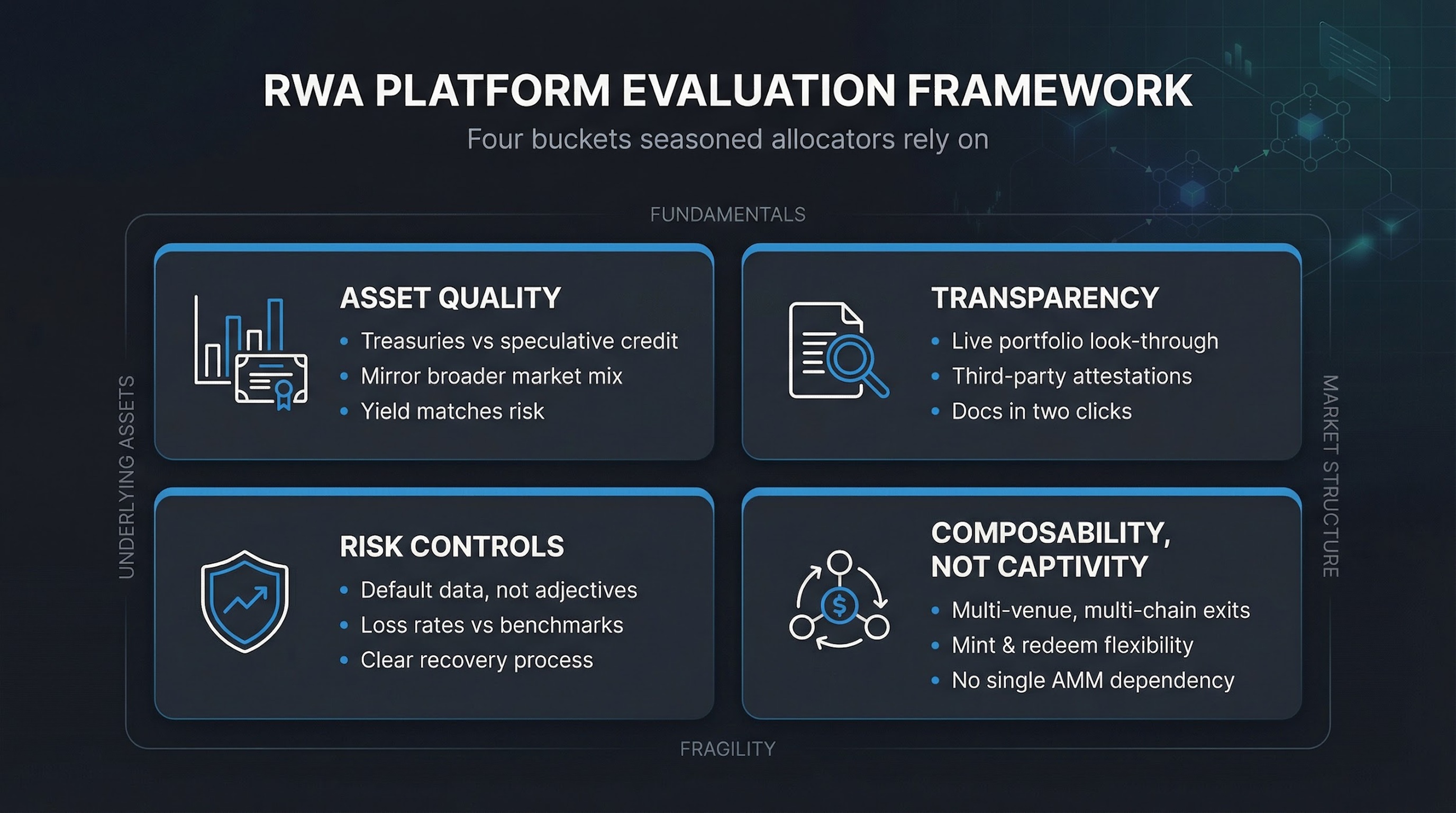
Seasoned allocators group diligence into four buckets, then test the numbers behind every slide.

A four-part framework allocators can use to evaluate real-world asset tokenization platforms beyond the marketing deck.
  1. Asset quality. Start with the cap table: what share of the book sits in cash-equivalent Treasuries versus speculative credit? A healthy venue mirrors the broader market. Tokenized Treasuries now exceed USD 7.2 billion, and Ondo’s OUSG alone floats USD 693 million, second only to BlackRock’s BUIDL. If a platform is 90 percent junior real-estate debt, treat the yield like high-yield bonds, not money-market cash.
  2. Transparency. Ask for live portfolio look-throughs and third-party attestations. Backed Finance releases monthly auditor letters and chain-verifiable CUSIPs. Centrifuge’s Tinlake pools post every loan term sheet and controller signature on IPFS. If you cannot reach the documents in two clicks, consider it a red flag.
  3. Risk controls. Look for default data, not adjectives. New Silver’s fix-and-flip pool on Centrifuge shows a 0 percent principal-loss record across 190 loans since 2019, outperforming the 1–2 percent industry average. Compare that to venues that hide or disclaim loss rates.
  4. Composability, not captivity. Tokenized positions should clear in multiple venues. OUSG can be minted on Ethereum, Solana, and the XRP Ledger, and redeemed around the clock via Ripple’s RLUSD stablecoin. If exit liquidity relies on one in-house AMM, you are inside a walled garden, not a market.

Platforms that land in the top quartile on these four metrics may grow slower, yet they fail far less often. In RWAs, boring delivers the real alpha.

Participating carefully as an investor or a builder

Treat RWAs like any new asset class: start small, read the footnotes, and track outcomes instead of hype.

For investors: Franklin Templeton’s BENJI money-market token shows that a cautious entry can still earn Treasury-level yield. Assets grew from USD 360 million to 580 million over the past 12 months while maintaining daily liquidity. A one- to five-percent sleeve in products this transparent lets you study the plumbing without risking your core capital. Spread exposure across issuers, structures, and geographies; Tinlake, for example, lists more than ten independent pools, so one default will not sink the whole position.

For builders and institutions: J.P. Morgan’s Onyx repo network cut intraday funding costs by 56 percent for one global dealer. Similar gains appear only when compliance, engineering, and operations share the same whiteboard, and when success is measured in basis-point savings or hours trimmed from settlement, not “total value locked.” Select one high-friction workflow such as trade-finance invoices, cap-table equity, or margin collateral, then automate it end to end before expanding.

Whether you are wiring USD 5,000 or writing 5,000 lines of code, treat the token as a regulated security first and a crypto artifact second. That mindset protects both capital and roadmaps when the regulations evolve.

Long-term view: RWAs as plumbing, not headlines

If tokenization succeeds, you will barely notice it; you will simply wonder why funds move faster. JPMorgan’s Kinexys network already settles about USD 2 billion a day for corporate treasurers, yet few outsiders realize the dollars travel across an internal blockchain. BNY Mellon’s triparty repo pilot let UBS borrow cash from Swiss Re and return the collateral before lunch, compressing a 24-hour cycle into four hours. The BIS Project Helvetia study showed that tokenized central-bank money can close wholesale trades in seconds without touching legacy core systems.

These quiet wins point to the future: settlement layers embedded in bank pipes, collateral tokens gliding between margin accounts, and investor dashboards that reference “fund shares,” not “smart contracts.” RWAs will prove their value not by trending on social media, but by shaving basis points, freeing intraday liquidity, and removing a few manual clicks from finance’s daily routine.

Gold blasts past $5,100 as investors flee to safety amid Trump-driven trade shocks and global unease

0

Gold surged to a fresh record above $5,100 an ounce on Monday, extending one of the strongest rallies in modern market history as investors rushed into the safe-haven asset amid rising geopolitical tensions, policy uncertainty in Washington, and a weakening U.S. dollar.

Spot gold rose 2.2% to $5,089.78 an ounce by 0656 GMT, after earlier touching an all-time high of $5,110.50. U.S. gold futures for February delivery climbed by the same margin to $5,086.30 an ounce, underscoring the strength of demand across physical and derivatives markets.

The latest surge adds to a historic run. Gold soared 64% in 2025, its biggest annual gain since 1979, driven by a powerful mix of safe-haven demand, easing U.S. monetary policy, aggressive central bank buying, and record inflows into exchange-traded funds. Prices have already risen more than 18% this year and have posted consecutive record highs over the past week.

Market participants say the current rally is being fueled less by traditional inflation fears and more by deepening concerns over geopolitical stability and confidence in U.S. leadership.

“The latest catalyst is effectively this crisis of confidence in the U.S. administration and U.S. assets, that was set off by some of the erratic decision-making from the Trump administration last week,” said Kyle Rodda, a senior market analyst at Capital.com.

Those concerns have been amplified by a string of abrupt and confrontational trade threats from President Donald Trump. Last week, Trump stepped back from threats to impose tariffs on European allies as leverage in a bid to assert U.S. control over Greenland, a move that had already rattled markets before it was softened. Over the weekend, he warned that the U.S. would impose 100% tariffs on Canada if Ottawa followed through on a trade deal with China, reigniting fears of a broader trade conflict involving close U.S. allies.

Trump has also threatened to slap 200% tariffs on French wines and champagnes, an apparent attempt to pressure French President Emmanuel Macron into joining his proposed “Board of Peace.” While Trump has said the initiative would work alongside the United Nations, some observers worry it could weaken the U.N.’s standing as the primary global forum for conflict resolution.

“This Trump administration has caused a permanent rupture in the way things are done, and so now everyone’s kind of running to gold as the only alternative,” Rodda said.

Currency markets added further momentum to the rally. A strengthening Japanese yen weighed on the U.S. dollar on Monday, with traders on alert for possible intervention to slow the yen’s rise. Investors also trimmed dollar positions ahead of this week’s Federal Reserve meeting, where policymakers are expected to keep interest rates unchanged but may offer clues on the timing of future cuts.

A weaker dollar typically supports gold, which is priced in U.S. currency, by making it cheaper for buyers using other currencies. Combined with falling real yields and heightened political risk, the environment has proved especially supportive for bullion.

Central bank demand has remained a key pillar of the rally. China extended its gold-buying streak to a fourteenth consecutive month in December, reinforcing a broader trend among emerging market central banks seeking to diversify reserves away from the dollar. At the same time, retail and institutional investors have poured money into gold-backed ETFs at a pace not seen in years.

Analysts increasingly see further upside. Some forecasts now place gold on course to test levels once considered unthinkable.

“We expect further upside,” said Philip Newman, director at Metals Focus. “Our current forecast suggests that prices will peak at around $5,500 later this year.”

“Periodic pullbacks are likely as investors take profits, but we expect each correction to be short-lived and met with strong buying interest,” he added.

The rally has not been confined to gold. Silver jumped 4.8% to $107.903 an ounce after hitting a record high of $109.44 earlier in the session. Platinum climbed 3.4% to $2,861.91, after touching an all-time high of $2,891.6, while palladium rose 2.5% to $2,060.70, its highest level in more than three years.

Silver’s move has been particularly striking as the metal broke above the $100 mark for the first time on Friday, building on a 147% surge last year. Analysts say strong retail-investor inflows, momentum-driven buying, and persistent tightness in physical supply have combined to push prices sharply higher.

With geopolitical risks mounting, trade tensions flaring, and confidence in traditional financial anchors under strain, gold’s role as a store of value has rarely looked stronger. Thus, investors appear willing to keep paying record prices for what they see as the ultimate hedge against uncertainty.

Europe-US Alliance Enters ‘Rupture Phase’ Amid Greenland Tensions and Eroding Trust, Warns Ex-EC Chief Barroso

0

Former European Commission President José Manuel Barroso has issued a stark assessment of transatlantic relations, declaring them at their “lowest moment” since NATO’s founding in 1949.

This comes as President Donald Trump’s disruptive diplomacy—epitomized by his persistent push to acquire Greenland—fuels a profound loss of confidence across the European continent.

In an exclusive interview with CNBC’s “The China Connection” aired Monday, Barroso described the current era as a “rupture phase,” where shared democratic values are giving way to interest-driven interactions, prompting Europe to accelerate its quest for strategic autonomy.

Barroso, who served as EC president from 2004 to 2014 and previously as Portugal’s prime minister, pinpointed Trump’s Greenland ambitions as a catalyst for the erosion of trust. The U.S. president’s threats of military action and escalating tariffs on European goods—initially set at 10% from February 1, rising to 25% by June—have rattled allies, even as Trump partially retreated last week, ruling out force and pausing the levies after talks with NATO Secretary General Mark Rutte.

In a Truth Social post following the meeting, Trump claimed a “framework of a future deal” on Greenland had emerged, though Rutte denied the topic arose, highlighting the opacity and unilateralism that Barroso labeled Trump as “the great disruptor.”

This episode has amplified doubts, extending beyond the EU to the U.K., where public sentiment toward the U.S. has soured markedly. A November 2025 survey by the European Council on Foreign Relations (ECFR), conducted across 12 EU member states and the U.K., revealed that only 16% of Europeans view the U.S. as an ally sharing common values—down from 21% in 2024—with a striking 20% seeing it as a rival or enemy.

In the U.K., the figure plummeted to 25% from 37%, reflecting backlash against Trump’s “America First” policies that Barroso said treat allies more harshly than adversaries.

The poll, part of ECFR’s broader analysis of a “post-Western world,” also showed shifting global perceptions, with many viewing China as ascendant amid U.S. unpredictability.

Barroso emphasized the need for a “more Europeanized NATO,” urging the bloc to bolster its own defense capabilities rather than relying solely on Washington. This call echoes actions at last year’s NATO Summit in The Hague, where members pledged 5% of GDP toward defense and security by 2035, spurred by U.S. demands.

He noted NATO’s strengthening since Russia’s 2022 invasion of Ukraine, including Finland and Sweden’s accession and enhanced eastern flank presence, but warned that the alliance’s future hinges on Europe’s self-reliance.

Outside Europe, a similar conflict has been in play with U.S.-Canada ties at stake. On Saturday, Trump threatened 100% tariffs on Canadian goods if Ottawa pursued a free trade deal with China, prompting Prime Minister Mark Carney to affirm Sunday that Canada has “no intention” of such an agreement.

Carney described recent pacts with Beijing as limited tariff reductions in select sectors, reiterating commitment to the USMCA amid escalating tensions.

This follows Trump’s Thursday withdrawal of Carney’s invitation to the “Board of Peace” for Gaza reconstruction, underscoring the poet Robert Frost’s cautionary lines on walls and offense—often misquoted as endorsing barriers.

Those have triggered market jitters, which were evident Monday, with gold surpassing $5,000 per ounce in Asian trading, while U.S. futures and regional indexes dipped amid geopolitical confluence. Investors brace for a pivotal week: Earnings from Apple, Meta, and Microsoft, plus the Federal Reserve’s rate decision on Wednesday, could sway sentiment.

Barroso, while pessimistic, stopped short of declaring the transatlantic alliance’s end, affirming the U.S.’s enduring role in European security. Yet his warnings resonate as Europe recalibrates, potentially toward greater sovereignty in a multipolar world. However, analysts have noted that Trump’s approach may inadvertently elevate China’s global standing, reshaping alliances in unanticipated ways.