DD
MM
YYYY

PAGES

DD
MM
YYYY

spot_img

PAGES

Home Blog Page 4636

Scaling Ethereum EVMs Via ZK- Rollups

0
TEHRAN, IRAN - JULY 19: (RUSSIA OUT) Russian President Vladimir Putin leaves his presidential plane during the welcoming ceremony at the airport, on July 19, 2022 in Tehran Iran. Russian President Putin and his Turkish counterpart Erdogan arrived in Iran for the summit. (Photo by Contributor/Getty Images)

When it comes to scaling Ethereum via rollups, zero-knowledge (ZK) rollups, and in particular the advent of EVM-compatible ZK-rollups (zkEVMs), are often considered the holy grail. Although we are not quite there yet in terms of development, various projects have recently turned up the heat in terms of innovation, making what once appeared years away seemingly within grasp. The race is now on to see which of these first movers can successfully implement a zkEVM at scale and gain the advantage in terms of early user adoption.

EVM (Ethereum Virtual Machine)

First off, what is EVM? EVM stands for Ethereum Virtual Machine, which is in essence a software platform. At a high level, remember that with a blockchain, at any given time there can only be one canonical “state” (akin to a balance sheet). This state includes all of the blockchain’s accounts, balances, etc. at that particular moment. In the case of Ethereum, the EVM partly serves as a large database for holding all of this data.

However, the EVM also plays a more dynamic role. Ethereum’s state is not only a large data structure holding all accounts and balances, but also what is known as a machine state, which can change from block to block according to a pre-defined set of rules. These rules, as you may have guessed, are defined by the EVM?—?so any smart contracts wanting to perform transactions on Ethereum that are not written in compliance with the EVM will not be processed. Not only that, but as the Ethereum blockchain’s record transforms with each permitted transaction, the EVM continuously tracks and computes the new state of the network (therefore serving as both a gatekeeper and real-time registrar). Let’s look at an example here to help illustrate.

Setting the Stage for ZkEVMs 

As an initial matter, note that this article does not serve as an introductory piece with respect to rollups. As a result, if you are not already familiar with the rollup landscape on Ethereum as well as the general advantages / disadvantages of using ZK-rollups in particular, I highly recommend reading this piece first which covers these basics in detail. I am sure Eli Ben-Sasson would prefer the use of “validity rollups” throughout this article instead of ZK-rollups, but we will stick with popular convention for now.

Keeping the above in mind, let us quickly remind ourselves why ZK-rollups are often looked on favorably in comparison to optimistic rollups. Although both forms of rollups offer huge improvements in terms of scalability and throughput, ZK-rollups provide an edge in terms of transaction finality (no challenge period) and security. For the latter, ZK-rollups are generally seen as more secure since they rely on trustless cryptographic mechanisms for security as opposed to relying on the honesty of other actors to submit fraud proofs. Of course, optimistic rollups have their particular benefits as well, such as not requiring complex calculations that are best performed on specialized machines to generate proofs (which has its costs), but these are the big-ticket items to note all else equal.

I want to stress “all else equal” because as of today, not everything else is equal. In particular, between the two forms of rollups, only optimistic rollups are generally EVM-compatible, which has contributed to optimistic rollups being more popular to date in terms of total value locked (TVL).

EVM-Compatibility and Equivalence 

I find the concept of the EVM and its various forms of compatibility to be one of the more overlooked and misunderstood topics in the space. The term is thrown around so often that you would think everyone understands the ins and outs, but this is most likely not the case. For an article focusing on zkEVMs, it is therefore imperative that we review the topic to ensure everyone has a strong grasp going in.

Keep in mind that public, general-purpose rollups all typically share a common goal?—?to onboard developers and users as quickly as possible in order to generate network effects in terms of adoption. This statement, in short, is what EVM-compatibility helps facilitate for new blockchain networks / rollups. Let’s explore how and why.

Assume you created a smart contract or decentralized application (dApp) on Ethereum. Like any standard smart contract, within this contract is a defined list of operations that are to be executed when certain conditions are met (e.g., given an input, the smart contract performs an output / function). To the extent this smart contract adheres to the current rules of the EVM, the EVM will help facilitate its execution leading to a new block and state on the Ethereum network (which the EVM computes). For the technically inclined, the EVM is helping facilitate execution by translating smart contract opcodes (short for operation codes, which are written in programming languages like Solidity) into bytecode so that instructions can be read and operations can be executed by the virtual machine.

The EVM can therefore almost be looked on as the lifeblood of Ethereum. By interpreting / executing smart contracts and computing the state of the Ethereum network from block to block in response to smart contract input data, it defines the rules for what can be processed and updates the state of the network in real time.
 

Yugalabs Pushing For Wide Web3; NFT Gaming Adoption

0
TEHRAN, IRAN - JULY 19: (RUSSIA OUT) Russian President Vladimir Putin leaves his presidential plane during the welcoming ceremony at the airport, on July 19, 2022 in Tehran Iran. Russian President Putin and his Turkish counterpart Erdogan arrived in Iran for the summit. (Photo by Contributor/Getty Images)

The World most influential NFT brand Yugalabs, creators of Bored Ape Yacht Club [BAYC] announced a global Partnership deal with the Animoca Brands to develop a P2E Game structure for the Club in March, one of the central aspects of the partnership is to develop a Staking – Yield Mechanism through its native token ‘Apecoin’ and its primary asset class; BAYC, MAYC, Meetbit, CryptoPunks and the recently acquired 10KTFshop Collective.

Staking is a myth and grants the biggest whales with best market knowledge an advantage. Yugalabs has already demonstrated some of it’s product and has also caught the attention of a much wider audience, even broader than Crypto-Twitter. The otherside is also the perfect place for large companies to buy land and develop.

During the last NFT Bull run, we were buying and flipping 0.05 $ETH to 4.5 $ETH within a week, Buying Yugalab’s MAYC for 3-4$ETH. Couple months before BoredApeYC was still around 8-10 $ETH around 1,800$. CryptoPunks nfts were trading for less than a 1,000$ for a year.

NFTGaming, will be crucial next bull cycle. I believe AxieInfinity, Yugalabs, CyberKongz will lead the way in gaming. The future of NFT gaming will open an entire new dimension to digital ownership and play to earn. What is coming is game changing literally.

The road won’t be easy especially with Tokenomics and Staking depending where you are located (U.S., etc), however the overall idea of gaming is still too huge and has shown how big it can be for adoption like AxieInfinity has proven over the years. Many came into the Crypto space with a dream of a decentralized future. Instead, we are stuck in a nightmare where we get scammed by SBF- FTX and tracked by MetaMask.

Web3- Gaming, is not easy but I believe who will get it right will really open an entire new market and more adoption. So much opportunity right now to expand on gaming- NFTs. Future of NFT gaming is ownership more than play-to-earn (though ownership of great assets lead to robust economies).

Still bullish on AxieInfinity, but watch out for PlayEmberSword and GuildOfGuardian, I think they have their head on right as far as web3 games are concerned. What I also want in future of blockchain gaming is interoperability. This will ensure assets can be used across these games. Gaming companies have to collaborate towards that future. I think that will be huge especially with so many metaverses existing.

Interoperability across platforms and maybe even various metaverse infrastructures will be some next level type of stuff that will lead to so much adoption, the easier they make it the more will use it.

Here are some burning questions from me on What could all these symbols mean in the Yugaverse and how do they all connect together to advancing the Web3 Gaming Adoption.

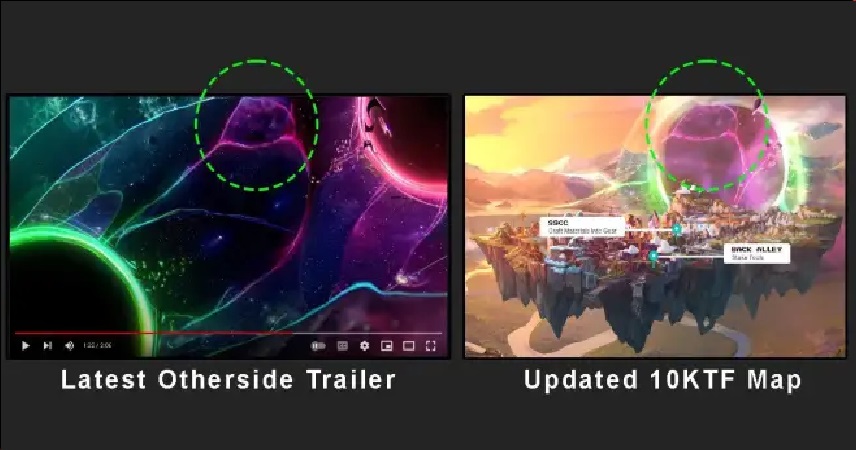
The green portal on 10KTFshop looks a lot like the green portal behind Blue the Koda from the OthersideMeta trailer. Very interesting that holders of BoredApeYC aren’t buying up all of their genesis 10KTFshop items.

It seems like the most obvious play in the game. 10ktf was built to continuously reward Community members, It’s only going to amplify with the project under the Yugalabs umbrella.

TEHRAN, IRAN – JULY 19: (RUSSIA OUT) Russian President Vladimir Putin leaves his presidential plane during the welcoming ceremony at the airport, on July 19, 2022 in Tehran Iran. Russian President Putin and his Turkish counterpart Erdogan arrived in Iran for the summit. (Photo by Contributor/Getty Images)

Was blue going to Neo Tokyo? if he didn’t have to his way to the mystery potion & land on OthersideMeta, The lore has been building up with each hint released from all Yugalabs projects like BoredApeYC, OthersideMeta and 10KTFshop. Excited to see the OthersideMeta story continuing soon.

You don’t think Yugalabs is thinking well into the future of NFT- Gaming? Adoption will take time, but with the ownership mechanics and scalability here, I think it could be huge. Don’t underestimate the building potential of 30k+ partners working in tandem.

This will scale much quicker than you think if done right.

Would yuga labs have been better off not launching a token?

What forces/motivations drove the decision to launch it and get so much legal and other risks?

Now, Apecoin is a huge pillar of their future revenue once unlocked in the spring. I think they should’ve launched when otherside was fully released so it immediately a use case.

We Sold A Whale ! AKA – Don’t Neglect The B Game!

0

We’ve had a crazy week. We sold a ‘Whale’. But if we had tunnel focus on or core objectives this would not have happened – Here is why:


What’s a Whale?

A whale is one piece of activity or entity in an ecosystem, that when it manifests, it dwarfs the impact of many other things, and its actions or manifestation can bring profound change or influence.


Revisiting the core business of 9ja Cosmos.

The core business of 9ja Cosmos is to bring Web 3 Domain access to EMDE’s (Emerging Markets and Developing Economies and we have started with Nigeria First. We were first to create a Web 3 domain service for a country (Web 3 version of a ccTLD) and Nigeria was first to get one. (hence the brand 9ja Cosmos)

We also have two other brands – Afri Cosmos (aimed at the wider Africa), and GeoNaymz (as the container for Web 3 ccTLD services globally).


What’s the significance of Cosmos?

Cosmos represents something bigger and wider than Metaverse notionally, and from a technical/commercial perspective it means build out and aggregation strategies for communities around the core products.

We know more about the Nigerian market than Africa as a whole, so 9ja will be pilot for the Cosmos expansion strategy. It isn’t a level of deep localized intuition that we can hope to roll out globally, hence the Pan African brand will be much slower to realize, while the third brand, GeoNaymz is orientated differently.


So where does the ‘Whale’ fit in?

Well, strategically it doesn’t, but tactically, that is a different thing.

We have to leverage a blockchain node in order to participate in the process of acquiring TLDs (Top Level Domains) that fit our objectives.

Blockchain domains, aka Web 3 Domains, on Handshake, (the blockchain we use), all go through an auction system, and the winner of the auction will get the domain. Even though one entity can create the name, and start the ‘auction’ process, (as we did with .9jacom and .9javerse), anybody with node access can bid. A bidder has to win in the bidding process to secure the name, whether they authored the domain or not.

It is an advantage to be the domain author because tracking the process can be more deliberate, but it is by no means a guarantee.

While we are tracking auctions, we sometimes notice TLD’s passing through the ‘auction’ process, which have been neglected by the individual or entity that started them. This can be because they had a health emergency, an urgent business or social demand, or simply they partied too late the night before and forgot the next day!  Thousands of auctions happen simultaneously and individual ones distinguish themselves through bid activity.  Domain authors tend to be first in with bids. There is a chance if they abandon it, the auction can expire with little or no attention. If we see value in a name, albeit no relevance to our core business, we will put in a bid.

It isn’t an extra investment of time, if we are on the node to monitor our own auctions anyway.

Every once in a while we get very lucky. We don’t keep these domains that are not a good fit for our objectives – We ‘flip’ them.

‘Flipping’ is just the process of selling something off at more than was paid for it, in as short a time as possible. It’s important to point out this isn’t the same as speculating, since we have acquired the assets inadvertently in the pursuit of our core business, and paid nominal prices.

We are not hanging out on nodes especially to discover flipping opportunities, nor are we risking assets that could compromise our liquidity.

When a buyer comes for a big value domain, excited to pay top dollar for it without quibble, to take ownership without delay – This is very rare.  This is a Whale!

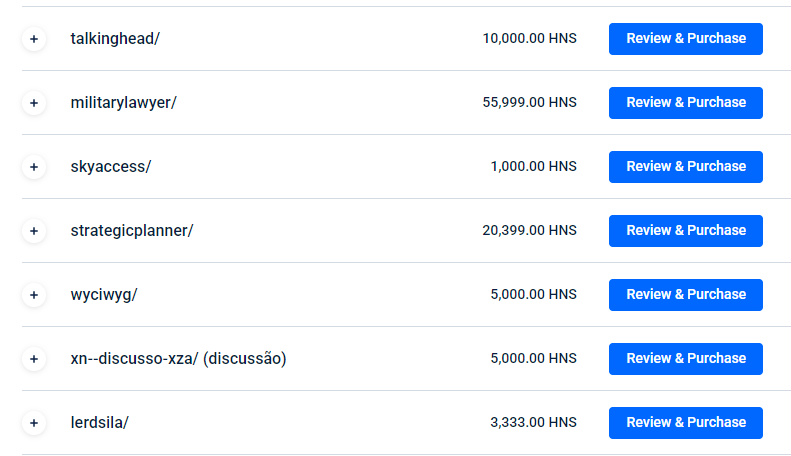
A crop from a secondary market schedule shows Web 3 domains in open market are generally very poor quality. 1000 HNS is about $22. Despite the relatively low cost compared to an ICANN TLD, such names with such poor IP are virtually worthless. Poor IP makes it almost impossible to secure revenue post the costs of the needful to achieve use case.

Don’t celebrate a battle when you have not won a war!

Any time there is a momentous success occasion linked to career or business, there is always a risk of over celebrating the success, and having a premature sense of arrival.

Those familiar with the music industry over a long period of time will know the phrase ‘One hit wonder’. The reason why they went on to never make any more was generally not down to lack of talent.

Readers who have been with me for many years will be familiar with my pivots to Igbo culture from time to time. Yoruba must be feeling neglected, so on this occasion I will pivot to a deity from Yoruba named Olodumare.

Now some believe Oludomare has this pot with a fathomless capacity that can never become exhausted.

Business is not Olodumare. There is no single act that can bring the realization of a pot of fathomless capacity.

Rather than languishing in it, what we now need to grasp is… that one is past tense.

We internalize the benefit so it becomes a vessel for production. We don’t focus on consumption at the earliest opportunity. We consolidate the process so going to the pot to put in becomes what is habitual, not taking out.

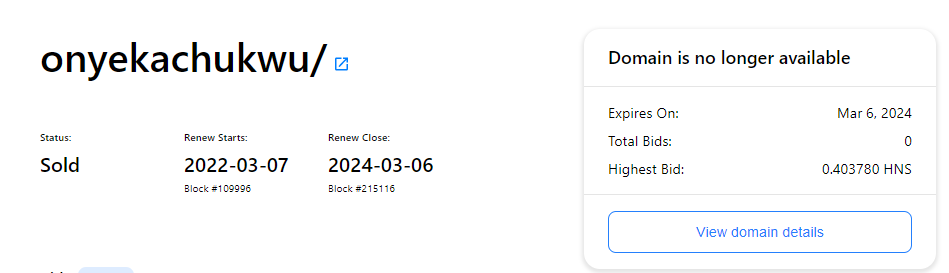
9ja Cosmos operates in the Handshake Ecosystem. Web 3 domains in this ecosystem are a huge success. As we can see, even a less common Igbo first name like Onyekachukwu as been snapped up in March this year. No hope for more known names… Ijeoma, Bamidele, Ekaete, Odion, Alero… and even less hope of internationalized names of Christian, Hebrew or Islamic extraction.

Two hours after ‘The Whale’, a ‘virtual’ friend in the Web 3 space,  who I have been talking for a few years,  said he was dumping all his domains… a massive number built over 2 years.

I generally ignore attempts to interest me in ‘collections’ of domain names. There are many with long stories attached to why they need to dispose of complete collections, and they will use the phrase ‘liquidate’.

I know what a liquidation is. The seller will get so many cents on the dollar of sourcing or manufacture cost, not retail or resell price. Most so called domain ‘liquidators’ expect fantasyland evaluations on their collections when they approach disposal.

I decided to entertain the discussion because we knew each other a while, he is also close friends with a group of folk that own the private node I use.  He had a ton of stuff. I could immediately see rare and now unfindable domains from the early days of domain ‘gold rush’ more than two years ago.

I was happy to offer him the ‘whale’ payment for the collection – even at that, it was still a steal.

He insisted on taking only half.

I close the article with a comment from Vitto Rivabella in a Tweet :

‘Learning Web 3 today, is like buying Bitcoin when it was $10’


Vitto Rivabella is at https://www.linkedin.com/in/vittorio-rivabella/

9ja Cosmos is here… Get your .9jacom and .9javerse Web 3 domains  for $2 at:

https://www.encirca.com/handshake-9jacom/

https://www.encirca.com/handshake-9javerse/

Nigeria’s Constitutional amendment: after five failed attempts

0

As society develops, it outgrows some of its archaic and mundane laws hence why there is the need for constant amendment and repealing of some constitutional provisions and clauses which are no longer useful or have become outdated and if still allowing it to be a law will do injustice rather than justice.

But it is really a herculean task to amend a written/ rigid constitution which is the constitution that Nigeria adopted. One of the disadvantages of adopting a written/ rigid Constitution is the difficulty or the cumbersome process for its amendment. This can as well be an advantage, depending on the vantage point you are arguing from.

For the fact that Nigeria’s constitution is written and rigid, we have seen a total of four failed attempts to amend the Constitution, and the fifth amendment attempt which is currently ongoing is already showing some indication that it may likely fail as well. It is more like it has been abandoned already.

The constitutional amendment itself is constitutional as it was provided for in the constitution; the Constitution provided for it to be amended, thereby vesting the powers to amend or repeal any clause or proviso of the Constitution on the national assembly in the S. 9 of the 1999 Constitution but the national assembly has so far failed to successfully amend this Constitution (in the proper sense of it) twenty-three years after this current Constitution was adopted in 1999.

Be it as it may, in all the yearnings for the constitutional amendment, it all revolves around the clamor (which has been interpreted to be selfish and politically motivated) for the following; Creation of state police, devolution of powers to the states ie the switch from a federal government to a unitary system of government where the regional government will be more powerful and semi-independent from the federal government, creation of more states (this quest is totally political and economically motivated), restructuring and fiscal federalism, the autonomy of the Local Governments; ie the total independence of the LGAs from the state governments, independent political candidacy, etc,

We have come to know that in every attempt to amend the Constitution, there is always that “one thing”  that will make the process come to a halt or make the process a total failure:

The first attempt at reviewing the 1999 Constitution by the 5th assembly failed woefully as a result of the allegation or the conspiracy that the then president Olusegun Obasanjo attempted to elongate his tenure by making a provision for a third term in office for presidents. The national assembly found this out and rejected the bill in totality. The mistake the national assembly made was rejecting the whole bill on the ground of that one clause; you cannot throw the baby out with the bath water, they should have sieved out the selfish clause that was allegedly squeezed in by the then president and then go about with the rest. 

The amendment attempt by the 7th assembly also experienced a catastrophic failure due to the clash between the presidency and the lawmakers. The lawmakers tried to strip the presidency the power to sign constitutional amendments thereby passing them into law but the presidency totally disagreed with them on this and this is what halted that attempt.

We can only hope and pray that this fifth amendment attempt that was initiated by the 9th assembly becomes successful but should in case this attempt fails, the lawmakers should learn from the mistakes of why the previous five attempts failed and do something new here is what I propose:

Firstly, The amendment process should be handled by experts like lawyers, political scientists, economists, etc other than professional politicians. Secondly, the 1999 constitution is a law made by the military government hence why it is inherently defective; a new constitution should be made afresh and the 1999 constitution totally discarded. 

Finally, anyone who will have a direct benefit or who may have a personal interest in the constitutional amendment should never be allowed to be part of the process because personal interest will always overtake patriotism or collective interest. 

Nigeria’s Chief of Army Staff, Farouk Yahaya, Sentenced to Prison for Contempt of Court

0
TEHRAN, IRAN - JULY 19: (RUSSIA OUT) Russian President Vladimir Putin leaves his presidential plane during the welcoming ceremony at the airport, on July 19, 2022 in Tehran Iran. Russian President Putin and his Turkish counterpart Erdogan arrived in Iran for the summit. (Photo by Contributor/Getty Images)

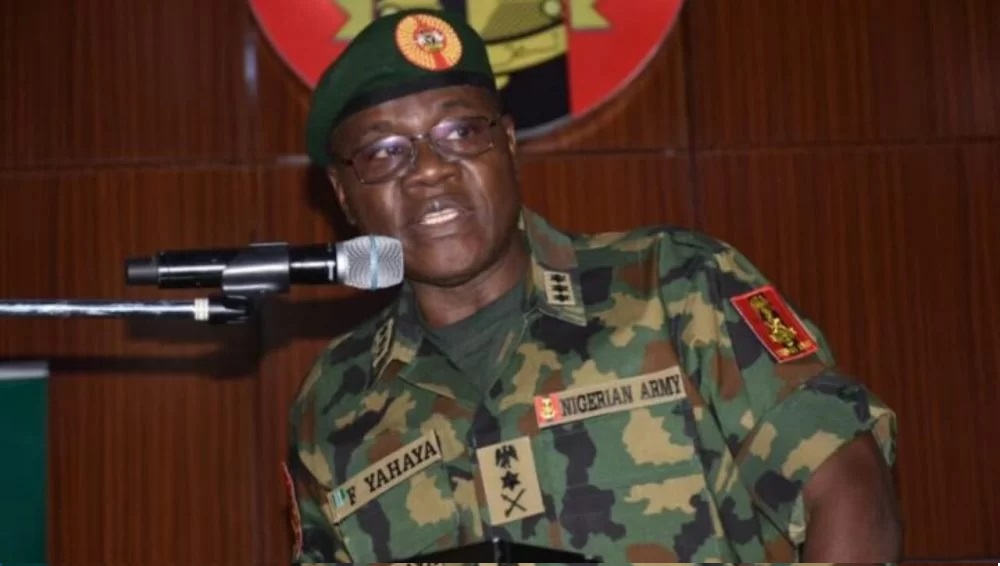
A federal high court sitting in Minna, Niger state, has ordered that the chief of army staff (COAS), Farouk Yahaya, be arrested and imprisoned for contempt of court.

The order, which was based on a suit marked NSHC/225/2019, involving Adamu Makama and 42 others versus the executive governor of Niger state and seven others, was issued due to blatant disregard of court judgment. A warrant of arrest was also issued against Olugbenga Olabanji, commandant of the training and doctrine command, Minna, over the same offence.

The motion for the issuance of the warrants was moved by Mohammed Liman, counsel to the plaintiffs/applicants.  Liman had prayed to the court to send the army chief and commandant to the correctional centre for disobeying an order made on October 12, 2022.

“An order is made committing the Nigerian Army Chief of Staff General Farouk Yahaya, and the Commander Training and Doctrine Command (TRADOC) Minna, i.e. 6th &7th respondents into the custody of the Correctional Centre for contempt of the order of this honourable court made on the 12/10/2022,” Justice Abdulmalik held in his ruling.

The judge added that they shall remain in the custody of the correctional centre until they purge themselves of the contempt.

The case has been adjourned to December 8 for continuation, follows other court orders that have seen heads of major government’s institutions sent to prison for contempt recently.

On Tuesday, the IGP was similarly sentenced to three months imprisonment by a federal high court presided by Justice Mobolaji Olajuwon for contempt of court. His sentence was as a result of a motion filed by one Patrick Okoli, a former inspector in the Nigerian Police Force, who said he was unlawfully and compulsorily retired.

In early November, a federal high court sitting in Abuja, similarly, ordered that the chairman of the Economic and Financial Crimes Commission (EFCC) be committed to prison for contempt.

The order, which was later set aside, bordered on the inability of the anti-graft agency’s head to obey an earlier judgment by the court judgment.

However, the growing trend is said to underscore the depth of total disregard for the rule of law by those in top offices in the country. It is also believed to signify a change from the status quo that has protected top public office holders from being held accountable under the law.