DD
MM
YYYY

PAGES

DD
MM
YYYY

spot_img

PAGES

Home Blog Page 4669

Government of India Proposes Tougher E-Commerce Rules, Seeks to Protect Consumer’s Interest

0

The government of India has stepped in to protect consumers’ interests by implementing a strict framework to halt fake reviews on E-Commerce platforms in the country.

To make these platforms less deceptive for consumers, the government has disclosed that there will be an introduction of guidelines, starting from November 25th, to curb the spread of fake reviews.

The consumer affairs ministry along with the Advertising Standards Council of India (ASCI) held a meeting with stakeholders, as well as several e-commerce entities to discuss how paid unverifiable reviews make it challenging for consumers to recognize genuine reviews.

India’s department of consumer affairs has already drafted standard guidelines that will mandate e-commerce platforms to set up review administrators to moderate reviews using automated or manual tools to filter out biases and restrict fraudulent reviews.

The reviews would also include the publishing date and star rating. The newly drafted guideline will ensure that consumers are not able to edit their reviews or use any foul language.

Platforms are also mandated to restrict authors giving fraudulent reviews from publishing fake reviews in the future.

Speaking in a press conference in New Delhi, India’s Consumer Affairs secretary Rohit Kumar Singh said, “All the countries where e-commerce is getting more and more prevalent and popular, they are all struggling with online fake reviews.

“Some are making rules, some are making a legal provision. But I think we are the first country and I qualify that statement subject to my knowledge, which is working at the standard, and we will take the standards route.

We don’t want to bulldoze the industry, we will first seek voluntary compliance and then if the menace continues to grow, we will maybe make it mandatory in the future depending on what happens”.

The issue of fake reviews on several e-commerce sites in India is not new, and these platforms have often claimed to have addressed it, yet it has continued to increase.

In a bid to drive sales, several sellers on these e-commerce platforms resort to unfair means to make their products sought after, knowing fully well that the algorithm on e-commerce platforms pushes products with more positive reviews to the top, which gives them an advantage over other products.

These reviews play a vital role in customer behavior as it spurs them to purchase products with more positive reviews.  With the recent development of a legal framework by the Indian government, hopefully, these fake reviews will be drastically reduced.

The rights of a remix maker in a song he remixed

0
music streaming

I am currently processing the license and clearance for a song that was made by (an artiste) client for an international deal.

A United States-based company wants to acquire the right to the songs from my client (the artiste) so they can legally use it in their production. 

Here is the twist; my client (an upcoming artiste), made a remix to a popular song that was initially released by a popular Nigerian star. The US-based company (for reasons best known to them) prefers the remix of the song made by my client who is an upcoming artiste to the original song made by the popular singer.

The issue now is who owns what rights to the remixed song that is to be purchased. Can the popular star who is the main originator of the song claim the right to both the original song he made and the remix made off the original song by my client?

This issue is peculiar to almost every Nigerian artiste and their record label. They find it difficult to distinguish the intellectual property rights of every individual who joined in the production and making of the song own in the song, especially if the song later becomes a “hit” song.

Now here is the law according to the general rule of intellectual property and music law:

Unless there is an otherwise agreement made by the parties involved, When an artiste remixes a song, even if he reproduces the song from the production to the composition of the song, in as much as he re-voiced the original lyrics of the song; the artistes only have master rights to the song but the original composer of the song that was remixed has the publishing and reproduction right to the song.

It does not matter that the remix maker of the song changed some words, phrases, or patterns of the song, in as much as there is a similarity in the lyrics of the original song, it will be said that he merely re-voiced the lyrics and the publishing rights to the song still vest in the original composer of the song.

This is not to say that the remix maker and the original composer of the song cannot enter into an agreement that states otherwise; hence the reason for the initial caveat. This general rule only comes into play when there is no prior agreement or contract between the original composer of the song and the remix maker.

How De-risking Your Crypto Portfolio helps in Securing Yields

0

Crypto assets, which were hitherto touted as deflationary, have witnessed an unusual sell-off in the past few days, as investors globally dumps risky assets. BTC is down -71% and ETH -73% within one year after a wide de-risking response to the Alameda Research, FTX and Genesis Implosion and also, the negative Inflation Margin, many Crypto degenerates are moving funds from Altcoins – BTC, ETH alike to stabilize asset class (presumably USDT, BUSD and USDC).

When the Crypto Market started looking wobbly a few weeks ago, it was an easy call for me to sell some altcoin losers (so many to choose from) and switch into stable-coins. But it’s good news for crypto as an asset class: Yields are lower simply because stablecoins have established themselves as a port of safety in a bear market storm.

While everyone has their own way of lowering risk, personally, de-risking to me means taking profits at certain preset levels and moving them into stablecoins or blue-chip Cryptocurrencies such as Bitcoin or Ethereum. While the cryptocurrency I’ve invested in could continue to trend higher, de-risking means that I’ve secured my profits and moved them to assets that are less volatile and have higher conviction in.

The fact that de-risking to money market funds yielding 0% is so uninviting is partly why I’m a buy-and-hold guy in equities, I’m much of a HODLer in crypto, though but the calculus there is different. That’s partly because it’s such a nascent asset class, but also because de-risking to stablecoins is a much more inviting option in a sell-off.

DeFi traders have been switching into stables in the same way that TradFi investors have been switching into US Treasury’s. Stable-coins are a more appealing hiding spot than Treasurys, however. For one thing, the yields in stablecoins, while lower, are still better than those in Treasurys where risks seem lower. Stable-coins are not entirely risk-free: You do have to take either some Smart Contract risk with a DeFi protocol or some counterparty risk with a CeFi exchange. But do those risks seem bigger than being long Treasurys when inflation is running at 8% and commodity prices are surging? To my mind, stablecoins represent a better risk-off option than what’s currently on offer in TradFi.

In one of my Tekedia Forum publications, I emphasized on what Smart Investors should do in safeguarding their funds. It is worthy to note that investment isn’t one off traffic, there are room for gains and losses, it makes sense if your gains outshine your loss, Crypto Investments is not about UPONLY, on fundamental analysis, there is room for retracement leading to break out which form hash for uptrend candle – this presumably takes along roll shifting base.

Points to note while Derisking an Asset

  • De-risk any investment as standard procedure when it hits a 10x multiple from the purchase price or more and the investment is liquid.
  • Standard de-risk by selling up to 100% of the initial dollar value of the investment at current prices back into the market.
  • A standard procedure where to take profit on another 100%, effectively taking back 200% of the initial dollar value that was invested.
  • Take profit on a maximum of 20% of the total token position. Meaning, the profit taking part could exceed 200%.
  • At this point, one would have doubled their investment. The investment is now completely risk-free and the Investor has double the amount of capital it can put into new projects.

With De-Risking your Crypto portfolio you manage your risk, take profits on the way up and buy cheaper so you own more.

Buhari Launches First Oil Drilling Project in Northern Nigeria

0

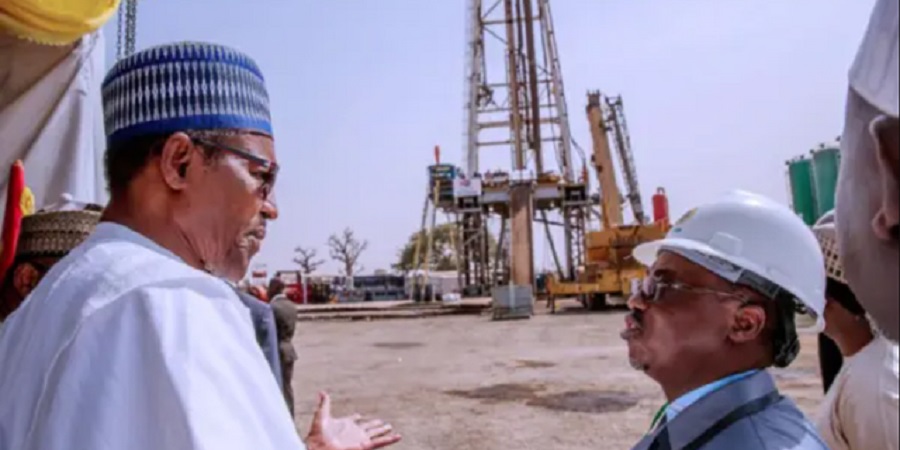
Three years after its oil exploration in northern Nigeria, President Muhammadu Buhari has flagged-off oil drilling projects in the region.

The project, dubbed Kolmani Integrated Development Project, heralds the first ever oil drilling Endeavour in the northern Kolmani River II Oil Field located at a border community between Bauchi and Gombe States.

NAN reports that Buhari will perform the official ground-breaking ceremony of the Oil Prospecting Lease (OPLs) 809 and 810 at the Kolmani River II Well on Tuesday.

The project partner, the New Nigeria Development Company, is owned by the 19 states of Northern Nigeria.

The Nigerian National Petroleum Company (NNPC) Limited, in October 2019, announced the discovery of crude oil, gas and condensate in the Kolmani River.

The commercial quantity discovery was the first in the region after several crude oil explorations on the Upper Benue Trough. The oilfield will be developed by Sterling Global Oil, New Nigeria Development Commission (NNDC) and NNPC Ltd.

The historical event would signal oil drilling and exploration in the oil field discovered in 2019 in the northern region. Many officials of Nigerian security agencies, including the State Security Service, the Nigerian Army, the Nigerian Air Force and Navy, and the Nigerian Police, are deployed at the site.

Some para-military agencies, including the Nigerian Security and Civil Defence Corps (NSCDC), the Federal Road Safety Corps and the Federal Fire Service, are also on ground. The officials of the NNPC Ltd, members of the cabinet and some medical teams with their equipment are also seen at the site.

The president is expected to be accompanied by the Minister of State, Petroleum Resources, Timipre Sylva, Bauchi and Gombe States governors, Bala Mohammed and Inuwa Yahaya, and other top government functionaries.

The onshore oil discovery marks a significant turn in Nigeria’s oil economy. The discovery of the 1 billion barrels of crude oil will be crucial to Nigeria’s economic survival as a nation, according to minister of state for petroleum, Timipre Sylva.

“This will boost infrastructure and industrial development in Nigeria; this is the motivation that has sustained the quest for the Petroleum Industry Act in 2021,” he said.

He disclosed that the ministry of petroleum is poised to employ frontier development funds to commence frontier basins and boost oil reserves from 37 billion to 40 billion.

“The key implication of these measures is that Nigeria needs to seek sustainability and expand capital for government spending. Drilling for hydrocarbons in the frontier development is crucial to Nigeria’s survival as a nation,” he said.

The Nigerian National Petroleum Limited (NNPCL) said the Kolmani oil site would also have a petrochemical refining site with an oil refinery of 120,000 bpd, a gas processing site of 500 million cubic feet per day, and also a 300 MW power plant.

With the 1 billion barrels of crude oil reserve from the new northern oil wells, Nigeria is expected to earn about N32.3 trillion over a period of 10 years.

Congratulations Boundlesspay For Raising Pre-seed Capital

0

Let me congratulate hometown boy Franklin Peters (FIMS) Odoemenam for raising a pre-seed fund for Boundlesspay. I gave him a very tough assignment a few months ago: an European startup wanted to buy his company and acqui-hire him in the process (they buy and will require him to work therein).

When I heard it, I told him NOT to go ahead with that sale. It was a very tough time for him but in the midst of that confusion, I challenged him to live above the easy path.  I reminded him that he was just as best as any person and could build that future.

Today, he raised at multiples he could have sold and all smiles. I am very happy for a kid who was nicknamed “blockchain oracle” at UNN and today he will make blockchain better. I will continue to wish him good luck and more wins. Thank you Adaverse for believing in this Isuikwuato Abia State innovator; we salute and thank you for opening this big partnership with Franklin and BoundlessPay.

Please celebrate one of our young men in our village by checking his company. I have told him that any day his company is valued at $1 billion, the Isuikwuato people will invite him to the Ikoro.