DD
MM
YYYY

PAGES

DD
MM
YYYY

spot_img

PAGES

Home Blog Page 4681

Regional Networks – Dr Yasam Ayavefe

0

The first and most obvious source of inquiry is the territoriality of the network.

It is necessary to examine the two main issues in the interconnection resource of capacity and information sharing, and in reliability, efficiency and scalability.

It doesn’t make much sense to build an Internet that is reduced to a national territory with a device guaranteed by decentralization.

Thus, the Internet is the tool of global connectivity that overturns existing regulatory frameworks built on the legitimacy of regions.

The state cannot control any kind of information exchange with its citizens that escapes its sovereignty. Therefore, any regulation regarding information via the Internet can be avoided.

Tools are needed to circumvent any restrictions on information use. The Internet does not make government intervention illegitimate. But it makes them ineffective or at least difficult to operate.

A major restriction bypass that previous technologies did not allow is possible today. This is not the first time in history that technology has challenged legal norms.

In practice, however, service and content providers place their activities in regions where the standards that best suit their preferences are imposed. The Internet tends to organize a conflict and direct competition between these standards.

Competition between standards can therefore lead to alignment on the lowest common denominator. For example, there is a decision to exempt e-commerce from tax.

This territoriality is limited to certain activities. (For example, when it comes to electronic commerce on tangible resources).

But this competition affects all standards related to content. It concerns a wide area from the use of intellectual property rights to the protection of personal data.

The effect of this competition for rights for everything related to information activities creates common law principles. Despite the possibility of defining international conventions, it carries a deep instability in existing legal systems.

Fiscal regulations explain the rationale for developing common restrictive standards. States are always ready not to comply with these international standards that limit their effectiveness in order to promote their economic development.

On the other hand, the ability to agree on precise standards beyond a few basic principles is limited. Because different rights reflect sometimes contradictory understandings of historical and philosophical traditions.

The probability of reaching operational agreements on standards to be applied internationally is relatively low, as evidenced by the differences in freedom of expression or use of personal data between Europeans and Americans.

Cross-Industry Network

The Internet tends to be the technological platform for exchanges. It also includes differentiation of arrangements between telecommunications, audio-visual, press, for the storage and processing of all information, whatever its form and content.

Publishing, etc., which the previous technological foundations had to impose. is also questioned.

For example, the differentiation of regulations in telecommunications and audiovisual was largely explained by the differentiated economies of various technical networks that had neither the same functionalities nor the same cost constraints.

The allocation of business licenses in the audiovisual sector was explained by the restriction of managing a rare resource, namely radio frequency.

The differentiation of legislation in terms of content control between audiovisual and written word is due to the technical difficulty of arranging filtering in the mass media according to the recipients.

Today’s internet, telephone, radio and television broadcasting etc. The possibilities for bypassing remain limited, as traditional network services such as Therefore, the regulations in force remain applicable.

The fact is that the development of the high-speed Internet and a number of complementary technologies such as electronic books (e-books) or print-on-demand techniques will transform the Internet into a potential medium for the dissemination and exploitation of most information content.

This technical change will have two types of impact:

  • First, to make traditional regulations partially dysfunctional
  • Second, to make some regulations partially illegitimate.

Regarding the territoriality issues mentioned above, the destabilization of the existing regulatory framework is not simply due to the possibilities of overcoming it.

It also comes from the removal of certain restrictions. For example, there is a need to manage a limited hertz spectrum to broadcast audiovisual programs or to make feasible the distribution network of cultural products that connects the region.


Find out more about Dr. Ayavefe and his work here:

https://yasamayavefe.com/

Milaya Capital

Green Climate World Token

Dr Yasam Ayavefe On Popular Cryptocurrency Units: What Are the Most Popular Cryptocurrency Units?

0

You know, traditional online payment systems belong to organizations. These organizations keep your money for you, and when you want to spend your money, you should ask them to transfer your money on your behalf.

In fact, cryptocurrency technologies are an ocean. In order to predict the movements of the prices well, it is necessary to do a very serious study. What are the most popular cryptocurrencies?

BITCOIN

Satoshi Nakamoto, an unreal person or team, briefly gave information about Bitcoin in a whitepaper they published in 2008. The concept was pretty simple: Bitcoin is digital money and provides secure peer-to-peer transactions over the internet.

Unlike services like Venmo and PayPal, which require traditional financial systems to allow money transfers to existing bank/credit accounts, bitcoin is decentralized: Anyone can send bitcoin to whoever they want without under the influence of bank, government ot institutes.

For Bitcoin, it is necessary to create a virtual wallet first. You can create this virtual wallet on your mobile phone, on your computer, or you can benefit from web services on the internet. There is no wallet limit per person. You can create as many wallets as you want. Moreover, you do not need to provide your private information for the wallet you will create. With this virtual wallet you will create, you can receive money, send money and even shop.

ETHEREUM

Ethereum is open access to digital currency and data-friendly services for everyone, regardless of your background or location. It is the community-created technology behind cryptocurrency ether and the thousands of apps you can use today.

Internet money may be new, but it is secured by proven cryptography. This protects your wallet, ETH and transactions.

You can send your ETH without any brokerage services like a bank. It’s like giving cash in person, but you can do it anywhere, anytime, with anyone, securely.

LITECOIN

Litecoin(LTC) is the shining new star of digital currency exchanges. Litecoin, a cryptocurrency such as Bitcoin, Ripple, Ethereum, Tether, is visually silver in color. Being an open source software project, Litecoin is not managed by any central authority.

The creator of Litecoin, Charlie Lee, took Bitcoin as an example while creating Litecoin and set a new vision for himself. Litecoin, like Bitcoin, is built on an open-source payment network that is not controlled by a central authority.

However, Litecoin differs from Bitcoin because of the Scrypt algorithm it uses. Thanks to this algorithmic basis of Litecoin, it has a high transaction volume and the ability to process blocks very quickly.

RIPPLE

Ripple is a payment settlement system and currency exchange network capable of handling transactions worldwide. The idea is that Ripple acts as a reliable intermediary between two parties in a transaction, as the network can quickly confirm that the exchange went smoothly. Ripple can facilitate exchanges for various fiat currencies, cryptocurrencies like Bitcoin, and even commodities like gold.

DOGECOIN

Dogecoin (DOGE) is a cryptocurrency that has become popular on the internet and is born from stereotypical dog (doge)-themed content. Dogecoin, with the Japanese hunting dog Shiba Inu as its logo, is a fork of Litecoin that was created in 2013 as a “joke coin”. Dogecoin is one of the widely used cryptocurrencies for tipping, paying on Reddit and similar community sites.

Dogecoin (DOGE) was created by forking the Litecoin blockchain. Like Litecoin, it uses the Scrypt encryption algorithm. In this way, the difficulty level is lower compared to Bitcoin and blocks can be verified within 1 minute. Although Dogecoin is produced from the Litecoin blockchain, its supply is not limited.

TETHER

Tether, (USDT) cryptocurrency refers to trading on the blockchain operating on the ERC-20 protocol. Tether (USDT) was launched in 2015 by Tether Limited, a cryptocurrency trading company. What is Tether and when was it released? Here are all the curious details.

Tether (USDT), for short, refers to a stablecoin that is a virtual version of the US dollar. Its value is always pegged at 1 USDT = $1. The company claims that there is 1 USD in the safe for every Tether (USDT) cryptocurrency on the market.

BINANCE COIN

Binance coin is a cryptocurrency created by the Binance company. It is on the list of cryptocurrencies based on ERC-20. Binance coin is among the high-volume cryptocurrencies. Therefore, the number of people investing in Binance coin crypto money has increased considerably around the world. Binance coin is currently serving with BEP2 base.

Binance coin can also be used to send money internationally. Binance coin blocking time is also low. Therefore, all these transfers are done very quickly. It ranks third among the world’s best cryptocurrencies. As of 2021, Binance coin is worth more than $500.


Find out more about Dr. Ayavefe and his work here:

https://yasamayavefe.com/

Milaya Capital

Green Climate World Token

Major Economies May Slide Into Real Recession — Ngozi Okonjo Iwaela, DG, WTO

0

Ngozi Okonjo Iwaela, Nigerian-American Financial economist and leader of the World Trade Organization (WTO) has warned several major economies face a real risk of sliding into recession as the war in Ukraine, rising food and fuel costs, and soaring inflation cloud the global outlook.

This according to Reuters was made known on Wednesday during the G20 leaders meeting that addressed the economic impact of the Russian-Ukrainian war in Bali, Indonesia. The meeting was disrupted by an emergency meeting to discuss reports of a missile landing in Polish territory that added to uncertainty over the economic fallout from the war in Ukraine.

The reigning Director General of WTO was reported to have made the following remarks:

“It may not happen everywhere, but several key countries risk sliding into recession.

“Of course the impact of that can be quite significant for emerging markets and poor countries, which need external demand from the developed countries to recover.”

“There are so many uncertainties and most of the risks are on the downside,” such as the fallout from the war in Ukraine and headwinds from inflation, she said.

According to Reuters, the WTO had earlier projected global trade to rise just 1.0% in 2023, down sharply from an estimated 3.5% rise for this year.

However, the WTO leader was said to express optimism at the recent posture of the U.S. President Joe Biden and the Chinese leader Xi Jinping to mend strained bilateral ties that are among the uncertainties weighing on the prospects for global recovery.

“One doesn’t want to read too much into it, but it’s always good when the two biggest economies in the world talk to each other,” Okonjo-Iweala said of the U.S.-China summit.

“Certainly with respect to trade, it’s very helpful.”

According to Reuters, Okonjo-Iweala also said she was “very hopeful” some breakthrough will be made in reforming the WTO’s dispute settlement system, which has been paralysed since 2019 when the administration of former U.S. President Donald Trump blocked the appointment of judges for an appeals body arbitrating on global trade disputes.

“The Americans are consulting actively with other members at an informal level,” she said, adding that the stronger U.S. engagement will help speed up progress on reform from the beginning of next year.

Reuters also states, in a meeting in September, trade ministers of the G7 advanced economies agreed to work towards having a functioning WTO dispute settlement system by 2024.

The Missile in Poland and Preventing a 3rd World War

1

President Trump has announced that he is running to make it back to the White House. While I am not a fan of Trump, I sympathize with him on one thing: mob journalism where journalists form opinions before they even analyze the news. Trump has a tough task ahead of him. Indeed, some journalists are becoming unhinged in many ways.

In the last few hours, the Associated Press, a US new wire-service (call it the largest news network in America), reported that Russian missiles had hit Poland and killed two people. In BBC Newshour, analysts after analysts, journalists after journalists, supported that thesis. Even when the Russian Ministry of Defense said it was not from it, they dismissed everything.

As that was happening, President Biden dropped a line: “It is unlikely in the lines of the trajectory that it was fired from Russia, but we’ll see?” To stay on their conceived mission, CBNC posited that “Biden didn’t address whether the missile could have been fired by Russia from Ukraine or elsewhere.” Yes, Russia is now operating from Ukraine on the border with Poland. The US defense boss put out a statement and the defense ministry spokesman put out his, yet journalists kept the message: this was Russia quoting the president of Ukraine who concluded it was from Russia in minutes.

In all these reports, there was no caution on the sensitivities of triggering a 3rd world war.  I was speechless on what men and women can put with their figures. I know that tech companies get fined these days, I think it is time to find a mechanism to fine journalists for recklessness and stress to the citizens. The AP later corrected itself:

“In earlier versions of a story published November 15, 2022, The Associated Press reported erroneously, based on information from a senior American intelligence official who spoke on condition of anonymity, that Russian missiles had crossed into Poland and killed two people. Subsequent reporting showed that the missiles were Russian-made and most likely fired by Ukraine in defense against a Russian attack”.

People, is that how they cover extremely sensitive topics like Russia and NATO that one unknown person can feed the world fake news with potential for one entity to send weapons and destroy this earth?  Whether you like Russia, Ukraine, etc, the world demands balance on hot topics. I am happy that despite what BBC, AP and some news organizations were reporting, Biden and his team had concluded that Russia was not attacking a farm in Poland! But we may not be lucky next time and that is why we expect better ethics from journalists.

Comment on Feed

Comment 1: Prof. Journalism as a respected profession is going down the drain, because of drop in revenue orchestrated by i technology disruption.

To make up for the short fall, most reputable news agencies now report opinions to stirr up emotions, drive traffic, get ratings and profit.

One needs to be a critical thinker to decipher their outright biasness, lies and sensational outburst.

Biden who had the most privileged intelligence report, denounced it immediately.

Comment 2: When news becomes business, the truth disappears. It’s no longer about the truth, but more about breaking news and filling people with opinions. If you read the same story on Fox and CNN, you’ll think they’re both reporting different stories. Neither bother about the truth, but focus on selling to their “customers”.
When Tucker was sued, the defense argument was “reasonable viewer would not take Tucker seriously”. Yet, he continues to “sell” news/opinion on Fox and makes money for the network. Many people have been killed and wounded because of some fake news/opinions.
I’m all for freedom of the press, but fake news is not encouraging freedom. Fake news threatens human existence and freedom. If humanity is destroyed, the so-called news will play a major role.

Comment 3: This again was a reminder to many of us about not acting on impulse or with emotions. Always remain calm even when the pressure is getting ‘worser.’ For this, I loved team Biden calmness to get the facts and not be bullied by some fake news press. I agree with you Prof we need to find a way to fine fake news mongers.

Use of emojis and Punycode in Web 3 Domains.

0

My last post was a commercial one, announcing that 9ja Cosmos could offer Web 3 TLDs involving non alphanumeric characters.

This is more of an edu-com piece so I will bring it to Tekedia.

First a bit of history –

Now some may think that emojis came about because of an iconic 1994 film starring Tom Hanks as Forest Gump.

The film was about one Forest Gump, who sat on a bench narrating his life, with a sense of profound understatement, to various individuals who came to sit beside him over the course of the day.  The hapless and socially awkward Gump meanders through life, completely oblivious to his inadvertent contact with others having dramatic life changing, and in some cases history changing consequences.

The whole emoji phenomenon probably has its roots in the US due to a graphic designer named Harvey Ball in 1963. Within a few years, it became a symbol of anti-war protests, and the  US ‘hippie’ movement. It was initially used by the insurance company that hired him, by making badges to hand out at promos. Later it began to be used as T Shirts, decorative jeans patches and stickers.

The next evolution of this was the ‘emoticon’.  In 1982, one Dr. Scott E. Fahlman had a university noticeboard message, misconstrued. Those who read it, interpreted it without the humour he had intended and this gave it a different meaning. He then suggested that jokes and nonjokes be marked by two sets of characters we now recognize as standard emoticons: the smiley face :-) and the frowning face :-(

With the advent of the internet in the mid to late 90’s, and the first chat mechanisms, AOL, followed by Yahoo and MSN, further emoticons began to be added.

Sentiment doesn’t easily convey either a broader aspect of activity,  personal identity or business.

Emojis first became an expression of a Japanese conglomerate SoftBank. They released the earliest emojis  in 1997. It is no surprise that they came from this part of the world.

Languages based on phonetic words (sometimes called ‘Latin’ alphabet) are composed of characters that have inherent sound qualities.  These sounds may be fashioned by diuretics or rules of the language. Eastern languages have compound characters with meanings, and these meanings become modified and more specified by the additional characters surrounding them.

This is also how emoji’s work. Emoji’s go beyond sentiment and can replace nouns to bring fuller meaning.

Use in  Web 3 domain names

When using them to make a domain name, they need to reduce the size of the expression in phonetics and create a pictorial flow that everybody will instantly get.

This one means ‘football world cup’ and by making a Web 3 domain this way, which supports emoji’s and special characters, we can reduce a sixteen character string to 3.

While emojis and special characters bring new and interesting ways to express a business, or to express an individual either professionally or personally, many find it difficult to embrace the concept and get it very wrong.

Making a domain is very different from having a chat conversation.

I frequently loiter on a node to track the closing of domain auctions I have interest in, and I see a lot of crazy stuff.

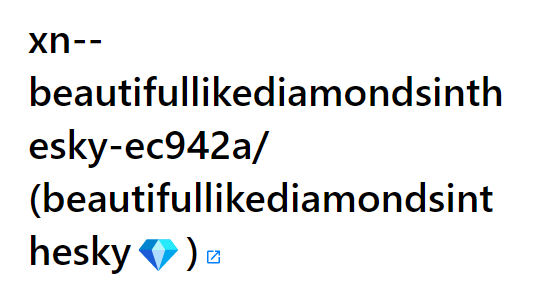
Yes, someone actually wasted their time, and nodal capacity to create this. They did not even bother to be around for the closing of the bid to claim their creation. They could have got it for 0.001 HNS (about .07 of a kobo) because nobody else would be remotely interested in bidding on it.

Note the ‘xn--‘ and the ending ‘-ec942a’ :  this is the punycode that will represent the diamond, but it won’t show in actual usage. This could have been made a small bit less awkward by removing the word diamond in the middle and placing the emoji there instead. In a domain, duplicating words with an emoji is just reducing value and good practice.

In ‘domainland’ less is more.

Cross platform and ‘Alt IDNA Emoji’s

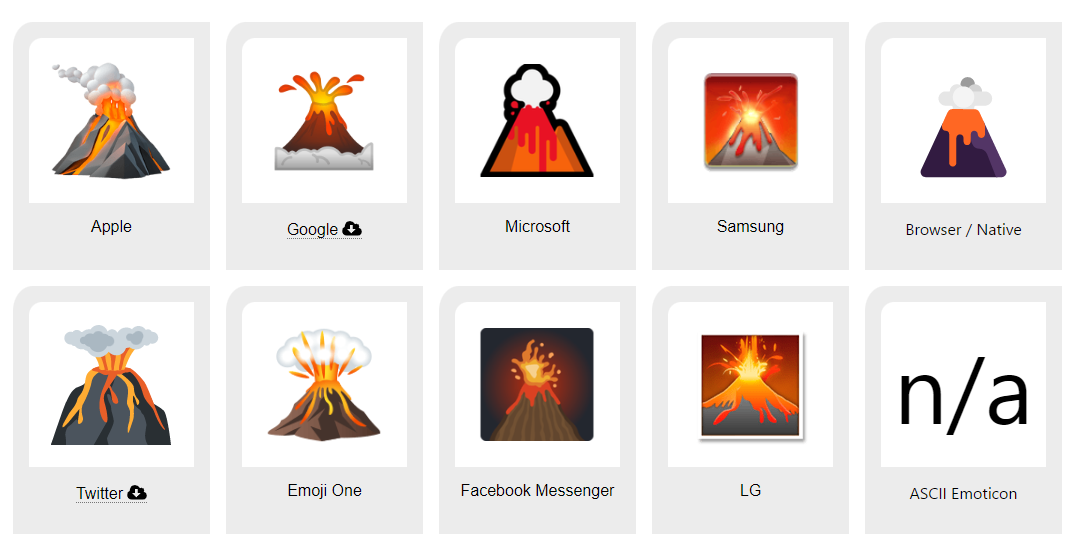
When we look at different platforms and social media environments we find that the emojis in various systems have unique proprietary appearances that differ slightly from the standard icon. Punycode is built around Unicode, and this allows emojis to display themselves in the native appearance of any environment when viewed.

‘alt’ is as it might suggest, ‘alternative’, and while there is no specific rule about using ‘alt’s it is best avoided.

The most recent well established unicode set is the 2008 specification which is guaranteed to cause a uniform character translation across platforms. Some ‘alts’ are the only alternative for what is needed, while others are contrivances to duplicate something already owned by someone else.

For example,

Liverpool is a world class City in UK. a small town in New York State US, (probably named after the former). a world class centuries old University, and an equally world class Football Club. ‘Liverpool’ can’t be registered. On attempt, a notice will come up – ‘

Reserved To ensure that Handshake is compatible with legacy DNS, existing top-level domains as well as the top 100,000 Alexa domains are reserved.’

The common ploy of replacing the ‘e’ with a ‘3’ is the ONLY way of securing this legally.

However, ‘streetcred’ is just an ordinary common noun with no such protections, and if someone attempts to make ‘str33tcr3d’ this will just directly come across as a ‘pirated’ version, and won’t hold much status.

There are all also ‘alts’ in emojis which are copies and not ‘the real thing’.


This is a fake of Grinning Face with Big Eyes, which was approved as part of Unicode 6.0 in 2010 under the name “Smiling Face with Open Mouth” and added to Emoji 1.0 in 2015. Note the abnormally long string for just a one character Punycode.

Here we see an attempt to clone a high value domain using the original ’emoticon’ type emoji. The correct Punycode for this is xn--h28h

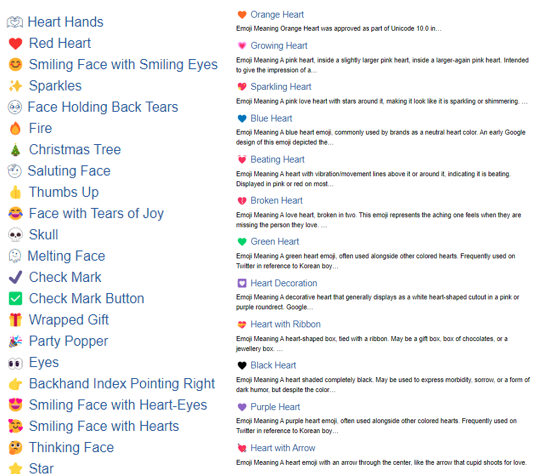
There are other ways people try to contrive to recreate their own ‘version’ of a domain owned by someone else by varying the emoji slightly. For example, the red heart is the second most popular emoji of all time, and the default in any scenario where a heart is needed for a domain. There needs to be a reason or argument why an alternative is a more accurate choice in context. Because the red one is already taken isn’t a good enough reason.

The left column shows the current most popular emojis in descending order. Note the read heart is in position 2. On the right column we see alternative heart emojis.

Another example, is the card suit emojis, there are two red ones – hearts and diamonds and two black ones, clubs and spades. There is an alt emoji called the ‘white spade’ emoji and there have been instances where it has been used to clone a domain where the default black spade is in use.

The black spade is iconic, and there is no useful reason to pick the white one over it, except that maybe it needs to be used against a black or very dark background. In a domain, the use of the white spade is definitely suspicious.

Finally some of the newer emojis like the footballs (soccer, rugby and American) high voltage, rocket, world, money bag, skull, bank, volcano etc… are from a newer specification which hasn’t filtered down into all recognition systems yet, and are sometimes given false positives as ‘alts’ instead of ‘IDNA’.

Summary points, emojis in Web 3 domains should –

  1. Use default norm choice unless there is a good reason not to, and never use a lesser known variant to ‘pirate’ an existing domain.
  2. Convey meaning and be a good fit for text and other emojis around them. They are never justified in themselves.
  3. Less is more, emojis should help convey a domains meaning while reducing the characters it would otherwise use with phonetic (Latin) text.
  4. Bear in mind emojis are used differently in domains than while chatting.
  5. As browser adoption of Web 3 domains and the use of emoji’s improves, the more popular emojis are more likely to see prioritized adoption over obscure ones.
  6. If you are buying a domain which includes emojis, check that the Punycode doesn’t look suspiciously long.


9ja Cosmos is here… Get your .9jacom and .9javerse Web 3 domains  for $2 at:

https://www.encirca.com/handshake-9jacom/

https://www.encirca.com/handshake-9javerse/


Ref:

www.britannica.com/story/whats-the-difference-between-emoji-and-emoticons

www.rd.com/article/smiley-face-invented/

emojipedia.org