DD
MM
YYYY

PAGES

DD
MM
YYYY

spot_img

PAGES

Home Blog Page 4754

Eviction by Police Order is Illegal

0

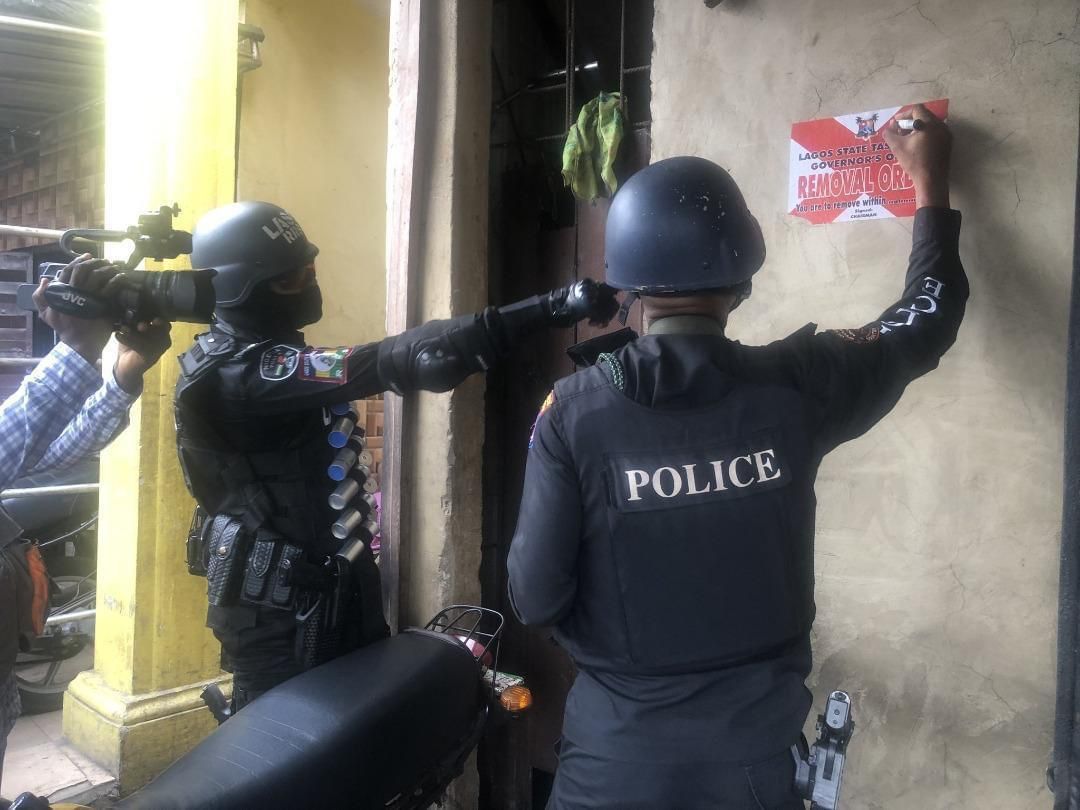
A picture has emerged on social media allegedly of a Nigerian police signpost, mounted on the entrance of an apartment, with the caption of the signpost reading; “You are to evict this premises in seven days, by order of the Nigerian police force, Force Headquarters”.

The legal issue that arose out of this incident is; whether the Nigerian police have the power to legally evict a tenant.

The straightforward answer to the issue above raised is typical No. The Nigerian police force or any other law enforcement agency does not have the legal power to issue an eviction notice to anybody or enforce an eviction notice without the order of the court.

It has been the case that landlords procure police officers and even military officers to forcefully evict their tenants, acts of that nature are not just illegal but also criminal.

This has on numerous occasions been emphasized by the court and even by lawyers that tenancy matters are within the realm of civil suits and police officers or other law enforcement agents have no part in it unless they have been authorized by the court to forcefully eject out a defaulting stubborn tenant.

Let us even assume that the property in question with the police eviction notice belonged to the Nigerian police and they were never procured by an external party to evict the tenant,  it is still illegal to issue a tenant a straight up seven days notice to quit and give up possession of a property or to evict a tenant by the order of the police.

Please take note that there is nothing like; quit premises by  “Police Order or by military order” known to law in the recovery of premises law or tenancy law; what is rather obtainable is “by court order”.  Therefore, if you see the notice pasted “quit premises police order of the police  or by military order” as we tend to see often, such notice is illegal and criminal, the law enforcement agency that pastes such notice is merely abusing their powers.

Once a tenant lawfully enters into a property and occupies the property, the procedure for evicting or removing him from that property is strictly regulated by law and if a tenant is forcefully or illegally evicted, that tenant can whip up legal action against the landlord for wrongful eviction and even for trespass.


Nigeria Lending Startup Hippo Acquires Micro Finance Bank to Expand Financial Services

0

Artificial Intelligence-driven lending platform that provides loans to small businesses Payhippo has recently acquired Maritime microfinance bank.

Maritime Microfinance Bank focuses on regular and specialized savings products, demand deposit and investment products as well as micro and SME loans carefully designed to empower Micro, Small, and Medium Entrepreneurs in Maritime and other Sectors of the Micro Economy.

Following the recent acquisition of the maritime bank by Payhippo, the Central Bank of Nigeria (CBN) is yet to approve the deal. On the other hand, Payhippo has disclosed that the recent acquisition will enable the expansion of their financial services.

The acquisition will also allow it to facilitate the sending and receiving of inter-bank transfers for its merchants with the integration of NIBSS, this means merchants will soon be able to perform all key financial functions from their Payhippo app.

Also, Payhippo merchants will be able to accept deposits and send and receive money across various commercial banks in Nigeria.

Speaking on its recent acquisition of the bank, Co-founder and CEO of Payhippo Zach Bijesse said, “At Payhippo, our mission is to provide seamless financial services for merchants throughout Africa.

We are investing in enhancing products and services for our customers, enabling us to reach a wider customer base. We are very excited to work with Maritime Microfinance Bank to revolutionize the SME financial service through digital innovation.”

Also commenting on the deal is the Chairman of Maritime Microfinance Bank Adetola Atekoja, who said “Nigeria has an ever-growing need for SME lending solutions to help businesses meet their financial needs. We believe Payhippo is well-positioned to develop new and customized financial products for SMEs in the country.

“The team is incredibly talented, and resilient and exudes excellent leadership. I am very excited to welcome them onboard and look forward to supporting them in achieving their goals.”

With a mission to make financial services seamless for African SMEs, Payhippo has disbursed over 25,000 loans to small and medium enterprises in Nigeria.

In the third quarter of the year, Payhippo distributed 6,726 loans, seeing a 39 percent increase from its 4,842 loan originations in quarter two, the company earned over $4 million in annualized revenue.

The startup has also witnessed exponential growth with an expansion in London to target Africans in the diaspora and global talent that would support the team in Nigeria to grow the fintech’s products and services for SMEs in Nigeria.

The EFCC Raids in Black Markets and The Own-Goals from Central Bank of Nigeria

3

Poor Naira, the gravitational pull is severe: ‘Operatives of the Economic and Financial Crimes Commission raided the offices of black market currency dealers in Abuja on Tuesday in a bid to halt the rapid fall of the naira… “For now, there is no dollar to sell. This morning (Tuesday), a dollar was selling for N850, while I bought a dollar at N840.. As of 1.53p.m, the USD was selling between N870 and N900 depending on sellers and buyers bargaining power,” another BDC operator told PREMIUM TIMES.’

While we commend the grand vision of the Central Bank of Nigeria to curb many vices by redesigning Naira, its implementation is poor. I had called the move which is commendable a draw: CBN scored a hat trick but it also conceded three.

Saving the Naira cannot come from EFCC and CBN headquarters since both cannot control the demand and supply equilibrium in all domains. Provided 85% of Naira cash will be emerging from underground vaults, and EFCC using its searchlights will not allow those players to deposit them in banks, the only option for them is to buy any foreign currency, in view, at any rate!

As that happens, Naira will have a long harmattan season. The apex bank made a huge mistake by not coordinating this playbook with the finance ministry to model the welfare shocks.  While in banking, I spent time researching currency (the topic of my doctorate and many briefs in African Union Congress). One of the critical elements when it comes to currency changes is to look at welfare losses. Did CBN model that? If it did, how did the government prepare?

People, I feel extremely disappointed on how the Nigerian leaders keep scoring own-goals against their own people. Did they not expect the Naira to have pressure as a result of this policy?

Comment on Feed

Comment 1: They didn’t expect any pressures as systems thinking was probably not even remotely applied.
You think “I wanna do this, and this is how it will help”, without thinking of what it will break along the way.

Comment 2: They didn’t, Prof. We need guys like you in government. Unfortunately, we hardly ever have any. Why? Because the muds out there are dirty. True intellectuals who have solutions would prefer to use them in business and make a living for themselves than risk the muds. Sadly.”

My Response: Indeed., Even if they do not have funds/time to do research and model the shocks, there are dozens of papers which would have helped them.  There are many models to use. While in banking, I studied currency during my postgraduate studies in Banking and Finance. For the African Union, World Bank, etc I had published on this domain http://www.afrique-gouvernance.net/bdf_document-1255_en.html . I had expected CBN to have plans ahead to cushion the impact of sudden supply of Naira which cannot find a clear destination. It seems that is not the case. Now, the bank will talk to that finance minister it did not have the courtesy to consult initially. 

Comment 3: We are always not prepared for everything! When are we going to get it right?

The people they are suspecting won’t bother bringing their money to the bank. Nothing will compel them to do so. Because they know the implications!

They will keep patronizing the black market. It’s a win-win for them since dollar will probably keep rising.

CBN to Issue New Naira Notes From Dec 15, Old Notes Cease to Be Legal Tender Jan 31 2023

The Most Important Provisions of the Central Bank of Nigeria (CBN) AML Regulations 2022

0

The scope of the new AML/CFT(Anti-Money Laundering/Combating the Financing of Terrorism) regulatons in Nigeria recently got enlarged with the Central Bank of Nigeria CBN Regulations on Anti-Money Laundering passed on the 20th of June, 2022.

The regulations were passed by the CBN in order to be in alignment with the provisions of the Money-laundering (Prohibition) Act 2022 as well as the Terrorism Prevention Act 2022 and the Proceeds of Crime (Recovery &  Management) Act 2022. 

The objectives of these regulatons include the following :

– To provide AML CFT & CPF( Combating Proliferation Financing) compliance guidelines for FIs(Financial Institutions) under the regulatory purview of the CBN.

– To enable the CBN to diligently enforce AML, CFT & CPF measures and ensure effective compliance by FIs.

– To provide guidance on KYC (Know-Your-Customer) measures to assist FIs in the implementation of these regulations.

This article will thus be focused on the topics of:-

– The applicable scope of the regulations.

– The most notable provisions of these regulations.

– The effects of non-compliance with the Regulations.

What is the applicability scope of the Regulations?

The Regulations apply to all Financial Institutions under the jurisdiction of the Central Bank of Nigeria.

In what aspects did the regulations successfully align with the new Money-laundering Prohibition Act & the Terrorism Prevention Act?

The regulations cover the relevant provisions of the MLPA & TPA on areas that include :-

– Key AML, CFT & CPF policy areas.

– Development of compliance units & their functions.

– The designation and roles of a Compliance officer.

– Customer Due Diligence (CDD) conduct.

– AML, CFT & CPF employee training.

– The monitoring and filing of STRs (Suspicious Transaction Reports) to the Nigerian Financial Intelligence Unit (NFIU) & other reporting requirements.

What are the most notable provisions of the Regulations?

Some of the most notable provisions of the Regulations are :-

– STRs :- FIs are required to file STRs to the NFIU where funds, assets or properties are suspected to have been derived from any but not limited to the following –

a). Bribery

b). Fraud

c). Currency counterfeiting

d). Murder

e). Forgery

f). Extortion

g). Piracy

h). Insider trading.

Terrorism Financing :- Terrorism Financing under the regulations is defined as either directly or indirectly and willingly providing, soliciting, acquiring, collecting, receiving, possessing or making available, property or funds with the intention or knowledge or having reasonable grounds to believe that it will be used in full or in part to finance a terrorist or terrorist group in line with the provisions of the TPA 2022.

Chief Compliance Officer(CCOs) Designations for FIs :- FIs shall designate CCOs with the relevant competence, authority & independence to implement an FI’s AML/CFT/CPF compliance program.

The CCO is to be appointed to a management level capacity and will have the functions of :-

a). Receiving & vetting STRs from staff.

b). Filing STRs with the NFIU.

c). Rendering ‘nil’ reports where necessary to the CBN & NFIU to ensure compliance.

d). Ensuring the implementation of an FI’s compliance program.

Anonymous Accounts :- FIs shall not keep anonymous accounts or accounts in fictitious names. FIs shall also not establish or continue correspondent relationships with shell banks with no physical presence in any country as shell banks are prohibited in operating in Nigeria by virtue of the MLPA.

Foreign branches/Subsidiaries of FIs :- FIs shall ensure that foreign banks and subsidiaries observe AML CFT CPF measures consistent with the CBN Regulations and apply them to the extent that the host country of the foreign branch/subsidiaries allow.

Customer Due Diligence (CDD) :- FIs shall undertake CDD measures when :-

a). Business relationships are established.

b). Occasional transactions by a customer above the applicable and designated threshold of $1000.00 occur.

c). Transactions that use transfers , cross-border or domestic, between FIs as well as credit/debit card money transfers.

Know-Your-Customer (KYC) requirements:- FIs may adopt physical or electronic KYC (e-KYC) approaches to on-board customers and these e-KYC procedures shall comply with CBN e-KYC guidelines.

Politically Exposed Persons (PEPs). :- FIs shall obtain senior management approval before establishing business relationships with PEPs and shall render monthly returns on all transactions with PEPs to the CBN and the NFIU

“Politically Exposed Persons” as a classification includes :-

a). Heads of Government

b). State governors

c). Legislators

d). Local Government Chairmen

e). Senior politicians

f). Senior Government, Judicial and Military officers

g). Royal Family members

h). International Organization executives

i). State Corporation executives

Trusts, Nominees, Fiduciary Accounts & Offshore Trusts :- Trusts, Nominees, Offshore trusts & Fiduciary accounts pose a higher Money-laundering, Terrorism Financing & PF risk and thus require a unique set of “KYC Business” (Know Your Customer’s Business) procedures.

For Nigerian Trusts, Identification evidence shall be obtained from either :-

a). Those having control over the funds

b). The providers of the funds

c). A grant of Probate or a copy of a valid will where the settlor/provider of the funds is dead.

PowersofAttorney :- Powers of Attorney are subject to Identification evidence requirements as well as verification and records of transactions undertaken in accordance with a Power of Attorney shall be maintained as part of the customer’s record.

What are the possible sanctions for non-compliance with the Regulations?

The sanctions for non-compliance with the provisions of the Regulations are derived from the general sanctions for non-compliance under the Banks and Other Financial Institutions Act BOFIA, The Money-laundering Prohibition Act, the Terrorism Prevention Act and other relevant laws/regulations .

Cybercriminals Capitalize on Musk Decision to Charge Verified Users For Verification Badge

0

Following Elon Musk’s decision to charge verified users a $20 monthly fee for the verification badge, cybercriminals are already taking advantage of it.

According to reports, these criminals are already sending phishing mail to Twitter users, which is designed in a way that when the link is clicked, they will be able to access the passwords of these users to carry out their mischievous acts.

The email is sent from a Gmail account and links to a Google Doc with another link to a Google Site, which lets users host web content. This, according to cyber security experts is done, to create several layers of obfuscation to make it more difficult for Google to detect abuse using its automatic scanning tools.

On Twitter, a security editor at TechCrunch Zack Whittaker posted a screenshot of a phishing mail sent by a hacker to a Twitter user.

He said, “Twitter’s ongoing verification chaos is now a cybersecurity problem. It looks like some people (including in our newsroom) are getting crude phishing emails trying to trick people into turning over their Twitter credentials.

“Phishing emails are sent from a Gmail account and point to a Google Doc with a link to a Google Site. Yes, incredibly crude, but looks like this. Clearly capitalizing on the uncertainty around Twitter verification. I forwarded details to Google to review/takedown”.

The email with the subject ‘Twitter Warning’ which is titled ‘Don’t lose your free verified status’ reads, “The verification Badge will be $19.9 per month for some users after November 2, 2022. These users are users that we cannot fully verify are famous or well-known people.

“You need to give a short confirmation so that you are not affected by this situation. To receive the verification badge for free and permanently, please confirm that you are a well-known person.

If you don’t provide verification, you will pay $19.99 every month like other users to get the verification badge”.

Google has reportedly taken down the phishing mail following an alert from TechCrunch company. A Google spokesperson said, “Confirming we have taken down the links and accounts in question for violations of our program policies.”

Some users on the micro-blogging platform disclosed how they have fallen for phishing scams in their DM a week before the Elon takeover.

A Twitter user said, “They used my hijacked blue check to lure other blue checks to the scam”.

According to reports, phishing emails have skyrocketed in the last week, following Musk’s plan to charge verified users for the verification badge.

However, Twitter is yet to react to this info, and has also not disclosed to the public its decision about the future of its verification program.

The verification badge was introduced in June 2009, to provide readers on the site a means to distinguish genuine notable account holders such as celebrities, Organizations from impostors.