We are about ready – unveiling precision medicine and personalized healthcare startup with genomic biotech capability in the heart of Africa. When I graduated from secondary school, I set an all-time best academic result in the school history (that record remains, unfortunately, unbroken to this day), everyone wanted me to study medicine.
But I said: I truly like electrons and would like to be an electronics engineer. I got into FUTO – and the next year, I wrote JAMB and got admitted into UNN for medicine and surgery. I waited till UNN matriculation to tell anyone. Why? I did not study medicine because it was harder to get into; I just feel that I was born for engineering.
Fast forward today, my companies are building and funding modern medicine. The minister will launch this in Nov. The focus is genomics and we will save lives across Africa. To learn more about Tekedia Capital, go here https://capital.tekedia.com/
Precision medicine. Personalized personalized healthcare delivery. Genomics. Africa, we’re home. Nov 2022, full operations will begin in the heart of Africa. Tekedia Capital continues to fund the foundations of NEXT Africa by supporting innovators and builders. See what makes us unique here https://capital.tekedia.com/ . we #move
After the National Assembly had passed the Startup bill for several months, President Muhammadu Buhari signed it into law on October 19, 2022. According to several social commentators and public affairs professionals who shared their thoughts on the law on virtual platforms, the president and his cabinet members have done poorly. According to the numerous perspectives collated and analyzed by our analyst, enacting legislation would not improve the startup environment unless existing economic challenges are addressed. The majority of people saw the signing as part of President Muhammadu Buhari’s regular governmental functions since 2015.
Our analyst believes that these and other opinions posted by Nigerians on online forums are pointless because no startups have ever been able to successfully navigate Nigeria’s challenging business environment throughout the years toward both sustainable success and abrupt failure. According to our analyst, the Act, which aims to strengthen the nation’s technology ecosystem and enable the sector’s rapid growth, will significantly help non-technology businesses as well, particularly in the areas of accessing funds, platforms for exchanging skills and knowledge, and adequate protection of their intellectual property and rights.
The signing keys into our analyst’s earlier suggestion that to increase innovation ecosystem, African leaders need to ensure sustainable patent and intellectual property protection. This is highly imperative in Nigeria, Kenya, Tanzania, Uganda and other countries where failure to file patent and trademark is reducing innovation output. This submission was based on analysis of innovation output and intellectual property in Nigeria and other select African countries.
The outcome of the analysis indicated that there was no significant difference between the innovation output of Nigeria and South Africa in 3 years [2017 to 2019]. However, there was a significant difference between Kenya and Uganda’s innovation output during the period. There was a significant difference between Nigeria and South Africa intellectual property protection during the period as well. South Africa has better intellectual property protection environment than Nigeria.
Our analyst notes that the absence of the rule of law has been one of the primary issues preventing Nigeria from scoring well in several regional and global ranking indexes throughout the years. The examination of many rankings suggests that South Africa, Kenya, Rwanda, and other nations with a modest number of startups have ranked ahead of Nigeria in some categories during the last five years due to a solid legal framework.
Our analyst observes that the regulation is necessary for entrepreneurs in Lagos, Port-Harcourt, Ibadan, Kano, and other places with a strong startup ecosystem. When strictly followed, it should assist these cities in improving their ranking status in upcoming regional and international rankings.
Political parties, candidates, and their supporters concluded 20 days of campaigning ahead of the 2023 presidential election on October 18, 2022, at various venues and on virtual platforms. Throughout the day, there were numerous nods and plaudits from supporters and detractors of the four leading candidates. The Centre for Research on Development of African Media, Governance, and Society, in collaboration with the Positive Agenda Nigeria, has been monitoring campaign activities of political actors and their supporters across various media platforms since the beginning of the campaign activities.
This piece examines 1,269 traces of policy and campaign issues, 357 levels of public discussion found in 2,493 messages gathered between September 28 and October 18, 2022, with a focus on questioning the role of opposition political parties (LP, NNPP, PDP, and others) in aligning with the ruling party.
Issue convergence or divergence in 20 Days?
This goal was previously examined using data gathered by Positive Agenda Nigeria during her monitoring of the 2022 governorship election campaign in Osun state. Part of the analysis reveals that, throughout the first four weeks of the monitoring, the ruling party (APC) concentrated on performance issues, with particular attention paid to the health sector, worker salaries, welfare and employment, social programmes, and infrastructure. The PDP, the main opposition party, addressed concerns of reputation (personality assaults, party attacks), security, and agriculture. After the PDP, Accord was determined to be equally responsible for addressing reputational issues. The party (Accord) also engaged the public by discussing concerns and/or needs related to education and security. Like the PDP, Labour party was also discovered to owned economy, reputational issues of the members and candidate of the ruling party as well as agriculture and found them worthy of discussing.
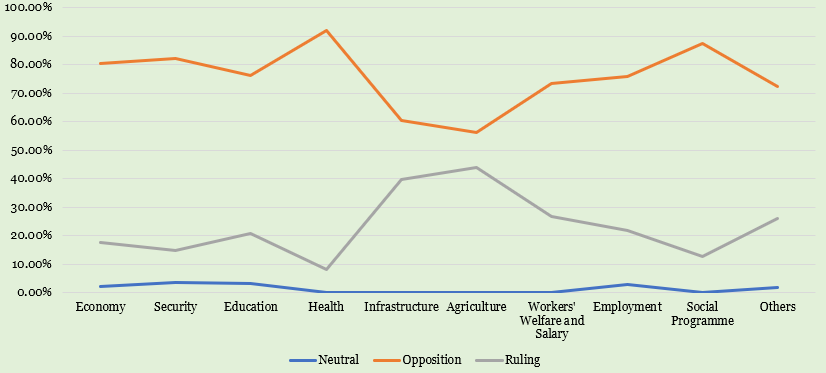
Meanwhile, an examination of the first three weeks of presidential election campaign monitoring by the two organizations shows that the opposition political parties and the ruling party have been somewhat closed in discussing infrastructure and agricultural issues, as well as residents’ needs. There was a considerable divergence in debating economic, security, education, health, workers’ welfare and salary, employment, and social programs. The findings also show a significant discrepancy in terms of discussing issues that are unrelated to people’s expectations. For example, personality attacks in the form of pointing out candidates’ health issues dominated the others category analyzed by the two organizations’ research teams.
Exhibit 1: Policy and campaign issue convergence and divergence
Data Source: CEREDEMS-Africa and Positive Agenda Nigeria, 2022 Key: Economy (137), Security (89), Education (97), Health (25), Infrastructure (48), Agriculture (16), Workers’ Welfare and Salary (15), Employment (37), Social Programme (24), Others (781)
Avoidance or engagement?
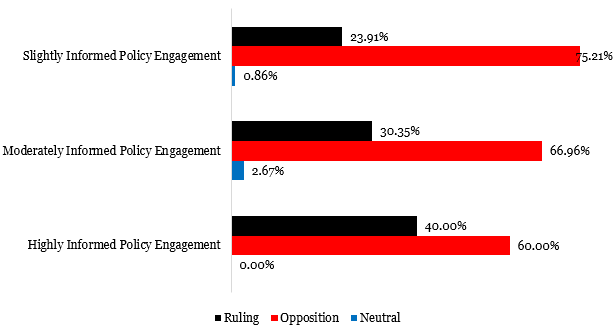
In terms of discussing the identified policy and campaign issues with citizens (via Facebook, Twitter, newspapers, and campaign rallies explored by the organizations), analysis shows that much attention has been paid to mentioning some of the needs and issues within the previously discussed policy and campaign issues (see Exhibit 1) without stating the impacts on people and the country as a whole. Meanwhile, it is surprising that the opposition political parties jointly lead the ruling party in all three categories of engagement level being examined by the two organizations. This also applies to the discussion of the issues (see Exhibit 1). Our analyst wonders why the opposition political parties are outperforming the ruling party in every category based on the information at hand and newly revealed insights. Does this imply that it is incredibly difficult to own and debate particular issues when a candidate is not the president in office?
The West African Examination Council (WAEC) disclosed that it has finalized plans to launch its new digital certificate to candidates, which will be automatically released to them immediately the results are out.
This was disclosed by WAEC’s Head of National Office, Mr. Patrick Areghan at a luncheon organized by the exam body in Lagos.
Mr Patrick stated that the digital certificate platform would be launched on Thursday, October 20, 2022, adding that the process would initially be applicable to those who wrote the exams between 1999 till date. He however stated that candidates who sat for the exams during the preceding years would be considered much later.
In his words, “Whether your certificate was burnt or lost to flood or eaten by termite, you don’t have to go through the stress of recovering it.
“Just pick up your phone and log on to our website and it comes straight from the WAEC database. We have solved the problem of theft. We have saved you the headache of carrying the hard copies of your certificate.
“And the good thing that will come out of this is, by the time we take a final decision and perfect everything if we release the results today, I can tell you that the certificates are ready. It is just to roll them out.
‘’If we announce the release of results today, the certificates will automatically be ready for release. It may just take a year to transit because the certificates we have now are going to be treated, but immediately after they are treated, they will be available in the database. The next one, that will be 2023 or 2024, immediately we release the results the certificate will be ready.”
This digitization of certificates by WAEC, has been described as a mobile and web-based application which comes with powerful features.
The examination council disclosed that this feature was designed to assist candidates, and institutions by giving them the access, to share, request, and confirm certificates.
It is interesting to note that the Digital Certificate Platform is already available online via www.waec.org. The mobile application can be downloaded on Android and iOS app stores.
At Tekedia Startup Masterclass, we solve the equations of business. We help you differentiate the business challenges and integrate your profits and growths. The founders have called us the “temple” for how we help innovators and builders to understand market.
We begin with this equation:
(1) Innovation = invention + commercialization.
As we explain that, we produce another one:
(2) Great Company = Awesome Product + Superior Execution.
Come to the temple today. More startup leaders spend more time in Tekedia Institute than any training institution in Africa. Register here and let’s do the limits of infinite growth.