DD
MM
YYYY

PAGES

DD
MM
YYYY

spot_img

PAGES

Home Blog Page 4996

ARM Set To Build The Next Class Of African Unicorns

0

About six years ago, the African continent could not boast of a single unicorn, but today, the continent now has Seven (7) Unicorns worth over $1 billion. It might interest you to know that out of the 7 unicorns, 5 of them are from Nigeria, namely; Flutterwave, Interswitch, Opay, Jumia, and Andela, with a majority of them in the Fintech sector.

The first wave of African tech unicorns are currently leaders in Fintech, reducing the friction in transactions across the continent. With the significant progress being recorded in the tech space in the region, Investors are now beginning to show confidence in African ideation by investing in the region.

Recently, Assets and Resource management holding company (ARMHoldCo) on Tuesday, July 19th, 2022 in Lagos, held a chat themed “Building the next set of Unicorns” in anticipation of the ARM labs Lagos Techstars accelerated program slated to begin in August 2022.

The ARM labs Lagos Techstars accelerator program is a partnership between ARM and Techstars, an American seed accelerator focused on providing funding and support to Fintech and Proptech startups who are poised to use innovation in solving problems across Africa.

Recall that ARM Labs Lagos funding and support to startups (Fintech and Proptech) is coming after it solidified Lagos as Africa’s most attractive tech hub. Nancy Wolff who is the General Manager of Techstars disclosed that the city has built a successful startup ecosystem that merits global exposure, investment, and resources with extraordinary potential in the market.

The event which had the presence of startups and organizers of the accelerator program in attendance, Chief Executive Officer of ARM, Jumoke Ogundare noted that in order to be at the forefront for these startups, the basis for ARM’s collaboration with Techstars to birth the accelerator program.

She emphasized that this collaboration will contribute to the nation’s economic growth in the areas of employment, promoting social development, and reaching the unbanked people through fintech services.

She further disclosed that such collaboration will ensure that all startups that the firm supports in the accelerator program would have access to ARM’s market, network and build a platform where they can develop capacities.

It doesn’t come as a surprise that there is a dearth of female founders in tech startups, as experts say one reason for the less number of female founders in tech is due to the fact that they have a harder time getting initial funding.

Addressing this issue, CEO of ARM Jumoke Ogundare stated that through the ARM partnership with Techstar, they are building an ecosystem where other female founders can support upcoming women startups.

ARM partnership with Techstars is indeed strategic and will no doubt yield a positive result, as Techstars has a portfolio of about 3,000 companies that have passed through their various program worldwide, where they invested $21.3 billion.

Startups that passed through the Techstar program raised an average of $1 million. With this program, in a bid to build the next set of Unicorns in Africa, 12 of the startups in the accelerator program will get a collective sum of $120,000 in investment and equity.

They will also get access to over 7,000 mentors in the TechStars network and 20,000 global investors in the same network. With all these programs and investments in the African region, it is imperative to say that the region will definitely produce more unicorns in the future.

Interrogating ASUU Strike as a Factor Influencing Low UTME Performance

0

Following the 2022/2023 Unified Tertiary Matriculation Examinations (UTME) which recorded that 378,639 candidates of the total 1,761,338 candidates who wrote the exam scored 200 marks and above, the Joint Admission Matriculation Board (JAMB) on 21 July announced 140 marks as the national minimum cut-off for the 2022 university admission exercise and 100 marks for admission into polytechnics and colleges of education in the same year.

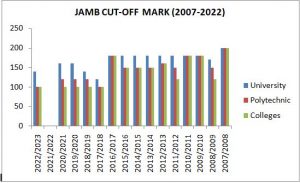
The decision of JAMB has since left many Nigerians wondering about the current state of education in the country. Some also wonder if the UTME gets tougher on a year-on-year basis considering how JAMB gets to reduce its cut-off mark every year. Between 2007 and 2022, JAMB has reduced the University’s admission cut-off mark from a minimum of 200 which is the average score of the overall 400 to as low as 120. The 2017/2018 UTME has the lowest cut-off mark of 120 since 2007.

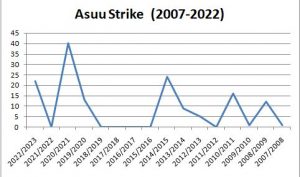
Another important factor that is often used by the public to appraise the state of the nation’s education at the post secondary level is the incidence of strike by the Academic Staff Union of Universities (ASUU). Almost every year ASUU goes on strike, causing disruption in the academic calendar and a deferment in the programs’ duration. During ASUU strike, students are expected to leave the school premises as all academic activities are put on a halt. Since 2007, the Academic Staff Union of Universities has embarked on a total of 143 weeks of strike in ten academic sessions.

When schools are in session, some of the UTME candidates visit their schools of choice for guidance and counselling at the schools’ admissions units, some candidates also get the opportunity to be tutored by University students who take up part-time teaching jobs, and some others get to use Universities facilities to prepare for their UTME through the assistance of friends, families or mentors who are registered students or workers in their chosen schools. All of these are expected to provide an enabling environment for UTME candidates to excel in their exams. Therefore, the primary assumption of this analysis is that the incidence of ASUU strike has a significant impact on the UTME performance.

Thus, we examined a link between the incidence of ASUU strike and performance in the UTME every year, using the JAMB cut-off mark as a baseline performance in the UTME dependent on the ASUU strike.

With 143 weeks cases of ASUU strike since 2007, a regression analysis shows that the incidence of ASUU strike is not associated with performance in the UTME from 2007 to 2022 admission year. The cases of strike only have 1.9 percent impact on UTME performance at p>0.05, which implies that the industrial action does not have a significant impact on the year-on-year decrease in performance in the UTME.

It is also observed that the 2017/2018 admission year which has the lowest UTME cut-off mark since 2007 recorded no strike by ASUU, whereas the 2020/2021 admission year which recorded the highest strike of 40 weeks has a minimum cut-off of 160 marks.

However, while we cannot pinpoint a convincing statistical link of the ASUU strike and the UTME performance, we were able to determine that the UTME baseline performance has continued to reduce year-on-year since 2007. After dropping from 200 marks in the 2007/2008 to 170 marks in the subsequent year, it increased to 180 marks in the 2009/2010 admission year which was maintained till 2017/2018 admissions exercise when it dropped sharply to 120 marks. The UTME cut-off mark again increased from 140 marks in 2018 to 160 marks in 2019 which was maintained till it reverted to 140 marks in the current 2022/2023 admission year.

The perception and assumption of the impact of ASUU strike extends beyond performance of candidates at the UTME. The intermittent ASUU strike is also believed to have ripple effect on the local economy. Professor Ndubuisi Ekekwe, the lead faculty at Tekedia institute and writer at the Harvard Business Review put this in good perspective when he said the following:

When students are in town, okada boys have jobs, mama put has buyers etc. In short every student could be contributing at least N1000 to the local economy (food, N800 and transport N200). Multiply this conservative N1000 by tens of thousands of students, workers and associate, you will see why every community wants a university. Withstrikes, those opportunities dry up.

It is suggested that the Nigerian government, the Academic Staff Union of Universities and other relevant stakeholders should in all sincerity work together to reach a comfortable financial structure for all parties to put an end to the incessant industrial actions that has continued to disrupt academic activities in the school and by extension economic activities in the country.

Rather than reduce admission standard every year, JAMB in conjunction with the Federal Government through the ministry of education should look inward to provide a lasting solution to the University/Polytechnic/College discrimination which has continued to add to university admission pressure every year.

BIG DATA FACT-CHECKING: Is BBNaija Really Taking Over Peter Obi’s Virtual Movement Ahead of the 2023 Presidential Election?

0

The fact that Mr. Peter Obi, a former governor of Anambra State and presidential candidate for the Labour Party in the 2023 election, left the largest opposition party, the People’s Democratic Party, on May 24, 2022, is no longer a breaking news story. The fact that the bulk of Nigerian youths have been supporting him on social media is therefore not breaking news. Peter Obi informed Senator Iyorchia Ayu, the PDP’s national chairman, in a letter saying he was resigning from the party due to changes within the party that prevented him from continuing to play a role and contribute positively. He further stated that: “Our national challenges are deep-rooted and require that we each make profound sacrifices towards rescuing our country.”

Claim

Meanwhile, as the LP’s candidate continues to garner considerable virtual support, a former presidential media advisor to President Goodluck Jonathan has claimed that social media support, particularly on Twitter, will be absorbed by Big Brother Naija, a popular reality TV show. The show began on Saturday, July 23 and Sunday, July 24, 2022. It is scheduled to run for 72 days. Mr Reno Omokri made his claim in the context of the show’s popularity among Nigerian youths. According to him, “In less than 24 hours, there has been an abrupt shift from Peter Obi to #BBNaija. For the first time in months, nothing about Obi is on Twitter’s top 10 trends. While others were building structures on the ground, Peter was fooling Obidients online. Oya, insult me!”

In line with his expectations, a number of tweeps reacted to his comment negatively. One of the tweeps said “#BBNaija hashtag will top the trend table for 12 weeks straight. Infiltrate it with Peter Obi’s fliers and posters. Keep Obi on their faces.” Another Twitter user advised young people to take advantage of the programme and include the presidential candidate’s hashtag in their BBNaija tweets in order to make him more popular as the 72-day show progresses. This looks to be a technique to maintain support for Mr. Peter Obi. “Dear Obidient Nigerian youths #BBNaija has started, and we all know it comes with super-trending topics. We must be more radical to keep the gospel of PETER OBI ahead of all trends.” Several other tweeps also aligned with this direction of pushing the presidential candidate to the public in real time during the show. “We will not be distracted by BBNaija We will not be distracted by BBNaija We will not be distracted by BBNaija We will not be distracted by BBNaija. In the middle of BBNaija, we will stay focused on Peter Obi and continue to press…”

Verdict

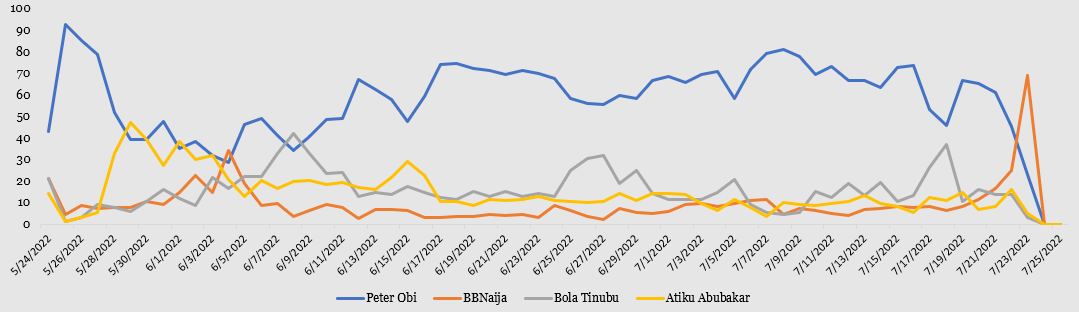
As Twitter users continue to respond to Mr Reno Omokri, our analyst investigates the claims using Google Trends, which normalizes public interest across time on a specific topic or term. The analysis was done in respect to the digital popularity of other candidates among netizens. The level of interest in the three major presidential contenders and the reality program was 3,885 between May 24 and July 26, 2022 (7am). Mr Peter Obi captured the attention of netizens with 58.40 percent of the total volume. Senator Bola Tinubu (16.74%) and Alhaji Atiku Abubakar came after him (15.31%). Netizens’ enthusiasm in the reality TV show has waned (9.80%). It was also revealed that the more people were interested in Peter Obi, the less they were interested in the TV reality show and other candidates.

A day-by-day analysis, however, indicates a range of outcomes. In comparison to other contestants and BBNaija, Peter Obi garnered 42.85% of the public’s interest on May 24, 2022. When the TV reality show premiered on July 23, 2022, it fell to 22.95 percent. The reality show benefits from the launch date. Analysis shows that the audience was more interested in the show than the candidates. For the date, the show attracted more than 68% of 122 volume of attention. With 22.95%, Mr. Peter Obi of the Labour Party trailed the contest, with Alhaji Atiku Abubakar, a former vice president and candidate for the People’s Democratic Party, coming in third. The candidates and show generated no attention between July 24 and July 25, 2022. According to our analyst, the lack of interest may be related to the public’s focus shifting to the release of additional victims of the terrorist attack on the Abuja-Kaduna Train. Our check reveals that Twitter and Facebook were primarily utilized to discuss the release and criticize the federal government for failing to ensure the safety of citizens nationwide.

Exhibit 1: Public Interest in Presidential Candidates and the TV Reality Show Overtime

Source: Google Trends, 2022; Infoprations Analysis, 2022

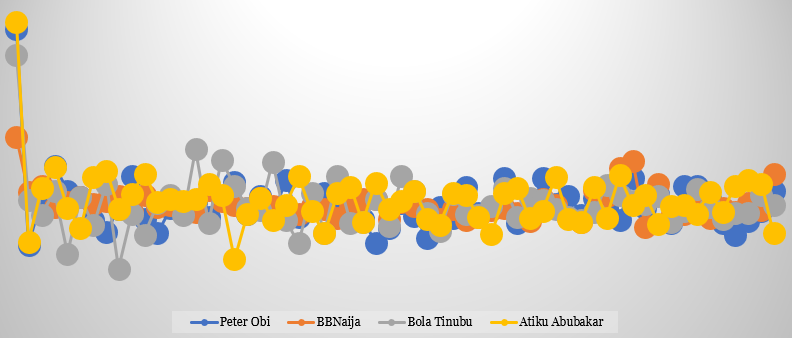
Given the emerging insights and the fact that Mr Peter Obi’s popularity cannot be established within regions of decrease and growth using the programme alone, our analyst predicts that Mr Reno Omokri’s claim will not hold significantly over the 72-day run of the TV reality show. The data in Exhibit 2 strengthens this position even further. According to the data, for the next 60 days (beginning July 26, 2022), Mr Peter Obi’s and other candidates’ virtual mobility will be diminishing and increasing in accordance with events that unfold as a result of the program, as well as other predicted and unexpected events. The projection favours the People’s Democratic Party candidate over others (see Exhibit 2).

Exhibit 2: Projected public interest in the next 60 days

Source: Google Trends, 2022; Infoprations Analysis, 2022

Top Five Performing Nigerian Tech Startups In Q1 2022 On Funds Raised

0
CEO of Flutterwave

Nigeria’s tech ecosystem has no doubt become the envy of its continental rivals due to the significant success of tech startups in the country.

Last year these startups attracted up to 35% of funding for African startups. The country has achieved an unprecedented milestone in its tech ecosystem as vibrant tech-savvy youths continue to create products and services that address the myriad of problems that the not just Nigeria but the African continent is faced with.

From Fintech, and Proptech to Edtech, young innovators in the country continue to break new grounds. It is interesting to note that these tech startups have only scratched the surface, because with new talents emerging in technology, more startups will emerge that will provide solutions to long-old problems.

There is no disputing the fact that Nigeria is gradually becoming a major tech hub in terms of startup generators which has become a preferred location for investors and entrepreneurs to invest and launch new projects.

This year, startups in the country have accumulated close to $1 billion in the first quarter. With 90% of Nigeria’s startup funding coming from Fintech which has the most unicorns in Africa.

Check Out The List Of Top Five (5) Performing Nigerian Tech Startups In Q1 2022

1.) Flutterwave -($250 Million)

Fintech company that provides payment infrastructure for global merchants and payment service providers across the continent, flutterwave which is currently the largest startup company in Africa.

The fintech startup has processed over 200 million transactions worth more than $16bn dollars in 34 African countries. Last year, the company raised $170m in a Series C round.

In February earlier this year, it raised another $250 million in its single-best funding round to date, which saw its valuation rise to over $3 billion as it targets mergers and acquisitions with a rapidly growing existing customer base.

2.) Moove -($105 Million)

Global mobility fintech that provides revenue-based vehicle financing to mobility entrepreneurs globally, Moove raised $105 million in an oversubscribed series A2 round to scale to seven new markets across Asia, and Europe over the next six months.

Launched in 2020 with its credit scoring system, the company constantly seeks to provide mobility entrepreneurs with revenue-based financing in markets where there is low access to credit.

Since its launch, Moove has rapidly extended operations to other African countries such as Ghana, Kenya, Uganda, and South Africa, as well as the Middle East, Asia, and Europe.

3.) Thrive Agric -($56.4 Million)

Agricultural technology startup that provides access to finance, premium markets, and data-driven advisory for smallholder farmers, Thrive Agric has secured $56.4 million in debt funding from commercial banks and institutional investors in March this year.

The startup company also received a $1.75 million co-investment grant from West Africa Trade and investment, which is funded by USAID.

This new investment will enable the company to expand its 200,000 farmer base as well as entering new markets in Africa. The startup also aims to build the largest network of profitable African farmers.

4.) Reliance Health -($40 Million)

Reliance Health, a startup company that uses technology to make healthcare more affordable and accessible, which uses both vital concepts so that users can get access to an integrated suite of healthcare products via subscriptions.

In February this year, the startup company completed a $40 million Series B funding round led by General Atlantic, a leading global growth equity investor.

5.) Credpal -($15 Million)

Credpal, a financial technology startup that allows businesses and individuals to buy anything and pay later in installments across online and offline merchants by providing them with instant access to credit at the point of checkout.

The company which is believed to be one of the earliest pioneers of ‘buy now, pay later’ services in Nigeria, closed a bridge round of $15 million in equity and debt in March this year to expand its consumer credit offerings across Africa.

WHO Declares Monkeypox A Global Health Emergency

0

As covid subsides, monkeypox beckons. The World Health Organization (WHO) has declared monkeypox a global health emergency, signaling a potential fresh global health crisis on the heels of the pandemic.

Rattled by the rising number of cases around the world, the WHO issued the declaration at the end of the second meeting of its emergency committee on the monkeypox virus.

“Having considered the views of Committee Members and Advisors as well as other factors in line with the International Health Regulations, the Director-General has determined that the multi-country outbreak of monkeypox constitutes a Public Health Emergency of International Concern,” the WHO said in a statement.

The UN health arm is apparently seeking prompt response to the virus to curtail the possibility of it spreading like covid.

Monkeypox is caused by the monkeypox virus, which comes from the lineage of viruses such as smallpox. But it spreads significantly slower than other viruses and has low infection chances.

However, the upsurge of monkeypox cases shows the virus needs to be taken seriously. The WHO director general Dr Tedros Adhanom Ghebreyesus said more than 16,000 cases have now been reported from 75 countries, and there had been five deaths so far as a result of the outbreak.

Although early assessment shows moderate spread of the virus it also shows signs of potential wider contagion. The emergency committee had been unable to reach a consensus on whether the monkeypox should be classified as a global health emergency, according to Dr Tedros.

However, he said the outbreak had spread around the world rapidly and he had decided that it was indeed of international concern.

Too little was understood about the new modes of transmission which had allowed it to spread, said Dr Tedros.

“The WHO’s assessment is that the risk of monkeypox is moderate globally and in all regions, except in the European region, where we assess the risk as high,” he added.

There was also a clear risk of further international spread, although the risk of interference with international traffic remained low for the moment, he said.

The declaration also comes with recommendations. The WHO, building on covid’s safety structure, outlined preventive measures that include establishing and intensifying epidemiological disease surveillance, including access to reliable, affordable and accurate diagnostic tests, for illness compatible with monkeypox as part of existing national surveillance systems.

In addition, the WHO urged the authorities to activate or establish health and multi-sectoral coordination mechanisms to strengthen all aspects of readiness for responding to monkeypox and stop human to human transmission, and also raise awareness about monkeypox virus transmission to quell the stigma that may prevent infected persons from seeking medical help.

Dr Tedros said the declaration would help speed up the development of vaccines and the implementation of measures to limit the spread of the virus.

“This is an outbreak that can be stopped with the right strategies in the right groups,” he said.

The world is now facing three global health crises at once. Covid, which although has subsided, is still spreading through emerging variants. Polio, which the WHO has been battling to contain and monkeypox.