DD
MM
YYYY

PAGES

DD
MM
YYYY

spot_img

PAGES

Home Blog Page 5

The Economics of Running an Online Store: Where the Money Really Goes

0

Think running an online store is cheap?

Most new retailers do. Free store rent. No store employees. Low electricity costs.

Here’s the problem:

Money doesn’t vanish…. it just moves.  If you don’t know where it goes your profit slowly leaks away one petty expense at a time.

This post explains exactly where your money goes when you sell online. And how to stop the leaks before they drain your store.

Time to dig in!

Inside this guide:

  • The Real Cost Of Your Store’s Platform
  • Why Certified Ecommerce Developers Save You Money
  • Marketing: The Biggest Monthly Bill
  • Returns & Shipping: The Silent Profit Killers
  • The Checkout Leak Nobody Talks About

The Real Cost Of Your Store’s Platform

Your platform is your store’s engine room. Every sale, product page and payment processed goes through it.

The majority of store owners begin on a low-cost monthly plan. That works for starters. Expenses can rapidly escalate as your store expands though:

  • Monthly platform fees
  • Paid apps and plugins
  • Payment processing fees on every sale
  • Hosting and security

Apps is the biggest culprit. You can easily rack up charges for 10x, 15x small apps at say $5 a month.

Add them all up and it gets scary.

Think about it:

Small monthly bills don’t seem like much. However they can add up to consume a large percentage of your annual profit.

Why Certified Ecommerce Developers Save You Money

Here’s where lots of store owners go wrong…

They attempt to cut corners by DIYing the store build. Or they find the cheapest freelancer available.

It’s intuitive, yes. However, poorly constructed stores cost you more money down the road. Slow pages, broken checkouts and sloppy code are losing you sales daily.

It’s also why emerging brands hire certified ecommerce developers. These developers have passed official certification exams for platforms such as Adobe Commerce, which means they understand how to build secure, optimised online stores that are easy to scale. Partnering with a trusted commerce development company will give you fewer bugs, fewer emergency hotfixes and significantly less cash burnt on problem remediation down the line.

Cheap builds are rarely cheap.

Certified ecommerce developers can help you stop paying for useless apps. Often times a feature can already be built into the store vs added on with another monthly plugin.

Marketing: The Biggest Monthly Bill

For most online stores, marketing is where the biggest slice of money goes.

Why? Because there’s no pedestrian traffic. People don’t stumble across your store. Each and every one of your customers has to be sought out….and being sought out isn’t free.

Most stores spend on a mix of:

  • Paid ads on Google and social media
  • Email marketing tools
  • Influencer deals
  • SEO and content

Paid advertising is the fastest way to build traffic. However, when you stop paying… there is no traffic.

And as you know…

Rising ad costs = Shrinking profit.

That’s why savvy retailers mix paid advertising with SEO and email. It takes longer to see those channels grow, but they keep sending customers without another bill every time someone clicks.

Ok, Here’s an Analogy.. Paid advertising is renting traffic. SEO and email are owning traffic. Renting is great if you need immediate sales but if you want your store to be profitable for years to come you need to own your traffic.

Before you spend another dime on advertising, know what percentage of your traffic is owned.  If its “little to none”, thats where you should be focusing your efforts.

Returns & Shipping: The Silent Profit Killers

Want to know one of the biggest hidden costs of selling online?

Returns.

Customers can’t feel or test drive your products before purchase. That means more of them are returning them. The National Retail Federation estimates that about 19.3% of online sales will get returned. That’s almost 1 in 5 orders heading back to your doorstep.

And every return costs you twice:

  1. You pay to ship it back, check it and restock it
  2. You lose the sale you thought you had

Here’s the kicker…

Free returns are now expected by customers. According to the same study, 82% of consumers ranked free returns as one of the most important aspects when shopping online. What’s even more alarming? Approximately 9% of all returns are fake.

Returns aren’t a minor admin issue. They’re an operational cost that requires an operational solution.

Ok but how do you reduce returns? First with improved product pages. Detailed sizing guides, descriptions, quality photos and honest reviews all help. The better informed a shopper is before purchase, the less likely a return.

Shipping is the other big expense. Carrier rates continue to increase. Packaging doesn’t cost nothing either. Many stores give away free shipping to secure sales… silently losing money on each micro order.

Tip: Offering free delivery when a customer spends a certain amount (£50 for example) will cover your costs and encourage customers to spend that extra bit!

The Checkout Leak Nobody Talks About

This is going to be surprising to you…

You can spend all the money in the world driving traffic to your store. But the majority of those people still aren’t going to buy. Studies indicate an average cart abandonment rate of 70.22%. In other words, seven out of ten visitors add an item to their cart, and leave.

Consider what that does to your marketing budget.  You spent money to attract those customers.  They loved your product enough to put it in their cart.  Then they left.

OK, but why do they leave? The biggest culprit is unexpected costs at checkout (39%).

Other common reasons include:

  • A long or confusing checkout
  • Being forced to create an account
  • Slow page speed
  • Not trusting the site with card details

The good news?

Easy fixes. Display all costs upfront. Include guest checkout. Speed up your pages. Display trust badges near your checkout button.

Optimizing your checkout is one of the least expensive methods to increase sales. You are not paying for additional traffic… you’re just retaining the customers you already attracted.

Pretty cool, right?

Counting The Real Cost

E-commerce isn’t necessarily low-cost. Costs aren’t disappearing — they’re just hidden from owners in places they’ll never look.

To quickly recap, your cash goes on:

  • Your platform — fees, apps and hosting that grow with your store
  • Development — where cheap builds often cost more later
  • Marketing — usually the biggest monthly bill
  • Returns and shipping — silent costs that eat into your margin
  • Lost checkouts — shoppers you paid for who never buy

Stop the bleeding and every pound you spend will stretch further. Attack the biggest leak first. Plug it. Attack the next.

Rinse and repeat.

ContiSX Opens Pre-order for ContiSX Phones

0

I have been building things since my days at FUT Owerri, where we launched the university’s first campus FM radio station. In industry, I served as a global lead ASIC design engineer, helping to develop the inertial sensors used in the early versions of the iPhone. I also invented a wafer-level chip-scale packaging technology for inertial sensors. Till today, the US Government has continued to honour royalties for using my PhD research and the patent that came out of it. I am a Nigerian and I build things!

Good People, when we engineered a native blockchain for Contisx Securities Exchange, we saw an opportunity to extend that operating system into a new category of secure communication. That vision led us to build the Contisx Phone, a cryptographically secured blockchain phone designed to deliver superior communication security for individuals, companies and governments.

Yes, blockchain-secured with absolute sovereignty. With ContiSX Phone, you get end-to-end secure communication,  across messaging, voice and video ,  with no eavesdropping or tampering, guaranteed by cryptographic encryption.

The Contisx Phone is now available for preorder, with shipments beginning on October 1, 2026. Preorder yours here: https://contisx.com/phone/

Every preorder comes with these benefits:

  • One year of complimentary Contisx Network services, including Contisx Mail, Contisx Audio and Contisx Video.
  • Zero-rated data access across the Contisx Exchange and CSD ecosystems for one year. Users will incur no telecommunications data charges when accessing core Contisx services.
  • Free access to the Tekedia Nigeria Capital Market Masterclass.
  • Free access to the Tekedia Mini-MBA.

From semiconductor systems to blockchain infrastructure, we continue to build the technologies of the future. Grow with ContiSX Phone contisx.com/phone

Ndubuisi Ekekwe, PhD

Engineer | Inventor | Nigerian & Ovim Village-Boy

More About ContiSX Phone and Services

Good People, we received nearly 50 orders overnight. I thank Nigerians for always supporting this village boy. Thank you. Let me respond to some of the questions here about the Contisx Phone.

– We have prepaid participating telecommunications companies in Nigeria. When you use the Contisx Phone for messaging through Contisx Mail, voice calls through Contisx Audio, or video calls through Contisx Video, you will not consume your mobile data because access to those services is covered within our native ecosystem. However, you will need your own mobile data to use external services such as YouTube, Facebook, etc.

– When we launch Contisx Securities Exchange, you will not need data to buy stocks, FGN bonds and other investment products within our ecosystem. We have prepaid the data costs. Our philosophy is Investment Inclusion, and we want to remove barriers that prevent citizens from participating in capital markets. We expect to extend this zero-rated access beyond the Contisx Phone to our web, Android, smartTV, Chrome Extension and iPhone platforms.

– The Contisx Phone works anywhere in the world. Outside Nigeria, however, users will need mobile data to access its services. The phone can call other types of phones, but you cannot install WhatsApp, Facebook, Instagram or similar applications because the Contisx operating system is different from Android and iOS.

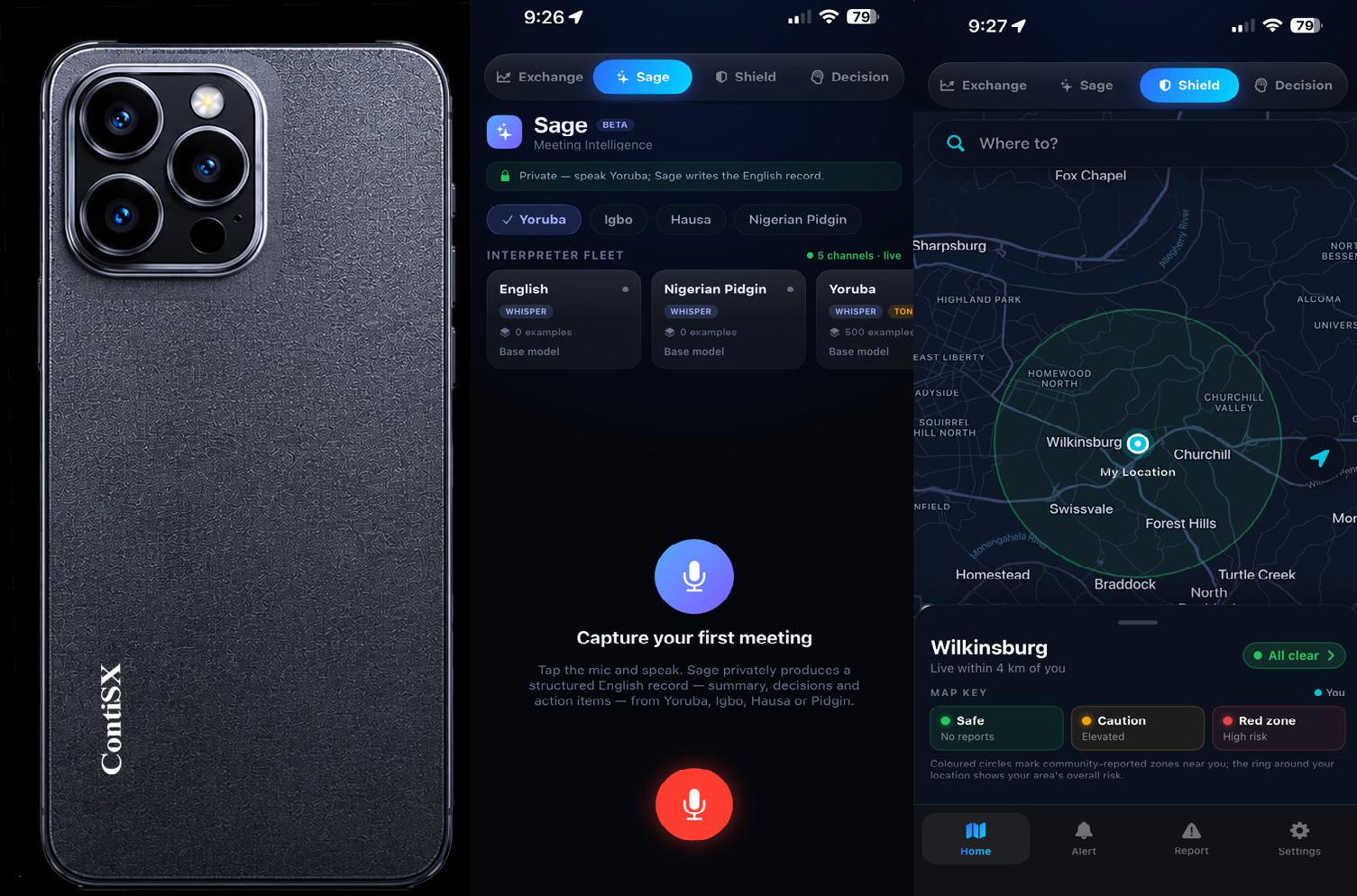
The Contisx Phone also comes with these native solutions which are available:

  • Decision Lab: Gathers and interprets insights to help you make better decisions and run your business more effectively.
  • Contisx Sage: Captures and interprets meeting notes in Igbo, Hausa, Yoruba, English and Pidgin. We just completed the Hausa integration in our Kano Design Center where 5 brilliant native Hausa speakers executed the playbook (middle image).
  • Contisx Shield: Provides live threat intelligence and security alerts for organisations (right image)
  • Business Suite: Supports bookkeeping and accounting, inventory management, human resources, payroll and access to funding opportunities.
  • Boardroom: Powers board governance and preserves decisions on a sealed, tamper-evident record.

We are building a new system for secure communication, commerce, governance and investment inclusion. Preorder ContiSX Phone here https://contisx.com/phone .

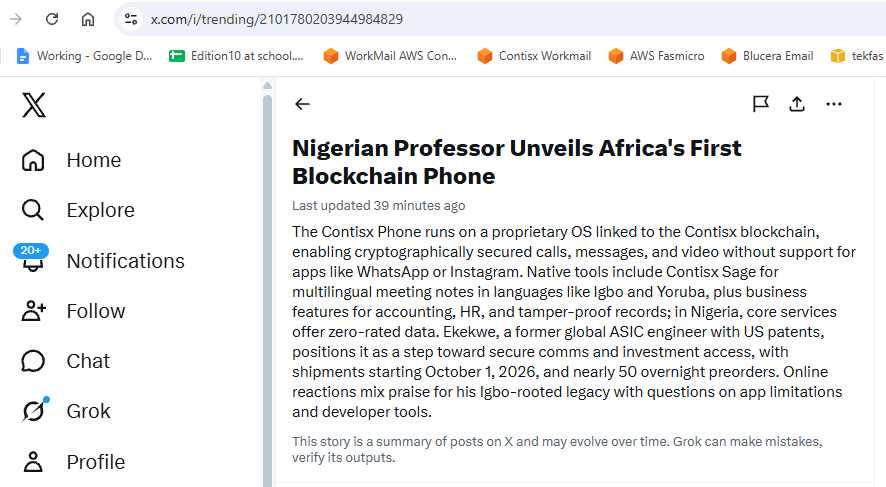
Trending on X

Contisx Phone trending on X

ContiSX Blockchain Card

The ContiSX Blockchain Card

Amazing young people, thank you to everyone who sent a CV to explore opportunities at Contisx. As promised, we will launch our comprehensive careers page as soon as the stock exchange begins operations. We are now at the finish line.

But you do not have to work directly for Contisx to participate in what we are building. Through our software development kits, APIs and other tools, developers and entrepreneurs will be able to build independent solutions on our infrastructure. We want you to create for the markets around you and prepare those markets for the future.

Beyond the Contisx Phone, we have the Contisx Blockchain Card and other solutions. The phone, card and the solutions provide a foundation for secure, affordable and scalable regional digital-asset infrastructure for emergent digital economy, well beyond what we have today. It integrates seamlessly with the Contisx Phone, enabling businesses and people to manage essential commercial services through a unified platform while eliminating most costs we see in the digital rails. Imagine paying for things without those expensive transaction fees. I am sure you will want your customers to save money! And ContiSX Blockchain Card will be amazing for them; we will launch it once our exchange begins.

Young People, we are here to support. Visit contisx.com and see what excites you. Together, we can accomplish remarkable things across Nigeria and Africa.

Volkswagen Plans More Than 4,000 More Porsche Job Cuts as Profit Crisis Deepens

0

Volkswagen is considering more than 4,000 additional job cuts at Porsche as part of its most sweeping restructuring yet, highlighting the depth of the crisis facing the German automaker as weak Chinese demand and a costly shift in electric vehicles weigh on its most prestigious brands.

Documents detailing a recent agreement by Volkswagen’s supervisory board call for about 4,100 positions to be eliminated at Porsche, with the measures aimed at addressing an estimated €700 million ($803.8 million) overhead shortfall, German business daily Handelsblatt reported on Saturday.

The cuts would come on top of existing agreements, the newspaper reported.

The scale of the restructuring underscores the pressure on Porsche, which has historically been one of Volkswagen’s most profitable businesses but is now confronting weaker sales in China, high costs and uncertainty over its electric vehicle strategy.

Porsche management and labor representatives agreed in July to an additional 5,000 job cuts, following 4,000 reductions already agreed earlier. Those measures would bring the number of currently agreed job cuts at the Stuttgart-based sports car manufacturer to about one in five employees by 2035.

Volkswagen’s parent company can recommend measures at Porsche but cannot impose them directly, adding another layer to the restructuring process.

The latest reported cuts come as Volkswagen itself has sharply reduced its expectations for the year.

On Friday, the group lowered its full-year operating margin target to as little as 1%, compared with its previous forecast of 4% to 5.5%.

The revision was largely linked to a write-down at Porsche, underscoring how problems at the sports car business are increasingly affecting the wider Volkswagen group.

Porsche’s difficulties are significant because the brand has traditionally provided Volkswagen with strong profitability and pricing power. A sustained deterioration therefore carries consequences beyond Porsche’s own financial performance.

Chief Executive Michael Leiters is under pressure to deliver a turnaround after the company suffered a sharp decline in sales in China and incurred substantial costs from changing course on its electric vehicle strategy.

The combination has exposed a difficult problem for Porsche: the company must invest in new technologies and products at the same time as it reduces costs and responds to weaker demand in one of its most important markets.

China and EV Strategy Drive the Reset

China has become a central weakness for Porsche.

The company’s premium positioning has not insulated it from the broader slowdown affecting foreign automakers in the Chinese market, where domestic manufacturers have strengthened their position through competitive pricing, electric vehicles, and sophisticated software.

The challenge is acute for European luxury brands because China’s auto market has shifted rapidly toward locally developed electric and hybrid models.

Porsche’s response has also been complicated by its electrification strategy.

The company invested heavily in electric vehicles as European and global regulations pushed automakers away from combustion engines. But weaker-than-expected demand for some EV models has forced Porsche to reconsider the pace and composition of its transition. That reversal comes with a substantial financial cost. Automakers cannot easily unwind years of investment in electric platforms, battery technology and production capacity without taking charges or restructuring operations.

For Porsche, the result has been pressure from both directions: the need to continue developing electric vehicles while maintaining profitable combustion-engine and hybrid models for customers who have not switched to EVs.

The reported 4,100 additional cuts suggest the company is now trying to bring its cost base into line with a weaker sales and earnings outlook.

Wider Volkswagen Restructuring

The Porsche measures form part of a much broader restructuring at Volkswagen. The group is attempting to reduce costs across its German operations while dealing with weak demand, intense competition from Chinese manufacturers and the capital requirements of the industry’s transition toward electric and software-defined vehicles.

The scale of the challenge weighs heavily for Germany, where Volkswagen has historically maintained a large manufacturing footprint and a powerful workforce.

Cost reductions therefore involve negotiations with employee representatives and can take years to implement fully.

At Porsche, the reported measures would extend an already substantial workforce reduction. If the latest plans are implemented alongside previously agreed cuts, the company would be reshaping a significant portion of its workforce over the coming decade.

The objective is not simply to reduce headcount. Volkswagen is trying to repair profitability at a time when the traditional advantages of European automakers are under pressure from changing consumer demand and a more competitive global market.

Porsche’s difficulties also reveal a wider problem facing established automakers: electrification has created new competitors while weakening some of the advantages built around traditional combustion-engine technology.

For Volkswagen, the immediate priority is restoring margins. But the scale of the reported Porsche restructuring suggests that the group is confronting a deeper question over how much of its existing cost structure can be sustained as competition, technology and demand patterns change.

The latest profit warning and reported job cuts indicate that the adjustment at Porsche is becoming a major part of Volkswagen’s broader effort to rebuild its financial performance.

Judge Signals Setback for TikTok’s $400 Million U.S. Privacy Settlement

0

TikTok and its Chinese parent ByteDance have hit a setback in their proposed $400 million settlement with the U.S. Justice Department after a federal judge indicated he would reject a key part of the agreement involving a long-running privacy consent decree.

U.S. District Judge George H. Wu in Los Angeles said Friday that he was inclined to reject the companies’ request to terminate a 2019 consent decree imposed on TikTok’s predecessor, Musical.ly. He scheduled a hearing for Monday to consider the issue.

Wu said that, based on the information currently before the court, he could not determine that ending the decree would provide a “durable remedy” or that the proposed termination was appropriately tailored to the changes cited by the government.

The ruling does not, on its face, reject the entire $400 million settlement. But it puts a significant component of the agreement in doubt and could complicate TikTok’s effort to resolve allegations that it mishandled children’s personal information.

Under the proposed settlement reached in August, TikTok agreed to pay $300 million immediately and another $100 million if the court terminated the 2019 consent decree.

The decree dates back to Musical.ly, the short-video platform that was later folded into TikTok. In 2019, the Federal Trade Commission alleged that Musical.ly knew children under 13 were using the service but failed to obtain parental consent before collecting their names, email addresses, and other personal information.

Musical.ly paid $5.7 million to settle those allegations. The resulting consent decree imposed reporting and record-keeping requirements that remain in effect through 2029.

The latest dispute shows why the decree remains important to the Justice Department’s case. Terminating it would have provided TikTok with a way to close out a regulatory obligation that predates the current ownership and operating structure of its U.S. business.

The $400 million settlement itself stems from a Justice Department lawsuit filed in 2024. The government accused TikTok and ByteDance of violating U.S. children’s online privacy laws by collecting personal information from users under 13 without the required parental consent.

The government has argued that TikTok has undergone substantial changes since the lawsuit was filed, including changes to its ownership structure, management, compliance operations, and privacy practices. Those changes form part of the rationale for seeking an end to the older consent decree.

But Wu’s tentative position suggests that the court wants more evidence that those changes are sufficient to replace the protections and oversight contained in the existing order.

TikTok’s Broader U.S. Restructuring

The privacy case is unfolding alongside a much larger effort by ByteDance to restructure TikTok’s U.S. operations and address Washington’s concerns over the platform’s ownership and handling of American user data.

In January, ByteDance agreed to establish a majority American-owned joint venture intended to safeguard U.S. user data and help avert a potential U.S. ban. TikTok’s U.S. business has more than 200 million American users.

The joint venture has pointed to new safeguards designed to prevent children from accessing the platform. In a court filing, it said all users are required to provide their date of birth and that it has developed age-moderation systems designed to identify users under 13 who misrepresent their age.

Those measures are relevant to the Justice Department’s argument that TikTok’s privacy practices have changed significantly since the original allegations.

The judge’s response, however, indicates that the court may require a clearer connection between those changes and the proposed termination of the 2019 decree. That creates an unusual situation for TikTok. The company is attempting to resolve a new federal privacy case while simultaneously seeking to remove an older regulatory obligation that remains in force for several more years.

The settlement would have, for the Justice Department, provided a financial penalty and a resolution to the litigation while allowing TikTok to operate under its newer compliance framework. For TikTok, ending the consent decree would remove an additional layer of federal oversight inherited from Musical.ly.

The court’s decision could therefore determine whether the proposed settlement can proceed in its current form or whether the parties will need to renegotiate the arrangement.

The Monday hearing is expected to provide more clarity on whether the judge’s concerns can be addressed without reopening the broader settlement. Until then, the $400 million agreement remains subject to a significant legal hurdle, with the fate of the 2019 consent decree at the center of the dispute.

IMF Says AI Could Lift Europe’s Productivity 1% But Deepen Inequality and Energy Strain

0

Artificial intelligence could raise productivity across Europe by about 1% over the next five years, but the gains are likely to be uneven and could widen inequality, put additional pressure on electricity networks and deepen Europe’s reliance on foreign technology, according to an International Monetary Fund paper.

The paper, prepared for an informal meeting of European Union finance ministers in Dublin on September 18-19, said the economic impact of AI would vary significantly across countries, regions and groups of workers.

The IMF argued that completing the EU’s single market could help spread the benefits of AI more broadly by making it easier for capital, labor, energy and technology to move across the 27-member bloc.

The assessment adds to concerns already raised by former European Central Bank President Mario Draghi and the European Commission that fragmented European markets are limiting investment, innovation and the region’s ability to compete in emerging technologies.

Europe’s fragmented economic structure could become an issue as AI investment accelerates. Countries with stronger digital infrastructure, larger pools of skilled workers and better access to capital are positioned to adopt AI more rapidly, while economies with weaker infrastructure or smaller technology sectors could capture fewer of the gains.

AI Could Reshape Europe’s Labor Market

The IMF estimated that about 60% of workers in advanced European economies are employed in occupations that are highly exposed to AI.

Exposure does not necessarily mean job losses. Some workers could use AI tools to perform existing tasks more efficiently, increasing their productivity. Others, however, could face displacement as companies automate routine work.

The distribution of those effects will depend partly on whether AI complements workers or substitutes for them. Jobs involving tasks that can be automated more readily face greater disruption, while workers whose productivity can be enhanced by AI could benefit from the technology. That creates a potential divide within European economies. Workers with the skills needed to use increasingly capable AI systems could see productivity and earnings gains, while those performing more automatable tasks could face greater pressure.

The IMF said the differences could also emerge between countries. More advanced European economies are expected to benefit disproportionately because they are more prepared for AI adoption and have greater exposure to the technology.

Completing the single market could therefore serve as an important mechanism for spreading AI investment and expertise beyond Europe’s largest technology and financial centers.

AI Expansion Adds To Europe’s Power Challenge

The IMF also identified electricity infrastructure as a potential constraint on Europe’s AI ambitions.

European data centers already account for roughly 3% of the continent’s electricity consumption, according to the paper. That demand is expected to rise substantially as AI applications require more computing capacity.

The pressure is already concentrated in major technology and data-center hubs including Frankfurt, London, Amsterdam, Paris and Dublin. Clusters of data centers in those locations are placing additional demands on local electricity networks.

The IMF said Europe should respond by investing in cross-border electricity infrastructure and deepening integration of its energy market.

The recommendation reflects a broader issue facing the AI industry. Building more data centers requires not only semiconductor capacity and capital but also reliable supplies of electricity. Where local grids cannot accommodate new facilities, access to power can become a constraint on AI infrastructure investment.

For Europe, that challenge is complicated by the fact that electricity markets remain fragmented across national borders. Greater integration could allow power to move more efficiently to areas experiencing higher demand and make it easier to support new data-center capacity.

Europe Faces Another Technology Dependency

The IMF also warned that Europe’s AI expansion could create a new form of strategic dependence. The US and China currently dominate the development of leading AI models, leaving Europe reliant on technology developed elsewhere unless it builds a stronger domestic AI industry.

That dependence could extend beyond AI models to computing infrastructure, chips, cloud services and other parts of the technology stack.

The IMF said Europe would need significant investment in its own AI industry to reduce the risk of becoming dependent on foreign technology. Building that capacity, however, would require addressing some of the same constraints that currently limit European technology investment, including fragmented capital markets and differences between national regulatory and energy systems.

The productivity opportunity is therefore closely connected to Europe’s ability to remove barriers within its own economy.

The IMF’s estimate of a roughly 1% productivity increase over five years suggests that AI could make a measurable contribution to European economic growth, but the gains are unlikely to arrive automatically or evenly. Countries with stronger infrastructure, deeper technology ecosystems and more AI-exposed industries could capture a larger share of the benefits. Regions facing electricity constraints or lacking access to capital and skilled workers could fall further behind.

For European policymakers, the challenge is consequently not only how quickly businesses adopt AI, but whether the economic infrastructure around them can support that adoption. A more integrated single market, stronger cross-border electricity networks and greater investment in European AI capabilities are expected to be a determinant of how widely the productivity gains are distributed.

Without those changes, the IMF’s assessment indicates that AI could increase Europe’s productivity while simultaneously bolstering existing gaps between countries, regions and workers and creating new dependencies on technology developed outside the bloc.