DD
MM
YYYY

PAGES

DD
MM
YYYY

spot_img

PAGES

Home Blog Page 5

What Does Flutter Leaving the London Stock Exchange Mean for FanDuel’s Growth

0

August 3 marks the date that Flutter Entertainment officially left the London Stock Exchange. While this has raised questions over the future performance of Flutter stock and its FanDuel brand, we need to look more closely at the market to understand how this fits in the overall growth plans for FanDuel.

The Full Story of the London Delisting

Flutter Entertainment will now only be listed on the New York exchange. The official reason given by the company is that its trading volumes in London have been thin, with New York now the main listing for trading volumes of its stock. Despite Wall Street recently having a sharp downturn, the New York market remains highly liquid.

This means that the cost and regulatory requirements of being listed in London are no longer viewed as worthwhile by the company. Removing the Flutter ticker from the London market doesn’t resolve all of the company’s issues, though. With the stock price down by more than 50% in the last year, analysts have been questioning whether the American sportsbook market has entered a slowdown phase that is affecting FanDuel.

The Changing Market in the US

Sportsbooks like FanDuel have dominated the sports betting market in recent years, as more states have opened up to them by passing regulations that make sports betting legal. However, that trend has shifted as prediction markets have now become massively popular.

This type of platform has a built-in advantage, since it can be accessed legally even in states where standard sports betting is restricted or directly banned. Rather than placing bets, users trade contracts on binary outcomes for named events. Sports make up a large percentage of this market, although it’s also possible to bet on other areas like cryptocurrencies, entertainment, and technology news or launches.

While this has put pressure on sportsbooks, the reply from Flutter has been to launch its own predictions platform. This sign-up offer for FanDuel Predicts shows how new players can sample this platform with a welcome offer. It’s available in all 50 states, although it’s noted that market restrictions are in place in some states.

This look by Reuters at possible changes to the regulations confirms the different views on the future. The Commodity Futures Trading Commission (CTFC) oversees this area, and it has proposed certain boundaries for individual markets, although not everyone is in agreement with this approach.

What the Future Holds

Flutter’s success in the second half of 2026 could depend heavily on how the predictions market continues to grow. However, with FanDuel also having a big sportsbook presence, the company could benefit from the market moving back in that direction too.

Overall, the future profits and stock market performance of Flutter are likely to be dictated more by the direction of the sports betting and prediction markets than the specific stock exchanges where it’s listed. FanDuel’s strong presence in different market sectors means that it should be well-placed to benefit from increased interest in either or both of these activities.
Create Better Video Ads in Minutes with BuzzHooks

0

Before AI, making a video ad meant you had to scout locations, set up a shoot, and piece it all together in the edit. As a small business, it was nearly impossible to afford this process at scale. Fortunately, AI video tools are starting to change that, and BuzzHooks is one of the best options. It is an AI-first alternative to tools like Higgsfield that helps brands and creators build short-form content without a full production crew.

Here’s Why Businesses Should Care About AI Video

A coffee shop down the street isn’t working with the production budget of a national brand, but it needs the same thing: social content that actually hooks the audience.

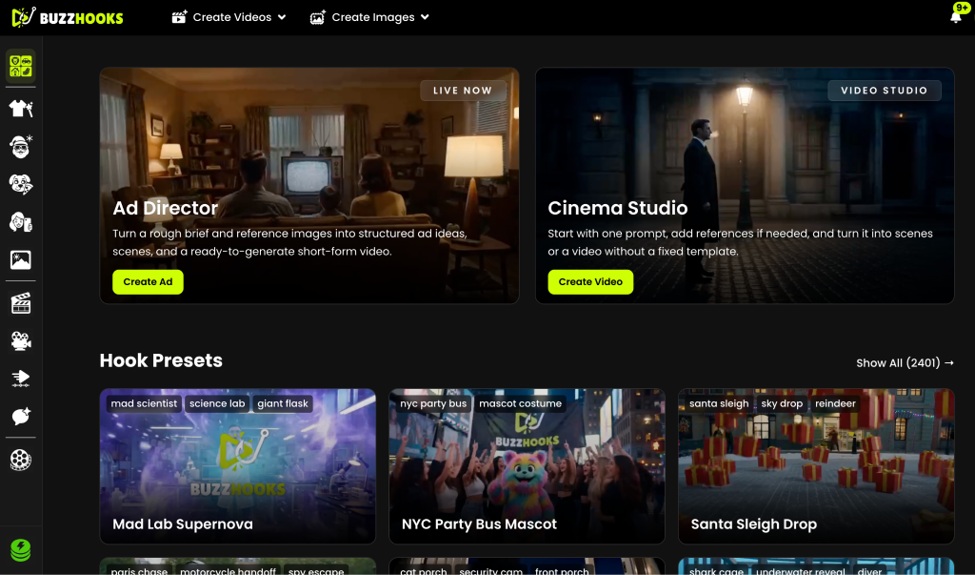
BuzzHooks brings a whole set of video creation tools under one roof to close that gap, including Video Apps, Viral Scenes, Hook Presets, UGC Presets, Ad Director, and, most importantly, Cinema Studio.

What Cinema Studio Can Do

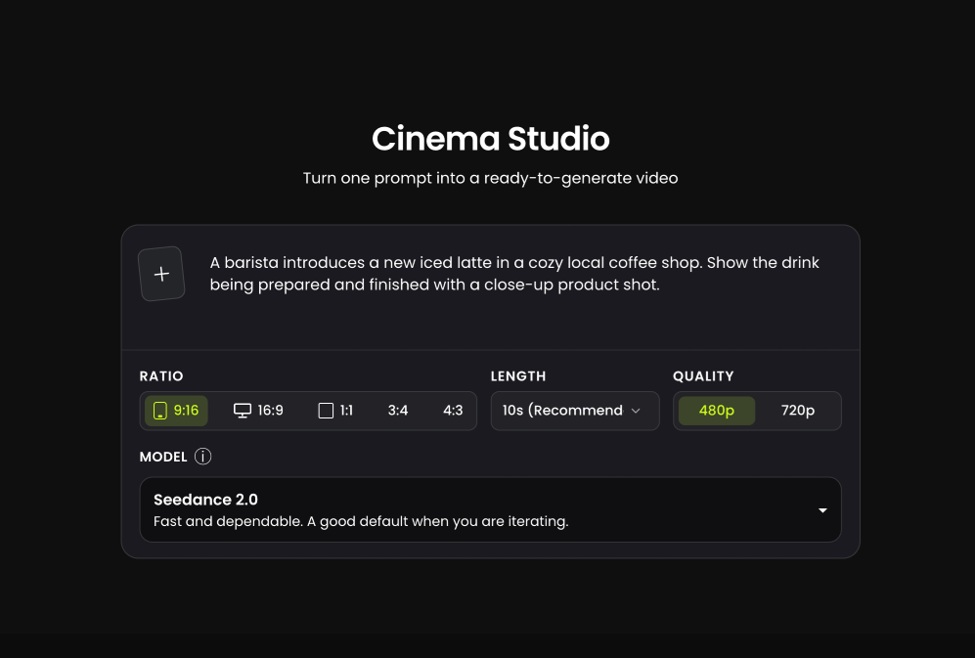
Cinema Studio inside BuzzHooks is the perfect tool for a business that wants control over the story it tells. You start the process with a single text prompt describing the shot you want, with the option to attach reference images. Everything else, aspect ratio, video length, resolution, and which generation model to use, comes with set defaults that can be adjusted.

From that one prompt, BuzzHooks builds the video as a sequence of individual scenes instead of a full clip, and each scene can be edited on its own without interfering with the other slots.

As a quick test run, here’s a sample ad for a local coffee shop. A short, minimal prompt is given to the tool, which is enough for BuzzHooks to draft four scenes:

  1. Barista introducing the iced latte
  2. Ice and milk being poured
  3. Espresso added on top
  4. Close-up of the finished drink

Once these scene drafts are approved, BuzzHooks generates the final version stitched together from all four shots.

That structure is the real value. A brand or creator gets a full concept laid out in sequence before committing to anything, and can accept or revise it shot by shot. You basically build the video one shot at a time, up to six shots in a 10-second ad.

Honestly, this is a game-changer for a small business, where the owner already understands their customers and their product better than anyone. What they usually don’t have is a creative team to help them with a campaign or an editor to help put it all together. With Cinema Studio, you don’t need to become a videographer, editor, photographer, or anything else. You just need to know what you want and describe the shot to BuzzHooks.

More Features For Different Marketing Use Cases

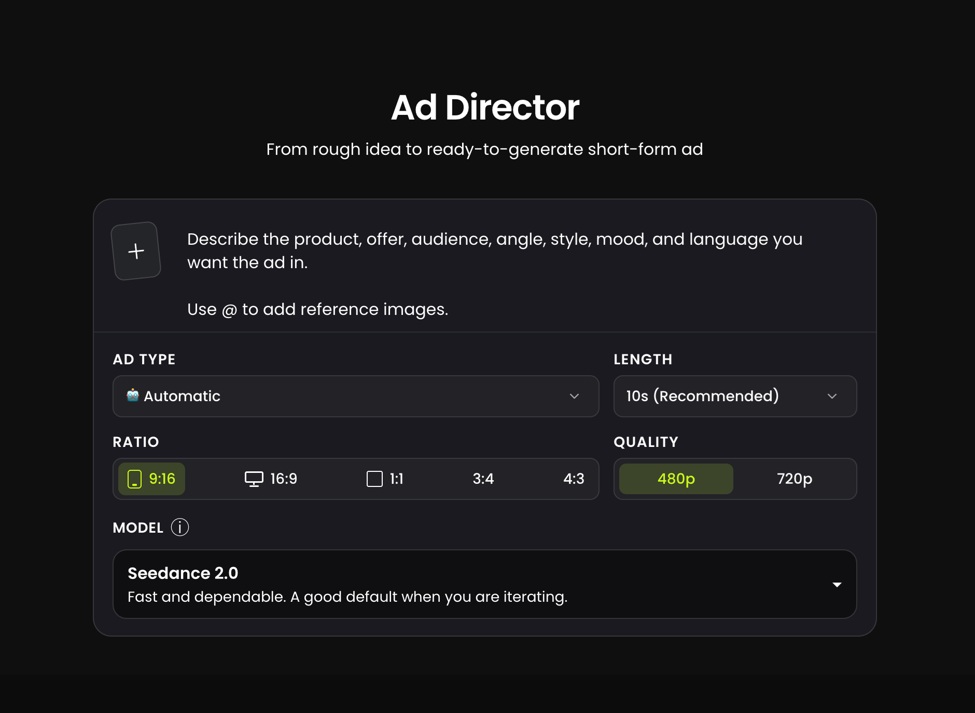
Cinema Studio is only part of what BuzzHooks offers. For instance, the Ad Director takes a different approach. You fill in the blanks on product, offer, audience, angle, style, mood, and language, and it gives you a structured outline for a short-form ad, working the process toward a finished deliverable. It’s perfect for a business that knows roughly what it wants out of an ad but would rather not set every creative boundary from a blank page.

The platform also has a massive library of templates to speed up production:

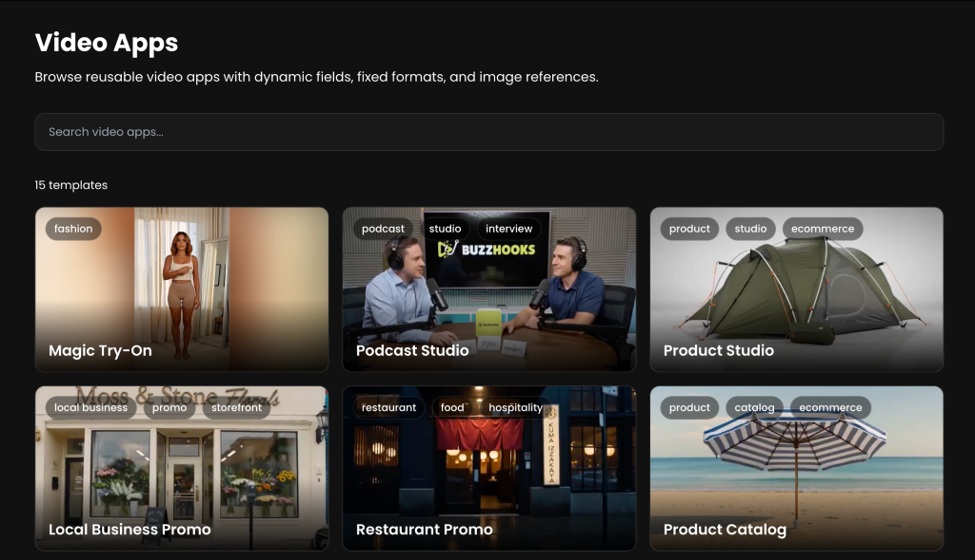
  • 15 Video Apps built around specific formats, including a Product Studio, a Podcast Studio, and a Magic Try-On app.

  • 37 Viral Scenes so you drop a product into a pre-built viral context.
  • 26 UGC Presets modeled on organic creator content.
  • 2,401 Hook Presets including left-field concepts like Mad Lab Supernova and NYC Party Bus Mascot.
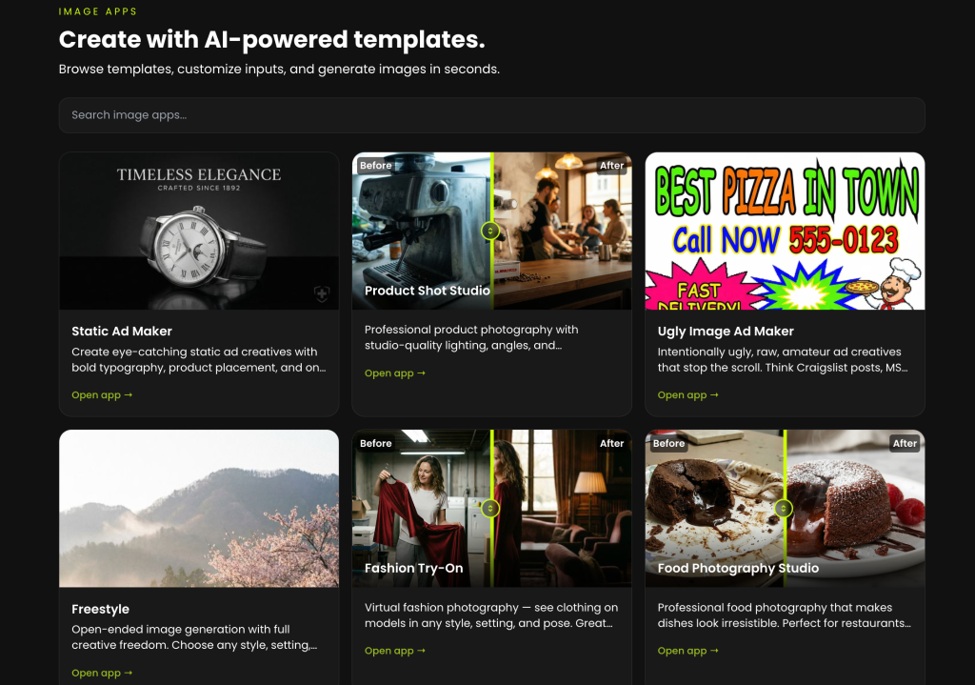
  • 10 Image Apps include a Product Shot Studio, Static Ad Maker, and Ugly Image Ad Maker for campaigns that need standard graphic assets alongside video.

The newest addition is Marketing Copilot, a chat-based assistant where you describe the video or image in plain language and attach a few product photos if relevant. The AI then uses those photos either as direct visual assets to animate or as stylistic references, putting the final creative together from there.

Can A Local Business Use Buzzhooks?

When small businesses like retailers or home service companies look at BuzzHooks, they’re not necessarily sold on the AI hype. What hooks them is the fact that they no longer need to spend time and money for a three-hour shoot just to get one commercial. Instead, they can create multiple short-form commercials for whatever they need: promoting a new menu item, launching a product, or running a seasonal campaign.

Launched in June 2026, BuzzHooks entered an AI-meets-video category that already has competition. However, it is an incredibly practical entry that will likely find its audience with small businesses looking for a cost-effective alternative to big-brand video campaigns.

BuzzHooks Frequently Asked Questions

1.   Is BuzzHooks a Good Higgsfield Alternative?

Yes, BuzzHooks is a great alternative to Higgsfield for businesses and creators whose priority is ad creation and short-form content specifically, rather than general-purpose AI video generation.

2.   What Is Cinema Studio by BuzzHooks?

Cinema Studio by BuzzHooks turns a single text prompt into a structured short-form video, broken into individual scenes that can be reviewed and edited shot by shot.

3.   Can Small Businesses Use BuzzHooks Video Ads?

Yes. BuzzHooks is built around exactly that use case, social-style ad content for businesses without an in-house creative or production team.

AI Can Transform Medicine, But It Cannot Cure Human Nature

0

Artificial intelligence is rapidly transforming medicine, creating extraordinary possibilities for diagnosing diseases, discovering drugs and personalizing healthcare.

Yet the enthusiasm surrounding AI has also produced increasingly ambitious predictions about its ability to eliminate disease.

Demis Hassabis, co-founder of Google DeepMind, captured this optimism when he suggested on “60 Minutes” that humanity could potentially cure all disease with the help of AI within the next decade. The ambition is inspiring, but the reality of medicine is considerably more complicated.

One major obstacle is that many of the diseases responsible for premature death are not simply problems that can be solved by decoding genes or designing better medicines. Human behavior plays an enormous role in determining health outcomes.

Diet, physical activity, sleep, stress management and social connection can influence whether people develop chronic illnesses and how those conditions progress. If a substantial share of disease burden is rooted in lifestyle and environment, then technological breakthroughs alone cannot eliminate it.

AI can certainly help address some of these challenges. Algorithms can analyze enormous medical datasets, identify patterns that physicians may overlook and accelerate the search for promising drug candidates.

AI-powered systems could also personalize health recommendations, monitor patients continuously and provide reminders designed to encourage healthier behavior. These capabilities could make prevention and treatment more precise and accessible.

But providing better information is not the same as changing human behavior. People routinely make choices they know may be harmful. Someone can understand the risks of smoking and continue smoking.

Another person may know that exercise and a balanced diet are beneficial but still struggle to maintain them. Human beings are influenced by habits, emotions, economic circumstances, culture, social pressures and personal preferences. AI can provide a nudge, but it cannot remove free will.

That reality helps explain why medical experts remain more cautious than some voices in the technology industry. Cardiologist Dr. Eric Topol has emphasized that medicine still lacks cures for major conditions such as diabetes, Alzheimer’s disease and heart disease.

Expecting a handful of AI-driven drugs to fundamentally transform these illnesses within five or ten years, he argues, ignores the historical pace and complexity of biomedical research. Cancer presents an even clearer example of the problem.

Bristol Myers Squibb CEO Chris Boerner has argued that AI is unlikely to cure cancer in the near term because cancer is not a single disease. It encompasses numerous diseases with different biological mechanisms, mutations and responses to treatment.

Cancer cells can evolve during therapy, meaning that even when researchers successfully attack one pathway, the disease can change. This does not make AI’s medical potential insignificant. Quite the opposite: AI could become one of the most powerful tools ever introduced into biomedical research.

It may dramatically shorten discovery cycles, improve clinical trials, identify disease earlier and help doctors make more informed decisions. Its greatest contribution, however, may be accelerating human knowledge rather than replacing it.

The future of medicine therefore requires a more balanced vision. AI can help humanity understand disease, develop better treatments and deliver more personalized care. But curing disease is not merely a computational problem. Biology remains extraordinarily complex, and human beings remain unpredictable.

The greatest medical revolution may not come from AI curing everything. It may come from AI helping doctors, researchers and individuals make better decisions—while recognizing that technology can enhance human agency, but cannot eliminate the human nature that remains at the center of health.

Young Workers Defy Fears as AI Creates 1 Million Jobs in America

0

The latest American jobs data is challenging one of the most persistent assumptions surrounding artificial intelligence: that young workers will be among the first and biggest casualties of automation.

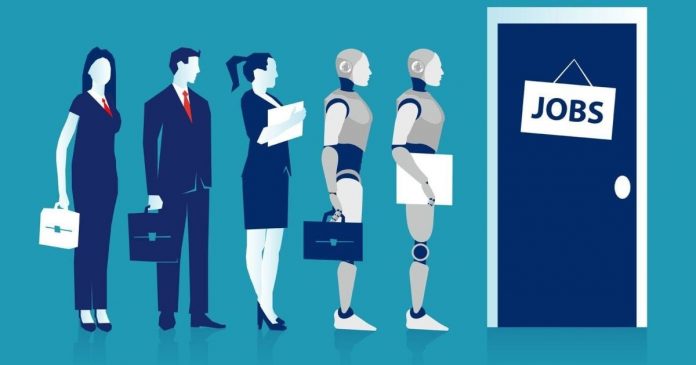
While AI is undoubtedly disrupting companies, occupations and traditional career paths, the labour market is telling a more complicated story. Rather than simply destroying jobs, AI is also creating new demand for workers with the skills needed to build, deploy and manage the technology.

America’s blockbuster jobs report last Friday offered an important indication of this shift.

Young workers, who have frequently been portrayed as particularly vulnerable to AI because they occupy many entry-level positions involving routine cognitive tasks, are holding up remarkably well.

This resilience matters because entry-level employment is often viewed as the first stage at which automation could reduce opportunities for inexperienced workers. If AI were rapidly eliminating junior jobs across the economy, youth employment should be among the clearest places to see the damage.

Instead, an AI hiring boom appears to be developing. The transformation is being driven by enormous corporate investment in artificial intelligence. Technology companies are spending heavily on computing infrastructure, data centres, chips, software and specialised talent.

Businesses outside the technology sector are also looking for employees who can incorporate AI into existing operations. The result is a new layer of economic activity around a technology that only a few years ago was largely confined to research laboratories and technology departments.

The Economist estimates that AI has so far created around 1m new jobs in America. That figure does not mean the technology has produced a net gain of one million jobs across the entire economy, nor does it suggest that disruption is harmless.

Rather, it illustrates an important economic principle: technological change can destroy particular jobs while simultaneously creating entirely new forms of employment. AI engineers, machine-learning specialists, data scientists and infrastructure experts are obvious examples.

But the employment effects extend beyond highly technical roles. Companies require people to evaluate AI outputs, manage implementation, oversee compliance, improve workflows and train employees. New opportunities are also emerging in areas such as AI safety, model evaluation, data management and human-AI collaboration.

Yet the benefits are unevenly distributed. Some workers face serious pressure as AI becomes capable of performing tasks that previously required human labour. Administrative work, customer support, basic content production, coding and other routine activities could experience substantial disruption.

Certain companies may respond by reducing headcount, while others may use AI to expand production without proportionately increasing their workforce. This makes the current employment picture less a victory over automation than an early chapter in a much larger transition.

For young workers, the central challenge will be adaptation. Their relative resilience suggests that AI has not yet closed the traditional entry points into the labour market. But the skills employers demand are changing quickly.

Workers who understand how to use AI effectively may increasingly have an advantage over those competing with it directly. The American jobs market therefore presents a more nuanced picture than the familiar narrative of machines replacing people.

AI is destroying some opportunities, transforming others and creating new ones. The crucial question is not whether artificial intelligence will change employment—it clearly will—but whether workers, educators and policymakers can adapt quickly enough to ensure that the new economy creates opportunity alongside disruption.

Canada’s Tariffs Challenge America’s Trade Leverage

0

Canada’s decision to impose retaliatory tariffs on American goods marks a significant escalation in the trade dispute between the two North American neighbours.

The measures, introduced under Prime Minister Mark Carney, are designed to match the tariffs imposed by the United States after trade negotiations broke down.

While President Donald Trump’s position is that the United States possesses overwhelming leverage because of its larger economy, Canada’s response demonstrates that economic size does not automatically translate into unlimited bargaining power.

The United States is unquestionably the larger economic power. Canada depends heavily on access to the American market, while American consumers and businesses also rely on Canadian products, energy and raw materials.

This imbalance has encouraged the belief that Washington can impose costs on Canada without suffering comparable consequences. However, international trade is rarely a one-way relationship.

Supply chains connect the two economies so deeply that disrupting Canadian exports can also create problems for American manufacturers, consumers and businesses.

Canada’s strongest advantage is the nature of its exports. The country supplies the United States with critical commodities and industrial inputs, including energy, minerals, agricultural products and manufactured components.

Some of these goods cannot be replaced immediately by alternative suppliers. Consequently, tariffs on Canadian products can raise costs for American companies that depend on Canadian resources.

In sectors where supply chains operate across the border every day, tariffs can become an additional tax on American production rather than simply a punishment directed at Canada.

Canada also has the ability to target politically sensitive American exports. Retaliatory tariffs can be structured to place pressure on industries and regions that have significant economic or political importance.

This creates a domestic constituency in the United States that may question the costs of maintaining the confrontation. American producers facing weaker demand or higher input costs could ultimately pressure Washington to reconsider its strategy.

For Canada, retaliation carries substantial risks. The Canadian economy is highly integrated with the United States, and prolonged trade restrictions could reduce exports, weaken business investment and increase prices.

Canadian companies may also struggle to find alternative markets quickly enough to compensate for lost American demand. Ottawa therefore has to balance demonstrating strength with avoiding an escalation that causes disproportionate damage to its own economy.

The dispute also highlights the importance of diversification. If Canada can expand commercial relationships with Europe, Asia and other international markets, its dependence on the United States could gradually decline.

Such diversification would not eliminate the importance of the American market, but it would give Ottawa greater freedom in future negotiations. Trade policy therefore becomes not only a question of tariffs but also a long-term strategy for economic resilience.

The broader lesson is that economic power has limits. The United States may have a larger economy and greater negotiating weight, but Canada controls resources and supply chains that are valuable to its southern neighbour. A trade war can therefore produce costs on both sides, even when one country is considerably larger.

Canada’s retaliation is an attempt to transform economic interdependence into bargaining power. Whether it succeeds will depend on how long both governments can absorb the resulting costs and whether negotiations eventually resume.

Trump may believe Washington holds all the cards, but Canada does not need to hold the strongest hand to make the American side feel the consequences of the dispute.