
DD
MM
YYYY

PAGES

DD
MM
YYYY

spot_img

PAGES

Home Blog Page 502

Cardano Community Weighs In as the Top Crypto Presale This Month Hits Whale Signal Stage

0

The Cardano community has raised its voice against Coinbase, urging the exchange to provide greater transparency on how assets are listed. This follows Coinbase CEO Brian Armstrong’s release of a “Guide to the Digital Asset Listing Process,” which claimed applications are free and merit-based but left many ADA holders dissatisfied.

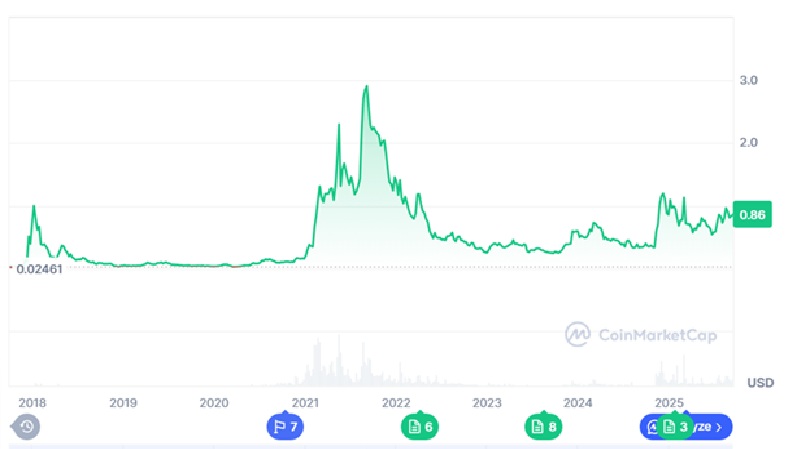
With ADA trading down 2.88% in the past 24 hours, the issue of visibility on top exchanges has become more urgent. Cardano’s highly engaged base argues that fair representation on Coinbase is critical for the blockchain’s global adoption and liquidity growth.

Meanwhile, the retail side of crypto is buzzing with a very different story. BullZilla ($BZIL) has reached Stage 3 of its presale, “404: Whale Signal Detected.” With over 25.8 billion tokens sold, $420,000+ raised, and more than 1,500 holders onboarded, BullZilla is proving that momentum-driven presales can capture attention while larger projects wrestle with institutional debates.

Cardano’s Call for Coinbase Clarity

Cardano’s demand for fairness reflects the challenges even top blockchains face when navigating centralized exchanges. Armstrong’s guide states that listings are assessed equally, but ADA holders remain unconvinced that the process provides enough clarity. Since Coinbase ranks as one of the largest U.S. trading platforms, the lack of confidence could directly affect Cardano’s retail accessibility in key markets.

This push comes at a crucial time. Cardano’s Voltaire governance upgrades and Hydra scaling initiatives are designed to secure long-term relevance, but without visible exchange support, adoption risks slowing. The call to Coinbase is not just about ADA’s price action ,  it’s about ensuring that innovation is matched by equal market exposure.
Cardano’s Market Outlook

Cardano maintains strong fundamentals: a fixed 45 billion ADA supply, low transaction fees, and one of the most decentralized staking systems in crypto. Yet the 2.88% daily dip underscores the market’s sensitivity to exchange news and regulatory uncertainty.

Despite short-term pressure, Cardano’s roadmap remains intact. The Basho scaling era and Voltaire governance phase are progressing steadily, while its grassroots community of over 1.4 million followers continues to advocate globally. Whether Coinbase responds positively could become a key moment for ADA’s U.S. market trajectory.

Whale Signal Detected: BullZilla’s Stage 3 Surge

While Cardano debates transparency, BullZilla ($BZIL) is powering through its presale with explosive momentum. Stage 3, “Whale Signal Detected,” marks a major milestone for the project’s retail-driven narrative.

BullZilla Presale Snapshot

Metric Status
Current Stage 3rd – Whale Signal Detected
Phase 1st
Current Price $0.00005908
Tokens Sold 25.8 Billion
Presale Raised $420,000+
Token Holders 1,500+
ROI (Stage 3A ? Listing $0.00527) 8,822.49%
ROI Until Stage 3A 927.47%
Upcoming Surge +11.27% (to $0.00006574)
Example Buy $1,000 = ~16.926M $BZIL

The presale’s progressive price engine ensures every new stage increases the cost per token, rewarding early participants. With lore-driven branding, supply-reducing Roar Burns, and staking through the HODL Furnace targeting 70% APY, BullZilla has quickly emerged as a top contender among meme coin launches in 2025.

Conclusion

Cardano’s fight for transparency with Coinbase highlights the tension between innovation and exchange visibility in the institutional sphere. At the same time, Bull Zilla’s presale shows how grassroots enthusiasm and whale symbolism can ignite extraordinary retail momentum.

Together, these parallel stories underscore the diversity of crypto markets: ADA focusing on governance, stability, and fairness, while BullZilla captures speculative energy with ROI projections exceeding 8,800%. In 2025, both institutional legitimacy and retail passion continue to shape the future of digital assets.

For More Information:

BZIL Official Website

Join BZIL Telegram Channel

Follow BZIL on X  (Formerly Twitter)

Frequently Asked Questions About Cardano and BullZilla Presale Momentum

Why is the Cardano community pressuring Coinbase?

They want greater clarity and fairer representation in the exchange’s asset listing process.

What stage is BullZilla’s presale currently in?

Stage 3, titled “Whale Signal Detected.”

 How much has BullZilla raised so far?

Over $420,000 in presale funds.

How many tokens have been sold in the BullZilla presale?

25.8 billion tokens.

What ROI is projected from Stage 3A to listing?

Approximately 8,822.49%.

How many holders are currently participating in BullZilla?

More than 1,500 investors.

What is the upcoming price increase for $BZIL?

An 11.27% jump in Stage 3B, raising the price to $0.00006574.

Glossary of Key Terms

  • Coinbase: Major U.S. crypto exchange.
  • Cardano (ADA): A research-first blockchain with a fixed supply and Ouroboros PoS.
  • Voltaire Era: Cardano’s governance phase enabling on-chain voting.
  • Presale: Token sale before public listing.
  • Whale: Large holder capable of moving markets.
  • Whale Signal Detected: BullZilla’s Stage 3 presale chapter.
  • ROI (Return on Investment): Percentage return relative to initial cost.
  • Listing Price: Expected market debut price.
  • Roar Burn: BullZilla’s deflationary supply burn mechanism.
  • HODL Furnace: BullZilla’s staking pool targeting high APY.

Article Summary

The Cardano community is pressing Coinbase for greater transparency in its asset listing process, following new guidance released by CEO Brian Armstrong. ADA dipped 2.88% as holders voiced concern that a lack of fair visibility could hinder adoption in the U.S. At the same time, BullZilla ($BZIL) is powering forward with its Stage 3 presale, “Whale Signal Detected.” The project has sold 25.8 billion tokens, raised $420,000+, and onboarded 1,500+ holders. With ROI projections of 8,822.49% from Stage 3A to its listing price of $0.00527 ,  and an imminent 11.27% price jump in Stage 3B ,  BullZilla is fast becoming one of 2025’s most talked-about meme coin launches.

Disclaimer

The article is informative in nature and ought not to be read as a financial or investment advice. Cryptocurrencies are unstable and risky, and one may lose the entire invested capital. It is recommended that the readers conduct their own research and seek the advice of a licensed financial advisor before making any decisions on investment. The author or publisher have no financial role to take in the loss that may occur due to dependence on this content.

Nigeria’s Inflation Falls for Fifth Month in August, Raising Pressure on CBN to Cut Rates

0

Nigeria’s headline inflation rate eased for the fifth consecutive month in August 2025, dropping to 20.12% from 21.88% in July, according to the latest figures released Monday by the National Bureau of Statistics (NBS).

On a month-on-month basis, headline inflation stood at 0.74% in August, reflecting a moderation compared to previous months. The NBS explained that this means the rate of increase in the average price level was lower in August than in July.

“This shows that the Headline inflation rate (year-on-year basis) decreased in August 2025 compared to the same month in the preceding year (i.e., August 2024), though with a different base year, November 2009 = 100,” the agency stated.

The percentage change in the average Consumer Price Index (CPI) for the twelve months ending August 2025 over the previous twelve-month period was 24.66%, showing a 6.6% decrease compared to 31.26% recorded in August 2024.

Urban vs Rural Inflation

Urban inflation in August 2025 stood at 19.75% year-on-year, down sharply from 34.58% in August 2024. On a month-to-month basis, it slowed to 0.49%, compared to 1.86% in July. The twelve-month urban inflation average came in at 25.81%, down from 33.44% in August 2024.

Rural inflation also showed relief, dropping to 20.28% year-on-year, compared to 29.95% in August 2024. On a monthly basis, rural inflation moderated to 1.38%, from 2.30% in July. Its twelve-month average fell to 23.07%, down from 29.32% in August 2024.

Food Inflation

Food inflation, which has been the most painful for households, slowed to 21.87% year-on-year in August 2025, compared to a staggering 37.52% in August 2024. The NBS attributed the decline partly to base-year changes but also to easing prices of staples such as imported and local rice, sorghum, millet, maize flour, semolina, and soya milk.

Month-to-month food inflation was 1.65% in August, down from 3.12% in July. The average annual food inflation stood at 25.75%, lower than the 36.99% recorded in August 2024.

Core Inflation

Core inflation, which excludes volatile agricultural products and energy, declined to 20.33% in August 2025 year-on-year, from 27.58% in August 2024. However, on a month-to-month basis, core inflation picked up to 1.43% from 0.97% in July.

The twelve-month average core inflation rate was 23.04%, down from 25.18% in August 2024.

However, Nigerians say that despite easing inflation on paper, prices of essential goods remain painfully high. This backdrop, coupled with questions surrounding the credibility of the NBS data, has made it difficult for many to believe that the inflation rate has been in decline.

Economists have expressed concern that unless structural challenges such as power shortages, logistics bottlenecks, and import dependency are addressed, the benefits of lower inflation and interest rates may not reach households or small businesses.

What This Should Mean for MPR

The Governor of the Central Bank of Nigeria (CBN), Olayemi Cardoso, has already hinted at future interest rate cuts if the trend continues. Speaking at the European Business Chamber (Eurocham Nigeria) C-Level Forum in Lagos, Cardoso pointed to easing inflation and more efficient capital allocation as reasons to expect downward pressure on lending rates, currently hovering between 32% and 36% on commercial loans.

At its 301st Monetary Policy Committee (MPC) meeting in July, the CBN maintained the Monetary Policy Rate (MPR) at 27.5%, signaling caution despite improving macroeconomic indicators.

But with inflation now falling for five consecutive months, expectations are mounting that the central bank will be compelled to loosen monetary policy. Business leaders and economists have warned that high borrowing costs are stifling growth, discouraging investment, and pushing small and medium-sized enterprises—seen as engines of job creation—into distress.

Some analysts suggest that if the downward trend in inflation persists, the CBN could reduce rates as early as the first quarter of 2026. A rate cut would ease financing costs for businesses and potentially revive the sluggish manufacturing and industrial sectors. Lower rates could also stimulate consumer spending, helping boost growth.

CBN MPC Member Flags Rising Debt Despite Reforms, Projects Naira to Strengthen to N1400/$1 by Year-End

0

A member of the Central Bank of Nigeria’s Monetary Policy Committee (MPC), Murtala Sabo Sagagi, has expressed concern over the ballooning country’s debt stock despite key reforms such as fuel subsidy removal and foreign exchange liberalization, deepening concern over Nigeria’s fiscal health.

In his personal statement released after the MPC’s 301st meeting and published on the CBN’s website on Sunday, Sagagi lamented that the Federal Government has maintained a “path of unfettered spending” even as revenues from the reforms were expected to ease fiscal pressure.

“Even with the removal of fuel subsidy and liberalization of the exchange rates, the appetite for unfettered spending by the government has grown even stronger,” Sagagi wrote.

Data from the Debt Management Office (DMO) underscores the point. Nigeria’s public debt climbed from N144.67 trillion as of December 31, 2024, to N149.39 trillion by March 31, 2025 — an increase of more than N4.7 trillion in just three months.

Currency Outlook

Sagagi, however, struck a more optimistic tone on the foreign exchange market. He projected that the naira, which closed at N1,503.5/$1 in the official market on Friday, would appreciate to N1400/$1 by December 2025.

“The recent increase in daily crude oil production, new inflows of capital and improved balance of payment, the naira is likely to keep appreciating to reach the projected N1400/US$1 before the end of the year,” he said.

Notably, this is a revision of his earlier forecast. After the 300th MPC meeting, Sagagi had projected the naira would firm to N1,450/$1 by year-end. In that statement, he stressed the currency’s undervaluation but expected a gradual rebound.

Call for Sustained Monetary Tightening

Another MPC member quoted by Naira Metrics, Lamido Abubakar Yuguda, cautioned that while growth indicators show resilience, the CBN must not ease its stance prematurely.

“MPC should sustain its focus on fighting inflation by maintaining the current tight monetary policy stance until inflation declines to a more reasonable level,” Yuguda stated.

He pointed to rebased GDP data showing 3.38 percent growth in 2024 and a steady rise in the composite Purchasing Managers’ Index (PMI), which reached 52.3 in June 2025 from 52.1 in May. According to him, sectors such as agriculture, industry, and services are all recording increased activity.

“This is further evidence that despite the tight monetary conditions, the Nigerian economy is growing modestly, and domestic investment is responding positively to the increasing certainty engendered by a declining inflation rate and a more stable exchange rate,” Yuguda added.

Debt Projections Signal Fiscal Strain

Still, the fiscal outlook remains concerning. A report by CSL Stockbrokers Limited, a subsidiary of FCMB Group Plc, warned that Nigeria’s debt could hit N160.6 trillion by year-end. The projection assumes the Federal Government may borrow an additional N9.3 trillion or more in the second half of 2025 to plug its fiscal deficit, potentially lifting the debt-to-GDP ratio to around 50.2 percent of the pre-rebased GDP.

This deepening reliance on borrowing has amplified fears that reforms hailed as game-changers — subsidy removal and FX liberalization — have not been matched with the fiscal discipline needed to rein in debt growth.

Echoes of Past Debt Cycles

Nigeria’s current debt dilemma is not without precedent. In the late 1980s and early 1990s, successive governments adopted structural adjustment reforms under pressure from international lenders, promising fiscal restraint and liberalized markets. Yet, a pattern of rising oil revenues fueling government spending without adequate savings led to ballooning debts that later required external restructuring.

The early 2000s offered another lesson: despite the landmark $18 billion Paris Club debt relief in 2005, which was supposed to reset Nigeria’s fiscal trajectory, public debt began climbing again within a decade. Analysts often describe this as a “boom-borrow-bust” cycle where windfalls from oil or reforms are quickly overshadowed by unchecked government spending.

Today’s scenario bears resemblance. Even after subsidy removal — a politically difficult reform — and exchange rate unification, borrowing has accelerated, raising fears that gains may again be squandered. Economists have argued that without strict fiscal discipline, Nigeria risks repeating its history of reform without consolidation, where temporary relief is overwhelmed by long-term debt accumulation.

Analysts have repeatedly warned that a stronger naira projection does little to mask Nigeria’s fiscal vulnerabilities. While the exchange rate has shown signs of stability, the debt trajectory signals the government is leaning heavily on borrowing rather than fiscal consolidation. This creates a policy contradiction: monetary authorities are tightening to fight inflation and stabilize the naira, while fiscal authorities continue aggressive deficit spending.

The coming months are expected to test whether currency appreciation and modest output growth can offset the drag from rising debt service costs.

Nigerian Fintech Kredete Raises $22M in Series A Funding to Expand Credit-Building Infrastructure

0

Kredete, a Nigerian financial technology platform that helps African immigrants in the diaspora build credit through instant international money transfers, has raised $22M in series A funding.

The funding was led by AfricInvest Group via their Cathay AfricInvest Innovation Fund and Financial Inclusion Vehicle (FIVE), Partech, and Polymorphic Capital.

This milestone allows Kredete to expand its credit-building infrastructure and stablecoin-powered transfers across 40+ African countries.

Speaking on the funds raised, the company’s founder and CEO Adeola Adedewe via a LinkedIn post expressed excitement about the new milestone. He noted that with the funds, the company is poised to scale its stablecoin infrastructure to facilitate global money movement for Africans worldwide.

Part of his post reads,

Since inception, our mission has been simple: help millions of African immigrants stay connected to home whether by sending money to family, paying with cards, or saving securely. This raise fuels our next chapter as we expand our stablecoin infrastructure to power global money movement for Africans everywhere unlocking access, credit, and opportunity across 40+ countries. To our team, partners, and investors thank you. We’re just getting started.”

This latest round brings Kredete’s total funding to $24.75 million, which will finance the company’s expansion into Canada, the United Kingdom, and key European markets.

Founded in 2023 by Adeola Adedewe, Kredete was built by African immigrants for African immigrants who understand the everyday challenges of building credit, sending money back home, and gaining real financial access across borders. The firm has been on a mission to help African immigrants build credit and access better financial services through stablecoin payments and responsible remittance infrastructure.

Since its launch, Kredete has reached over 700,000 monthly users, facilitated $500 million in remittances, and helped raise users’ U.S. credit scores by an average of 58 points. The company combines international money transfers with a proprietary credit-building engine, enabling users to send money to over 30 African countries while improving their credit history in the U.S. and beyond.

It has also built API-based infrastructure to help businesses make secure and affordable cross-border payments into Africa, leveraging modern payment rails and stablecoin technology.

Notably, Kredete is doubling down on its mission to make credit universally accessible for Africans by expanding its credit-building infrastructure. The company is introducing new features like rent reporting, credit-linked savings plans, and responsible goal-based loans. These features are designed for thin-file or no-file immigrants who have historically been excluded from traditional credit systems.

At the core of this expansion is Africa’s first stablecoin-backed credit card, set to roll out across 41+ African countries, enabling users to spend seamlessly, build credit, and avoid costly foreign exchange fees. To complement this, Kredete is launching interest-bearing USD and EUR accounts, empowering Africans globally to preserve value, earn yield, and hedge against local currency volatility.

On the infrastructure side, Kredete is building the continent’s largest aggregation layer of banks and wallets  giving businesses a single API to enable secure, real-time, and affordable payouts into Africa. With this foundation, Kredete is redefining cross-border finance helping Africans everywhere send, spend, save, and build credit on one powerful platform.

The fintech is on a mission to give African immigrants the financial power, trust, and tools they need to thrive globally.

Trump’s Call to End Quarterly Earnings Reports Sparks Debate Over Future of Market Transparency

0

President Donald Trump floated the idea Monday of companies no longer providing earnings reports on a quarterly basis and switching to semiannual instead, reviving a debate that has simmered for years on Wall Street.

In a Truth Social post, Trump said the idea is “subject to SEC approval” and would “save money, and allow managers to focus on properly running their companies.”

“Did you ever hear the statement that, ‘China has a 50 to 100 year view on management of a company, whereas we run our companies on a quarterly basis??? Not good!!!’” Trump said.

During his first term, Trump had asked the Securities and Exchange Commission (SEC) to study the issue, but no recommendations came of the matter, according to CNBC.

The wisdom of quarterly reports has long been under scrutiny. In a 2018 op-ed piece for The Wall Street Journal, noted by CNBC, Berkshire Hathaway’s Warren Buffett and JPMorgan Chase CEO Jamie Dimon advocated doing away with quarterly guidance, though not earnings reports.

“In our experience, quarterly earnings guidance often leads to an unhealthy focus on short-term profits at the expense of long-term strategy, growth and sustainability,” Buffett and Dimon wrote.

Currently, U.S. regulations require companies to report earnings every quarter, though providing forecasts is voluntary. Those rules could be changed either by the SEC or by Congress. Logistically, the move would not require congressional approval, but rather a majority vote on the SEC, where Republicans currently hold a 3-1 majority with one open seat.

The process could take six to 12 months, said Sarah Bianchi, chief strategist of international political affairs and public policy at Evercore ISI.

“Administrations have to varying degrees given policy steers to the SEC, and with Trump’s directive this is now something that has to be taken seriously as a possibility,” Bianchi, a former U.S. deputy trade representative, said in a note. “However, the SEC has also historically been able to operate with some measure of independence.”

SEC Chair Paul Atkins has not spoken on the issue.

Bianchi noted that “if the effort at the SEC to reconsider quarterly reporting gains steam, it could also prompt conversations around when and how companies issue guidance and communicate with investors that would have important ramifications for public markets.”

Supporters of the current quarterly system argue that it provides investors with timely updates and transparency.

“When you weigh this out and put it on a whiteboard, the pros of quarterly reporting outweigh the cons,” said Art Hogan, chief market strategist at B Riley Wealth Management. “Having to wait six months for official results, I just think would cause more difficulties than it would add benefits.”

While corporate executives have faced criticism for reporting misleading earnings, the use of generally accepted accounting principles (GAAP) has provided guardrails for standardization, making U.S. reporting among the most transparent and reliable in the world.

Despite Trump’s comparison to China, companies there face reporting requirements similar to those in the U.S., if not more stringent. Chinese firms must file quarterly earnings reports as well as semiannual and annual reports. Companies listed on the Hong Kong exchange, however, only report every six months.

Trump’s proposal would align U.S. practice more closely with the U.K. and European Union, where companies are required to file semiannually but can issue quarterly reports if they choose. But Hogan dismissed the comparison.

“How many companies in the European markets have trillion-dollar market caps and are growing revenues at 60% a year or have gross margins that are north of 50%?” he asked. “The investor is better suited to having more information than less or more frequent information.”

Earlier this year, Norway’s sovereign wealth fund proposed switching to semiannual reporting, reasoning that lengthening the timeframe would allow companies to focus on the longer term. The Long-Term Stock Exchange trading platform has also supported less frequent reporting.

Pros and Cons of Semiannual vs. Quarterly Reporting

If the U.S. were to adopt semiannual reporting, as Trump suggested, the structure of the markets could shift in several ways.

Under semiannual reporting, companies might gain breathing room to focus on strategy and innovation rather than chasing quarterly targets. Advocates say this could curb the tendency toward “earnings management,” where executives cut costs or delay investments simply to meet Wall Street expectations.

More breathing room might also help companies in industries with longer product cycles — such as pharmaceuticals, semiconductors, and aerospace — communicate performance in a way that reflects long-term value creation rather than short-term volatility.

But there are risks. Investors accustomed to a steady flow of information would face longer gaps between updates, potentially leading to higher market volatility when reports finally arrive. With fewer official updates, the market might rely more heavily on alternative signals such as analyst notes, leaks, or management commentary at conferences, which could privilege institutional investors over retail ones. Critics warn that less frequent reporting could make markets less efficient and increase the risk of mispricing stocks.

By contrast, under quarterly reporting, the U.S. maintains its reputation for transparency and timely disclosure, helping investors price risk with precision. While the system can pressure companies to chase short-term profits, quarterly updates reduce uncertainty, especially in fast-moving industries like tech and e-commerce. Investors argue that the frequency helps U.S. capital markets remain the deepest and most liquid in the world.

Globally, the U.S. would be sending a signal if it pivoted toward semiannual reporting. Such a shift could encourage other markets to reconsider their own rules. But skeptics note that many of the largest, most innovative companies in the world are U.S.-based precisely because of the confidence fostered by frequent, standardized disclosure.

As Bianchi put it, the question is not just about saving companies money or aligning with global peers, but about how the very nature of communication between companies and investors could evolve — with long-term consequences for market trust and efficiency.