DD
MM
YYYY

PAGES

DD
MM
YYYY

spot_img

PAGES

Home Blog Page 5039

Nigerian Executives Of Fintech Firm, Ping Express Jailed Over $160m For Money Laundering Scam

0

A texas-based remittance company, Ping Express has pleaded guilty in the United States to money laundering scam, after sending over $160 million to Nigeria in suspicious transactions over a period of three years, some of which the proceeds were disclosed to be from online romance scams.

According to a statement released by the U.S attorney for the Northern District of Texas, Chad E. Meachan, he disclosed that the firm admitted that it failed to maintain an effective anti-money laundering program and they operated without a license in at least 5 U.S states.

The CEO of Ping Express Anslem Oshianebe and the COO Opeyemi Odeyale pleaded guilty to failing to maintain an effective anti-money laundering program. They both received 27-month prison sentences according to U.S legal filings.

Ping Express IT/Business Development Manager, Aleoghena Okhumale who pleaded guilty to knowingly transmitting illegal funds, received a prison sentence of 42 months.

The U.S Department of Justice disclosed that Ping Express’s anti-money laundering policy claimed that it limited first-time customer transactions to $3,000 and monthly transactions to $4,500.

The company also admitted in the court that it allowed more than 1,500 customers to violate these rules. Ping Express also admitted that it failed to seek sufficient details about the sources or purposes of the funds it helped to transmit, or the customers initiating the transmissions.

By law, Ping Express was supposed to report any suspicious transactions to regulators, but according to the U.S court filings, the fintech company violated the law by failing to make a single report on anti-money laundering in 3 years of operation.

The company disclosed that it has a software that could detect and deter transmissions initiated in “unlicensed” states, but it revealed that the software did not function. This money laundering scam and transmitting business in States where it was not licensed in the U.S by Ping Express has spelled doom for not just the executives of the company who risk jail terms, but also the company as a whole.

The company faces five years of probation and a fine of up to $500,000. The sentencing of these offenders has been set for December 19, 2022.

Ping Express’s experience should be a wake-up call to other fintech companies to take their anti-money laundering law seriously and also, they should not hesitate to report any suspicious transactions on their platform to the relevant authorities.

Fintechs today are constantly exposed to the risk of money laundering and much more. In a bid to curb such risk, one Fintech solution that has great potential to help fight money laundering is machine learning.

This program uses algorithms to analyze information, make decisions, and learn from those decisions. Machine Learning can modify its code without human oversight, so it can make faster and more accurate decisions.

This machine learning technology has been proven to review money laundering and identify obscure predictive variables that often go unnoticed by data scientists.

It might interest you to know that some fintech start-ups continue to underestimate the reach of compliance regulations which is very risky. Fintech firms must ensure to be constantly committed to preventing their company from persons seeking to launder proceeds from criminal activity or risk a jail term and fine.

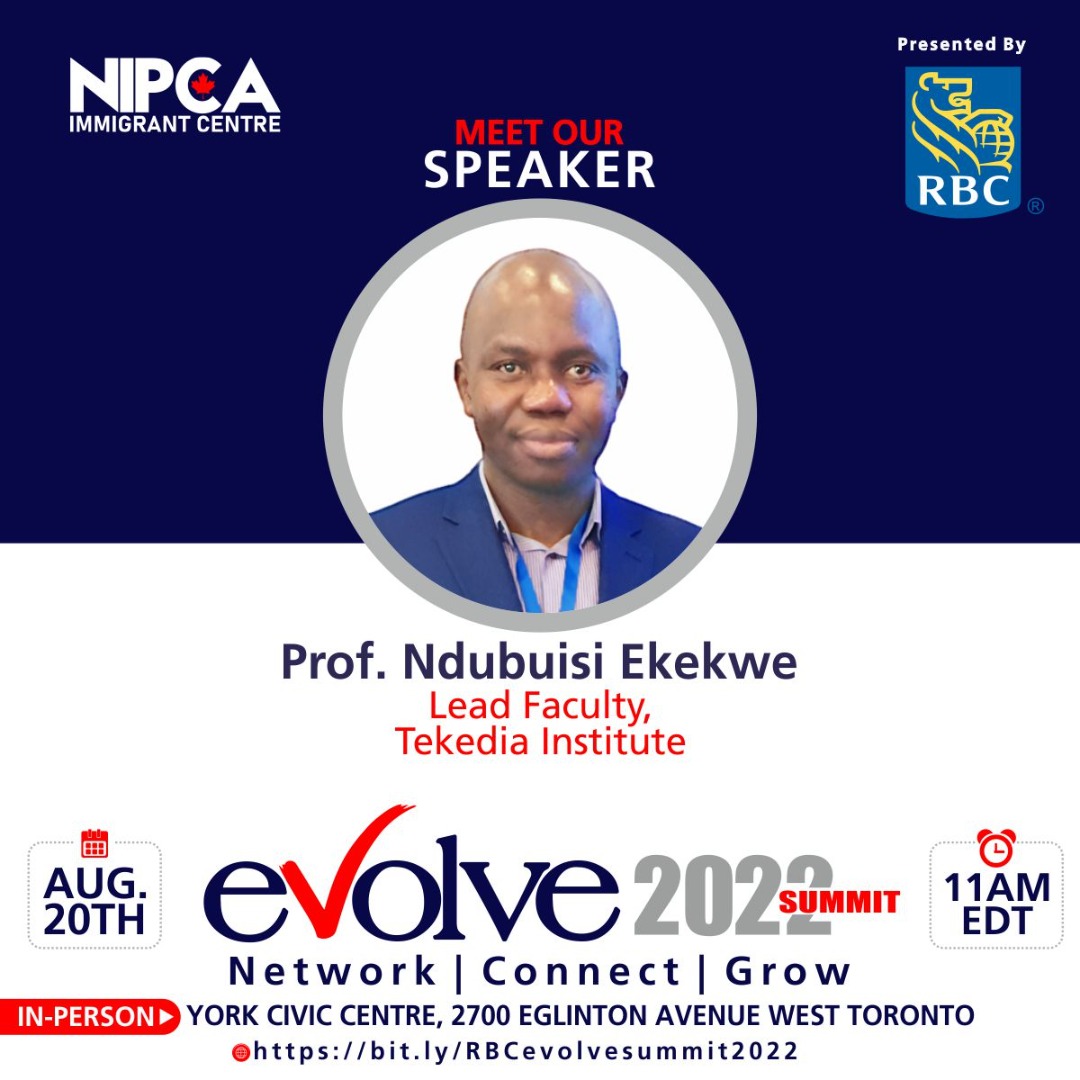
Ndubuisi Ekekwe To Keynote eVolve Summit 2022 in Toronto

0

Hello Toronto…..it is going to be super-amazing. Thank you Royal Bank of Canada. Thank you NIPCA Immigrant Centre. I am truly honoured for your invitation to keynote eVolve Summit 2022. More details coming…this is to confirm that I have accepted to speak in this event (Aug 20) and please register  .

eVolve Summit is an annual conference for professionals in Canada to share their knowledge, learn, and empower each other.

This year’s summit which is themed “The Journey” will focus on future-readiness for professionals in their respective career paths?by driving awareness of evolving technology, and the need to elevate our platforms, methods, and resources to rise to the challenges of the future.

eVolve Summit 2022 will be presented as a hybrid of in-person & virtual. We will be creating unique experience for all those attending physically as well as streaming across eight time zones to allow more professionals participate globally.

Prof. Ndubuisi Ekekwe invented and patented a robotic system which the United States Government acquired assignee rights.

Prof. Ekekwe holds two doctoral and four master’s degrees including a PhD in engineering from Johns Hopkins University, USA. He earned an undergraduate degree from FUT Owerri where he graduated as his class best student. While in Analog Devices Corp, he co-designed an accelerometer for the iPhone.

He is a recipient of IGI Global “Book of the Year” award, a TED Fellow, IBM Global Entrepreneur, World Economic Forum Young Global Leader and Lead Faculty, Tekedia Institute.

The RBC evolve Summit is a transformational event that promises:

  •  Professional networking
  •  Thought leadership sessions
  •  Tech industry insights
  •  Job referrals & sponsorships
  •  Career opportunities

Register here https://nipca.ca/evolvesummit and connect with Prof. Ekekwe at evolve Summit.

LinkedIn Summary

The Royal Bank of Canada eVolve Summit is a transformational event that promises many amazing things. Yours truly will keynote the 2022 event on Aug 20 . I invite you to join us in Toronto. I will share the American translation and the vision that anything is possible in life. Yes, a village boy from  Ovim creates a technology which the American government likes, and seeks  rights to use; I approved and gave those rights.

Why not? In their generosity, they offer you an unbounded and unconstrained future, putting you on a path to ascension. But it does not have to be only America, or Canada, or the UK. Yes, we must write of such translations in Kenya, Nigeria, Gabon and more.

I invite you to register here https://nipca.ca/evolvesummit .

The Africa We Want: Reflections on e-government services in Rwanda

0

When I first ventured into this unfamiliar territory of e-governance, I must admit that I hadn’t really heard about Rwanda. This adventure into the public administration space as a marketing Professor with research interests in African Entrepreneurship and its intersections with Marketing is thanks to two colleagues at the now AACSB accredited university of Sharjah in the United Arab Emirates.

That debut article is entitled “An initial assessment of e-governance and public sector marketing in the UAE” published about 15 years ago in 2013, and yours truly, it was just that – an initial assessment! Looking back to a decade and a half, it is my intention to provide not just my readers, but also myself, some key highlights from that article prior to going into the business of the day, which is all about “e-governance in Rwanda” – excerpted below:

The 2010 UN e-Government survey described [the process] as a “citizen centric practice” – analogous to’ e-commerce’, which allows businesses to transact with each other more efficiently (B2B) and brings customers closer to businesses (B2C) [with the view to making] interactions more friendly, convenient, transparent, and inexpensive at three distinct levels, between government and citizens (G2C); government and business enterprises (G2B); and government and government (G2G) (e.g., inter-agency relationships).

“… [the key message for] public administration [is on becoming more] transparent, faster and accountable [meeting] societal needs and expectations through efficient public services and effective interaction between the people, businesses and government [i.e., through what is now generally accepted as] public sector marketing.”

The snippets from that non-African context carry on thus:

“…We can quite easily notice three key benefits [of e-government] – accessibility, convenience and cost-saving […] a ‘one-stop’ gateway, opening up government websites to the public in order to facilitate the provision of a variety of services to its citizens.”

Come in Rwanda – what’s the story?

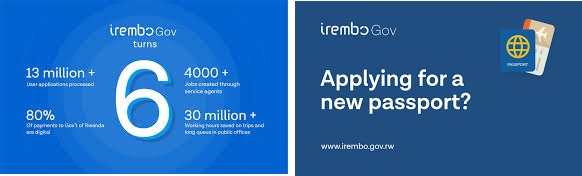
The Irembo e-government services cover key areas from family, through identity, land administration, policing, health and education, to museums, governance, transport and museums.

In all these, however, and obviously nothing to do with rankings, but health, identity, and museums, stand out for obvious reasons. In terms of health, that sector has been acknowledged as one of the best in Africa. For identity, post the 1994 genocide and the kwibuka, no Rwandan is identified based on ethnicity.

Building on this de-ethnicisation, the Genocide Memorials dotted across the country, demonstrate the coming of age of museums management in the country. Drilling down further, the following summary might be useful those unfamiliar with what Rwanda has on offer as the acclaimed “first world” of the “developing world”.

In no particular order, the e-government services cut across:

  • Family – notably certificate of residence; certificate of genocide survivors; certificate of “being single”; and certificate of “cohabitation”.
  • Health – notably the Community Based Health Insurance (Mutuelle de Sante).
  • Education – notably the application for equating foreign qualifications.
  • Governance – notably NGO registrations.
  • Land – notably e-payment services.
  • Police – notably motor vehicle inspection, driving license exam results, and renewal of driving licenses.
  • Immigration/Emigration – notably e-passport application processes.
  • Identification – notably certificate of “full identity”, nationality, and “being alive”.
  • Transport – notably transport authorisation – something that was especially demonstrated at the recent CHOGM event.

So, there you go, Irembo.Gov to the world! As we aspire to bringing the narrative of the “Africa we Want” narrative to fruition, it is my sincere hope that Africa (academics, policy-makers and other key stakeholders) are actually watching, and learning, from a well-established and articulated sibling, which also currently holds the revered office of the Commonwealth Chair-in-Office.

All said and done, it is my heartfelt hope that my peers in the “academe” begin to see the value of, not only “tasking”, but also challenging and nurturing students to “take on” this discourse to the next level through research.


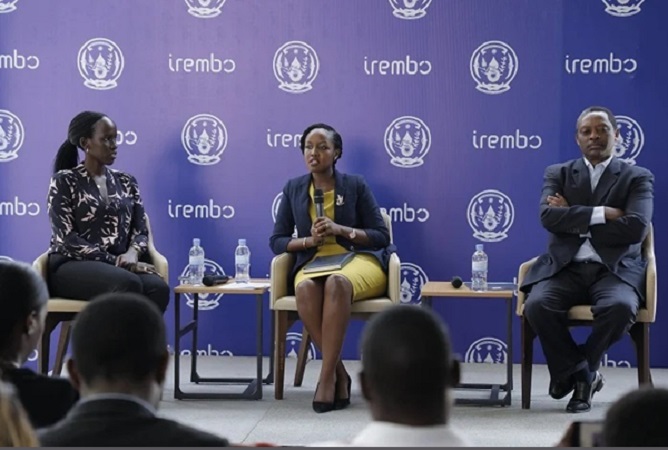
Featured photo: The Direct General of Irembo on the left, Minister of ICT and Innovation, and the Minister of Local Government on the right, during the talk show with journalists at the launch programme of Irembo.


Nnamdi O. Madichie is a Professor of Marketing & Entrepreneurship, University of Kigali, Rwanda

Human-Centered Product Design At Tekedia Institute

0

From Google California, Dr. Obinna Anya, on Aug 2, will be live on Tekedia Mini-MBA to teach “human-centered product design”; please take note. Come and learn #design which is centered around humans. Design wins markets because every great company has a great product.  To join the next edition of Tekedia Mini-MBA which begins Sept 12, go here .

Between Strategy, Popularity and Aggressiveness: How the Electioneering toward the 2023 Presidential Race is Unfolding

0

The Nigerian political terrain is being enlivened with motley episodes of theatrics and rhetoric that unearth and bolster on a quotidian basis toward the 2023 presidential election. From Osibanjo’s Judas-like genuflection to Obi’s dastardly party-defection and from the  Jagaban’s haughty acclamation of “emi lo kan”, to  Lawan’s disillusionment with the consensus candidate theory, the Nigerian electorates have been observing the political atmosphere with a normative faculty that predates the extant dispensation.

Furthermore, there is a bourgeoning force from the current political awakening in the youth faction that is curiously spicing up the whole scenery – it is a fine social awareness brewed from many years of untold hardship. In a previous article, I dissect the current political wave from a dialectic and critical sociology point of view and I observe that in connection with the defunct #endsars movement, the ongoing #get-your-pvc campaign across the social media platforms is snowballing like the Hermes winged feet. Never before in the history of Nigerian politics have the Nigerian youth characterize this much political consciousness. But still much thanks to the digital technology, a compelling force in modern democracy that the youth have largely enculturated themselves with.

From the updated statistics of the Nigerian registered voters by the Independent National Electoral Commission (INEC) published at Nairametrics, it is evident and interesting to note how the young population is aggressively positioning itself as a force to reckon with in the nation’s politics. About 9 million Nigerians have been newly registered and certified eligible voters adding to the voters list which stood at 84 Million in 2019. From the data, 6 million out of the new 8.6 million registrations were done by the youth; the youth currently accounts for 74 percent of the voters list with ages between 18 and 34 years. The figures are still adding up since the indefinite extension of the Continuous Voters Registration’s deadline on June 27. ‘’it’s the election of the youth’’ the INEC chairman, Mahmood Yakub declares.

The sentiment of the Nigerian youth is palpable and intelligible too. For many of the young electorates, the problem with Nigeria is a leadership paralysis invariably recycled by the same old political characters that have been ruling the nation since independence in 1960. Thus, the youth want direly the breaking of the gerontocracy jinx; they want a fresh perspective, a youthful and vibrant leadership that will reignite the good fate of the nation and bring hope to the common man with the required agility.

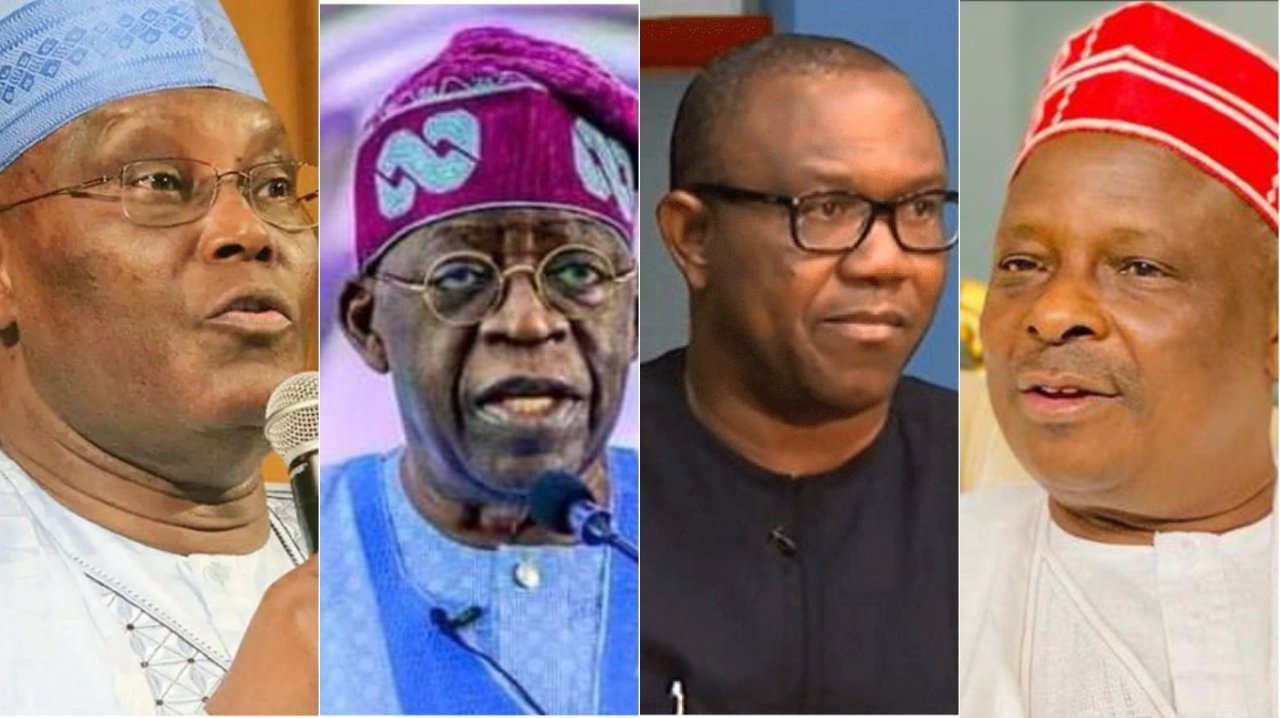
Peter Obi, the flag bearer of the labour party and youngest of the three major presidential candidates is highly favoured among the Nigerian youth partly because of his relative youthfulness and partly because of his apparent enthusiasm in articulating his political ideas. Data from Google trends analyzed by Ripples Nigeria reveals Obi is one of the most searched and talked about politicians on the social media with most of the searches coming from the south.

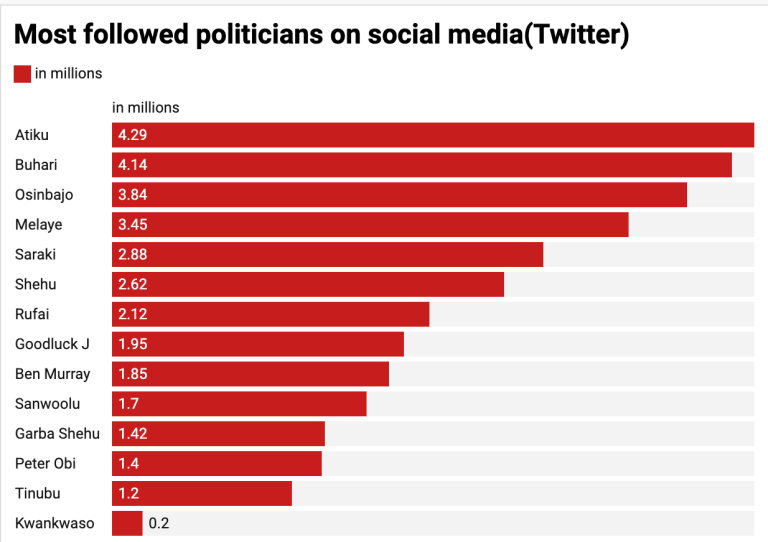
Statistics based on followership on Twitter, the most widely used medium for campaign, puts Obi followership strength at 1.4 Million, though considerably below Atiku’s 4.2 Million and a little above Tinubu’s 1.2 Million. However, Obi’s social media presence is said to be growing rapidly and it’s added 357 thousand new followers in June with the #i-am-obidient campaign gathering momentum daily on the internet.

The popularity of Peter Obi among the Nigerian youth and on the social media also recalls the Machiavellian golden rule of how civil principalities are established through the popular platform of the people. According to Niccolo Machiavelli, ‘’the people only wants to not be oppressed, hence they tend to favour passionately the prince that appeal to that sentiment. Furthermore, the prince who gets the favour of the people has much less difficulty maintaining his position since the people’s demand is simple and righteous’’. Since the fear of many Nigerian youths is simply not to allow the same old politicians to continue to govern the affairs of the nation, Obi’s candidacy stands striking among this demography, and he seems to be the least agitated among the three major contenders in the presidential race.

However, it must be stated, the alternative platform to power which is the elitist route. This is a platform where Obi seems to be the least strong compared to Bola Ahmed Tinubu and former vice president, Atiku Abubarka. Tinubu’s membership of the ruling party and his self-built political network provides his candidacy with a great leverage. Among the elite, fortune is determined not by popular ideology or by public sentiment but by one’s ability to reconcile vested interests which is a difficult affair in real politics. Thus, according to Machiavelli, seeking power through the assistance of the nobles create a much too difficult terrain to make quick decisions since “one cannot by fair dealing and without causing injuries to others satisfy the elites”.
The dilemma of the elitist platform played out twice during the All Progressives Congress’ electioneering. The first great indecision was in the party’s pre-primaries which agitated Tinubu and almost thwarted his long-term political ambition with the debate over south zoning and the consensus candidate theory. Hence, his “emi lo kan” coinage. Following Tinubu’s trojan-horse victory within the party, the second indecision appears in the post-primaries with a new debate on the selection rule for a running mate. After series of consultation and sending of tentative name to the INEC, the party flag bearer eventually selected his running mate, former Governor Kasim Shettima of Bornu state, which arrived at a much less desired muslim-muslim ticket for the party.

Chief Wale Owu, a member of the APC described the muslim-muslim candidacy as ‘’bold, strategic and politically expedient’’ while speaking in voices with Edmund Obilo last Saturday on splash fm 105.5. According to the progressives’ apologist, the muslim-muslim ticket may not be politically correct to some Nigerians, but it is politically expedient to the current realities of the APC.

The great indecision is not restricted to the progressives. There are also conspiracy theories about how some elite members of the opposition party, Peoples Democratic Party, at the regional level in the southwest have demonstrated indifference or half-hearted support to party members in the presidential campaigns due to a fear of being overhauled or shortchanged in their states by the ruling party, especially after witnessing the APC’s clean sweep in Ekiti. However, the recent victory of the PDP in Osun State should allay this fear.

Whether taking the elite way or the popular route in the quest for power, the rational politician seek a thorough understanding of the key stakeholders involved and how he could best appeal to their sentiments. When he reaches such awakening, he swings into action with bold moves.