DD
MM
YYYY

PAGES

DD
MM
YYYY

spot_img

PAGES

Home Blog Page 5046

Flutterwave Accounts Frozen in Kenya Over Fraud, Money Laundering Allegations

1

Months after Nigerian investigative journalist David Hundeyin published a story accusing Flutterwave, Africa’s largest fintech and its CEO Gbenga Agboola (GB), of gross malpractice, the payment company is in the news again for the wrong reasons.

Flutterwave has been indicted by a court in Kenya alongside others for money laundering, Kenyan news outlet, The Star, reports.

The report said the High court has frozen 56 bank accounts holding a whopping Sh7 billion suspected to have been laundered by foreign nationals.

Following investigation, Kenya’s Asset Recovery Agency (ARA), told the court that the accounts for seven targeted companies were used as conduits for money laundering in the guise of providing merchant services. The agency said it began investigations after suspicious activities and transactions in the seven companies were flagged on suspicion that they were proceeds of crime. It also said that the fintech was illegally operating in Kenya, because it has no valid license from the Central Bank of Kenya (CBK).

These allegations prompted the court to issue orders freezing Flutterwave’s accounts.

But in response, the fintech denied any of the allegations, describing them as false. The company told TechCrunch that it has records to corroborate the high volume transactions in question, which were facilitated due to its cross border operations. It said it has launched its own investigation into the matter.

“Claims of financial improprieties involving the company in Kenya are entirely false, and we have the records to verify this. We are a financial technology company that maintains the highest regulatory standards in our operations. Our Anti-money laundering practices and operations are regularly audited by one of the Big four firms. We remain proactive in our engagements with regulatory bodies to continue to stay compliant,” the company said.

Flutterwave reached the $3 billion market capitalization milestone last October, after securing new funding – making it the most valuable fintech from Africa with investors scattered across the globe. This latest development unfortunately casts further dirt on Flutterwave’s operations, standing tall against the company’s chances at IPO.

Read the report from The Star below:

The accounts that have been frozen are in USD, British Pound Sterling, EURO and Kenya shillings.

The companies listed are Flutterwave payment technology limited, Boxtrip travel and tours limited, Bagtrip travel limited, Elivalat fintech limited, Adguru technology limited, Hupesi solutions, Cruz ride auto limited and one Simon Ngige.

According to the court documents, Flutterwave was registered on February 23, 2017.

Its directors are listed as Olugbenga Agboola, David Mouko (Kenyan) and Flutterwave Inc.

The company operated 29 bank accounts with Guaranty Trust Bank, 17 with Equity Bank and 6 with Ecobank.

The Agency says the company’s account received billions of shillings and the same was deposited in different bank accounts in an attempt to conceal the nature, source or movement of the funds.

“Investigations established that the bank accounts operations had suspicious activities where funds could be received from specific foreign entities which raised suspicion. The funds were then transferred to related accounts as opposed to settlement to merchants,” said the Agency.

In an affidavit, Isaac Nakitare, an investigator with the agency says they obtained orders on April 4 this year to search and inspect the accounts.

Nakitare says by the time he obtained the orders, the accounts at Guaranty Trust bank belonging to Flutterwave had a balance of Sh5.3 billion, Sh1.4 billion at Equity bank and other millions at  Ecobank.

Some of the funds he said were transferred into fixed deposit accounts.

The Agency further established that Flutterwave was concealing the nature of its business by allegedly providing a payment service platform without authorization from the central bank of Kenya as required by section 12 of the national payment system act.

The accounts he said were used as conduits for money laundering in the guise of providing merchant services.

“If indeed the Flutterwave was providing merchant services, there was no evidence of retail transactions from customers paying for goods and services. Further, there is no evidence of settlements to the alleged merchants,” he said.

The company’s Equity account number revealed that at some point in May 2021, it received 185 online card payments all sharing the same bank identification number.

The transactions were done using cards issued by the same bank at the same point on the same day raising suspicion of card fraud.

For instance, ARA says the Flutterwave equity USD Bank account was opened in November 2020.

The funds received were mainly from Flutterwave Inc.

Between 2020 and 2022, the account received approximately Sh12 billion and the funds were either transferred to Remix ltd while the rest were invested in a fixed deposit account.

Justice Maina further issued orders stopping Boxtrip travels and tours limited from transferring or withdrawing 3.9 million dollars (Sh460 million) held in his Eco bank account

The Director of Boxtrip travels and tours is listed as Enyioma Olufemi a Nigerian national.

“It received the money from Flutterwave ltd in two days. That is 27 to 28 April this year.”

“No explanation nor supporting documents were provided to justify the transactions therefore reasonable grounds to believe that the accounts were used as conduits for money laundering,” said ARA.

For Bagtrip travels, the court froze its account holding Sh425 million shillings.

The director of the company is listed as Taiwo Soyemi, a Nigerian National.

It received the monies from Flutterwave ltd and rainbow solution technology on 28 April and 6 May 2022.

A further Sh1.2 million belonging to Elivalat Fintech Limited was frozen.

Some of the monies were transferred to Tiware Adrian Simon who is one of the directors at Elivalat ltd and to Muoko David who is one of the directors of Flutterwave ltd.

For Aduru technology limited, the court froze Sh100 million held in its Equity account.

The directors of the company are listed as Adaeze Okonkwo, and Caroline Muchina, wife to David Muoko who is a director of Flutterwave.

For Hupesi solutions, the court preserved the Sh1.6 million held in its Equity account.

The proprietor of the company is listed as Festus Mutuku.

The documents indicate that the company’s equity account received a total of Sh143m  of which 54 million was transferred to Flutterwave payments, 45 million transferred to GC Natural PL and internal transfers of Sh26 million.

The transactions were done in tranches of below Sh1 million to avoid reporting threshold.

But by the time the agency obtained orders to freeze, only 1.6 million was left in the account.

The court preserved another Sh2.4 million held in the account of Crus ride, a motor vehicle dealer.

The company is said to have received the monies from Flutterwave on June 6.  The funds were later transferred to Simon Ngige.

“The account had been dormant and had not received any funds from September 2021 to May 2022. However, in June 2022, the account received 269,000 US dollars (31.7 million shillings),” said ARA.

The documents indicate that Ngige received 452000 US dollars (Sh53.3 million) in his KCB account from Flutterwave, Cavin solutions and Cruz ride auto.

On 24 June, Ngige transferred 200,000 US dollars (SHS 23.6 million) to his KCB account. The court stopped him from transferring Sh14 million left in his account

“An analysis of the statements of accounts established that the accounts received suspicious deposits that indicate smurfing activities hoping to evade detection,” said ARA.

The orders granted by the court will be in force for a period of 90 days.

The case will be mentioned on November 7.
United Kingdom Cooks for Boris Johnson; He Ran Away

2

In the Igbo Nation, the elders have it that no man can cook for the fulfillment of all his kindred, but when the kindred cooks for a man, he has no chance of finishing the food. What they are saying is this: no single tree can make a forest no matter how big it is. Also, in any village square, to keep it clean, everyone must sweep from his house to the square.

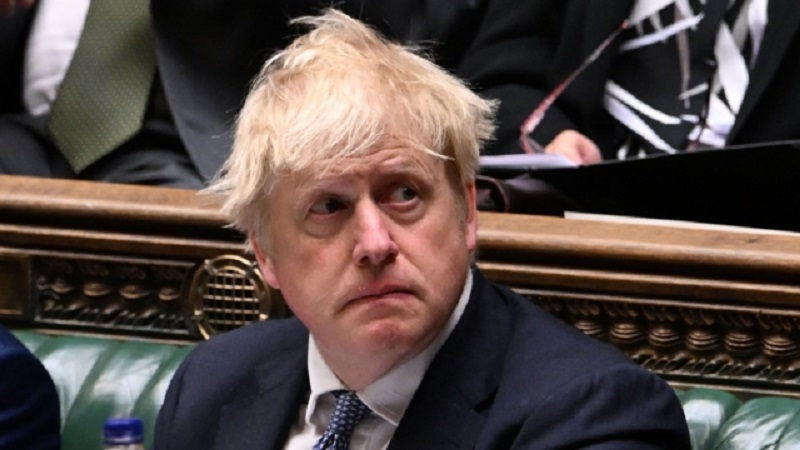
We are learning that from what just happened in London: UK Prime Minister Boris Johnson has resigned. He has cooked for the Tories and the UK people with his style of leadership. But over the last 48 hours, they started cooking for him. Being overwhelmed, he dropped the lines: “In politics, no one is remotely indispensable,” he said.

That is the magic of Great Britain. They have got leaders who have the capacity to save a nation when they think it is missing the path. Yes,  when “over 50 government members in the last 36 hours” resigned, it came home to Mr. Johnson. It was no more about him, it was all about the nation.

Contrast that with Africa where leaders face minimal consequences from their parties, allowing them to focus on the party over the nation. This is a lesson for African parliaments and appointees, you can bring the change you desire by putting your country over titles or parties. They cooked for Boris Johnson and he ran away – that is the beauty of mature democracy: the supremacy of the people over any human. Africa needs that prescription at scale.

U.K. Prime Minister Boris Johnson announced his resignation Thursday, following the resignation of over 50 government members in the last 36 hours. “In politics, no one is remotely indispensable,” he said, confirming he would remain in his role until a new leader was chosen. Widespread calls for Johnson to resign came after he appointed a deputy chief whip who had a history of sexual assault allegations, which Johnson is said to have known. Johnson was already “suffering the after effects of a long-running saga over parties at Downing Street during various Covid-19 lockdowns,” said The Wall Street Journal. (LinkedIn News)

Digital Africa and Women of STEAM – Insights from Somalia Women Photography Changing Perceptions and Narratives

0

It wasn’t too long ago that I pitched my recent book, “The Creative Industries and International Business Development in Africa“, to a packed audience at a side event at the University of Kigali on the subject of “digital gender divide”, which coincided with the recently concluded Commonwealth Heads of Government Meeting (CHOGM) in Kigali, Rwanda. Shortly after that event I posted on Celebrating the Commonwealth Women’s Forum 2022.

In my presentation at the event, I did highlight the need to incorporate STEAM (science, technology, engineering, arts, mathematics) into the conversation of African development whether in the context of Commonwealth countries, the African continental Free Trade Agreement (AfCFTA) or any other fora for that matter.

I have always been an advocate for real African stories, changing the narratives to resonate with the realities on the ground. While Somalia might not be a Commonwealth country even with 21 out of the now 56 member countries being from the region (both Gabon and Togo recently joined the family), the story around “changing African narratives” through photography, as the illustration of Somalia women shows, is more than a fairytale.

Prior to September 2020, there was nothing like the Somali Arts Foundation (Saf), as that was its launch date. According to a BBC News feature, however, all that has changed. Somalia, with its more often conjured up images of violence and destruction, has thrown out a few surprises with a photography exhibition in its capital, Mogadishu. This revelation has not only set out to challenge the negative perception, but also served the purpose of recasting who is defining the true images in the first place.

Indeed, the narrative was captured and also featured in a recent book The Creative Industries and International Business Development in Africa. What is even more revealing is that the Somali photographers in the feature were all female – Sagal Ali, Fardowsa Hussein and Hana Mire.

The exhibition, called ‘Still Life’, is the brainchild of Sagal Ali, the director of the Saf, which she launched in September 2020. While reaffirming that photography in Somalia is considered a man’s trade (especially when it comes to street photography), Women are not expected to be outside documenting day-to-day life, in a place where most people are still busy simply surviving’, she demonstrates how this is changing. Sagal Ali goes a step further to state that, ‘creativity and culture have been decimated by more than 30 years of conflict in Somalia […] The aim of Saf is to revive it, to give people space to breathe’.

Her motivation seems twofold, that is, gender-related and culture (albeit national) contingent. At the national level, her main aim is to alter the way people are seen, and in this exhibition, she hopes to challenge the view that women cannot accomplish highly technical works of art. As she points out:

I was attracted to the female gaze and the emotions the photos invoked in me. I don’t think these pictures could have been taken by men’.

On her part, Fardowsa Hussein explains the rationale for her photography craft. According to her, ‘Somalis say this is the hardest job one can do, but also the most rewarding as camels are so precious in our culture’. Talking about one of her favourites, she opines:

I took this photo near the south-western town of Hudur […] Herding camels is the most beautiful thing you can see. Young boys are responsible to taking them into the bush for grazing. Two boys have to look after as many as 50 camels and are sometimes gone for six to seven days with no water.’ 

Fardowsa points out further: ‘It’s important that women reclaim the public space […] I want it to become entirely normal for a woman like me to go out and about, filming and taking photos, without fear of harassment or worse’.

Her photo, ‘a young woman enjoys a swim at Lido Beach, Mogadishu’ is a portrait of a woman in the sea and also her favourite image. She says the fact that she too was wearing a hijab put the woman at ease, giving her the opportunity to capture this intimate moment. As she goes on to elaborate, ‘there was a beautiful stillness about her, despite the commotion all around her’. This is amazing as framed stick photo tiles.

In the case of Hana Mire, her portrait of Awais, is much-loved. As she states, ‘He has such a kind soul. He told me it’s the first photograph he has ever had of himself. He faces all sorts of discrimination’. The skin tone in the portrait tends to provide some insight into the reasons for the discrimination Hana alludes to. Hence, it was quite understandable that Hana felt it ‘important to show how diverse Somalia’ truly was – albeit through photography and the power of its imagery. As she points out:

“too often people think Somalis are just one tribe, that they all speak the same language.” 

But this is not true’. She describes the inspiration of one of her works thus:

I was in an auto-rickshaw in Mogadishu when I caught sight of these two girls […] It was totally spur of the moment. I leapt out of the vehicle, and they had no idea I was taking their photo. Afterwards, I showed them the image, which they loved.

Hana’s Woman in Orange Jilbab image was taken inside one of the oldest mosques in Hamar Weyne, one of the capital’s oldest districts, during the Eid al- Fitr holiday. As she points out, ‘A woman stood up while others knelt and prayed, a fan was blowing her orange robes, so they looked like a ship’s sail’. In another image also shot in Hamar Weyne, Side Portrait, Hana reveals the narrow winding streets and Arab-style architecture of the district. As she points out:

This is one of my favourite places to take pictures in Mogadishu […] I saw this man walking along and I loved what he was wearing. I asked him if I could take his photo and he said he would be delighted for me to do so.

Another photo deserving mention is Shangani, named after the district it was taken, and also reportedly Hana’s favourite photo. As she put it, I was in the ancient district of Shangani:

“Even though I could see the trauma of war in the buildings, it reminded me of my parents and their happy memories of the once beautiful, elegant city.”

She explains how she was being silent, reflecting on her parents’ experiences, when she saw a boy staring out to sea. ‘I thought it was me. He represented the child in me’.

Do you recall the “orange robes” previously mentioned? Yes, that is the “new black” capturing the Orange Economy that has now become the accepted appellation of the creative industries – thanks to HE Iván Duque Márquez. Yes, the Orange economy does avail infinite opportunities, and the sooner the world, and especially Africa, realises that and capitalises on it, the quicker the anticipated bridging of the gender gaps would be.

Lawyers/Judges sleeping with clients or parties in a suit: The legal/ ethical provisions

0

News report: Lagos govt sacks judge who dissolved marriage, snatched complainant’s wife.

This news of a customary court judge in Lagos, Nigeria who coveted/ snatched the wife of a divorce complainant in a divorce petition before his court is funny and at the same time ridiculous, hence the reason for this post so as to buttress what is the legal and ethical viewpoint in the legal profession in this instance. 

It is a rule in the professional code of conduct in most legal jurisdictions of the world that a lawyer shall not have a sexual relationship with his or her client unless such relationship already existed previously neither should a judge ever have a sexual relationship or any form of relationship whatsoever outside the courtroom with any party in a matter before the judge’s court.

As lawyers are in a fiduciary relationship with clients, many clients are in a vulnerable position vis-a-vis their lawyer and there may arise the temptation or the carnal urge to take each other to bed but any sexual activity between the lawyer and the client would be unethical at the barest minimum and highly unprofessional, it could even be deemed that the lawyer used an undue influence or advantage to engage the client in the sexual activities. 

Most law firms and organizations prohibit this act, although in some organizations it is unwritten, however, it is an unwritten rule that every member of the organization is expected to observe that “thou shall not engage in a sexual relationship with your client”. 

It will also be a very difficult situation for a lawyer or a judge to maintain professional objectivity with the person that the lawyer or judge has engaged in a sexual relationship with and acts like this brings the most enviable legal profession to disrepute. 

In many jurisdictions, sex with a client would likely result in professional discipline, potentially including suspension and even disbarment and an outright sack of the judicial officer involved, and sex between a judge and a party before the court in which the judge is presiding over is never to be heard of, it is a gross act of professional misconduct and highly unethical. 

For instance, The American Bar Association prohibits a lawyer from having sex with his or her client. In the  ABA Model Rule 1.8(j), enacted independently and applicable  in various forms throughout the 56 states of the United States jurisdictions it provided thus: 

“A lawyer shall not have sexual relations with a client unless a consensual sexual relationship existed between them when the client-lawyer relationship commenced.”

This rule is not to be overstretched to a person whose partner is a lawyer or to be misunderstood that a lawyer should not represent a spouse or have the spouse as a client but the condition is that the sexual relationship between that lawyer and the client must have existed before the person engages the lawyer and not after the engagement as a lawyer to the person. So, from the ethical perspective, a lawyer can represent their spouses, and anyone else they were bedding before the lawyer-client relationship began. 

The purpose of this rule is to restrict the overreach in the Attorney-Client relationship and mostly to prevent lawyers from exploiting the vulnerability of the clients. 

There are punishments for fake news in Nigeria

1

The highest victims of fake news in Nigeria are celebrities, politicians, and those in the public eye. They most times wake up in the morning to fake news about them and even fake news about their death trending in news blogs and social media spaces. 

A Popular entertainer woke up yesterday to the news about his death trending on news blogs and social media spaces. He started getting frequent calls from his family members, close friends, associates, and even fans who have read about his death sending him condolence messages.

According to him, his old mother had a panic attack after she saw the news about her son’s death and she had no idea that the news was fake, coincidentally, she called the son nonstop and it happened that the son was indisposed to come to the phone or take the call from the mom at that time as he is still sleeping. Before he could call the mom back the mom already had high blood pressure and was rushed to the hospital.

This trending of fake news about the death of celebrities is becoming a regular thing in social media spaces and blogs in Nigeria. Just a few weeks back, Kanayo o Kanayo, the legendary Nollywood actor started his day with news from blogs and social media spaces about his death flying in. So also Julius Agwu an iconic comedian earlier this year, trended that he is dead, the posters even added pictures of him on his deathbed and they claimed that he died on the sick bed as he has been battling an unknown ailment for years after his wife dumped him. Julius Agwu was actually busy going on tours in solid-state of health while mischief-makers and netizens who are only interested in attracting huge traffic to their blogs were trending the news about his death.

This is one of the major reasons the government has been planning to regulate the media space and regulate the contents that are shared in the media space and news blogs and provide a heavier punishment for fake news mongers. If you know that there is a huge consequences awaiting you for sharing news that you know to be fake then you will think twice before sharing it and even if you believe that the news may be true, you are expected to take active steps in verifying the veracity of the news before sharing it or posting it on social media space or news blogs.

In as much as most of us will always stand against the government for trying to restrict or regulate the media space, social media users and bloggers should as well know that sharing fake news with the intent to damage a person’s reputation, cause a threat or emotional distress to the victim is an offense which carries both criminal consequences that the poster can be prosecuted and if found guilty sent to jail and also can give the victim right of action against the poster in tort. 

The provisions of S 24 of the Cybercrime Act of 2015 specifically criminalize the act of sharing fake news of this nature and any person that is found guilty of this act is liable for at least 3 years imprisonment term. 

It provides thus:
Any person who knowingly or intentionally sends a message or other matter by means of computer systems or network that –

(a) is grossly offensive, pornographic or of an indecent, obscene or menacing character or causes any such message or matter to be so sent; or

(b) he knows to be false, for the purpose of causing annoyance, inconvenience danger, obstruction, insult, injury, criminal intimidation, enmity, hatred, ill will or needless anxiety to another or causes such a message to be sent:

commits an offence under this Act and shall be liable on conviction to a fine of not more than N7,000,000.00 or imprisonment for a term of not more than 3 years or to both such fine and imprisonment.