DD
MM
YYYY

PAGES

DD
MM
YYYY

spot_img

PAGES

Home Blog Page 5063

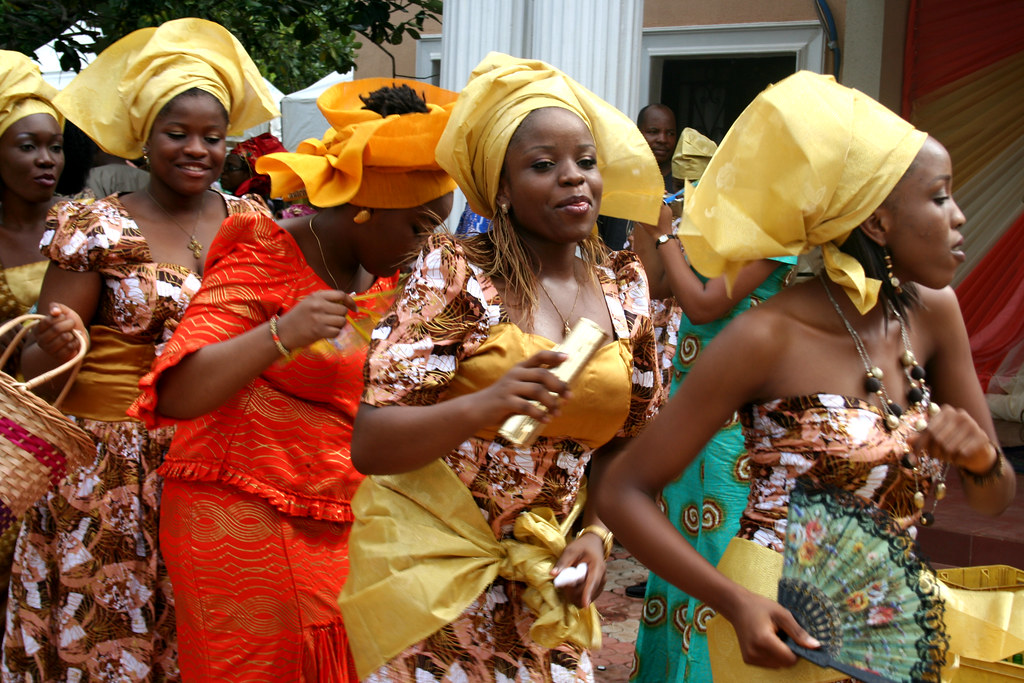
‘Nneka’ – And Why Igbos See “Mothers as Supreme”

1

In a post here on LinkedIn, a comment from a member made it look like ancestral Africa was all against women. While every culture has many regrettable components (think of killing of twins, slavery/imperialism of Europe, etc), I will like to note, on many instances, that Africa actually treasured women and put so much power in the hands of women, despite men appearing to be in charge.

In the Igbo Nation, a mother is supreme. That is why the Igbos name their daughters “Nneka”. The peerless Chinua Achebe wrote “a man belongs to his fatherland and stays there when life is good, but he seeks refuge in his motherland when life is bitter and harsh.” So, if things become hard, you run to your mother’s place.

And when you get there, things open up. When a man arrives at his mother’s birthplace, he automatically assumes rights over most indigenes. If you check, as elders break kola nuts and drink palm wine, they first ask “do we have nwa-ada [child to our daughter] here?” If there happens to be nwa-ada, they will acknowledge him, and once after taking the palm wine, they will give him over the sons of the soil. The idea is this: no matter what brought you to your mother’s birthplace, you are welcome! We will feed you before we eat!

And those daughters – Umu-ada (some communities use Ndi Ada Nwanyi)- have an unusual influence in their fatherlands despite being married many miles away. In Ovim, my village, you are better off dealing with the Nigeria Police than them because with them, you have no chance. The anticlimax of a troublesome man happens when the elders (men) invite Umu-ada to come and help. 

Let us not see globalization as all evidently pure with the mindset that Africa’s culture is all primitive. Many practices were bad and those cut across all cultures including Europe, Asia and Africa. This is the key – we need to push for an equal world on gender, race, nationality, etc.

My agric science teacher made raising organic chicken, goat, etc as being “bad” [they’re small, take years to grow, etc}. But when I got to US, I noted that only the “rich” actually eat organic because they are expensive.  Africa has got many things right even before the world comes along. The Igbo Apprenticeship System is the ancestral version of the stakeholder capitalism we preach today in Wall Street.

Feedback on LinkedIn Feed

Comment: The rights/priviledges of the “child of a daughter” is news to me given that married daughters do not seem to hold privileges even in their compound. I guess the principles are different across villages.

My Response: That is one distortion of African culture which many push, comparing it with the European model, without taking a wholistic viewpoint. A daughter does hold rights in her father’s compound and land. When a lady is being married, families sell properties, take loans, etc to buy her things which will help her begin a new life in the husband’s place.  They do this to make sure her standard of living does not degrade after the marriage.

Boys do not get that. And when the parents die, they automatically assume what remains. Sure, you can argue that the sons get more. But understand that the daughter’s husband assumes his own parent’s which seems to balance out, under the ancestral agrarian system. What we can say is this: African culture is unfair  to unmarried daughters who get nothing!

Every daughter in the ancestral Igbo nation holds “privileges even in their compound” and that is on display on her Igba nkwu day (traditional wedding) as the family shares her “inheritance”.  Sure, because we have shares, bonds, etc as assets now, those have to be updated. But no one should accuse ancestral Africa of discriminating against daughters.

Comment 2: Apt! Umu-ada is indeed a very powerful traditional institution in Igbo land till date. However, I’m not quite sure as to the extent our modern day umu-ada particularly the ones that live in Lagos, Abuja, and other cities recognize and play their roles in those families and villages they come from.

We must sustain our rich traditions as we outplay each other in effort to perfect the imported ones white men foisted on us!

Nneka – “Mother is Supreme”

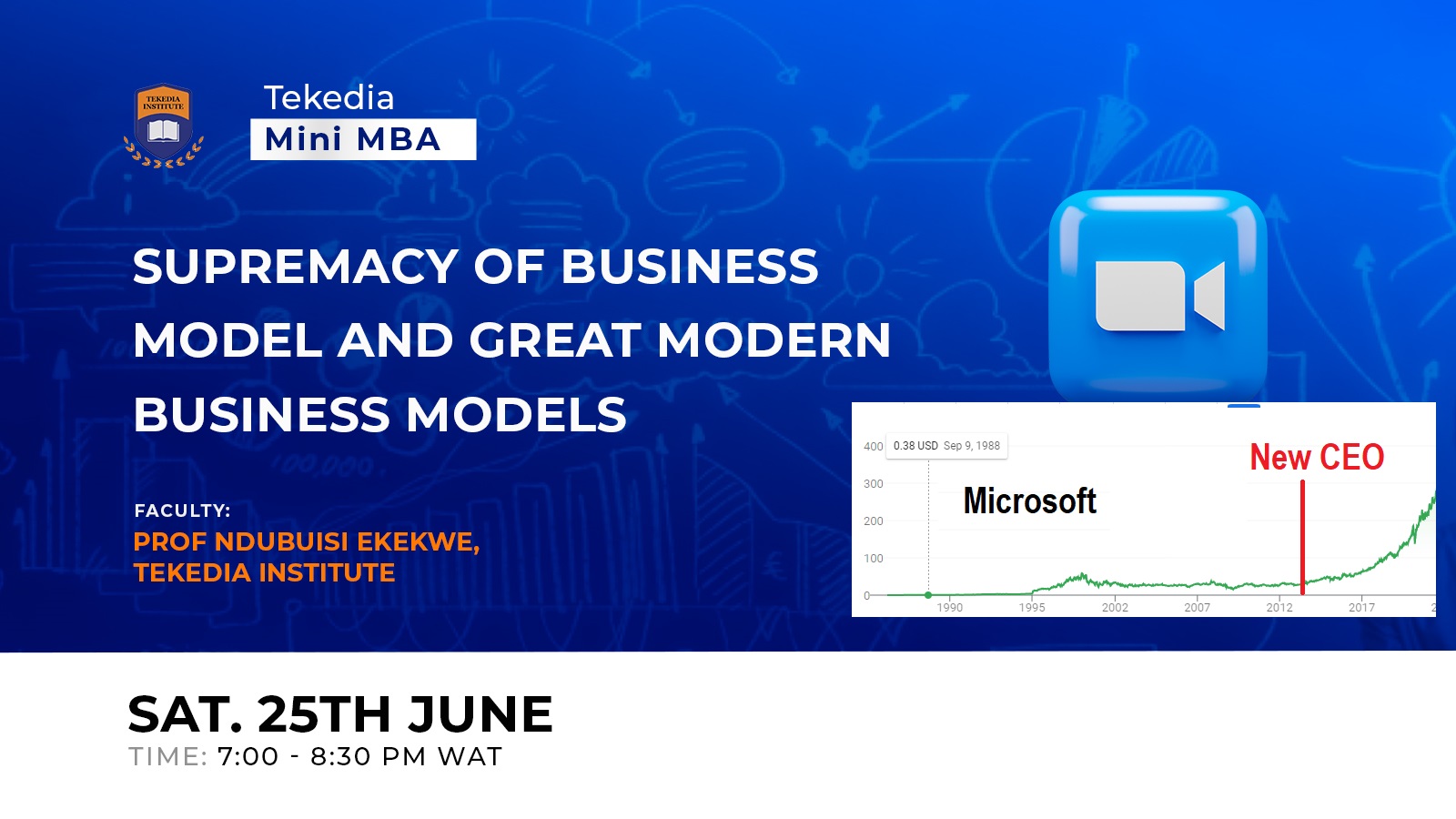
The Supremacy of Business Model – A Tekedia Mini-MBA Course

0

Business model encapsulates the logic of a firm and the way it uses factors of production to create value for stakeholders. To a large extent, that is the outcome of any business strategy framework. A good strategy decides on the best business model through which a company will compete and operate in the market.

In the scheme of things, you can have many models at the end of the strategy session. The business model you commit your business to has a catalytic impact on your success. Period – business model is supreme.

At Tekedia Mini-MBA Live today, I will explain that supremacy and why leaders must pay attention to the business models they operate. Microsoft had a lost decade until they changed a CEO. When the new boss man came, he changed the business model. Looking at the plot, the impact is significant and well correlated. I will present more cases to show why a change in CEO who comes with a new business model has transformed the destinies of firms.

Yes, the company has been bleeding revenue, but they changed the CEO. Magically, using the same staff on the products, the revenue started going north. What happened? New business model has been deployed.

Join me at Tekedia Mini-MBA live; Zoom link in the Board.

Shortage of Manpower – Canadian Employers Willing To Hire Workers Without Direct Experience

0

A new study revealed that Canadian employers are willing to hire workers without experience related to the job, due to a tight labor market.

The Canadian government also announced that the country is faced with an acute shortage of manpower, and is inviting other foreign nationals to fill existing vacancies in various sectors of the country’s economy.

The labor shortage in the country is said to have reached an all-time high of one million. Canada has an aging population with declining birth rates and immigration is one major avenue that employers of labor are employing to fill the existing vacancies in organizations to support economic growth.

A survey carried out, disclosed that a large percentage of employers in Canada, disclosed that their company would consider hiring an applicant who does not possess a degree or certification that is related to the job, rather they will go ahead to offer on-the-job training to new workers.

The country is presently faced with the tightest labor market they have ever had, which saw the unemployment rate fall to 5.1% in May, which is reported to be the lowest rate since 1976.

A survey poll revealed that employers in Canada are more likely to hire an employee based on soft skills such as communication, problem-solving, creative thinking, adaptability, attention to detail, etc, rather than hard or technical skills.

This means that regardless of whether an employee possesses a hard skill or not, employers in Canada are more concerned about what they can contribute in terms of attributes, and what soft skills they can bring to the role.

This shows that those who do not possess any hard/technical skills have the opportunity of still being employed. No doubt employee skills and the ability of employers to attract and retain skilled workers will definitely impact the country’s economic success.

With a land mass of 9,985 million km2, currently the second-largest country in the world, it is not far-fetched that there is a shortage of manpower in Canada, which is why the country has remained open to receiving immigrants since the 1980s.

There are already thousands of unified jobs across Canada in all sectors of the country. If the country doesn’t open its door to immigrants, there will be a decrease in the ability of companies to match available jobs with available workers which will have a high impact on the country’s inability to innovate and improve competitiveness to compete globally.

Immigrants contribute to the economy and create jobs for Canadians. Thanks to immigration, Canada’s labour force continues to grow by a small amount every year. If it weren’t for immigrants, employers would have trouble finding enough qualified workers to fill available jobs.

Lagos-based LaVida Studios Secures $50m Investment, Signs Partnership Deal with The Story Lab

0

The inflow of investment funds into Nigeria, which has been largely focused on tech, has touched the entertainment industry – a sector of Nigeria’s economy that has been sidelined as the country records huge numbers in foreign investment.

Lagos-based LaVida Studios has secured $50 million production investment and signed a partnership deal with The Story Lab US, a subsidiary of Dentsu.

“We are thrilled to be working together with Dentsu and its The Story Lab team in the U.S. to bring authentic and compelling African stories to the world,” Chioma Ude, founder of AFRIFF and managing partner in LaVida Studios, said.

The three-year deal with The Story Lab will birth 10 films and television properties which will showcase African stories on the global stage. Covering both scripted and unscripted film and TV projects, the partnership will see production handled by LaVida Studios for all Africa-based production out of The Story Lab.

The Story Lab invests in talented creators and producers to develop entertainment that challenges storytelling conventions. It also innovates the way entertainment is packaged, distributed and marketed to reach global audiences.

“It is partnerships like this one which really help move the dial when it comes to discovering and elevating emerging talent. I’m so pleased we can be part of amplifying the diverse voices of Africa alongside our friends at LaVida and AFRIFF,” Mike Ferry, head of The Story Lab U.S. said.

LaVida is supported by PAC Capital Limited with an initial $50 million for LaVida’s film and TV projects, including the collaboration with The Story Lab. The funding comes from PAC Capital’s Pan African CCI Fund 1, a $100 million fund dedicated to financing film production and distribution in Africa.

Also, both LaVida and Dentsu are working on collaborating with the African International Film Festival (AFRIFF) to create a joint initiative, which would recruit and support top African writing talent in creating original stories that appeal to a global audience.

“The combination of LaVida’s partnerships with top Nigerian creators and Dentsu’s global network and presence will serve as a bridge between these top content creators and the global market through this collaboration. We are honored to bring these stories to the world,” Geneva Wasserman, executive VP and head of scripted content, The Story Lab U.S said.

LaVida Studios and Chioma Ude are represented by CAA and The Story Lab US is represented by UTA.

Nigeria’s Nollywood is the second-largest film sector globally with a projected worth of $6.4 billion in 2021. It is also Africa’s largest in terms of value, number of annual films, revenue and popularity – producing around 2,500 films annually.

In recent years, the industry has seen a new phase of skit-making being spearheaded by young talents. With the rising popularity of short-form films that is increasingly adding millions of dollars to the industry’s market value, investors are expected to follow The Story Lab’s steps by betting more money on Nigerian film companies.

International Brands are ripping off Nigerian creatives

0

I just got a document sent to me by a client who is a popular Nigerian entertainer. The document is a partnership agreement proposal from a massive international brand that is into fintech. They want to endorse my client to partner with them as an influencer/brand Ambassador in Nigeria to promote the brand in Nigeria for the brand to penetrate the Nigerian market.

After I finished going through the partnership agreement proposal I was livid. The contractual terms were well engrossed with the phrase “rip off”. The clauses were couched in a way to have the entertainer work for the brand as a slave for a meager sum. It was nothing less than total slavery.

Unfortunately, this is not far from the majority of the deals most Nigerian entertainers get from these “big companies” and the entertainers will grab it and welcome it with both hands. I have been privy to most of the partnership agreements and I have worked and drafted some, so this is first-hand information and not some hearsay. 

Some of the notable clauses that caught my attention in this partnership agreement proposal that my client forwarded to me was the one that states that the partnership deal between my client and the company is to last for just six months and after the expiration of the six months term my client is not allowed to take a deal from any other brand that is in a similar line of trade with this company for the period of twelve months. Another clause states that my client is bound by confidentiality for the period of seven years after the expiration of the contract term. Another clause in the contract agreement states that my client should assign his intellectual property rights that emanate from the cause of this partnership to the company for life.

Some of these international brands are big bullies and extortionists who are prying on the desperation of some Nigerian creatives to land deals in order to make money and escape poverty due to the economic situation of the country. The fee they are proposing to pay my client after all these strict and stringent clauses they inputted into the contract is just a meager sum.

Nigerian creatives should stop being desperate and stop selling themselves cheap. Any brand that discovers that you are very desperate will never value you and will always throw insults at you disguising them as deals and expecting you to grab them with both hands.

I have always tried to advise clients in the entertainment space to turn down some offers or we can amend the offer and send back our proposal to the company offering the deal but most of the entertainers always say no and that they will accept the offer the way it came because they have no idea when next offer will come and some that listened to me about making adjustment on the offer and sending it back to the brand end up getting a better deal.

International brands are really ripping Nigerian creatives off because they are paid a little and expected to deliver a high target. Creatives should stop selling themselves short, you all deserve better.