DD
MM
YYYY

PAGES

DD
MM
YYYY

spot_img

PAGES

Home Blog Page 5084

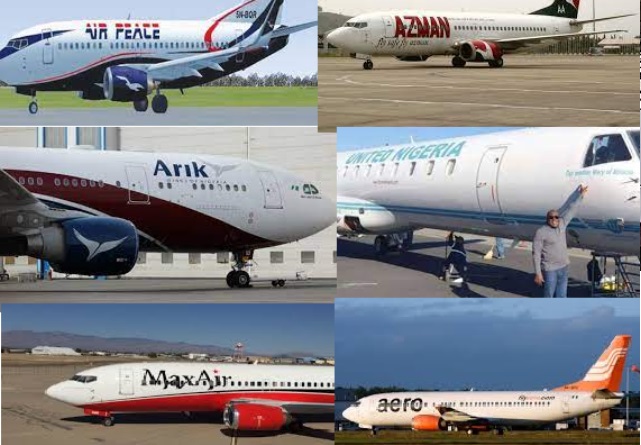
Nigerian local Flights and their bad time management habits

0

I have never flown a Nigerian local airline that departed at the scheduled time for take-off. The Cabin crew and the flight captain must apologize for departing behind schedule and I’m quite certain that this is not my personal experience, many other constant flyers can confirm to this my assertion that Nigerian airlines are fond of failing to keep to time. I for one am actually tired of hearing the cabin crew or the captain giving apologies over the bad-sounding microphone for departing later than the scheduled time.

This experience is quite unique only to the Nigerian local flights as international flights operating from Nigeria always keep to time and it has only been in rare cases that an International aircraft would take off behind schedule may be due to factors beyond their control; like the weather factor.

The “African time” factor has really eaten deep into the Nigerian system, everything in Nigeria that requires time is being driven by the “African time” factor. According to the “African time” principle, you are not to keep to your time because the other party you are dealing with is bound never to keep to the time. The principle expounded that if your event is scheduled to start by 10 am you are to state that the meeting is starting by 8 am and expect the guest(s) to come around by 10 am, if you make the mistake of stating the right time your event is to start, expect your guests to show up late; an hour or even two hours late.

This African time factor has really messed up the whole system in Nigeria and it seems we won’t get over it any time soon but it is despicable that flights that are run by time management and people chose it over other means of transportation because of the time management advantage will keep failing to keep to their time schedules. Not just local airlines, rail networks also don’t keep to time in Nigeria. This is not hearsay, I’m a regular user. 

The Nigerian system needs to take time management seriously as time management has a huge impact on the economy and other productive sectors. A properly utilized time will have a good effect and Vice versa.

An old English cliche goes that time is money. I guess Nigerians are yet to grasp this concept and believe in it that time is not just abstract but actually money and we should do more in our time management especially our local airlines should do better in time management and working within schedule except when it is beyond their control.

Growing Nigeria’s GDP Even During Global Recession!

2

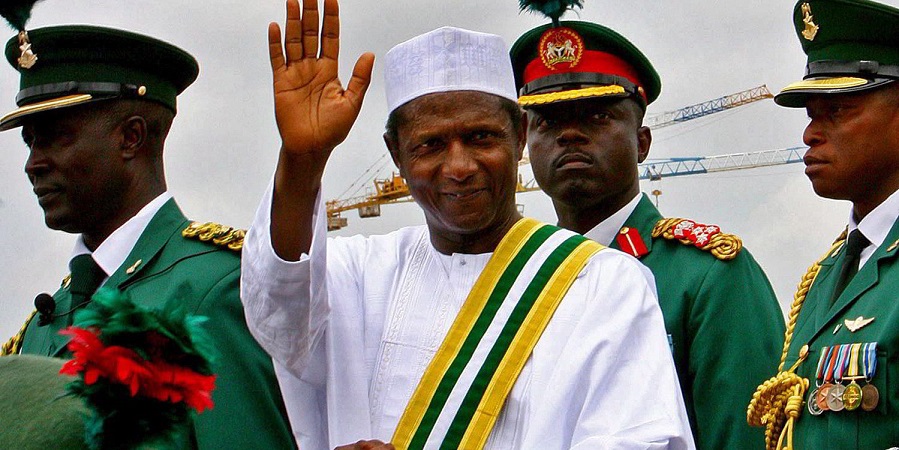
As we expect the full vice presidential selections (PDP’s Atiku had gone with Okowa, Delta state governor), it is about time to begin to examine the economic postulations of Obi, Atiku and Tinubu. Some of the finest budgets I have seen in Nigeria since 1999 remained the ones headed by Musa Yar’Adua. 

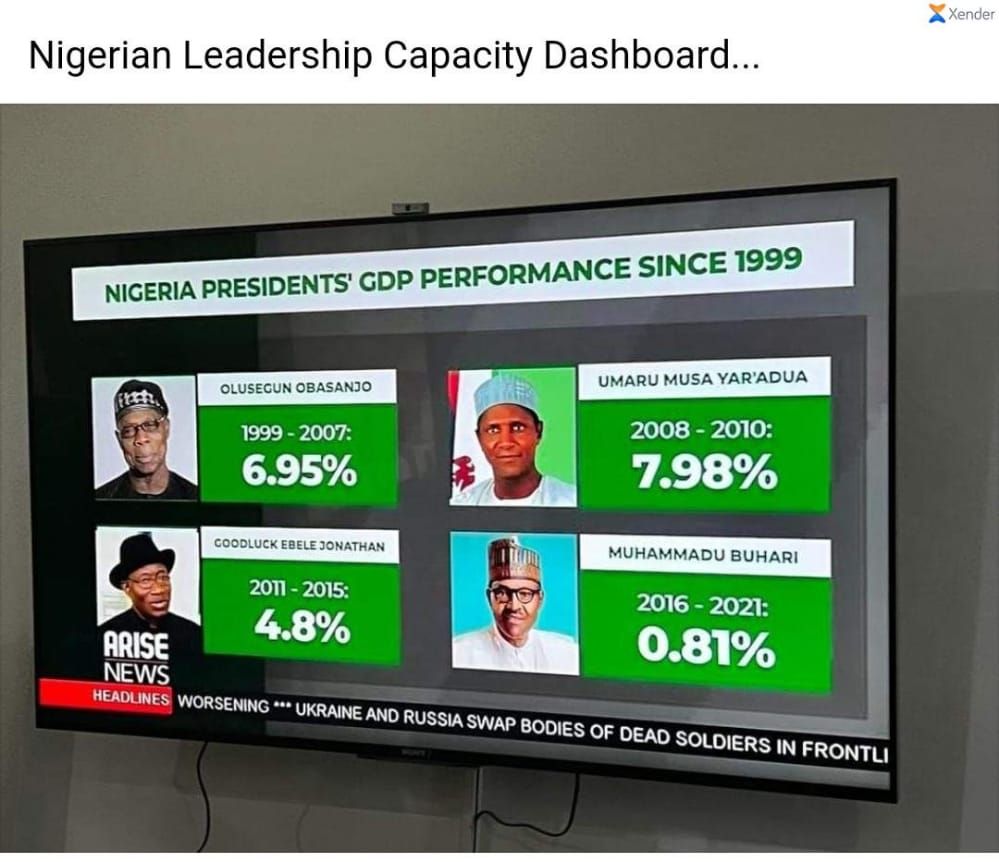
His budgets were evidently Keynesian with a sharp focus on how aggregate demand could influence economic output; sure, he needed to do that since he led the nation during a global recession. And that is the beauty of Yar’Adua because during the Great Recession, he grew the economy! Between 2008 and 2010, his GDP average growth was 7.98% (OBJ, GEJ, and Buhari* averaged 6.95%, 4.8% and 0.81% respectively).

Another component was also his vision for building new centers of growth. His budget for the Niger Delta was so big that when he died, the next administration had to cut it! Reading his budget, he believed that the Niger Delta, if well invested in, could unlock more growth for the nation, well ahead of what oil & gas was providing.

When a man can grow an economy during recession this big, a nation cannot allow his legacy to be forgotten. Some of the recent budgets we have seen are paddles of ephemeral political hacks. I am hoping that Obi, Atiku and Tinubu will give us economic visions for the future that all Nigerians will unite for.

Indeed, even in a global recession, Nigeria can keep growing because we’re very far from the optimal state. No excuses; we want growth.

Comment on Social Media Feed

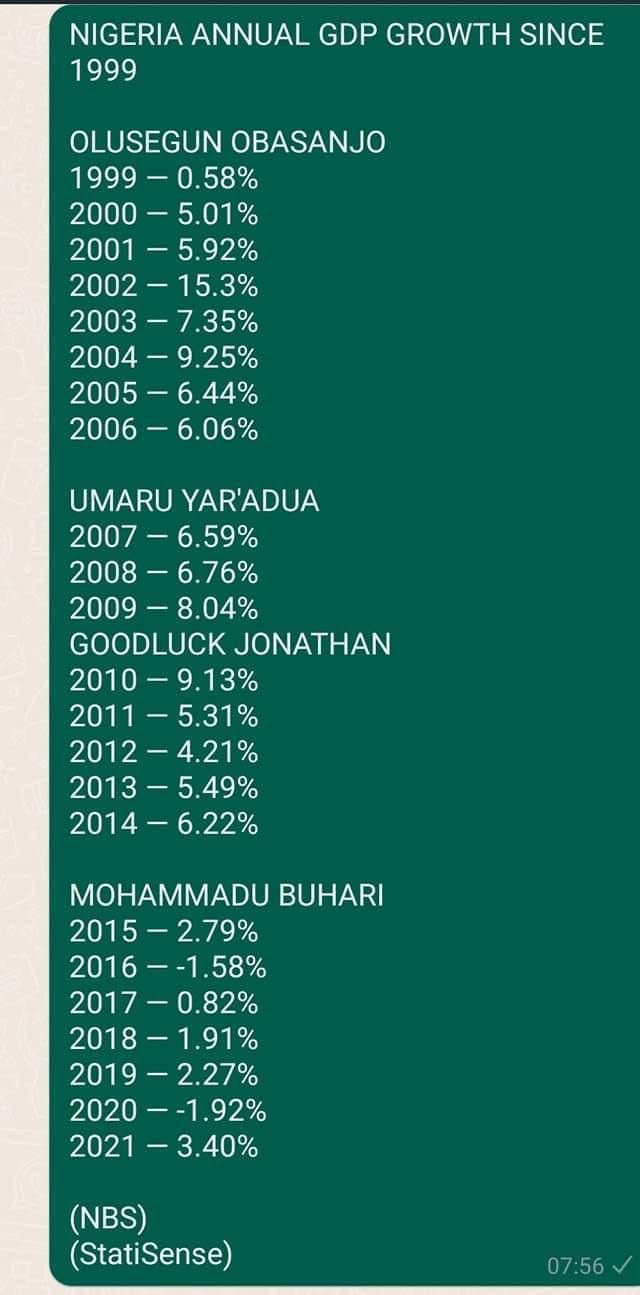
Comment: Hello Prof., I have challenged and disputed these figures (for Jonathan) on another platform. Jonathan’s economy didn’t average 4.8% please. GEJ’s administration can be judged from May 2010 to May 2015 (a five years term). If you put those figures together, they’d give you an average GDP growth of at least 6.1%. That’s the true picture please. I know for your part, you state this in good faith. But there are some persons who deliberately obfuscate these numbers to belittle Jonathan. The man doesn’t get the credit he deserves in this country; at least Nigeria saw its highest overall GDP ($510bn) during his tenure. See breakdown of GDP growth in the three administrations by NBS?

My Response: Yar’Adua was “alive” when 2010 passed. It was his budget and his economic vision. Jonathan took over in 2011. While Jonathan supervised the execution of that 2010 budget, it was not his vision. So, many people still attribute that to Yar’Adua. 

We want all to have a #plan. Attend Tekedia Business and Personal Economy course

0

On July 2, at Tekedia Mini-MBA, we will discuss how each and everyone of us can navigate the evolving economic paralysis which is evolving around the world. We have added a new course in the current Tekedia Institute Mini-MBA titled “Business and Personal Economy Scenario Mapping During Economic Upheaval”.

Our goal is for us all to explore how to position and reposition ourselves as possible economic upheavals breeze. We will look at the elements at personal and business dimensions.

We will be making available some tools to help you. Some bankers and investors are assisting us. The goal: we want all to have a #plan.

Register for Tekedia Mini-MBA here

Another Take on the Nollywood/ Bollywood Nexus: “Indiyawan Kano” (The Indians of Kano)

0

The “Indiyawan Kano” (The Indians of Kano) Narrative is not a common one, as the situation remains rather fluid.

I start off this article by drawing from a book “Nigerian Film Culture and the Idea of the Nation: Nollywood and National Narration,” edited by Professor James Tar Tsaaior and Professor Françoise Ugochukwu, which posits that Nollywood, “the Nigerian video film text, is deeply rooted in the sub-soil of its social and cultural milieux.”

It further argues that the genre is “engaged in the relentless negotiation and re-negotiation of the everyday lives of the people against the backdrop of their cultural traditions, social contradictions and the politics of their ethnic/national identity, longing and belonging.” 

Featuring a range of essays, there is a further claim that the contributions “weave an intricate and delicate argument about the critical role of Nollywood to the idea of nationhood and the logic of its narration with implications for language, politics and culture in Africa.” 

Setting the Scene

Yusuf Baba Gar’s investigation of “Folktales in Kannywood Videos” interrogated the storylines in Kannywood (the film industry in Kano, the commercial nerve centre of northern Nigeria) videos, and highlighted how cultures can transcend geographies through film and folktales. It also speaks to the never-ending debate around migration, migrants and acculturation of settlers in a host context. Interestingly the intercultural integration and amalgam of cultures as something that is not much envisaged.

Disaggregating, Kannywood from the broader Nollywood, he draws attention to a growing crop of actors/actresses described as the “Indiyawan Kano” (The Indians of Kano). Yes, you heard/ read right – the Indians of Kano.

Therefore, when we talk about the arguably Big Three – Hollywood, Bollywood and Nollywood, we need to pause and reflect upon this study, which provides some interesting insights into some recent interactions and alliances. As the study challenges “the initial criticism that the videos are mere adaptations of Bollywood.”

Adaptations of Bollywood may be putting it mildly considering what has been denounced as a “Menace of Appropriation” of Bollywood by Kannywood. Let me explain drawing further insight from three articles.

First, the study by Professor Muhammad Muhsin Ibrahim of the Institute of African Studies and Egyptology University of Cologne entitled “Kannywood and the ‘Menace’ of Appropriation of Romantic Movies,” echoes this view. As Professor Muhsin points out about his article:

“This paper is set out to discuss this issue through a content analysis of a recent film titled Sareena (2019, dir. Ali Nuhu). The movie, released early this year (2019), is not only a bloated, implausible melodrama but also a direct mimicry of a famous Indian film, Kaabil (2017, dir. Sanjay Gupta).”

Second, the study by Professor Abdalla Uba Adamu of the Bayero University, Kano on ‘Currying favour: eastern media influences and the Hausa video film’, confirms this ‘new’ narrative. Indeed, the professor has more recently written about “The Linguistic Domestication of Indian Films in the Hausa Language,” and all the red flags being raised. Citing prominent scholars in this research area such as Professor Adamu, Muhsin highlighted how Hindi (arguably Bollywood) films have been appropriated in Hausa from songs (e.g., So Bayan Ki) to storyline (e.g., Ciwon Ido, Burin Zuciya and Zo Mu Zauna), and even choreography (Zabari).
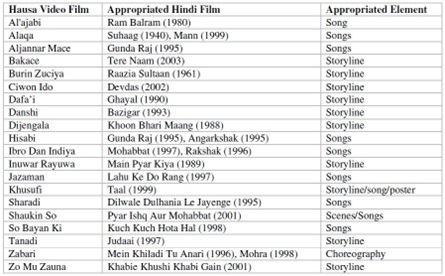
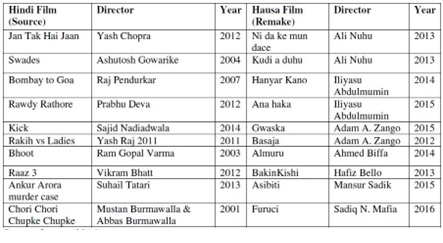
Third, and moving away from the scholarly discourse (for the time being at least), one article entitled “Move over India: How Bollywood conquered Nigeria,” published by Asia by Africa, in February 2018 points out, “originally, a cheap alternative to Western films, Bollywood’s themes and stories resonated with Nigerians turning an import gamble into a national obsession. From literature to music to filmmaking, Bollywood has had an indelible impact on Nigerian culture.”

Evidently, Nollywood, and it’s Nigeria audience, have been obsessed with Bollywood for over six decades, and this obsession has been captured in this third article, which places the country as “one of the Indian film industry’s best export markets.” The history dates back to the 1950s, a period that coincides with the pastime of Lebanese immigrants in the country. With screening popping up almost any or everywhere – from open-air courtyards and impromptu movie houses, especially in northern Nigeria. 

Breaking down barriers

Other interesting cultural barriers seem to have been negotiated, and navigated, because of the prolonged interactions of both cultures. The first is the language barrier issue, and a second is cultural bonding. Starting with the language barrier issue, it has been reported, “many people re-watched the same movies dozens of times, eventually learning snippets of Hindi in the process.” The argument remains that, “while Nigerian audiences could not understand the dialogue, the pacing and plot of films nevertheless enabled them to figure out the stories. For instance, the three hour long, 1957 classic Mother India remains one of the most popular Bollywood films of all time in Nigeria.”

A recap of the highlights:

  • Originally, a cost-saving gamble, Bollywood’s introduction into Nigeria in the 1950s evolved into a cult following in subsequent decades.
  • The Bollywood craze hit new heights in the 1970s and 1980s. Afterwards local films began to supplant Indian ones – with the emergence of Nollywood.
  • The resurgence of Bollywood in recent years is due to Indian studios outpacing their Nigerian counterparts in terms of production quality and This makes some nervous that Bollywood could spell Nollywood’s demise, while others maintain that Nollywood should focus on quality, not quantity, in order to regain market share.
  • Throughout Nigeria, informal movie venues showing Indian films regularly sell out, buoyed by the support of loyal fans “singing along in Hindi” despite not speaking the language.
  • In the 2012 film U.D.E. became the first co-production between Nigeria (Chukwuma Osakwe, director) and India (Parveen Kurma, assistant director). The two co-stars make a fitting metaphor for the ties between the two film industries, with Lavina Qureshi playing the Indian love interest of Nigeria’s Daniel Lloyd.
  • Set in Lagos and Chandigarh (Punjab), the movie deals with the same cross-cultural themes that made Bollywood resonate in Nigeria e.g. religion, visa denials by western countries and the challenges faced by young people, thereby, creating a loyal audience in Nigeria.
  • In January 2015, India’s high commissioner to Nigeria announced that India would facilitate a partnership between the Nigerian and Indian film industries.
  • In 2015 Nigerian-Indian actor Aivboraye Lawrence Osagie became the first Nigerian to feature in a Bollywood film, Love is an Illusion.
  • An example of Bollywood’s international success and ease with which it has surmounted language barriers comes in the form of a 2015 video showing Miss Nigeria and Miss Indonesia bonding over their shared love of Bollywood films, before breaking into a song.
  • In January 2016, Emem Isong (Nigeria filmmaker) created Love is in the Air, a romantic comedy starring popular actors from both Nollywood and Bollywood.
  • Lagos’ Indian Festival in 2016 also saw film industry cross-promotion, with the Indian embassy and Lagos city displaying the best of the best of Indian and Nigerian cinema.
  • As one report puts it, “perhaps the most meta example of the cross-pollination between Nigerian and Indian film has been the 2017 Nollywood movie ZeeWorld Madness, a comedy that pokes fun at the Nigerian obsession with the ZeeWorld Bollywood movie channel on DSTV.”

In the light of the above, perhaps it may well be time to reconsider the posturing of one Prince Bubacarr Sankanu, a scholar on African cinema, and founder of a think-tank on African cinema, on whyWhy the generic name of the Nigerian Film Industry should be CineNaija The “wood” suffix from the above is something I found an issue with in my recent article “Time to get out of the Woods.”

Apple’s Launch Of “Pay Later” Heats Up Competition In The Buy Now Pay Later Industry

0

Buy now pay later (BNPL) a digital version of installment plans that allow customers to split large purchases into several monthly payments, which attracts no interest fee.

The industry is fast-growing, with about 37.7% of consumers in the U.S choosing the option in July 2020. Recall that Apple recently launched its new feature called “Apple Pay Later”, which will enable users to pay for purchases with four equal payments made every two weeks, with no interest fees.

Apple’s move into the “Buy now pay later” industry has raised concerns for Fintech companies and also those that pioneered the trend. These companies have the fear that Apple, one of the world’s largest company, could drive their client away from such services.

The announcement of Apple “pay later” has sent shocking waves in the “buy now pay later” industry, as some companies are already upgrading and introducing new features. Following Apple’s shake in the industry, electronic commerce financial company, Pay Pal has introduced another upgraded version of the “buy now pay later” feature on its app.

The company already offered a range of “buy now pay later” deals including pay in 4, which is the same as the Apple buy now pay later, consisting of four equal payments over six weeks with no interest rate fees.

According to reports, PayPal is expanding its buy now pay later options, with a longer-term payment plan. The new payment plan enables users to cover the cost of a purchase over a few interest-free payments, and it also offers credit cards.

The new rolled-out payment plan is valid for purchases between $199 and $10,000, and the cost will be split across monthly payments between 6 and 24 months. If a customer selects the pay monthly option at checkout, they will be redirected to fill an application.

Once that is approved, they will be able to select from three payment options with different time frames. It seems PayPal is actively on the lookout for Apple’s every move. It might interest you to know that this is not the first time PayPal is responding to a move by Apple.

The company one time redesigned its app for iOS with a focus on making it easier for users to send and request money. This move was made by PayPal after Apple launched its pay cash app, a peer-to-peer platform.

No doubt Apple’s pay later feature could present another challenge for BNPL companies who are already updating and devising new methods to challenge that of Apple. Analysts have suggested that Apple’s entry into the BNPL industry will pressure fintechs which are already facing regulatory and competitive tailwinds.

The fierce competition in the “buy now pay later” industry will see the market rapidly evolve as some BNPL providers are rolling out more payment options. No doubt a lot of companies know that Apple is a very strong rival, despite the company’s limited line of products, every product it has created is top-notch.

Apple’s products are designed with great innovation which is no doubt why the BNPL industry is shaking at Apple’s entry because the company’s products are often the preferred choice of consumers.