DD
MM
YYYY

PAGES

DD
MM
YYYY

spot_img

PAGES

Home Blog Page 5092

Nigeria Savings And Investment Platform, FundBae Hits Milestone Of 50,000 Users

7
Piggybank for saving has enslaved many to online lenders

FundBae, Nigeria’s Savings and investment platform, has recently hit a major milestone of having 50,000 users. The start-up has indeed been helpful to a lot of Nigerians, by helping them to preserve wealth through its value, offerings, savings, investors, and payment.

Its simple and flexible use has helped its users to build and sustain a good savings habit. FundBae disclosed that since its inception, it has paid a sum of N14,000,000 in interest, over N2 billion in the volume of transactions, and about 40,000 in transaction count.

FundBae has always ensured that its users get the maximum satisfaction they deserve from using the app, which reflects in its preference for user-centered product development.

At the beginning of 2022, in a bid to ensure user satisfaction, the team got to work, by improving service delivery and enriching the functionality of the product to make onboarding simpler and the user journey quicker.

The solution was drafted which saw the team work relentlessly to create one of the most adaptable apps that gratified the evolving lifestyle of its users. After many weeks of hard work and improving the app, the team officially launched the latest 2.5 version of the FundBae app.

The new upgraded version (FundBae 2.5) according to the team has the true definition of digital financial flexibility. It addressed customers’ pain points and it is faster to navigate. The app has a beautiful UI/UX design that is very appealing to its users, and they also get to enjoy seamless navigation.

The upgraded version offers so many amazing features to its users, like; fast interbank transfers to third parties, Fundbae users can transfer funds to another Fundbelae user at zero cost, users can get to pay recurring bills quickly and safely, without any hassle.

The simpler and faster onboarding process was done to eliminate bottlenecks faced by users when they login to the platform. Also, Fundbae users can now upgrade their tier or savings level on the app.

The app provides its users with referral links that they can use to earn extra money when they refer friends and family to the app. It operates a strong security system, to ensure safe and secure transactions to prevent users from the risk of falling into the hand of scammers.

This means that customers have no worries about the risk of losing their funds, as FundBae has given them the assurance that their funds are safe. It is also interesting to know that FundBae now features a US-Dollar-denominated savings plan.

In fact, looking at all the amazing features customers get to enjoy by using the FundBae app, permit me to say that this app is not only here to stay, but will give other fintech apps a run for their money. They have ticked if not all the boxes that are required to attract customers to use the app.

The app not only meets the needs of its customers, but also their perceptions, which is key to staying relevant in today’s market. The recent cases of fraudulent activities going on in banks, which has seen a rise in customers complaining of missing funds, have no doubt  increased the fear of people saving money in the bank.

FundBae has however offered a very good option for its users, and the app is also transforming lives, by giving ordinary individuals the power to meet their savings goal target, without the fear of losing money.

This savings plan will no doubt help individuals save seamlessly towards achieving their dreams. I also love the fact that the app constantly evolves, giving its users every reason not to look elsewhere. It doesn’t come as a surprise at all that FundBae hit a major milestone of 50,000 users, because looking at all the amazing features they have to offer its users, the app will no doubt record higher milestones.

It Is Looking Really Bad for Bitcoin

1

This is the summary: BTC is just lines of codes, and codes belong to the world. This thing is behaving like most tech companies without the balance sheet (and possible dividends). People, bitcoin is crashing really fast!

Some crypto lending platforms like Celsius are pausing withdrawals as its CEL token plunges 50%. Microstrategy Inc may be over if care is not taken; it has fallen from $891 to now $153 in twelve months.

Coinbase is in another world, from $368 to $50 in twelve months. This is the reality: bitcoin may be “decentralized” but humans and companies which trade on it are “centralized”. If inflation ravages the world, those humans and companies will exit some asset classes. Unfortunately, with no balance sheet to trust, this may not be the bottom for BTC.

Shine ya eyes, people.

Cryptocurrencies kicked off a new week with deep losses, extending weekend selling following surprisingly high U.S. inflation data and troubles for a major cryptocurrency lending platform.

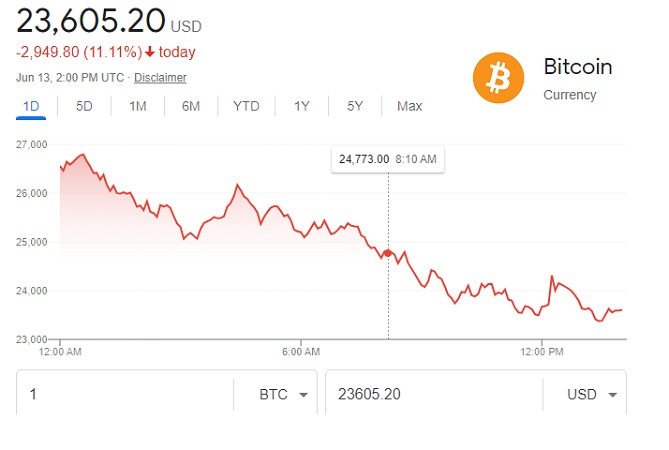
Bitcoin  BTCUSD, -14.66%  has slumped around 12% over the past 24 hours, last trading at levels not seen since late 2020 of around $24,228, with a low in that period of $23,822. Those represent levels not seen since late 2020. Bitcoin is down more than 60% from its November 2021 high.

Ethereum ETHUSD, -17.80% fell more than 17% to around $1,246, hovering at an early 2021 low, after touching $1,180. Meme coin Dogecoin DOGEUSD, -18.60% lost 17%.

Bitcoin Drops to $24k, Adding to Fears that the Crypto Market May Be Heading for Worse

Comment Below

The most valuable and precious things are the ones wanted by everyone but only few can get them. The value doesn’t increase because of increased utility, but rather because it’s very difficult to acquire.

There is inflation in energy and food, so if you keep money on crypto, to what end exactly? The price would have remained up if it has a single supply source, with limited quantity; but as long as people can launch their own coins, the market will remain chaotic.

If you are holding coins but seriously in need of gas, but no one is willing to take your coins in exchange for gas, you are still in deep trouble.

Only things that are productive on their own command greater value, money is not productive on its own, because you cannot eat money. If you are hungry and they serve you food, it’s problem solved; but if they give you money and you can’t find food to buy, you will still die of hunger, while having money in your pocket.

Those who have things that matter will always attract money, but those who have money may not be able to attract things that matter.

Key Insights and Foresights from 148 Nigerian Public Companies in 99 Years

0

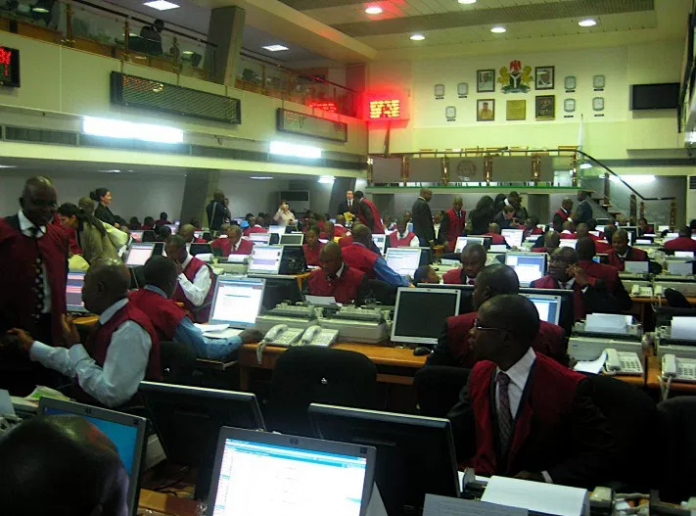
In 1961, the Nigerian Stock Exchange was established. It is a privately held company that assists firms in raising funding for scaling up or financing existing expansion. The Securities Exchange Commission was founded a few years later, in 1979. These suggest that the capital market began as soon as the country gained independence in 1960. The Nigerian Exchange Group has replaced the NSE, which is regulated by the Securities and Exchange Commission.

This piece is not about disclosing the legal and regulatory frameworks that govern capital market participants. Rather, it concentrates on the NEG database’s quality. After several hours of searching the database, our analyst discovered that 148 companies were reported to be incorporated between 1920 and 2019. There were 79 companies with the year and date of listing out of this total. Companies were more listed between 2000 and 2009, 2010 and 2019, while companies were more incorporated between 1990 and 1999, 1960 and 1969, according to further analysis. Despite the large number of firms established between 1950 and 1969, our analysis finds that just a few were listed on the Exchange.

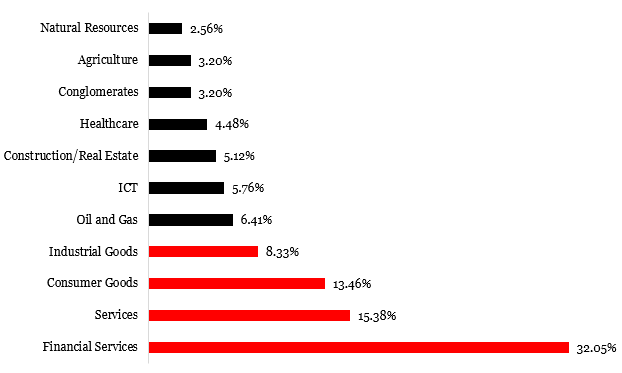
Exhibit 1: 156 Companies by Sector

Source: Nigerian Stock Exchange, 2022; Infoprations Analysis, 2022

Sector-by-sector analysis shows that over 32% of 156 companies are operating within financial services. Services other than finance also dominate with 15.38%. Consumer goods and industrial goods are in the third and fourth position respectively. Our analyst notes that the presence of companies from service sector could be linked to the relative growth of the sector over the years in Nigeria. However, the low representation of corporations in the oil and gas, ICTs, construction/real estate, healthcare, conglomerates, agriculture, and natural resources sectors could not be related to the sectors’ recent underperformance in terms of nominal GDP growth rates. Instead, it should be connected to variables including company size, a lack of interest in attracting public investors, and having too few shareholders to qualify for a listing.

Exhibit 2: 79 and 148 Companies by Decade of Listing and Incorporation

Source: Nigerian Stock Exchange, 2022; Infoprations Analysis, 2022

Moving forward, our analyst believes the NEG and SEC should focus on improving data quality by adding necessary variables or indications to the existing database. It’s astonishing that NEG is unable to search the Corporate Affairs Commission’s database for adequate evidence of company incorporation years. Simultaneously, the Group is neglecting to use company data in the creation of the CEO database. Our analyst expects parties to collaborate on data collection and administration.

World Bank Predicts More Nigerians, Africans To Fall Into Extreme Poverty

0

The impact of the Russian-Ukraine war has no doubt had a crippling effect on the world, with the African region being the worst hit. The world bank has predicted that more people in Nigeria and its sub-Saharan neighbors are expected to fall into extreme poverty.

A report by the World bank via a newsletter titled “Global Economic Prospects”, disclosed that the invasion of Ukraine by Russia, affected the commodity in the market, supply chains, inflation, and intensified financial conditions which have led to the slowdown of economic growth.

The World Bank further disclosed that the high global inflation caused by the war could result in tightened monetary policy in advanced countries which might lead to financial stress on emerging markets and developing economies.

According to World Bank President, David Malpass, he disclosed that the world is facing the deepest global recession since world war II. In his words, “The global economy is facing high inflation and slow growth at the same time. Even if a global recession is averted, the pain of stagflation could persist for several years, unless major supply increases are set in motion”.

No doubt the Russian-Ukraine war exacerbated the supply of food to other regions, and also threatened global economic growth, with the African region as the worst hit. It has been predicted that more people in sub-Saharan Africa are expected to fall into extreme poverty, especially in countries reliant on imports for food and fuel.

It is a known fact that Nigeria is highly reliant on importation for its food supplies and fuel. Therefore, the prolonged Russian-Ukraine war has significantly increased poverty in the country which for Nigerians, could increase the risk of social unrest.

It has been predicted that the Russian-Ukraine war could reduce the disposable income of Nigerians, which will no doubt affect the standard of living for a lot of Nigerians. Ukraine and Russia are known to be the largest producers of grains and wheat in the world. The war, therefore, affected the demand and supply of wheat which saw many African countries faced with extreme hunger.

The economy of Nigeria is unfortunately a monocultural one with high dependence on oil which is not enough to boost the economy. Importation of food has been expensive, due to the effects of inflation. Despite the distance of Nigeria from the war zone, the country has however not been immune to the effect of the war.

The country is currently battling with high inflationary pressure and food supply chain disruptions. The surge in food prices further puts a strain on the local market, since Nigeria largely depends on importation to meet local demands.

The continuous increase in food commodities and other necessities in Nigeria indicates a continuous dent in the purchasing power of average Nigerians, which could in turn reverse the movement of Nigeria’s consumer price index.

Due to the negative impact of the Russian-Ukraine war on the Nigerian economy, there is a need for synergy among all tiers of government, at this critical time to respond collectively to the dwindling economic crisis.

There is a strong need for the government of Nigeria to diversify the country’s economy, which could be a panacea for Nigeria’s economic development. The economy has for decades leaned on the fragile leg of crude oil. It is a known fact that for a country to attain growth and development, the economy has to be diversified.