DD
MM
YYYY

PAGES

DD
MM
YYYY

spot_img

PAGES

Home Blog Page 5129

Nigeria’s Big OPEN: The Age of Open Banking Is Here and New Opportunities Await

0

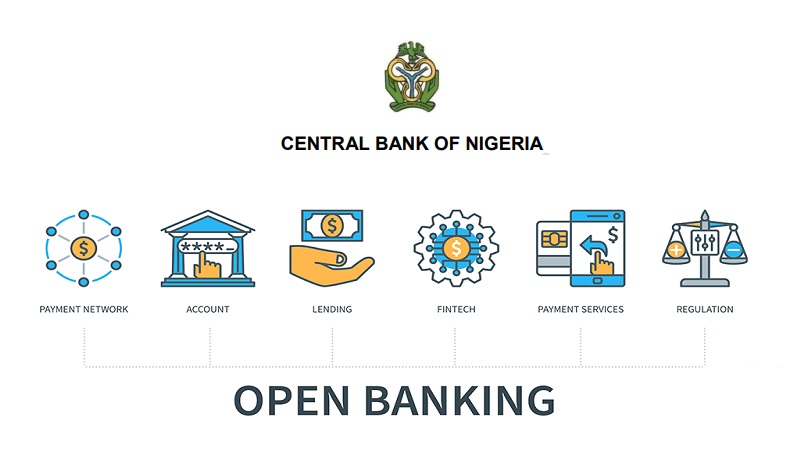
The Central Bank of Nigeria has published a 61-page operational guideline on Open Banking in Nigeria. Through this new ordinance, the apex bank is working to see how data could be shared across the broad financial service ecosystem to deepen innovation in the nation. With this, fintech startups can tap into bank customers’ data via APIs, and deliver services to those customers. The overriding philosophy here is that by sharing data, customers would be better serviced, compared to when the data is disparate and siloed.

“The Regulatory Framework for Open Banking in Nigeria established principles for data sharing across the banking and payments system to promote innovations and broaden the range of financial products and services available to bank customers. As a result, open banking recognises the ownership and control of data by customers of financial and non-financial services, and their right to grant authorisations to service providers for the purpose of accessing innovative financial products and services. 

“This is anticipated to drive competition and improve accessibility to banking and payments services. Participants in open banking shall adhere strictly to security standards when accessing and storing data, and shall be subject to minimum privacy standards, operational standards, risk management standards and customer experience standards as prescribed by the Bank.”

Tekedia Mini-MBA will run a session on Open Banking, looking specifically at the new CBN guidelines, during our next edition which begins June 6. The non-profit Open Banking which has championed this redesign in Nigeria will lead it.

Download the document here and begin to study it. This document will change how fintech startups and even banks will operate in Nigeria, going forward. Imagine if you launch your company today, and magically you can have access to millions of customer data warehoused in banks’ siloed databases? Yes, all GTBank, First Bank, Zenith Bank, etc customers become “available” to you via APIs.

New business models would need to be created and the end-game will now move to the best customer experiences because the moats to the castles are out! Join us at Tekedia Institute as we examine these evolving paradigms. Yes, new business models would need to be created and massive opportunities await. 

https://youtu.be/vVKGnSoQtGQ

An explanation of open banking using the UK system.
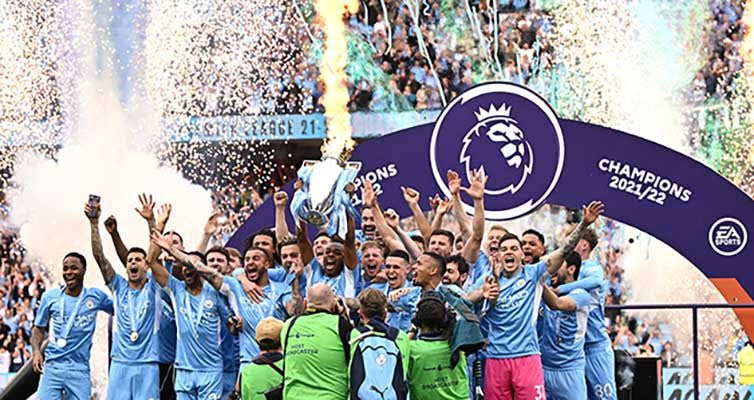
Manchester City narrowly escape avalanching Liverpool to win domestic title for the 4th season in 5 years

0

City finally had their thirst for silverware quenched as they claimed the English Premier League on Matchday 38. Guardiola’s men overhauled a two goal deficit to put an end to the writing of a Liverpool fairy-tale

37th and 69th minute strikes from Matty Cash and Philippe Coutinho were seemingly going to stab Guardiola and hand over the trophy to Jurgen instead but the former fought hard and pulled as many stunts as it took to turn around within the space of five minutes.

Guardiola’s tactical prowess was once again a card up City’s sleeve and worthy of some eulogy as the Spaniard made tactical decisions late into the match that turned it on its head. Guardiola’s technical know how for the game was highly rewarded as off-the-bench IIkay Gundogan bagged a brace in the 76th and 81st minute respectively while Rodri’s 78th minute equalizer was assisted by Zinchenko who replaced Fernandinho.

City were careful not to let loose of the reins like they had done in Madrid earlier this month and they were able to see this one through. Jurgen Klopp and his men also registered a 2-1 win over Wolverhampton Wanderers but Gundogan’s match winner proved effective and had the final say as Liverpool finished strong nonetheless runners-up

It’s not about Liverpool failing to win the cup, it’s about City being phenomenal. Liverpool chased with all strength and pace but City simply capped up all their efforts. Klopp and the players tried to fight back, get into the driving seat but The Sky Blues were better by an inch.

Reminiscence

It’s not the first time an EPL season has ended in such competitive manner between two massive Titans. The 2021/22 season is infact a remake of the 2018/19 season, one in which Liverpool also chased all the way to the end but despite amazing resilience failed to outwit their Blue rivals. During this particular season, City were strong in the game, finishing with an outstanding 98 while Liverpool were just a point inferior at 97. Liverpool were good, City were better. It’s no fault of Klopp’s or The Reds’ that they had a simply classier or more difficult competitor in form of Manchester City. There was nothing Liverpool could do about this. They did their homework; only they didn’t stop The Citizens from doing theirs, as a matter of fact, Etihad did even better on this course.

Manchester City have now won the EPL four times in the past five seasons. Their prolonged reign began in 2017/18, Guardiola’s second season in charge and the blue outfit have gone on to win four titles since then. But there remains a longing for the entire City verse and that is the UCL. So far, the Spaniard has experienced seasons of disappointment playing in Europe. Madrid, Chelsea, Lyon, Monaco, Liverpool, Tottenham are the six clubs who have obscured City’s dreams to quintessential european glory during Guardiola’s tenure.

For today, City will try to forget the infamous night in Spain, the aura, their UCL jinx, they’re going to focus on yet another milestone they’ve achieved. They’re the champions of England, they crushed Liverpool’s dreams of a quadruple, they’re now second placed in terms of number of EPL trophies, 6 behind United’s 13. With a lease of new life, they’ll look to the next season, perhaps they can make it this time around. BUT FOR NOW, MANCHESTER CITY ARE ONCE AGAIN CHAMPIONS OF ENGLAND.

On Tony Blair’s Remarks At Africa Tech Summit In Nairobi

0

The Africa Tech Summit graciously held sometime in February, 2022 in Nairobi, the Kenya capital territory, West Africa.

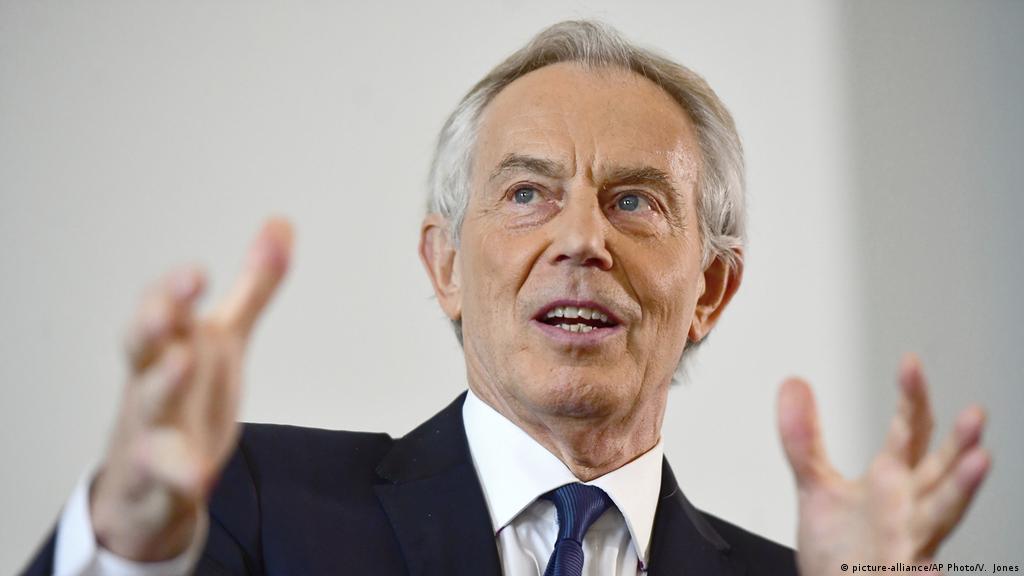
At the summit, the erstwhile Prime Minister of the United Kingdom (UK), Tony Blair who was a guest speaker, elatedly opined that the tech revolution continued to redefine what was possible – for individuals, states and societies – and Africa was in an excellent position to harness the power of technology for good.

The British statesman said in a pre-recorded conversation, that, “Technology is changing the world, it’s the 20th Century equivalent of the 19th Century Industrial Revolution, but it moves at an even faster pace. This is a real moment of opportunity for Africa.”

He therefore challenged the audience to help create an environment that fosters tech and supercharges start-ups across the continent.

He further hinted, “The cost of regulatory compliance for tech start-ups that want to scale is just too high, and investment in Africa’s tech ecosystem is still way below what other parts of the world are getting”.

“You can have the greatest idea in the world but unless you have the access to capital, it’s very hard to make it work.”

It’s noteworthy the Tony Blair Institute For Global Change  works in 25 countries around the world, 16 of them in Africa, brokering strategic partnerships between governments and leading tech companies towards harnessing the power of technology to change people’s lives.

Citing his Institute’s tech-based work in Senegal in the health sector, and in Rwanda in the agriculture sector, Mr Blair disclosed his teams were involved in real projects on the ground and he kept seeing immense opportunity for growth led by African entrepreneurs, tech start-ups and governments.

In his words, “The challenge is both within the tech sector and from the government to find ways to give this work legs, to make it move as fast as possible. We have got to understand the big gap between where we are and where we need to be in Africa.”

Mr Blair told the audience there were three things, as outlined in a newly published report (LINK TO COME) by the Institute, that were really important for Africa in order for it to supercharge its tech ecosystem.

According to him, “The first is access to funding, which needs to be a big part of the conversation we have with international financial institutions – it’s certainly a large part of the conversation we have at the Institute – as to how they help create bigger pools of venture capital and are prepared to partner with venture capital funds that are looking to come into Africa but we need much more capital and seed funding going into Africa.

“The second is the right regulatory environment in country to support the growth of technology, for things like financial services.

“The third is the African Continental Free Trade Area agreement, which is a big opportunity that’s going to create the largest free trading market in the world, allowing people to develop products and start exporting them across the continent.”

It’s worthy of note that the home to the world’s largest free trade area, and with the highest rates of entrepreneurship in the world, African tech creators, are already generating some of the most exciting innovations in the world.

Mr Blair, however, told the audience that he felt optimistic about the future because all over the world, young people were starting their own businesses.

He then concluded by saying, “The question everyone asks is, how do we do more?”

It’s very obvious that though the African tech sector is obviously booming as the days unfold, the prime challenge being faced by it remains insufficient access to the required capital, as was highlighted by Mr Blair. This therefore is one of the major areas the concerned authorities need to seriously consider.

The second main challenge remains the lack of the needed enabling environment to thrive. The environment is so conspicuously hostile that it has ended up compelling most of the tech start-ups in Africa to seek greener pastures elsewhere. This must equally be addressed headlong to avert colossal brain drain, as I have hinted in my earlier analyses.

The BIG Eclipse: MTN Nigeria Is Worth More than All Banks, All Insurers, All OFI Combined!

10

Every decade, there is a massive translation in the Nigerian economy. The decade of the 1990s gave us the new generation banks. They used technology to rewire the ordinance of banking systems – and they experienced glory.  The leading banks of today like GTBank and Zenith Bank were born in that era.

In the decade of 2000s, the voice telephony era came with MTN, Glo, and Airtel. They brought a new ordinance in communication and they changed the economy.

In the decade of 2010s, it was a time for mobile internet. Yes, our phones became computing devices with access to the internet. New vistas were unlocked.

But you know? We’re in the application utility era, the decade of 2020s, where software and service systems will unlock values out of those connected devices at scale. The transformation is huge, across industries and territories. 

From logistics-tech to fintech, from agtech to edtech, and indeed all sectors, software systems will “eat” and “save” the world of commerce. And as that happens, telcos will SMILE to the bank. They will smile because their data is powering that future – and everyone is working for them. Whatever you do that needs data, you are expanding the world of telcos. Telcos are the kings in the market.

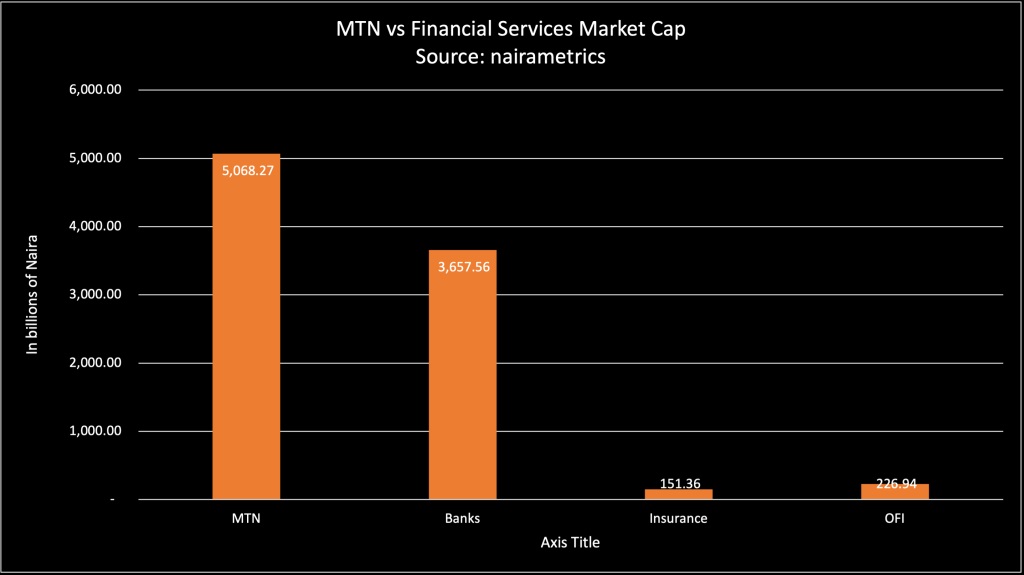
That is now evident in the Nigerian stock exchange: MTN Nigeria has a market cap that is bigger than all banks, all insurance firms, and all other financial institutions combined: “MTN was briefly the most capitalized stock two weeks ago when the share price was trading at N264 per share valuing it at N5.3 trillion… The entire Nigerian Financial Services sector which includes banks, insurance companies, and other financial institutions is valued at a combined N4 trillion.” (Fintech companies like Flutterwave, Interswitch, OPay, etc are not included as they are not traded publicly in the Nigerian Stock Exchange.)

MTN Nigeria belongs to a category of companies termed SWOOTs by Nairametrics which means Stocks Worth Over One Trillion Naira. Other members of the group include Airtel Africa (N5.5 trillion) Dangote Cement (N5.1 trillion), BUA Cement (N2.5 trillion), Nestle (N1.1 trillion), and BUA Food (N1 trillion).

The challenge next decade (2030s) will be which entity becomes the operating system of this application utility era in Nigeria: satellite-based providers or GSM-based providers? But before that, the economy belongs to Airtel and MTN! That ordinance is consistent with how nations have evolved on the technology stacks except that Nigeria is evidently slow here.

From these companies, one can also pick the states of the economic developments: Nigeria’s is still emerging with cement and food catalytic while in the US, those have since passed their growth phases. While Nigeria bets big on the infrastructures of the digital economy  with MTN and Airtel, the US is focusing on the utilities built on those infrastructures with the core infrastructure players largely not dominant.

What Nigeria and United States Largest Public Companies Teach About their Economies

Comment on LinkedIn Feed

Comment 1: Being a privileged elite sometimes means breathing rarefied air. The upper echelon sometimes is not aware of the plight of the ground floor and how difficult life is.

Meanwhile the energy and currency crisis in Nigeria has prevented 50% of the arable land to go uncultivated. The failure of governments in recent years have come to roost. While the world struggles with record inflation and a lack of food the elite are never cognizant of the hunger felt by the poor.

Wheat grown in Europe is staying in Europe. Africa will see little of that essential commodity. But that’s not necessarily the current problem as African nations don’t consume it in any great quantity anyway. A greater problem is one of cassava production, where because of the economic situation and energy instability, has been declining. Cassava flour is very energy intensive and becasue of the situation on the ground the negative impact on production has a double negative affect.

The poorest always feel greater pain during instabilities. The elite feel very little, often just an inconvenience. While MTN rise, with their technological advocates by their sides patting them on their backs, many use their last few Naira to pay their service fees instead of seeds or food

My Response: great observations. Unfortunately, you did/will not skip meals today because the guy in Ukraine, Somali, Mali, Afghanistan, etc has not eaten. In this world. we’re all guilty. In college, food was a luxury in the bukka. Then, I began work in the bank and my problem was to eat right. I came to America, I now spend money to avoid eating recklessly. MTN is not the problem; you are not the problem; Ndubuisi is not the problem. But the day you run and hold a political office, I will say you have a problem to deal with. Political leaders are supposed to structure economies for the RISE of All. Private entities are largely focused to become best in their missions. That is noble!

Arsenal missing out on UEFA Champions League: Arterta’s fate

0

Back-to-back defeats have been the nemesis of the Gunners. With fellow contestants Tottenham and Newcastle getting the better of the North London side, Arterta’s men are plunging deeper, falling away from the UEFA Champions League (UCL) prospects and the graces of Europe’s elite competition

The Gunners who were on a three game losing streak were able to upturn their fate, pulling on the strings as they withstood Chelsea, United and Westham. However, they failed to follow up with their improving form as they succumbed to The Lily whites and the richest club in England.

Rewind to three matchdays ago, post-Westham victory, the Gunners looked like potential competitors in next season’s UCL. With 63 points harnessed already, the 13-time league winners were seemingly out of harm’s way and well on course to making a return to the grandest stage, one they exited in a humiliating manner back in 2017 (a 10-2 defeat at the hands of a ruthless Bayern Munich). When compared to Tottenham’s 61, it was a bit of logical to say that the latter were in the driving seat for the race to the last undecided spot of the league.

However, a lot has happened to Arterta’s side since then. After defeating Leeds, the Gunners have started to fall behind in the race to make it to the UCL. Matchday 36 saw a painful 3-0 defeat to the North London neighbours and fellow top four contestants. As if that wasn’t enough, Newcastle who have nothing to compete for this season stabbed the hearts of the Gunners, players and supporters with a 2-0 upset on Matchday 37 to seemingly seal the fate of Emirates residents. Gradually, the fairly tale and story of possibilities has now turned to a near-impossible and illogical feat to achieve, a tale of sloths outrunning cheetahs.

With one match remaining in the league, it is almost definite that Arsenal have missed out on their dream competition. Considering the criterion for leapfrogging Conte’s men, Arsenal race for the top four is infact a Penelope’s web. Tottenham sit two points ahead of the red and white outfit. They have a relatively large goal difference of 24 compared to Arsenal’s somewhat miniature 9. Should Tottenham draw, Arsenal must find the back of the net at least 15 or 16 times, an extensive taking to the cleaners and a task that can be compared to herding cats. Tottenham must lose to Norwich while Arterta and co conquer Everton in a classic matchday 38 battle

The opponents make it a little difficult for Arsenal to turn this around. On head to head statistics, the Merseyside Blue team fare better than the North London side. In total matches played, they have 17 more wins than Arsenal i.e 84 when compared to Arsenal’s 67. The past three games between Arsenal and Everton ended in three wins for Everton. This statistics are not an uphill to climb as residents of Emirates are capable of coming out on top in this contest. However, if Arsenal are to make it to Tuesday nights, two things have to happen which makes it more difficult.

They have to beat Everton and simultaneously watch Tottenham lose to Norwich. They can’t win and let Tottenham win neither can they lose alongside Spurs. Rather, they must win and watch Spurs lose too. The stats prove this to be a backbreaking task as Norwich last defeated Tottenham in an EPL match in 2014. Surely, Arterta and all Gunners have a very steep hill to climb if it’s at all climbable.