DD
MM
YYYY

PAGES

DD
MM
YYYY

spot_img

PAGES

Home Blog Page 5197

My “3T2030 Plan for Greater Nigeria” Will Unleash Prosperity, Strong Rural Economy and Abundance for All

2

Good People, never doubt the capacity of Nigerians to fix the current paralysis in the nation. This nation used to work. Many things seem like fictions these days but just decades ago, we were on the path to the mountaintop. Remember, decades ago, Nigerian scientists were creating vaccines approved by WHO (check cholera) out of our universities. Today, we have to wait for Pfizer, Modena, etc to save us! We will fix that because we’re as smart as those guys.

As I welcome Prof Osinbajo (he declared for Presidency this morning)  and other politicians into the arena for the next President of Nigeria, I make it clear that Nigeria can cut poverty by half, deepen industrial competitiveness, elevate rural Nigeria,  etc within 4 years. I have no party affiliation but “running” for a federal ministerial position. In my 3T2030 Plan for Greater Nigeria, I posit that we can create millions of low middle class citizens in Nigeria within two years. How?

Go back to any plot of gross world product (aggregate of global GDPs) over the last 2,000 years. There is one thing that is consistent: property rights. No nation has developed without property rights and until nations have built that capacity, they cannot advance. The efficiency of the utilization of factors of production has always tracked strengthening of property rights.

My plan is simple: expand the national balance sheet by unlocking dead assets in rural Nigeria. We will put property rights on all lands, farmlands and properties, enabling transferable velocity in them.

I will do that within the first few months, using startups to grow and map lands. Each local government area will use its young people to do this job, and we will provide a market-driven process that will not cost the government anything. The plan is to make it easier for people with land assets to have access to credits even as we improve the ease to buy and sell these assets.

The ministry of lands under the existing land use act will receive immense technology evolution by bringing innovators to drive property rights in Nigeria. I expect to unlock massive wealth and open new vistas for a dynamic rural economy in Nigeria. Yes, anyone with land  or property will suddenly become rich! I want those properties to show in the national balance sheet; today, they are invisible!

If we do that, I expect at least 5 million families to move into the low middle income class. Imagine inheriting 100 hectares of land which will now show up in the national “balance sheet” of Nigeria giving you the opportunity to access credits in your local bank for your business, or even easily sell one hectare to educate your children.

More so, with stronger property rights, developments will come to rural areas and agriculture will blossom. How do you expect someone to invest long-term in assets he does not have legal rights? Part of the problems with agriculture could be traced to our property rights. That would be fixed.

As Your Federal Minister, I Will Fix Nigeria’s Educational System


The Death of Mrs Osinachi Nwachukwu: The need for the declaration of state of emergency on Domestic violence in Nigeria.

0

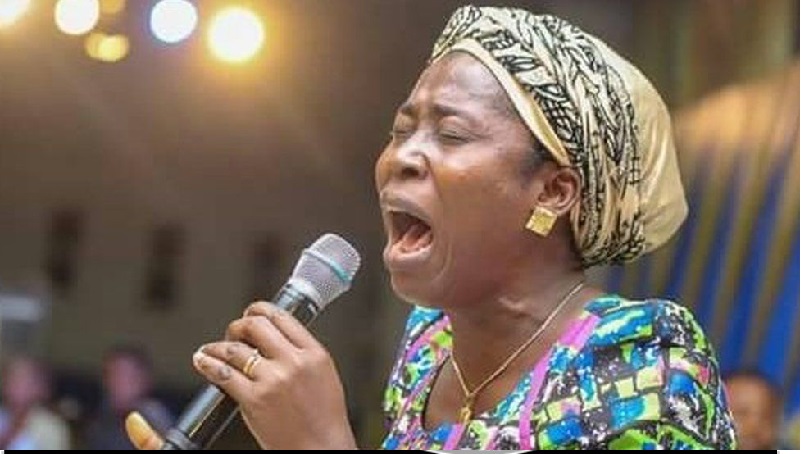
The famous gospel singer, Sis Osinachi Nwachukwu was reported to have “joined the saints” last week. The report claimed she died of cancer while her family members and close friends/ associates are clamoring that she died of domestic violence from her husband. Some gave a vivid report on how her husband had turned the late gospel singer into a punching bag landing her in the hospital on numerous occasions before she finally gave up the ghost.

Although, these reports are merely speculations and accusations; legally speaking, they are just accusations against the husband of the late singer until the law enforcement agents carry out an intensive investigation to determine the veracity of this accusation.

But this is not the first time reports are making around the media of a wife being murdered by her husband. Not quite long, a traditional ruler in Ondo state physically assaulted and sent one of his wives to her early grave. It seems we have forgotten about that and the case and swept it under the carpet.

Every day, there are incidents of family violence in Nigeria, the ones that make it to the media are the ones we know about.

Last year, specifically on the 27th of February, 2021, the Guardian Newspaper reported that at least once a week, there’s a case of a man beating, maiming, or killing his wife in Nigeria. 

Domestic violence is a big deal in Nigeria and it doesn’t seem to be ending any time soon because it appears that some cultures and religions have accepted and approved some form of domestic violence. For instance, some cultures and religions encourage a man to beat up his wife as a way of cautioning her, even the penal code legalizes a man beating up his wife as a way of correcting  her if she “misbehaves”. S 55(1)(d)  of the penal code made this provision: “Nothing is an offense which does not amount to the infliction of grievous hurt upon any person which is done by a husband for the purpose of correcting his wife…”.

Also, Spousal rape which is another form of domestic abuse/ violence is yet to be criminalized. That spectrum of domestic abuse by one partner having a forced carnal knowledge of another partner is not a crime or an offense in as much as the parties are married. It is not recognized or is yet to be recognized as a crime or offense in Nigeria for the husband to sexually abuse or rape the wife and vice versa.

Importantly, it is noteworthy that When we talk about domestic violence as a concept, it is not limited to physical assault by one partner on another partner. In its broadest sense, domestic violence also involves violence against house help/maids, children, parents, or the elderly. It can come in different forms, including physical, verbal, emotional, economic, or sexual, and it can also include the use of technology to stalk harass, control, monitor, or hack a spouse a family member. It is this wide and encompassing.

Western countries like the UK and the US have made several legislations criminalizing the offense of domestic violence and gender-based violence with stiffer punishments. The Uk has made a lot of legislations like The Domestic Violence, Crime and Victims Act 2004, the Domestic abuse act, The Council of Europe Convention on preventing and combating violence against women and domestic violence, which is known as the Istanbul Convention passed in 2011 which the UK is a signatory to are some of the notable laws in the countries that are made specifically to protect the weaker partners in the marriage institutions against physical assault and abuse.

In the USA as well, the Violence Against Women Act (“VAWA”) and many other legislations recognize that domestic violence is a federal crime.

Despite the high rate of domestic violence in Nigeria, It seems that the country is yet to legally step up and do the needful in terms of making stiffer legislation and making sure such legislation is enforced in the fight against domestic violence.

What needs to be done to stop or reduce the cases of domestic violence in Nigeria?

The Nigerian lawmakers should make law(s) that concerns itself specifically with Domestic violence and abuse which provide stiffer punishments for the offense.

Some of these laws that encourage domestic violence like the penal code should be amended. Those specific sections of the penal code like s.55(1)(d) that subtly advocated for domestic violence should be abolished.

Customs and traditions that promote domestic violence should be held to be repugnant to natural justice, equity, and good conscience and therefore cannot stand.

Domestic violence should be treated as a violation of the fundamental right of an individual thereby making it a criminal offense against the state.

Women who are the most known victims of this violence should be encouraged to speak up and taken into therapy and rehabilitation sessions.

These few recommendations should be implemented as soon as possible. 

In conclusion, I will not fail to mention that there are NGOs who are always ready to take up cases like this pro bono; for instance, The International Federation of Women Lawyers (FIDA) is very notable for their  fight against gender based violence, spousal abuse and any form of domestic abuse. They have offices scattered all over the country With their head office located at Block 1, Flat 1, Ankpa Close Ogun Street Area 2, Garki, Abuja. Email:fidanigeria@yahoo.com
Phone: +234 708 849 6115  and their Lagos office is located at 14/16 Makoko Road, Off Herbert Macaulay Way, Yaba, Lagos.

The Cleen Foundation is also one of the notable NGOs doing a lot advocating against domestic abuse in Nigeria. Their headquarters is located at 26, Bamenda Crescent, Wuse Zone 3, Abuja, Nigeria.
Phone number:  +234-7067899368

These and many more are some of the NGOs that are established to fight against domestic violence and abuse in Nigeria. 

If as a victim of domestic violence and any of these NGOs are inaccessible or unreachable to you, you can approach the nearest police station and lay your complaints or can approach any lawyer. Many lawyers including myself (the writer) are always ready to come through and take up any case of this nature Pro Bono. I will always be ready to pull whatever resources necessary to follow up and handle any case of this nature that comes my way; you just have to speak up. My personal email address is infoitooknow@gmail.com

On the victim’s part; speak up, seek help, leave the relationship and stay alive. 


As Your Federal Minister, I Will Fix Nigeria’s Educational System

3

I am not running for President of Nigeria but I desire to be a federal minister in our nation. There are many ministries that I can  transform. If I make it into the ministry of education, I will work to redesign the architecture of our educational systems.

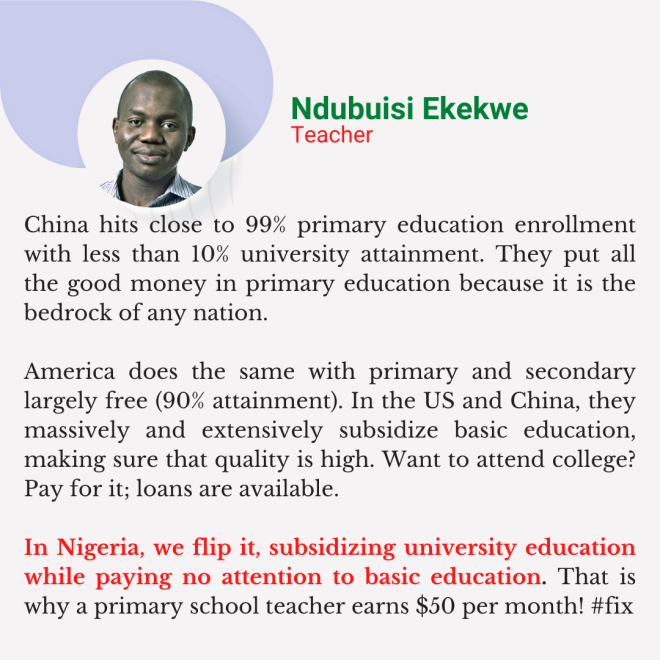
My #1 priority will be to deepen primary & secondary education attainment and quality. China hits close to 99% primary education enrollment with less than 10% university attainment. They put all the good money in basic education because it is the bedrock of any nation. America does the same (90% attainment). 

In Nigeria, we largely  flip it, massively subsidizing university education (which is great) but, unfortunately, paying little attention to basic education. That is why a primary school teacher earns $50 per month! 

Under the direction of the soon-Mr. President, we will put massive resources into basic education, drawing from the current budget structure. But as that money goes, we will measure outcomes and drive accountability.

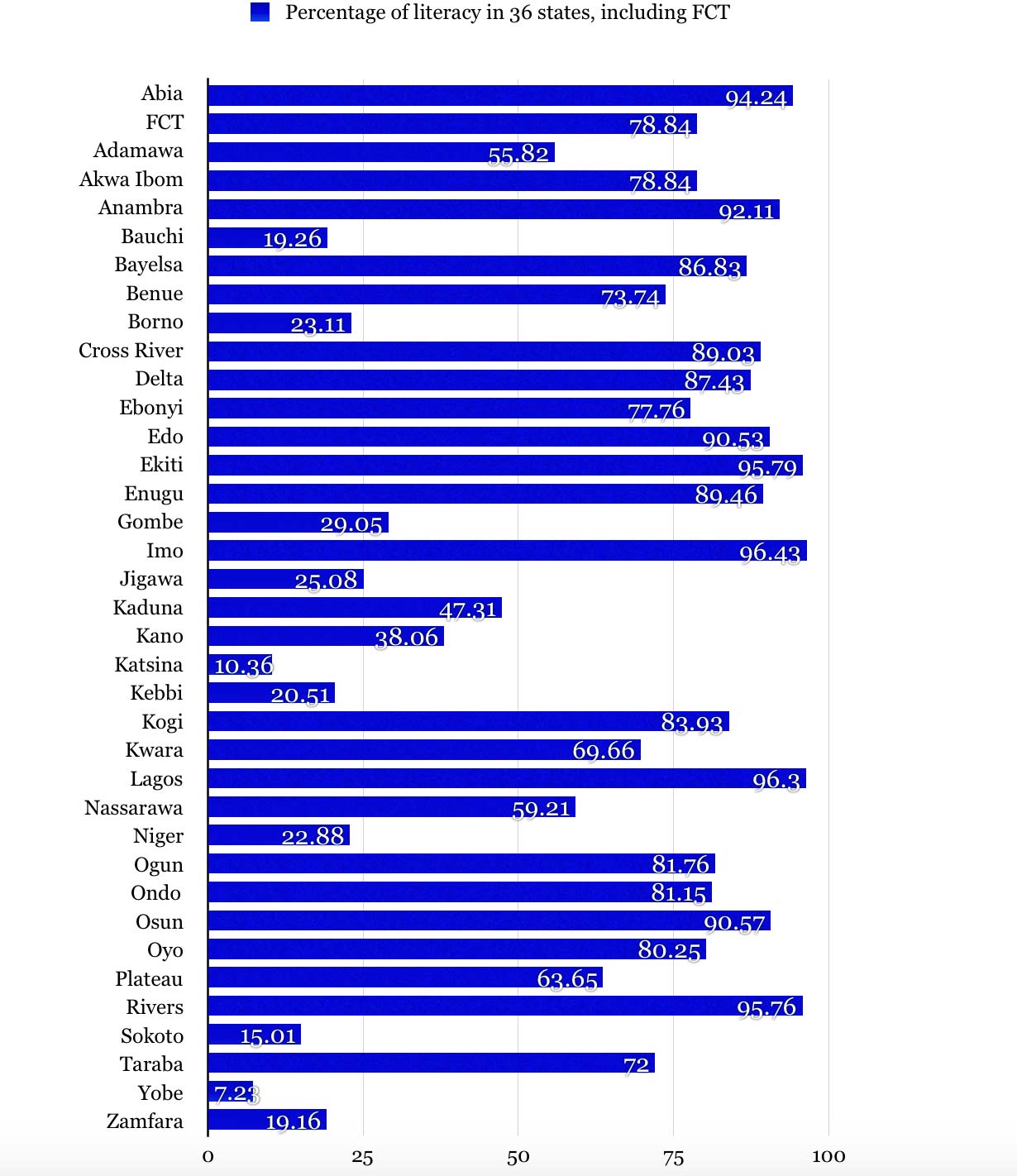
There are many areas we will fix. Looking at the universal basic education fund, you see disparities; some states have literacy rates below 20% while some hit more than 90% but the funding mechanism is largely the same per child, across the nation. So, what happened in some states? We will close that loophole. If Nigeria is sending the same amount per child to states, we expect outcomes to correlate and equilibrate.

Looking at this plot from the government, released a few years ago, there is no way you can spend the same amount per child, and have this type of outcome. That would be fixed.

literacy rate Nigeria (NBS)

At the university level, we will work and present a bill to adjust Nigeria’s tax system with some special deductions for education. Every partnership or donations to universities will become tax deductible, instead of just pure expense. My goal will be to use that vehicle to attract at least $5 billion into the university system purse, by making it easier for local and global firms to work with Nigerian universities (overall, we can hit $10 billion across all levels of our educational systems). If Huawei works with UNN and commits $10m in a partnership research, it can deduct 100% of that; if Microsoft partners with ABU for $20m, it will deduct, etc. Our tax model will activate interests to partner with schools, by stimulating new incentives for companies.

My strategic goal will be encouraging companies to become partners with universities by bringing taxation into their planning models. In other words, if Microsoft wants to set up a design center for $100m, can it spend that money in Nigeria and still deduct it by working with FUTA, FUTO, FUTMinna consortium instead of going alone?

More so, I believe that we can unlock billions of naira internally via local companies through tax structuring. If we do these things and more ideas I will present to Mr. President, the university system will have resources, and our economy will become more dynamic as university-industry relationships will deepen.

Think about it this way: if Innoson Motors wants to hire 1,000 technicians for its Owerri Naze factory. Today, the firm has to recruit and train them outside the university/polytechnic system. Let us assume that the training will cost $2 million; that will be an expense in the balance sheet. 

But under my plan, Innoson Motors can partner with The Polytechnic Nekede to train those 1,000 young people. It will spend that $2 million with the school but in its tax form, it can still deduct that, essentially reducing its taxable income. Magically, you have created an incentive for Innoson to partner with Poly Nekede, and the school will then have the resources it needs.

You can also see this within the window of tax credit which will offset corporate tax even if it is not deductible on  taxable income. 

Restructuring our tax code will unlock $$millions, and as your minister, we can rebuild many fundamental architectures in Nigeria.  ASUU will have resources but it has to work. We will not have strikes anymore as our educational system will become a virtuoso circle of innovation and human development. Today’s structure makes no sense and we will replace it!

The full and comprehensive ideas are contained in my 3T2030 Plan for A Greater Nigeria where I have articulated how to grow Nigeria’s economy from its current sub-$500 billion to $3 trillion by 2030. I will be sharing in piecemeal my ideas across sectors.

In my document, I explain how common sense policies can rewire the structures of our market systems. Under my plan, Microsoft’s planned $100m investment in Nigeria would not have been pure expenses in Redmond USA; I will get it to work with FUTO-FUTA-FUTM consortium ( for at least $20m), and use the tax code to make it tax deductible. That way, these schools will have resources, etc. If we do that, Microsoft can even commit $200m into Nigeria because the more it commits, the more it saves!

Comment on LinkedIn, FB Feeds

Comment: What about the introduction of Federal Student loan.

My Response: At primary and secondary, education has to be FREE. But at the university level, we will provide ways to help people that cannot pay. But it cannot be a “pure loan”. If you borrowed N1,000 in 1995 to attend UNN and you have to pay for it now, I am not sure you are fair to the lender. N1,000 of 2022 is not the same as N1,000 of 1995. (In FUTO, my tuition was N25 in 1998 to give an idea how things have crashed.)

So, looking at currency, you have to make sure the loans track inflation plus prime set by CBN, at least from the 4th year of the loan. With that, you will see lenders show interests unlike today where no one wants to do that because it makes no business sense. We will have policies and executive orders (plus fixes at the National Assembly) to make sure the system works. It will be actionable leadership from those who understand markets.

Comment 2: To reach 3 trillion USD dollars by 2030,  growth rates need to be almost 25% per year over 8 years.  I would be interested to have a look at your economic policies.

My Response: Of course, we have lost some years since I crafted it. But if I document all farmlands in Nigeria and make it possible that 100% are transferable with ease, I can unlock more than $100b in assets which can be used for credits within 6 months. If that happens, those classified as “poor” by the World Bank will become low middle class because most have farmlands they inherited. My model is that banks will move into rural areas, and using those new assets, those men and women can access credits. That translation will anchor a massive boom in rural stimulating economic opportunity. Nigeria’s wealth remains latent because the wealth has no velocity (easy to buy and sell). We will fix that.

Nigeria And The Unharnessed Resources

0

It has become compelling for Nigeria to look inwards toward discovering her entire natural resources with a view to harnessing them for economic turnaround.

Some of the common natural resources on earth are land, water, sunlight, atmosphere, wind, coupled with animal life and vegetation. A natural resource may exist as a separate entity like fresh water and air as well as a living organism such as fish, or it might exist in an alternate form, which must be processed to obtain the required resource to include petroleum, metal, ores, and most forms of energy.

It’s noteworthy that some, including air and sunlight, can be found everywhere, and are known as ‘ubiquitous resources’. Whilst most resources only occur in restricted areas, and are referred to as ‘localized resources’.

There are very few resources that are considered inexhaustible – these are solar radiation, geothermal energy, and air, though access to pure air may not be possible. But the fact is that some of the natural endowments are practically infinite.

The vast majority of the available resources are theoretically exhaustible, which means they have a finite quantity and can be depleted if improperly managed; a good example of this is petroleum. Such finite resources require a sound policy and regulation to be implemented by the concerned government towards their preservation.

It’s pertinent to acknowledge that every man made product consists of one or two natural resources. Needless to say that everything required or used by mankind constitutes, at least, a natural resource. In most cases, some of these resources such as air and water, are directly utilized or consumed by man without processing them.

The above outlined phenomenon proves beyond doubts that humankind cannot survive or strive successfully, as the case may be, without natural resources. This assertion is not unconnected with the reason every rational government makes frantic effort toward adequate use and preservation of the resources found within their jurisdiction.

In Nigeria, hundreds of natural resources abound, in which each state including Abuja is a beneficiary. Some of these resources are petroleum, tantalite, lead, zinc, glass-sand, copper, gemstone, crystal, oil/gas, bitumen, phosphate, gold, coal, clay, salt, gypsum, iron-ore, uranium, and limestone, in addition to sunlight, wind, land, water, vegetation and air that are ubiquitous in nature.

Some of the aforementioned substances can enable any country to massively embark on agriculture, and attain to any desired height. Nigeria does not possess just land, but a well fertile land that can produce crops in any quantity and quality. Her vegetation and atmosphere are equally invariably good enough to raise every kind of animal life, including wildlife.

Though crop and livestock farming used to be the talk of the day in the Nigerian society, it’s sad to note that currently such lucrative occupation is being relegated to the background owing to over-reliance on mono-resource, petroleum.

It’s really high time we as a people desisted from this irritating high level of dependency that has eaten deep into our socio-economic bone marrow, especially at this time the crude oil price has globally fallen.

Proper utilization of clay alone can take the country’s tourism industry, that’s presently moribund, to enviable heights. Same is applicable to the use of other similar compounds or metals that are in abundance across the federation, to include uranium, limestone, and gold.

In the same vein, it is disheartening that an essential mineral resource like coal has, over the decades, been swept under the carpet. Coal can be used to produce energy, both in the form of heat and electricity.

It’s mind-boggling to hear that a country like Nigeria that can boast of abundant sunlight, wind and what have you, is still battling on how to generate steady and reliable electricity, whilst countries like U.S.A, Russia and Germany, blessed with just limited amount of the resources, are invariably experiencing uninterruptible power supply.

Away from energy, it could be observed that our forest reserves that could produce enough timber for importation are currently wearing a pathetic physiognomy as a result of docile policies.

Indeed, Nigeria is densely endowed with various lucrative natural resources, but it’s very sad that the governments at all levels are not doing enough as regards the adequate use and conservation of the resources. Hence, this calls for drastic turnaround via deployment of genuine political will.

Now that the sale of petroleum resources is no longer booming, it’s high time we retraced our steps with a view to ensuring that each of the available resources is thoroughly harnessed for the needed economic emancipation.

It’s noteworthy that Nigeria’s leadership has overtime borne great and amazing ideas, but the fundamental plight remains inability to formulate powerful and reliable policies and their consequent implementation.

The government really needs to ensure adequate conservation and sustenance of these natural resources, through implementation of strict and viable policies cum laws, and their proper enforcement.

Most of these needed policies such as Land Use and Forests Reserve Acts, which were duly upheld in the past, are presently abused or overlooked in virtually all quarters within the shores of the country.

They need to be urgently revived, make apt amends where necessary, as well as introduce new ones in a bid to attain the required emancipation of the country’s economy, which is currently in a dilapidated state.

On the other hand, individuals on their parts ought to equally think outside the box with a view to diversifying their respective sources of income to avert the foreseen state of doom. The good news is that, if the needful is done henceforth, the current economic hardship will surely be regarded as a blessing in disguise in no distant time.

Hence, it’s high time the concerned authorities acted as expected.

Ukraine War – A Negotiation Between NATO and Russia Now Necessary

2

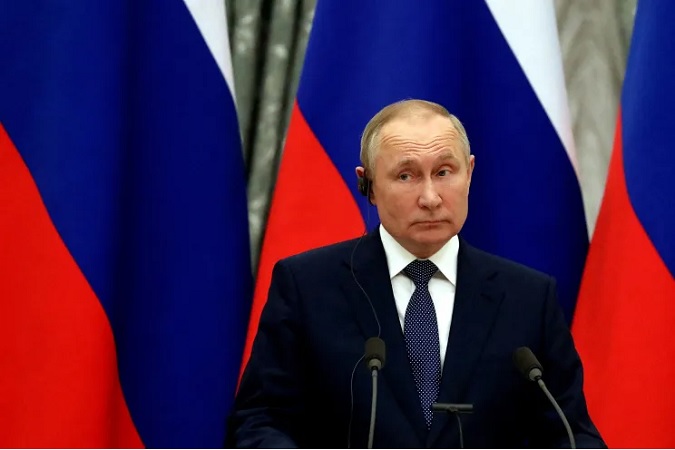
Our world may be in for a really long summer or rainforest season depending on where you live. I watched videos on Russian websites where citizens are waving as soldiers move to Ukraine for battle. As that is happening, possibly, in the Western part of Ukraine, NATO weapons are flooding into Ukraine. This is not looking good: as Russia upgrades itself, NATO ships more weapons to Ukraine – and the theater is in Ukraine.

So, who loses? The guy who runs out of supplies first. Certainly, on paper, Ukraine has an edge to win since NATO can supply weapons till eternity. But will that mindset end the war since Russia, even after retreating, if it runs out of gears, can come back in 2 years when it has more resources?

People, this is NOT good for Ukraine and the world. This is now a loop – and a vicious circle of evil; working on a ceasefire makes better sense. A negotiation between NATO and Russia may even make more sense now since both are “fighting”, extrapolating on the sources of weapons.

Comment on LinkedIn Feed

Comment 1: Ukraine has won this war. The important thing is that the West, NATO and EU ensure that Ukraine doesn’t lose to Russia. This is DerangedPutin end game and as a tyrant he must win also to remain a tyrant. The Battle for Kyiv was won by Ukraine and the Battle for the Donbas would also be won by Ukraine. The odds aren’t now in favour of Russia.

My Response to 1: “Ukraine has won this war.” If Ukraine has won the war, what has Russia lost? I find that mindset ridiculous from CNN, BBC, etc when technically Ukraine is being levelled, citizens killed, etc and yet to use the word “win” for Ukraine means Russian has “lost”. When the Europeans wanted to colonize Ethiopia and they fought back, did Europe lose? Was there anything to lose by Europe to start with?

User Response to Comment 1: how has Ukraine won the war when it has lost crucial territory? It has lost 80% of it’s coastline along with the posts, it has been blockaded by the Russian Navy Black Sea fleet. A considerable chunk of the Donbass is under Russian control along with territory like Melitopol, Kherson, Berdyansk, and Mariupol. The land bridge by Russia is complete, and fresh water from the Dnipro river for Crimea has been fully secured with the Ukrainian built dam to starve the peninsula destroyed. To add to all these Russia controls Ukraine a skies and Ukrainian military units in the cauldron at the East face possible annihilation. So pls tell me, how’s that winning the war?

(1) Demilitarization of Ukraine: Russia has practically wiped out the Ukrainian Navy, and considerably decimated Ukraine’s Airforce and Air Defences. Defence of built up areas in Ukraine presently favours the defenders (i.e. Ukraine), but the Ukranians can’t presently launch a decent mechanized counter-attack because the military has been seriously degraded. That’s why they’re crying for more weapons with the Czech Republic rushing in old Soviet era T-72s and BMPs in limited numbers, and the Australians Bushmasters MRAPs.

(2) Denazification: All I have to do is point you to Mariupol, the home base of the Azov Battalion. The battle is almost over there with the Azov Battalion resistance pretty much driven to the edge of the sea and split into smaller pockets of resistance by the Russian military, thus making coordination impossible. In the last few days scores of Ukranian Marines have surrendered with 2 attempts to perform a hot extraction of Azov Battalion leadership by air failed woefully with the Ukrainian helicopters shot down. In a nutshell the Azov Battalion is almost finished as a fighting force, the only saving being that the Russian Navy are not too keen to unleash their firepower on the industrial estate and port they currently occupy for their last stance.

(3)Regime Change and NATO Membership: In week 2/3 of the war, Zelensky clearly stated that joining NATO was no longer feasible. In response the Russians said that they will no longer pursue regime change. Let me equally point out that any future talk of joining NATO is no longer possible as Russia presently occupies a portion of Eastern and Southern Ukraine along with it’s skies and waters, plus any form of membership will place NATO in direct confrontation with the Russians

In summary, the Russians have considerably succeeded in objective 1 and 2, and have basically won objective 3

Comment 3: The same people who preach peace and democracy are messengers and orchestrators of war. Between hypocrisy and deceit, all the leaders of the world are sitting comfortably somewhere in the middle. Once you make truth the first casualty of war, the moral and ethical guardrails guiding humanity are automatically pushed below zero. Ukraine soil is the testing ground for two counterforces fighting for the soul of the earth, unfortunately both are evil…May the Spirit of God go forth and renew the face of the earth.

video credit: takj