DD
MM
YYYY

PAGES

DD
MM
YYYY

spot_img

PAGES

Home Blog Page 5221

Reviving Nigeria’s Textile Sector Toward Economic Diversification

0

Nigeria’s textile industry was the third largest on the African continent, following Egypt and South Africa. It used to employ over 350,000 individuals when all the textile mills in the country were functional.

The aforementioned figure was about 25% of the entire workforce in Nigeria’s manufacturing sector. It was an indisputable note that the said sector was then the second highest employer of labour, following the country’s civil service.

Between 1985 and 1991, record has it that the sector had an annual growth rate of 67%. Survey showed that the number of mills in operation as at then was about 180 and they were all reportedly doing very well, especially the Kaduna Textile Limited (KTL) and Nigerian Textile Mills (NTM) in Lagos, which were the oldest having been established as at 1957.

It’s therefore needless to assert that the now comatose textile industry was one of the booming subsectors of the nation’s economy during the post-independent era. The current pathetic state of the industry could not be unrelated to the level of neglect experienced by it in recent times owing to the overwhelming dependence on oil revenue.

The obvious decline in, or depreciating effect of, the textile industry could be aptly traced to influx of cheaper textile fabrics from China and India, among others, sold at prices the local mills can’t compete with. This ugly trend has resulted in a drastic downfall of the industry.

It would be recalled that in 2010, the Goodluck Jonathan-led Federal Government (FG) placed a ban on importation of textile fabrics. This approach – like other restrictive trade policies as at then – failed to yield the needed result.

Rather than bringing relief in the industry as expected, the above measure regrettably ended up causing the ‘smuggling industry’ to grow more wings. This unfortunate resultant effect made it possible for continued influx of textile materials into the country. It’s noteworthy that at the moment these materials have virtually zero revenue for the government’s coffer.

In a bid to alleviate the excruciating effects of the present realities, in early March 2019, the Central Bank of Nigeria (CBN) led by Mr. Godwin Emefiele, under the watch of President Muhammadu Buhari, made a frantic move on the moribund textile industry by adding textile materials to the list of the already restricted items regarding foreign exchange (forex).

In his words while disclosing the plan to the textile industry stakeholders during a meeting, Mr. Emefiele informed that the restriction would awaken the sleepy sector and ensure the required growth was actualized.

The CBN’s boss, however, disclosed that – as part of the apex bank’s intervention for the industry – it would currently support the importation of cotton lint for use in textile factories with a view that the concerned importers shall start sourcing all the needed cottons locally, commencing from 2020.

He further stated that as part of the CBN’s Anchor Borrowers’ Programme, the bank would also assist local growers of cotton towards enabling them meet the entire need of the textile industry domiciled in the Nigerian State. Additionally, he notified that the Mother bank would support Nigeria’s cotton farmers to source high yield cotton seedlings with a view to meeting global benchmarks.

It’s worthy of note that the Nigeria Employers’ Consultative Association (NECA), alongside the Senior Staff Association of Textile (SSAT), applauded the Emefiele-led CBN over its restriction of forex to textile importers, saying it would go a long way in rejuvenating the moribund industry.

In a related reaction, the Lagos Chamber of Commerce and Industry (LCCI) however cautioned the FG over the strong move. In his statement, the Director-General of the body Mr. Musa Yusuf opined that there was need for a strategic approach before such policy pronouncement was made.

Mr. Yusuf argued that given the position of Nigeria in Africa as a leader in fashion, the range of fabrics being produced by the Nigerian textile industry could not favourably support the industry in terms of the quantity and quality required by the consumers. He therefore urged the government to reconsider the CBN’s move, which he described as ‘harsh’.

In his swift response to the argument, Mr. Emefiele clarified that the measures as announced by the apex bank were targeted to revive the Cotton, Garment and Textile sector. According to the boss, “the measures were well thought out to reposition the sector for job creation and economic growth”.

To assert the least, the inclusion of the textile materials into the list of the restricted items regarding forex couldn’t have come at a better time than now. The textile industry is almost going into extinction and the era when the FG is apparently intensifying its diversification mantra.

It suffices to enthuse that the frantic move was, without equivocation, a welcome development and a round peg in a round hole. I’m even of the candid view that the austerity measure ought to have been implemented long before it came on board.

Meanwhile, it’s appalling that two years down the line, absolutely nothing is being felt as regards improvement of the said sector, perhaps owing to lack of policy direction and insincerity on the part of the concerned authorities.

Knowing full well that epileptic power supply has hitherto been an overwhelming plight in the manufacturing sector at large, it’s preposterous to remind the FG that efforts need to be thoroughly intensified towards boosting the said source of energy. This will help tremendously to encourage the prospective cotton millers.

Similarly, towards encouraging the cotton growers, the farmers ought to be made to easily assess funds or low-interest loans to enable each of them purchase the needed machinery. It’s not anymore news that the continual deployment of crude pattern of cultivation and harvest has overtime bedeviled Nigeria’s agricultural sector.

In the same vein, the governments at all levels should equally assist in providing adequate irrigation systems for the farmers domiciled in their respective jurisdictions. The enabling environment must holistically be provided by the governments for business to strive.

Inter alia, acknowledging that policies of this kind are often, in the long run, frustrated by the forex black markets littered all over the country as well as importation smugglers, the FG must seriously implement measures to tactically checkmate these markets and our various borders, respectively.

It’s quite appalling that a few years after the policy was reportedly implemented by Nigeria’s apex bank, nothing tangible has been achieved in the country in regard to the textile sector.

Hence, the concerned stakeholders and authorities must be prepared to fish out the bad eggs militating the progress of the lofty initiative. 
Russia-Ukraine War: U.S Urges African Countries To Respond Strongly To Russia’s Aggression

0

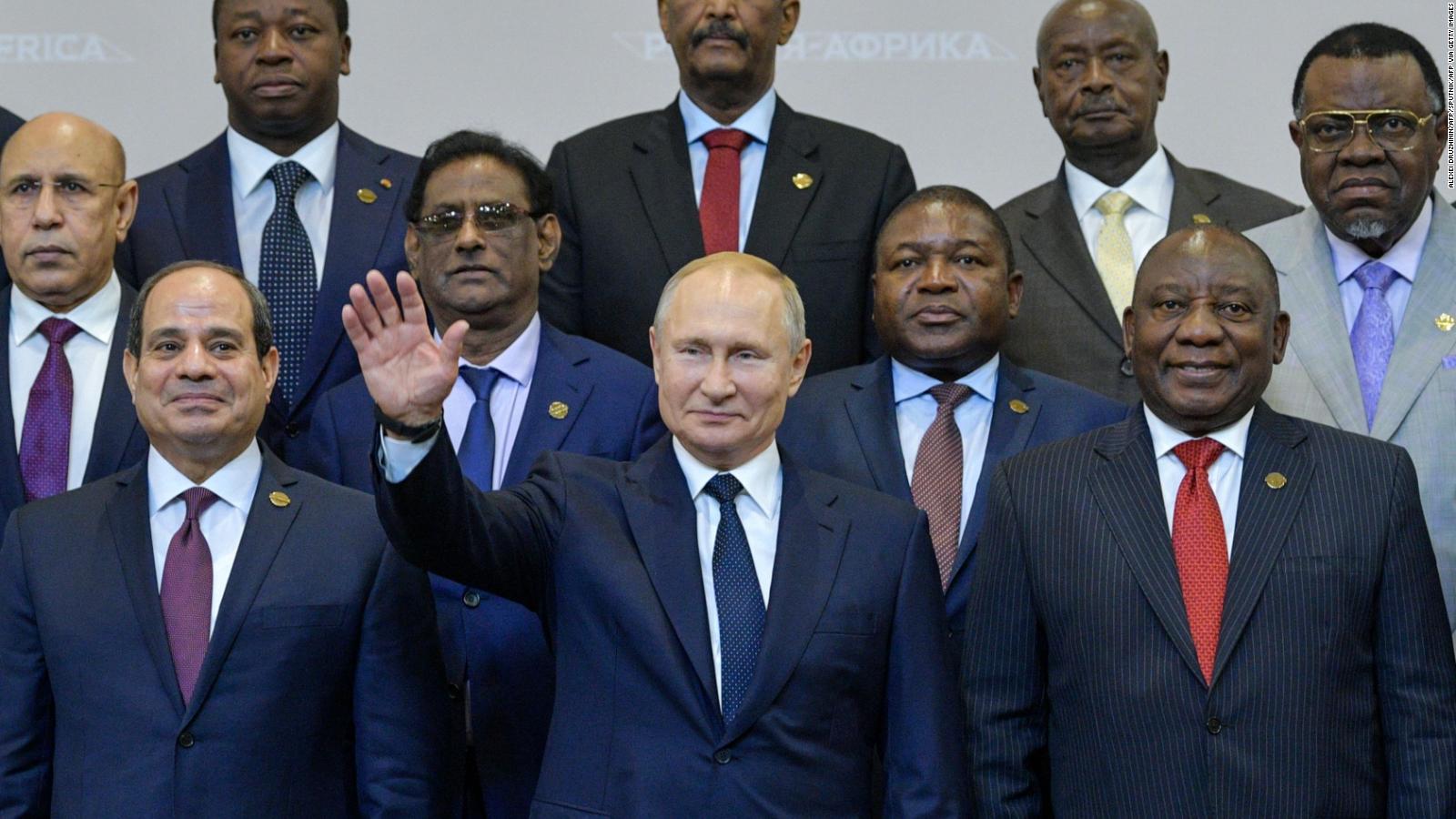
Following the Russian-Ukraine war, which saw Russia’s forceful invasion of Ukraine, the United States has once again urged African nations to strongly respond to Russia’s aggression. They further disclosed that they are setting up plans on how to help reduce the economic effects of the Russia-Ukraine conflict on the continent, knowing full well that some countries in the region have been greatly affected.

According to U.S ambassador Jessica Lapenn, in her words, “We look forward to a strong African response to Russia’s aggression and welcome the opportunity to partner with Senegal and other Africans on both the response to Russia’s aggression but also to address the implications of it globally”. Recall that earlier in March, nearly half of all African countries abstained or did not vote at the UN General Assembly that demanded Russia Immediately stop its military operations in Ukraine.

This is the second time the U.S is calling on African countries to react aggressively to Russia’s invasion of Ukraine. The first time they called on African nations, was through its secretary of state Molly Phee who stated that their voices matter in the international community urging them to vote against Russia at the UN general assembly. Recently, due to the strong relations that Senegal has with the West, some officials from the U.S State Department on African affairs paid a visit to the country where they had a meeting with President Macky Mall who currently holds the African Union rotating presidency. Their visit was to discuss with him ways to ensure that the African continent responds to Russia’s aggression.

I still do not understand why the U.S is hell-bent on ensuring that African nations condemn the action of Russia. Earlier in March, the same U.S was slammed by the Pakistan government through its president Imran Khan who had to counter U.S requests by asking them if they were their slaves. The US must understand that every sovereign country, most especially countries in Africa has the right to abstain or condemn Russia’s attack on Ukraine, regardless of whether they are negatively affected by the conflict or not.

I believe any country that wants to condemn Russia’s action, will do so at their own will without necessarily being coerced. The decision of most African countries to stay neutral and abstain from condemning Russia can be traced to issues relating to political, economic, and other considerations. These countries have based their decisions on strategic calculations on the war to avoid making rash statements that will jeopardize their relationship with Russia.

It is a known fact that some countries in Africa, Nigeria inclusive, have significant military alliances with Russia. Some of these countries have depended on Russia to combat insurgencies in their country. In the past, Russian mercenaries have been active in Libya, Sudan, Mozambique, and Mali which has seen them restore peace in war-torn areas. Also, Africa is a key market for Russia’s arms industry, with almost half of all the arms coming into Africa being imported from Russia. 

With Russia being the highest exporter of wheat, most African countries heavily depend on them for wheat and fertilizers which have deepened their economic ties. Seeing all these benefits and many more not listed here that the African continent gets to benefit from Russia, one can reasonably deduce the reason why most countries in the African region chose to stay neutral or abstain.

If African countries decide to heed to U.S statement and go ahead to aggressively condemn Russia’s actions on Ukraine, will it reduce the effects of the war on the African region? I doubt so because such an act will only worsen matters and make Russia aggressive towards the region which will affect them in so many ways. The U.S should therefore respect these African countries’ obvious stance on the Russia-Ukraine war.

BIG ISSUE: With Circular Campaign Promises, Everyone Wants to Be Nigeria’s President

0

According to the requirements of the 1999 Constitution, anyone who is a citizen by birth, has attained the age of 35, is a member of a political party, and possesses at least a Senior School Certificate or its equivalent is qualified to be president. These rules have been questioned on numerous occasions and are still being scrutinized in light of the country’s current issues by both state and non-state entities. The argument has been made that citizens who have had the opportunity to be president tended to be older rather than younger. As a result, the age of 35 appears to be feasible on paper. This has recently become a hot topic among young people, who believe they have been denied the opportunity to define a better and more sustainable course for the country’s socioeconomic and political development. The Not Too Young To Run Movement arose from the demand for a “youthful president” a few years ago.

While this article has briefly discussed the requirements for becoming president in Nigeria, as well as concerned stakeholders’ criticisms of the age clause, there is a need for Nigerians, particularly those of voting age,who would go to the polls in 2023 and elect a new president after President Muhammadu Buhari’s term expires, to understand circular campaign promises of the senior citizens who expressed interest in contesting for the presidential position.

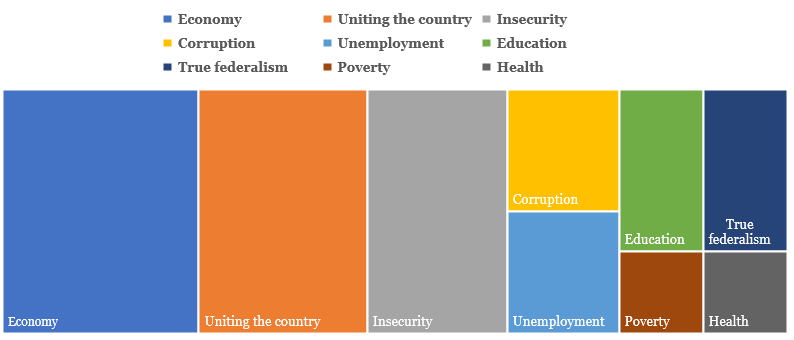
Our analyst investigates several well-known politicians and professionals’ recent expressions of interest. Analysis reveals that all the candidates repeatedly duplicated campaign pledges made by previous politicians dating back to 1960. They largely believed that the key problems of the country are bad economy and insecurity. According to them fixing these challenges would bring sustainable development in Nigeria. This was the same proposition of President Muhammadu Buhari in 2015. Then, President Buhari believed that the ruling party and previous administrations largely failed to utilise available resources for benefit of all citizens and placing the country among the top developed economies in the world.

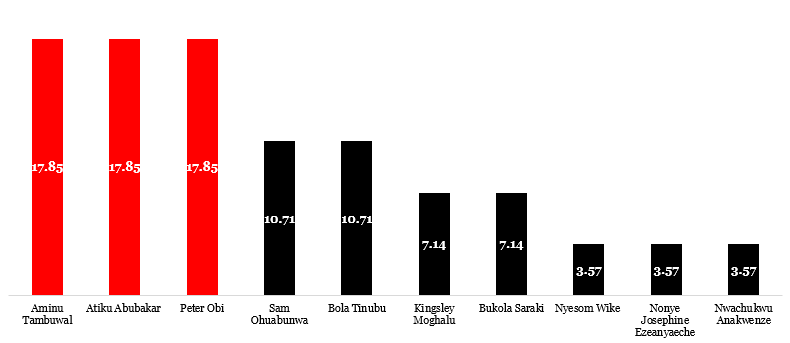
Exhibit 1: Interested Citizens’ Solution Index based on Total Areas of Country’s Needs

Source: Infoprations Analysis, 2022; Nigerian Newspapers, 2022

In terms of adopting the same past campaign pledges in their EOIs, Governor Aminu Tambuwal of Sokoto State, former Vice President Atiku Abubakar, and former governor Peter Obi of Anambra State stood out. Former President of the Pharmaceutical Society of Nigeria, PSN, Sam Ohuabunwa and the All Progressives Congress leader, Senator Bola Ahmed Tinubu followed the trio (see Exhibit 1). Our analysis also revealed that the aspirants thought Nigeria had become more divided in recent years. As a result, a leader who can unite all the regions is required. This was more Aminu Tambuwal’s, Bola Tinubu’s, Atiku Abubakar’s, Bukola Saraki’s, Peter Obi’s, and Nwachukwu Anakwenze’s position.

As the election for 2023 approaches, our analyst believes that voters and players in electoral and political institutions must consider the country’s issues beyond basic necessities and improving economy locally. This is required since the country must meet a number of regional and global commitments by 2050. For example, none of the politicians and professionals thought it was appropriate to discuss Nigeria’s foreign policy if they were elected.

Exhibit 2: Interested Citizens’ Focus Areas

Source: Infoprations Analysis, 2022; Nigerian Newspapers, 2022

Looking for Challengers to Multichoice (DStv, GOtv) in Nigeria

24

Many comments on FB and LinkedIn on my piece on Multichoice (DStv, GOTv) and my position that Nigeria should not use Courts to determine the price of an imported product. I have written on this many times: “MultiChoice (DStv, GOtv) was not built with debt. But HiTv and TStv went through life via debts. In the media business, in Nigeria, that is very risky. It is nearly impossible to grow faster than your bank interest rate.” 

Indeed, controlling prices from the Court, while popular, will never improve our market systems. We have enough evidence that  the rascality of the court has cooled investments in the electricity sector. They want you to invest $millions and be paid nothing. So, the implication is that no investor wants to invest because the smart court has priced electricity before it is produced.

Check potable water also; some rates have not changed for years, making investors run away from the opportunities. Push for changes, people will go to court to block them. In one state, the last water rate was updated in 1997!

Bringing that mindset to TV and shows may not be helpful unless everyone is ready to watch the Ajonkwu festival of Ovim Abia State. That may not be bad except that the show is free! But until we do that, bashing Multichoice without going after the root cause of empowering local companies will not help the outcome, court or no court.

It is a popular thing to kick Multichoice. But that does not make it the right move. Indeed, I have never read of where the activists have gone to court to block increased prices of milk, bread, noodles, yam, etc. These are the essentials we should put our energy into, and fight prices.

As I noted here, the only way to deal with Multichoice is to increase competition, not via the court. The opportunity remains. Yes, while many  hail the Court for going after Multichoice, I want to throw it back to Nigerian governments: you need to build an ecosystem where great digital companies can thrive.

HiTV failed. TStv is struggling. DStv is winning territories. If you look at these companies, you will notice a clear catalytic difference: funding mechanisms. DStv was built by the largest purse in Africa, the unlimited Naspers of South Africa, which has so much money that it could buy all the publicly traded stocks in Nigeria with just 30% of the Group’s market cap. This is a company that battles Facebook and comes out as a winner. MultiChoice, though separated and traded differently now, connects to that heritage of wealth. At any point, Naspers has more cash on its balance sheet than …. (let me not make people feel bad).

Building A MultiChoice (DStv, GOtv) Challenger in Nigeria; HiTv, TStv Weakest Factors

Update: Telecom operators are planning to increase rates to manage the higher costs of delivering services in Nigeria. This goes back to the root cause of most recent price changes: cost of production is rising and companies are adjusting prices accordingly. Possibly, someone will go to court to stop them as was done in the case of DStv!

The Association of Licensed Telecommunication Operators of Nigeria (ALTON) also says it is considering varying tariffs to some ‘unfriendly telecommunications states’ in order to accommodate their demands. ALTON is an association of major telecoms operators, including MTN, Glo and Airtel. The Chairman of ALTON, Gbenga Adebayo, told journalists on Thursday in Lagos that the high cost of energy and security of telecom workers was hampering its operations.

An honest and (un)professional advice on divorce from your lawyer friend

0

Being a lawyer has really messed up my mindset about marriages and relationships lately. You need to see the tons of emails and calls I get daily from folks seeking my legal services to institute a proceeding for divorce for them (both men and ladies); I got two emails to that effect just today. The professional ethics of lawyer-client confidentiality binds me if not I should have shared some receipts of them here.

Due to the fact that I constantly write articles on law-related topics (including divorce), people get my email address from news blogs and messages from those seeking divorce keep trooping in on daily bases, this has forced me to raise this unprofessional but friendly alarm.

“It seems everyone wants a divorce. There’s no other better explanation for it”.

Sometimes when I ask about the duration of the marriages, some of these marriages are even barely up to a year. It seems everyone wants to be out of the marriage institution and you will be forced to ask yourself, does it mean that these days marriages are no longer working or what is really going on.

I know as a lawyer I should be eager to jump on those divorces briefs and go ahead to file the processes as much as the client is ready to pay me my professional fee (some of the clients don’t even care about how much the fee cost, they just want to be out of the marriage no matter what it takes) but as a human who has empathy before anything else, I am sometimes reluctant to take up some of those briefs, especially after carrying out due diligence inquiry and meeting with the client and I found out that the reason(s) he/she wants the divorce is too trivial that the court will not grant us audience.

Be it as it may, as a lawyer and as a human, I do not advocate that anybody remain in an abusive relationship; God forbid that I do that or ask a person to remain in a marriage that has failed completely but some of the issues or reasons why some of these clients want a divorce when you hear of it are just too trivial; just mere misunderstandings in most cases that the partners can talk through and settle it with makeup sex; unless they are not telling the lawyer everything or the real reason why they really want the divorce.

How can you ask a lawyer to institute a divorce because your husband does not answer your phone calls immediately or because your spouse snores or your spouse refuses to cook or wash for you? These are some of the reasons I hear from some clients and they will end it with “it’s a long story or lawyer you won’t understand, just go ahead with the divorce process, I’m tired of the marriage”.

I am honestly not an insensitive person; I am not insensitive to the fact that some of these issues are deeper than what they may seem on the face of it but sometimes it circles back to ego. A partner does want to let go of ego.

As a lawyer who is also a certified mediator and counselor, sometimes I can decipher that the relationship has not broken down irredeemably, the partners just need to talk things through, or that a partner just needs to let go of ego and apologize and they will live happily ever after.

In as much as the spouse is not abusive and you are not physically abused or mentally abused, whatever other reasons that do not fall into that category are always considered trivial by the court and the court will be reluctant to listen to the divorce proceedings because the marriage has not broken down irredeemably.

Some of you all need to understand that divorce is not as simple as you think. I have never seen a person that went through a divorce and remain the same, it also does have a huge negative effect on the children. Divorce is also very expensive. It is never cheap.

The litmus test before a court will grant a divorce is “has the marriage broken down irredeemably? have the partners tried all they could to make the marriage work and it is not working?; has a mediator or the lawyers to the spouses tried to mediate and seek amicable settlement of the partners and it failed?

If all the answers to these questions are in affirmative then the court will proceed and grant the divorce but if any answer to the above questions is in the negative then the court will be hesitant in hearing the divorce proceeding.

Most importantly, the court considers the duration of the marriage. The court will definitely be reluctant to grant a divorce for a marriage that is barely a year.