DD
MM
YYYY

PAGES

DD
MM
YYYY

spot_img

PAGES

Home Blog Page 5232

Nigeria’s Economic Status And The Mining Sector

1

It’s indisputable that Nigeria’s mining sector is presently in a moribund state, despite the government’s diversification mantra.

Mining is usually referred  to as the extraction of valuable minerals cum other geological materials from the earth crust, usually from lode, vein, ore-body, seam, reef, or placer deposits.

These deposits constitute a mineralized package that is of economic interest to the prospective miner. Ores obtained via mining activity are gemstones, limestone, coal, oil shale, metals, dimension stone, clay, gravel, potash, and rock salt, among others.

Mining is required to obtain essential commodities that cannot be possibly grown via agricultural processes, or created artificially in a factory or laboratory. Mining of stones and metals has been a well-recognized human occupation since the prehistoric era.

Modern days mining processes involve prospecting for ore bodies, analyzing the profit potential of the proposed mine, extraction of the desired materials, and final reclamation of the affected land after the mine is closed.

The economic importance of mining cannot be overemphasized. In Ghana, for instance, the country’s mining sector is a very vital segment of its economy, and has played a significant role in its socio-economic development since the colonial period. Historically, the Ghanaian mining sector’s contribution to the country’s gross foreign exchange – particularly gold – has only been paralleled by its cocoa sector.

Not only do the products power the family car as well as heat the family home, the manufacturing sector, high tech industries, and even the better known resource industries, are all dependent – in one way or the other – on the mining industry.

The mining industry will continue to be an important support to the economy of any country that embraces it. Aside from boosting Gross Domestic Product (GDP), it encourages high rates of employment opportunities and equally thrives to ensure that the number of entrepreneurs in the country is increased tremendously.

In spite of the ongoing boom in the sector, Nigeria still lags behind. It’s shocking to note that notwithstanding the unquantifiable solid minerals the country is blessed with, mining presently accounts for barely 0.3 per cent of the country’s GDP, due to the influence of its vast petroleum resources.

The country’s domestic mining industry is conspicuously underdeveloped, leading to importation of minerals such as, but not limited to, iron-ore and salt, that could be domestically produced with ease. It’s a shame that the only material that’s overtime mined across the country is sand.

Rights to ownership of mineral resources is held by the Federal Government (FG) who grants titles to interested organizations to explore, mine, and sell mineral resources, but the business has hitherto been relatively unpopular.

The Chief Olusegun Obasanjo’s administration began a process of selling off government-owned mining corporations to private investors in 1999. It’s pathetic and disheartening to acknowledge that till date, those firms are ostensibly lying moribund.

On assumption of duty, perhaps piqued by the ongoing devastating physiognomy of Nigeria’s mining sector, the President Mohammadu Buhari-led government strongly assured the teeming Nigerians that the administration would rejuvenate the industry.

Little wonder the government recently approved a sum of N12.7 billion solid minerals exploration contract. Yet at the moment, pathetically no serious and practical impact has been recorded, probably owing to lack of policy direction.

It’s therefore high time Nigeria started mining the available solid mineral deposits abound in the country – to include tale, gypsum, lead, zinc, bentonite, gold, uranium, bitumen, coal, rock salt, gemstones, kaolin and barite – all which are highly lucrative and of great economic value. This can only be actualized by deploring the required techniques tactically as well as imbibing viable policies into the system.

Surface mining and subsurface (underground) mining are the available two major forms of mining. The target minerals are generally divided into two categories of materials namely, placer deposits and lode deposits. The former comprises valuable minerals contained within river, gravels, beach sands, and other unconsolidated materials, whilst the latter are those found in veins, layers, or in mineral grains widely distributed throughout a mass of actual rock.

Both classes of deposits could be mined by either of the aforesaid mining types. Moreover, in-situ leaching is another technique mainly used in mining rare earth elements cum soluble minerals like uranium, potash, potassium chloride, sodium chloride, and sodium sulfate. Of all, surface mining is at the moment much more common and viable.

However, it’s pertinent to comprehend that mining, likewise petroleum drilling, is associated with various environmental factors. These include erosion, formation of sinkholes, and loss of biodiversity, coupled with contamination of soil, ground cum surface water by chemicals from mining processes.

In some cases, additional forest logging is done in the vicinity of mines to create space for the storage of the created debris and soil. Basic examples of pollution from mining activities include coal fires, which can last for years, producing severe amounts of environmental damage.

These menaces, as outlined above, can be properly controlled through the effort of the concerned law enforcement agency by implementing stringent environmental and rehabilitation Acts as well as functional policies.

Now that diversification is apparently the only way to revive Nigeria’s troubled and epileptic economy, the governments at all levels ought to endeavour to take the bull by the horn towards ensuring that the mining industry is accorded a well-deserved attention.

Taking into cognizance the impact the said sector stands to create on the country’s economy at large, it’s needless to state that its exploration is long overdue, thus feasible policies and actions are seriously needed. 
The Nigeria’s Social contract

0

The social contract theory is a political philosophy that tends to concern itself with the legitimacy of the authority of the state over the citizens or individuals who call the state home.

Social contract theorists propound the arguments that posit that individuals or citizens of a particular state have consented, either explicitly or impliedly to surrender some (if not all) of their freedoms and natural rights and submit themselves to the authority of the state or to submit to the decision of the majority in exchange for protection of their remaining rights against aggression or invasion and maintenance of the social order.

The starting point for the social contract theory can be directly linked to an English philosopher; Thomas Hobbes when he propounded that man at his natural state is a bully and hence there is the need for there to be an authority which man or citizens can surrender their freedoms or submit to in the exchange for protection by the state.

Thomas Hobbes argued that without a constituted social contract, the society will be like a jungle where the big or the powerful will be feasting on the weak and it will be like the animal kingdom where the order of the day is the survival of the fittest and life in this state will be nasty, brutish and short.

The social contract theorists seek to demonstrate why rational individuals would and should voluntarily consent to give up their natural freedom to obtain the benefits of the political order of the state for the benefit of everyone in the society.

Everyone must consent (expressly or impliedly) to give up some of his natural rights and freedom in exchange for the provision and protection by the authority to which everyone submits.

This theory is of the view that the society or the state came into being and can only exist by a consensual contract that was made between the individual and the society or the contract that was made amongst the individual people.

There are five notable elements of the social contract theory which is worthy of mention:

(1) the role of the social contract

(2) the parties which are usually the state and the individuals

(3) agreement or the contract

(4) the object of agreement or contract

(5) what the agreement is supposed to show.

Every constitution of a republican country or a democratic government tends to boldly display this contract in its constitution, usually in the preamble of the constitution.

For example, the preamble of the constitution of the federal republic of Nigeria, 1999 (as amended) reads;

We the people of the Federal Republic of Nigeria

Having firmly and solemnly resolved, to live in unity and harmony as one indivisible and indissoluble sovereign nation under God, dedicated to the promotion of inter-African solidarity, world peace, international co- operation and understanding

And to provide for a Constitution for the purpose of promoting the good government and welfare of all persons in our country, on the principles of freedom, equality and justice, and for the purpose of consolidating the unity of our people

Do hereby make, enact and give to ourselves the following Constitution:-

This preamble is an indicator of the social contract which everyone that is a member of the Nigerian society is a party to.

Governor Soludo Orders All Public Servants To Work On Mondays Against The Sit-At-Home Order

0

Ever since the trial of the leader of the indigenous people of Biafra, IPOB, Mazi Nnamdi Kanu began, the group ordered the shutdown of businesses on Mondays, declaring it as a sit-at-home which is solely carried out to stand in solidarity with the Biafran leader. Just recently, the newly elected Governor of Anambra state Gov. Charles Soludo has ordered all public servants in the state to go to work on Mondays and other weekdays, and also ordered businesses to be opened as well.

Governor Soludo, therefore, warned that absence from work will attract sanctions. In a circular that went into circulation in the state, the memo reads “following the need to reposition the service for better performance and productivity, his excellency, the governor of Anambra state, Prof. Chukwuma Soludo has directed that henceforth, all public servants should report at their places of work every Monday like every other weekday. Consequently, absence from work on Monday, or any other day without any approval will be viewed as serious misconduct, which will attract appropriate sanctions. This directive takes immediate effect”.

Recall that last year, Governor Soludo, who was not yet the governor of the state at the time he made this statement, lamented on the sit-at-home order. He disclosed that such an order hurts the economy of the state, saying that the state loses an estimated N19.6 billion every Monday. As someone who was one time the governor of the central bank, I strongly believe that Gov. Soludo is well-grounded on the implications of such an order on the state, so therefore his cancellation of the order should be strictly adhered to.

I remember vividly during his inaugural speech, he disclosed that he was ready to engage the Ipob group in a round table discussion for both parties to come to a common agreement. He lamented that many criminals now hide under the guise of freedom fighting to perpetuate criminality in the state, such as looting, arson, harassment of people, killings, etc. This statement by the governor is indeed true as all these vices above-mentioned were evident during the Ipob movement. Hoodlums hijacked it, using it to carry out dastardly acts that don’t align with the motive of the IPOB group.

I will say the cancellation of the sit-at-home order by Governor Soludo is a welcome development, and I strongly commend him for implementing the order, not minding whose ox is gored. In one of my articles, I wrote extensively on the impact of the sit-at-home order in the South-Eastern part of Nigeria. The sit-at-home order hurts the economy of States in the Eastern Region, and it also crippled economic activities thereby incurring so many losses. You cannot say you are standing in solidarity with your leader, and at the same time inflict hardship on a large number of your people. It’s counterproductive!

This order is more like the Igbos shooting themselves on the foot, as the order has no positive effect on the release of the Biafran leader. Some people compared the sit-at-home order as akin to drinking poison and hoping that your enemy would die. Regular observance of the sit-at-home in the Southeast is not even effective for the actualization of Biafra. It has affected and killed so many businesses. Big organizations have been said to have moved out from the region because a lot of them were greatly affected by the order.

When these organizations begin to move out of the region en masse, how will the economy grow? Let’s not forget that the Eastern part of Nigeria suffered great damage during the Biafran civil war, and they have tried rebuilding it back. So, therefore, anything that will retard growth and progress in the Eastern part of Nigeria is not ideal and welcomed.

Paternity fraud should be made a criminal offense in Nigeria

0

The level of paternity fraud in Nigeria is alarming. It has gotten to the point where lawmakers should make law(s) criminalizing paternity fraud.

According to a report, Nigeria ranks number one in Africa and second in the world as the country with the highest rate of paternity fraud. It was also reported  that 30% of Nigerian fathers aren’t really the biological father to their purported children i.e. 3 out of 10 fathers have the wrong kids as their biological children. 

Some of us recently read the story of the popular Calabar based OAP that goes by the name Father Kane who just discovered after a DNA test that his two children for twenty years were never his biological children. Stories like this are disheartening, heart breaking and it can only make you doubt the honesty of some ladies.

His Facebook public post read; 

“This is to inform the general public that I, Kanedrick Kingsley Agwu, popularly known as Fada Kane is not the biological father of Anthonia Duke and Paul Duke as alleged by one Miss MarryAnn Efa Duke,” he wrote.

Attached here are the copies of DNA and court affidavit to further ascertain my claims. MaryAnn Efa and her family are free to contest the DNA results through the court where I too can legally file for damages for such allegations.

Last year also, the story of Nedu Waziobia, a popular entertainer also trended, his first kid was not his biological child as the ex wife claimed after he carried out a DNA test. These are some of the numerous cases that made it to the news. 

When you force a kid on a man that he is not the biological father to, you are also doing the kids a grave harm because you are building their lives on a lie and depriving them the chance of knowing their biological father. These can damage the kid’s future.

The only way to reduce the issue of paternity fraud in Nigeria is to criminalize it and those that engage in the act should be properly tried and prosecuted and made to face harsh punishments.

The issue of paternity fraud is currently in the realm of morality but morality police cannot  tackle the menace, hence the need for legal forces to come to work.

The significance of a Website in Nigeria

0

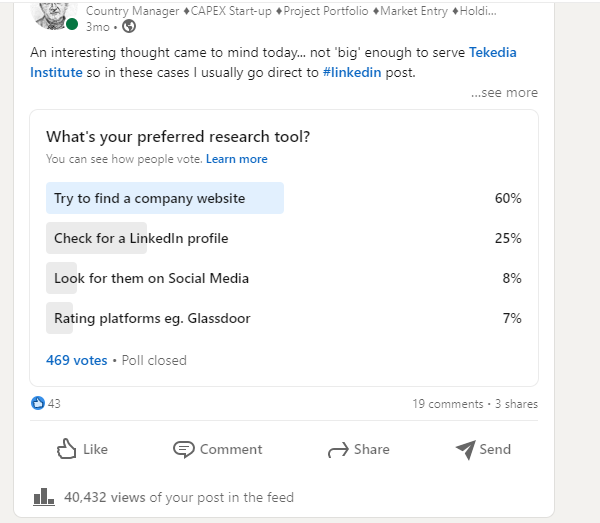
Earlier this year, I posed a question on LinkedIn via a poll. I asked if people saw a job advertised, what would their first ‘go to’ be as a research tool?

It is probably important to point out that 78% of my first degree connections are Nigerian, so this would be reflected in the result.

60% said they would look for a website.

The remaining 40% comprised 25% said they would look for the LinkedIn profile (some may say it had an unfair weighting, since the question was actually posed on LinkedIn)… 8% said they would look on ‘Social Media’ (this would be taken to mean platforms to include Facebook, Instagram, Twitter, Pinterest and TikTok (for example).

7% said Glassdoor (known for its employer rating feature).

LinkedIn only allows four options in polls… were there to be less limit to the options, I might have included Fiverr and Upwork.

Now, you may think that LinkedIn, Social Media and some other online platforms would reveal more impartial opinion than a company’s website, so what could the reason be for 60% of people wanting to look for a website, while only 40% pursue all other options combined?

CORPORATE IDENTITY

Getting a wide birth of opinion about a company, may clarify one’s own questions about company culture, corporate behavioural expectations and other things, but it doesn’t tell anything about the kind of employee or business partner they want people to be.

A LinkedIn Corporate page is a help, but the world is not the ‘LinkedIn Nation’

Companies have their own perception of themselves..  where they feel they fit in the world, where they feel they fit in markets, where they are and want to be with products and services,  and importantly, who they see as a prospect to be one of their people.

Only their website has potential to tell you this.

VISIBLITY, TRANSPARENCY AND ACCOUNTABLITY.

One of the problems with online platforms and social media is the potential to create people that really don’t exist, or to create counterfeit accounts of people who do.

I like to throw random questions to professionals in my network about technological advancements. If there is something new or cutting edge going on, and I want to know more about it, I will do a search on LinkedIn, pick the top 5 first level contacts who seem SME’s (Subject Matter Experts) and fire off a few DM questions and see what comes back.

Within three months, one person had a strong profile against five different inquiry scenarios, but their responses were weak and evasive as against others whose profiles were a weaker fit, but provided much more meaningful replies.

On looking at LinkedIn participation, I also noticed the person frequently commented about ‘being human’ , trying to ‘inspire and motivate’, looked to resonate emotionally, and frequently gave opinions on HR issues, but never mentioned anything technical, in line with the profile.

The person had 70k followers, and over 300 common contacts with me, but when I reached out to my contacts, nobody actually knew this person.

It is very easy to get a web based email address and create online identities without proving who you are. This is because most web-based emails, social media, and other platforms, all work on a ‘fremium’ model. (A fremium model involves a basic service for free, with additional services that come at a cost). As long as services are kept at free use level (no card payment involved), it is possible a person can create a whole online ecosystem around them without ever proving who they are.

Owning a website leaves a clear transaction chain of custody via payment to the web hosting service provider. The registrar can be identified by conducting a ‘who-is’ online search. Both civil and criminal courts, along with other authorities, depending on country, can compel a registrar to reveal a website owners identity.

It is so much harder for an entity with a website presence to completely vanish without a trace following fraudulent behaviour. The existence of a website is the ‘Gold Standard’ in believability for online presence.

Are Web 3.0 (i.e. blockchain) websites likely to offer the same lack of traceability that is possible with Social Media and Online Platforms?

The simple answer is no. There are basically three types of Web3 domain operators:

  1. Providers of ‘Handshake’ Domains – These are already Web 2.0 Web Hosting and Domain Sellers. They have just added Blockchain Domains to their existing portfolio of products. They transact business the same way they have always done, in FIAT; and so a legal or public authority can demand transaction details from them to identify a website owner.
  2. Providers with their own blockchain and crypto. These usually require payment in the ‘house’ crypto to buy a domain, so a payment in FIAT from someone’s bank account isn’t done directly to pay for the domain, however the provider still has records which are traceable.
  3. Providers of domains to be minted to a third party blockchain (not ‘Handshake’). These have their own business records and charge for services in FIAT.

There is an endless supply of Web 2.0 domain hosting  and domain sellers, and none have a monopoly over selling ‘.com’ or ‘.net’ etc domains. This is why the ‘Who-is’ system has to be used to find who the registrar is. Blockchain (Web3) TLDs (Top Level Domains) however are unique to the provider, and are easily identified using a simple online search.

Web3 domains are very cutting edge and not yet commonplace. This makes their owners conspicuous, something those intent on fraud would be keen to avoid.

Also see: johnmckeown.tiny.us/web3-domains

Building fraudulent capacity online starts with using an untraceable web based email address to sign up for services, and then using those, such as Google or Facebook etc accounts to then sign up for further ‘freemium’  online services. The lack of confidence is rooted in the ‘freemium’ nature of the services as long as the participant never pays for anything.

Traceability comes the moment the participant opts for paid services in any part of their online ecosystem. However, because of the conspicuous nature of a website, it is the best tool for confidence building among online/remote associates or peers, and the broader metaverse.

Are there other conclusions and lessons businesses can glean from the poll?

As people, we generally have common practices when we think about the believability of others… validating things.. doing due diligence.

This transcends across whether we are scoping out a new employer, seeking a business partner, or looking to source products or services.

Mostly a website will form part of their checklist, but won’t be the decider. A business without a website may  be seen as below some sense of corporate maturity at a very basic level, and can’t be relied upon. It doesn’t make every website owning trader or business a winner though. Everybody has to fashion their own ‘silver bullet’

It also means that a business’s own website is its own best advertising agency. Businesses with a promo  budget  should try to look at how to empower their own online ecosystem with its website at the epicentre.

This also raises issues around why companies bother paying influencers, and even if they do, how they choose them.

I was once asked who is an example of a great influencer in Africa?

I paused for a bit, and then said:

‘A person whose ranting and rebuking of somebody else’s pet hyena causes it to do their bidding’


Please visit johnmckeown.eu

Acknowledgements:

YouTube Video – Influencers have no value – ‘Truly Strategic’ – Tara Hunt.

www.lyfemarketing.com/blog/importance-of-a-website/

profitworks.ca/blog/297-why-having-a-website-is-important

www.infidigit.com/blog/importance-of-website/

www.forbes.com/sites/forbesagencycouncil/2019/04/04/digital-influence-web-designs-impact-on-marketing-strategy/

conversionstrategies.com/website-vs-social-media-small-business/

www.oasdom.com/website-better-social-media/

www.smallbusinesssem.com/why-a-website-is-more-important-than-facebook-twitter/6692/