DD
MM
YYYY

PAGES

DD
MM
YYYY

spot_img

PAGES

Home Blog Page 5330

Airtel Africa Plc Market Cap Eclipses 14 Publicly Traded Banks in Nigeria As Telcos Become Operating Systems

2

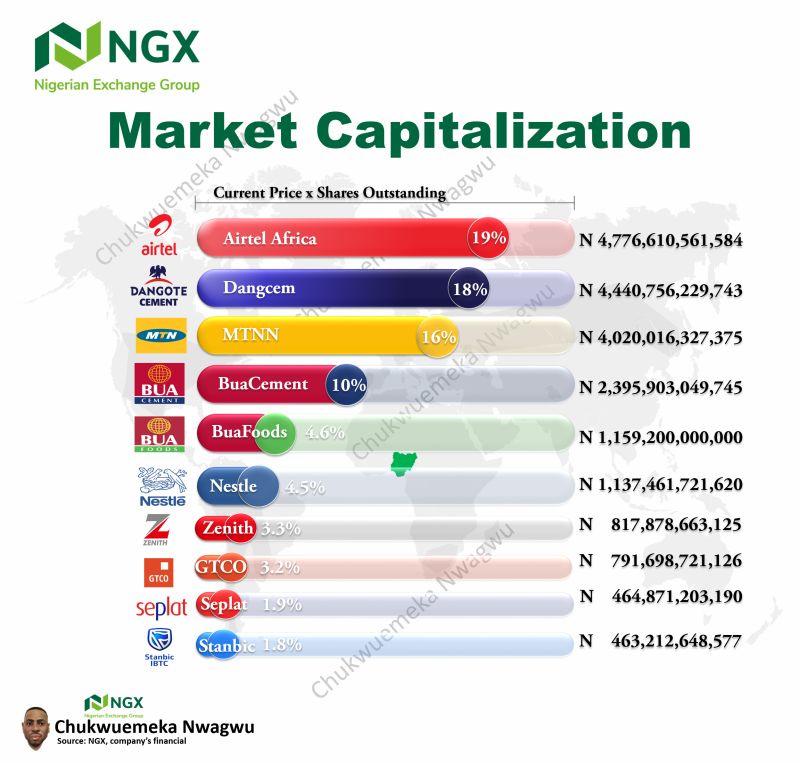
According to Nairametrics analysis, Airtel Africa Plc has a market cap that is bigger than all the 14 banks listed in the Nigerian Stock Exchange. Airtel Africa has a market cap of N4.78 trillion while the 14 banks combine for N3.77 trillion.

This trajectory will continue because telecoms is the operating system of the knowledge economy. As banking, logistics, retail, and indeed all sectors are being digitized, telecom companies will capture more value.

Simply, everyone is growing the telecoms market. Move retail to ecommerce, you have created more data plans for the likes of MTN, Glo and Airtel. Call it being positioned at the edges of the smiling curve.
 

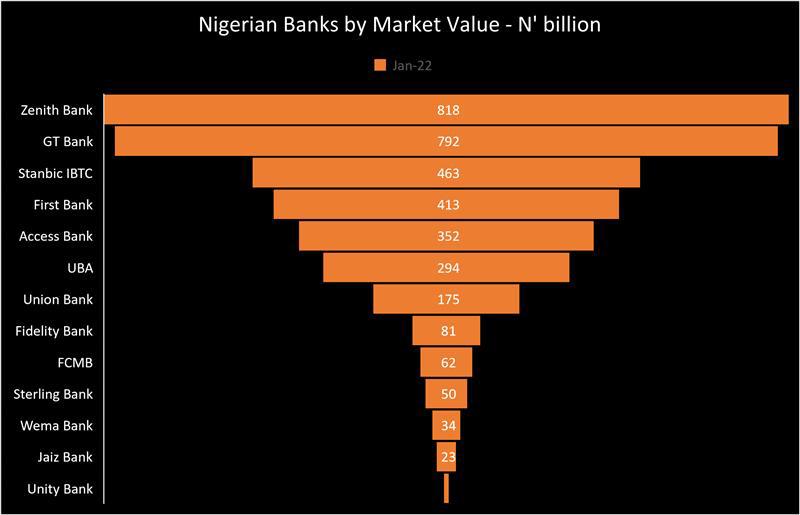
In the banking sector, Zenith Bank maintained its lead as at Jan 31 2022: “Zenith Bank maintained the top spot with a market valuation of N817.9 billion, closely followed by GT Bank with a market cap of N791.7 billion. Stanbic IBTC with N463.2 billion valuation stands in third place, while First Bank’s valuation stood at N412.8 billion as of the end of January 2022. On the flip side, Unity Bank has the lowest market capitalization with N5.96 billion, following a N351 million decline compared to the previous month. Jaiz Bank also followed with a valuation of N23.5 billion, albeit a N4.1 billion gain in the month of January 2022.”
Source: Nairametrics

The biggest threat to the Nigerian banking sector is now the telecom companies like Airtel, MTN, etc. Across most dimensions, the telcos are now at the edges of the smiling curve while the banks are clearly at the center. The fintech companies, provided they can grow their user base, will be fine as they have made us accept that they can “tax” all transactions with their 1.99% charges. Banks do not have that freedom. In short, the Central Bank of Nigeria has reduced the charges with the slash of ATM, card and electronic fees. 

Largely, can the big  banks double their market caps in the next decade at least to beat inflation and currency deterioration? Where investors do not think so, the high-growth, record-breaking telcos will be the new brides in the market.

Comment on LinkedIn Feed

Comment 1: MTN and Airtel will be the next biggest Fintechs. They make lots of revenue on inelastic demand to diversify and take over any sector that can use telecoms infrastructure as a launch pad. It’s simply the most logical next stop for MTN and Airtel. Interest rates on loans will drop,Lol, as banks will see far less patronage.

If MTN/Airtel gets a Fintech (eg Momo) that can give N10M loans via an app,It will send banks into mergers. Banks may become suited more for institutionalised and mega corporate biz banking- in addition to serving as physical vaults (like the gold vaults of old). With more progression to a cashless society,banks will struggle to make profit margins (If there aren’t newer innovative value propositions).

Comment 2: Why should banks have high market valuation, just for accepting deposits, giving loans and charging commissions here and there? That’s too traditional for investors of today, they want more.

When you go through financial statements of our banks, how many revenue streams are outside traditional banking services? If I don’t bank with Zenith Bank, which other services does it offer that I can pay for? Does any of our banks offer enterprise software it pioneered that is used across all industries? Innovation is not digitizing your operations, there’s much more.

Access Bank has branches across the country, can it build a massive logistics entity anchored on that, with those branches serving as pick up centres as well? What happens when it acquires a e-commerce firm and add it to the mix with its own payment gateway? Magically, it will become a behemoth across banking, logistics, commerce and financial services, all powered by tech!

The valuation will continue to crawl or decline, until the banks rethink everything, they cannot be too comfortable making money, just for being ordinary.

It’s a waste of time advising lazy people.

My Response to #2: I am not sure that I will want banks to become players in some of the sectors mentioned. Let them focus on lending and do just banking.


Join Our Show – Knowledge…a factor of production

0

Understand why the factor of production which was omitted in your Economics textbook rules the world. Discover Knowledge as a factor of production, at Tekedia Mini-MBA. The show begins on Monday, Feb 7.

Join us today before we close admission.

Welcome to Tekedia Institute. We run an amazing business school which has attracted professionals and students from 39 countries. Our Faculty members come from Microsoft, Shell, Flutterwave, Nigerian Breweries, Jobberman, Coca Cola, and other great organizations. Thrice weekly, I personally coordinate live Zoom sessions on the mechanics of business systems. We bring our Faculty and Guests on those sessions, covering industries and business domains. REGISTER today and join us! – Prof Ndubuisi Ekekwe, Lead Faculty.

Comment on Facebook Feeds

Comment 1: Prof sir. Was knowledge omitted as a factor of production in economics? Not really. It was the classicals that did not explicitly include knowledge as a factor of production. The new growth theorists led by Paul Romer explicitly accounted for knowledge among others as a factor of production that have explained the differences over time and across countries.

My Response: In your AO Lawal, was Knowledge included as a Factor of Production. That it is included now does not change that it was not explicitly there.

Comment 1a: You are right Prof. Knowledge was not included in AO Lawal because it is an elementary economics textbook. Like every other science, economics starts from simple to complex. Paul Romer modeled the place of knowledge as a factor of production in 1986, that is, 35 years ago.

My Response: “Knowledge was not included in AO Lawal because it is an elementary economics textbook.” – what did I write? I was hoping you can point otherwise. I said it was not in your textbook and you just confirmed.

On the reason it was not there could be another discussion. Yet, new economic textbooks are now including it even in secondary school books. In a knowledge economy era, KNOWLEDGE is the real factor of production and new secondary school economics are adding it, not because it has become less complex but because the economic system runs on it. In the industrial age economy, it was not evidently necessary.

On Paul Romer, I think he is a very young person. Peter Drucker wrote of knowledge workers decades before Romer published his work. That was in 1956. But few paid attention because it was not considered catalytic.

Creating A Healthy And Balanced Work Environment

0

One of the most important elements to motivate and promote staff productivity is by creating a healthy and balanced work environment. Employees feel happy and motivated to give their best when a workplace is healthy and balanced. They tend to feel in control of their work-life which often leads to greater employee loyalty, a happier/ less stressed workforce, and positive perception towards the management. On the other hand, an unbalanced work environment often brings about stress and lack of motivation from employees, which usually affects productivity in the workplace.

So how can one make the workplace healthy and balanced where employees are happy and productive?

Below are three (3) tips on how workplace health and  balance can be achieved;

  1. Communication: It is important to have a balanced work environment with proper communication. Communication is arguably the cornerstone of any effective work environment. Communication is more than just talking, it’s about connecting with people. According to a survey conducted on 210,000 American employees, it was discovered that less than half were satisfied with the information they got from the management. What some organizations fail to understand is that one of the most powerful benefits of better communication in the workplace is more engaged employees. When employees are engaged to get feedback from them on the information passed across, it creates a healthy and balanced workplace. This will therefore make employees more engaged in their work making them align better with company objectives and goals.
  2. Empowerment Of Employees: Employee empowerment is a management philosophy that emphasizes the importance of giving employees the autonomy, support, and resources they need to act independently and be held accountable for decisions they make. When employees are empowered, it boosts their creativity and performance which leads to job satisfaction and commitment in the organization. Employees who have the potential to do more but lack the authority or resources to make it happen are usually frustrated in the workplace which often leads to disengagement, demoralization, and low productivity. According to experts, it is reported that employees who have control over how, when, and where they do their job will work harder and find their work more engaging. When they are not confined to a specific role, but given the chance to show off their ability in other areas, they will always want to put their best foot forward leading to satisfaction in the job. Leaders should understand that employees aren’t just working for the paycheck, they also want to be appreciated. So leaders must learn to always celebrate employees’ achievements.
  3. Offering Awards, Benefits, And Incentives: Any organization that doesn’t reward or offer incentives to employees for their efforts is on its way to experiencing an unhealthy and unbalanced work environment. Both employees and employers benefit when rewards and incentives are offered. It is a known fact that offering rewards and incentives boost the morale of employees which often leads to high productivity. In return for rewards and benefits, an organization can experience employee loyalty, positivity within the office, and an increase in sales. Employees when appreciated become loyal to the organization and even go to the extent of recommending open vacant positions to their contacts. Rewards and incentives could come in Cash, gifts, awards, Day off from work, Executive breakfast/ lunch, pay increases. Etc.

Conclusion

Creating a healthy and balanced work environment is key to the growth and success of an organization. There is usually high productivity on the part of the employees because the environment gives them the room to freely express themselves and ideas. Organizations that have a healthy work environment experience more profit than those that do not have.

Apple, TikTok, and Other Factors Threatening Meta’s Existence

0

On Thursday, Meta, the parent company of Facebook, saw its shares plunged 26%, wiping over $252 billion off its market value, in a first of its kind dip for any U.S company.

The company’s chief executive Mark Zuckerberg also lost more than $29 billion of his personal fortune, one of the biggest single-day declines in net worth ever recorded. It is a whirlwind of misfortune stemming from events, antitrust regulations and market headwinds that could be the beginning of a troubled future for the social media conglomerate.

Facebook’s market value’s slump was inspired by four major factors, Apple’s new privacy policy which gives iPhone users the choice to disable the social media platform’s tracking system, curtailing its ability to curate data for targeted ads (Snap avoided that well). Facebook usually harvest the needed data for its targeted ads by tracking users across the web.

Snap has finally logged its first quarterly profit as the Snapchat maker begins to deftly navigate the seismic shift in digital-advertising sparked by Apple’s privacy policy changes. While Meta — parent company of Snap rival Instagram — said those changes were partly responsible for a disappointing earnings report that sent its stock tumbling, Snap’s earnings report for the final quarter of 2021 suggests the company is adapting to the new environment. Snap’s $22.6 million profit exceeded expectations and sent the company’s stock rocketing more than 50% in after hours trading Thursday.

The second factor comes from European antitrust watchdogs, who have been tightening policies around the use of private data by tech companies. The third revolves around market competition, which has been shifting recently in favor of younger TikTok, a short-form video app that has stolen hearts around the world, particularly, those of young people. And the fourth is apathy toward Facebook, which has built up overtime due to the social media giant’s perceived complicity in the promotion of immorality on its platform. Facebook is said to have chosen profit over morality, riling up series of antitrust cases against the one-time most darling social network platform.

“This isn’t simply a disappointing quarter but rather an existential moment for Meta. Investors will be forced to take a long and hard look at the company’s competitive position and consider whether it isn’t heading into a prolonged period of subpar performance – this will make it hard for the stock to quickly rebound,” says Vital Knowledge founder Adam Crisafulli.

Zuckerberg appeared to have seen this coming. He said last year that Apple’s new App Tracking Transparency (ATT), has the capability to halve Facebook’s 2022 revenue.

Last year, when Facebook announced that it’s changing name to Meta, in line with its metaverse vision, it was seen more as a rebranding move geared toward escaping the controversies that have been attached to the company overtime, than a shift from social networking to a new tech idea. But while the rebranding notion could not be entirely discredited, Zuckerberg had a plan – divest from social networking.

In his statement on Thursday, during Meta’s earning call, the CEO announced seven major investment priorities for 2022: Reels, community messaging, commerce, ads, privacy, AI, and of course the metaverse. He said “if last year was about putting a stake in the ground for where we’re heading, this year is going to be about executing.” But it is far off, expensive, and uncertain, which makes the situation more challenging than he, Zuckerberg would want everyone to believe, even though he referenced the time in the past when Facebook embarked on this types of transitions with mobile feed and Stories.

“We took on headwinds in the near-term to align with important trends over the long term. And while video has historically been slower to monetize, we believe that over time short-form video is going to monetize more like feed or Stories than like Watch – so I’m optimistic that we’ll get to where we need to be with Reels too,” he said.

Among the four factors threatening Meta’s existence, competition with TikTok and Apple’s ATT appear to be among the biggest. Zuckerberg acknowledged the threat in his speech by saying that “People have a lot of choices for how they want to spend their time and apps like TikTok are growing very quickly,” and that “with Apple’s iOS changes and new regulation in Europe, there’s a clear trend where less data is available to deliver personalized ads.” His answer to this threats is Reels.

“And this is why our focus on Reels is so important over the long-term. As is our work to make sure our apps are the best services out there for young adults,” he said, adding that “we’re rebuilding a lot of our ads infrastructure so we can continue to grow and deliver high-quality personalized ads.”

Facebook went public at around $100 billion in 2012, and has posted share gains every year since then, except 2018. The social media company started the year 2022 with a near $1 trillion market capitalization, but has watched it plummets to around $670 billion. A major reason for this is its dwindling users.

Meta revealed that its user growth has slowed, and that Facebook has lost 1 million daily active users, compounding its declining user growth that spanned across other quarters of 2021. The users leaving Facebook are believed to be joining TikTok. Investors who dumped Meta shares were alarmed by the situation, especially TikTok’s intimidating growth.

Advertisers who now have a minimized chance to reach their targeted audience on Facebook due to Apple’s ATT, are shifting to Google. The web search giant has a good relationship with Apple. Google has a deal with Apple to be the default search engine for Apple’s Safari browser. In addition, Google is not heavily dependent on Apple for user data. Meta’s chief financial officer, David Wehner, noted that it’s likely that Google had “far more third-party data for measurement and optimization purposes than Meta’s ad platform.” All these make a massive migration of advertisers from Meta to Google search ads inevitable.

Although Zuckerberg said he believes that over time, short-form video is going to monetize more like feed or Stories, and he is optimistic that Meta will get to where it needs to be with Reels too, it will take quite some time that both investors and advertisers don’t have.

To add salt to injury, Zuckerberg has been pumping money into his metaverse idea, even though its chances of success are quite uncertain. Last year, he poured more than $10 billion on it, and he is expected to spend more in the future.

The only other time Facebook came close to this type of damning reality was in 2018, during the Cambridge Analytica data scandal that saw the social media platform’s shares dived 20%, and later in July when it transitioned from Newsfeed to stories, losing 19% shares. But it bounced back quickly, recovering all the losses within one year. But that was about four years ago. Then, TikTok and Apple’s ATT were not in the way.

Intensifying Awareness On Cancer Scourge Amidst World Cancer Day

0

February 4 annually, the world commemorates World Cancer Day. This signifies that today, the global community is marking the 2022 edition of the laudable commemoration.

Each year, the World Health Organization (WHO) in collaboration with the International Agency for Research on Cancer (IARC) supports the Union for International Cancer Control (UICC) to promote ways to ease the global burden of cancer.

The annual World Cancer Day was formally adopted in Geneva, Switzerland by the United Nations (UN) General Assembly in the year 1933 through the remarkable efforts of the UICC and other world’s prominent cancer societies, in order to support the goals of the World Cancer Declaration.

The primary aim of the day is to significantly reduce illnesses and deaths caused by cancer via raising awareness on cancer and encouraging its prevention, detection, and treatment.

Cancer, also known as malignant tumor or malignant neoplasm, is a group of diseases involving abnormal cell growth with the tendency of invading or spreading to other parts of the body.

Possible signs and symptoms of cancer include a new lump, prolonged cough, abnormal bleeding, unexplained weight loss, and a change in bowel movements, among others. While these symptoms may indicate the occurrence of cancer, it’s equally worth noting that they may occur due to other medical issues.

Cancer, which can occur in over one hundred different ways in the human body, is mainly caused by either uncalled practices or dietary risks, such as tobacco smoking, incessant intake of alcoholic drinks, obesity, low fruit and vegetable consumptions, lack of physical activities, as well as certain infections like hepatitis B, hepatitis C, Sexually Transmitted Diseases, and human papillomavirus. Some cases of cancer could also be as a result of genetic defects one inherited from his/her parents.

Cancer can be detected by certain signs and symptoms or by screening tests. It is typically further investigated by medical imaging and confirmed by biopsy. Early detection through screening is useful for cervical and colorectal cancer.

Cancer, though a preventable disease, is indeed a human frightening and deadly medical condition that can occur in any essential organ in the body including stomach, lung, breast, kidney, liver, heart, eye, nose, skin, cervical, bone, and brain, just to mention but a few.

Many cancerous growths can be prevented by not indulging in smoking, maintaining a healthy weight, not drinking too much alcohol, eating plenty of vegetables, fruits, and whole grains, being vaccinated against certain infectious diseases, not eating too much red meat, coupled with avoidance of regular exposure to sunlight and urban air pollution.

Cancer is usually treated with chemotherapy, radiation therapy, surgery, or targeted therapy; or sometimes, a combination of all. In a typical cancer treatment, pain and symptom management are an important and basic part of care. Palliative care is particularly recommended for patients suffering from advanced cancer conditions.

The chance of survival solely depends on the type of cancer and the extent of the disease as at the time the treatment commenced. In children under the age of fifteen, at diagnosis, the ‘five-year survival rate’ in the developed world is on the average eighty percent (80%).

In 2012, about 14.1 million new cases of cancer occurred globally, not including skin cancer. Statistics show that the outbreak caused about 8.2 million deaths or 14.6% of all human deaths in the aforementioned year. This implies that, in the near future if adequate care is not taken, cancer cases might be responsible for over twenty per cent (20%) of the death rate in the world.

The most common kinds of cancer in males include lung cancer, prostate cancer, colorectal cancer, and stomach cancer; whilst in females, breast, colorectal, lung, and cervical cancers are mostly common.

Diagnosing a new cancer in pregnant women is difficult, because any symptom is commonly assumed to be a normal discomfort associated with pregnancy. In children, acute lymphoblastic leukemia and brain tumors are mainly common except in Africa where non-Hodgkin lymphoma occurs more often.

The risk of cancer increases significantly in regard to the age of the potential sufferer, and several cancers occur more often in developed countries. Unequivocally, cancer rate increases on a daily basis as more people live to an old age and as lifestyle changes are regularly witnessed in the developing world.

As World Cancer Day is being observed globally, there is an urgent need for every one of us to detest any form of uncalled or unhealthy lifestyle such as tobacco smoking, intake of hard drugs like cocaine, regular consumption of alcoholic drinks and what have you, that could jeopardize our precious lives.

In the same vein, there’s a need for us to be extremely mindful of whatever we eat or drink at all times. We should also not forget that adequate and instant treatment of any illness or infection we notice in our body remains one of the major avenues of embracing a cancer-free society.

Those suffering from the disease ought to continually and strictly adhere to their treatment procedures and should endeavour to consult their physicians when necessary. They should as well ensure that they are placed on a proper diet like regular consumption of vegetables and fruits.

In addition, we are expected to comprehend the fact that early detection of cancer enables adequate eradication of the disease from the body of the sufferer. Thus, there is a need for us, irrespective of age, to go for constant cancer testing or screening.

On this note, I call on all health practitioners and stakeholders to, at all cost, strengthen their crusade targeted to educate the entire public on the dangers and possible causes of cancer, so that we shall all live to celebrate a cancer-free world as it is widely anticipated by the global society.

Don’t forget, prevention is no doubt far better than cure.