It is always an honour whenever alumni groups of FUTO (Federal University of Technology Owerri, Nigeria) invite me to speak to them. Yes, never going to be a greater honour than the one which comes from home. Two years ago, I was to visit Abuja and got to Hilton and realized that 3 people paid reservations in my name and one put a note “his bills on me”. I came here to write: “pray that you have rich alumni friends who own big companies”.
My classmate, Chidi Nwosu will always write “Prof, you cannot spend money in Abuja when we’re here”. And you know what? They pay 100% of my bills. Pray that you are a teacher.
If you can make it today, join FUTO Alumni class of 2001. I will be having a conversation with them on Zoom. For all questions, connect with Kingsley C. Umege. MBA, SBD, BEng.
Join Zoom Meeting
Meeting ID: 881 114 8938
Passcode: Wf7xvX
Time: 7pm WAT
Topic: The Wealth in Nations
Great FUTOITES , I salute and thanks for the honour, as always.
Since we are talking about exploring a series of issues around fundraising for startups, I thought I would say a couple of things about the running cost and how it affects fundraising.
One of the many reasons a startup could be raising funds is to serve a war chest of some sort and give it enough running capital till it gets to the next milestone. It will be unusual to find any startup that simply raises funds and then channels all of them into the purchase of equipment or just launching a product into the market. Some funds will normally be set aside to cover the cost of running the business.
Once you understand this, you will realize that knowing your running cost can help you better decide the sum to raise. After all, what will be the point of injecting funds into a marketing campaign and not having enough money to pay the staffs that will keep the campaign afloat?
So, how do you determine your running cost?
It might surprise you that even some small business owners do not have a clear picture of their running costs. Most of the owners only keep account of salaries, which is the most obvious one. But running costs cover a whole lot more than just the salaries of your employees.
Besides the salaries, you should be looking at other costs like renting an office space (if you choose to), purchasing the right technology and equipment and so on. If you or your team members are going to have potential trips during the period, it will also be good to factor in the budget for the trips.
If you do not have a marketing or sales team yet, you should consider that when you do set them up, they will have to run with a budget as well. If you already have one, get a budget that covers whatever activities they need to carry out in line with the new milestone. Are you going to be creating a website or building an app for the next stage? Factor in the cost too. Your digital marketing team may also need to present you with their strategy and budget for running ads and setting up distribution channels.
This is only a small part of the math you need to do. In determining the sum to raise, you need to get the running cost (for the number of months) to keep the startup running till the next time you will need to raise funds, or till the point it becomes profitable. This could be anywhere from 12 months and 30 months. How much you will raise is determined by your unique needs and goals as a startup, what you have achieved and what you plan to achieve. Even if two startups are looking to raise the same amount, their budget for the money cannot be the same.
Now here is a trap you should not fall into.
After understanding running costs, some founders and entrepreneurs think that all they need do is multiply it by the number of months projected till the next milestone. So if their present monthly running cost is $2,000, they think that by simply multiplying it by 12 or 24 months, they will get the total running cost for the period.
This is very wrong, and if you do make the mistake, you will discover that you have fallen into a capital sin.
Your monthly running cost changes over time. You must factor in inflation (there is the percentage used in calculating that). You also have to factor in additions to the team. For instance, hiring two more tech developers over the span of the expansion will increase your running cost significantly. So always keep in mind that at some point, you may need to hire some more hands especially if the growth happens faster than you envisaged.
You should also factor in transition costs. Are there marketing experts, salespeople, or engineers who are currently working part-time but will need to move to full-time employment for you to achieve your next milestone? What extra will it cost you for such staff to transition into full-time employment?
When you eventually figure all of these out and do the math to cover the period before your next funding, you will have had a minimum figure of what you need to raise. A smart thing is ensuring that your budget is sufficient to cushion the impact of unexpected lags and delays which often come up. It will not be good for you to run out of funds just at the point you need all the financial momentum to push through on your targets
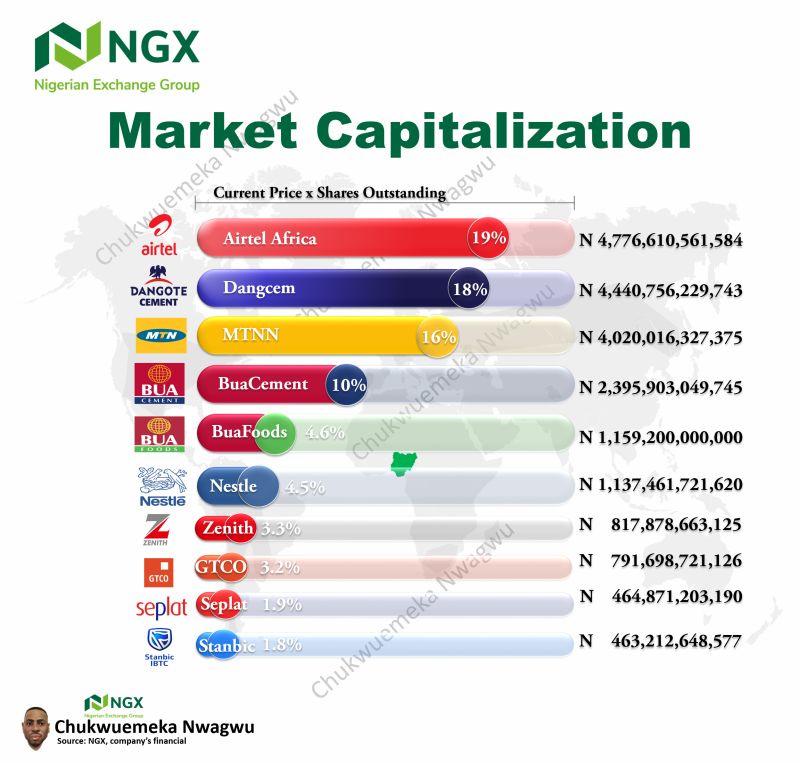
According to Nairametrics analysis, Airtel Africa Plc has a market cap that is bigger than all the 14 banks listed in the Nigerian Stock Exchange. Airtel Africa has a market cap of N4.78 trillion while the 14 banks combine for N3.77 trillion.
This trajectory will continue because telecoms is the operating system of the knowledge economy. As banking, logistics, retail, and indeed all sectors are being digitized, telecom companies will capture more value.
Simply, everyone is growing the telecoms market. Move retail to ecommerce, you have created more data plans for the likes of MTN, Glo and Airtel. Call it being positioned at the edges of the smiling curve.
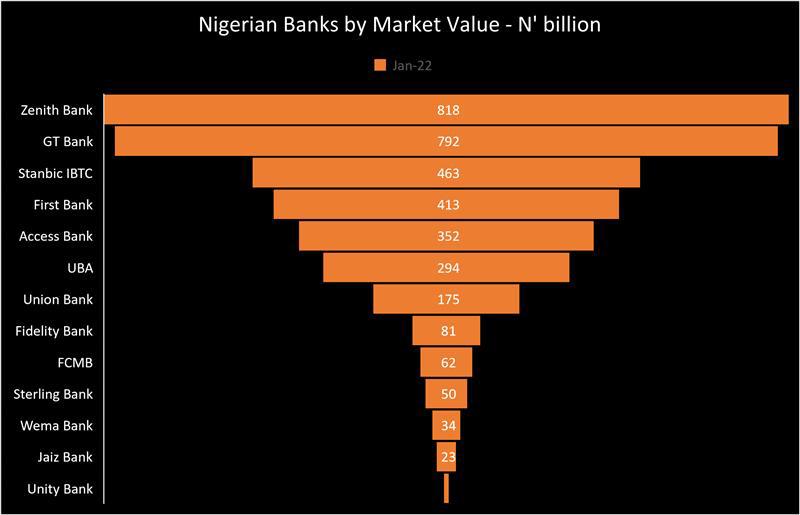
In the banking sector, Zenith Bank maintained its lead as at Jan 31 2022: “Zenith Bank maintained the top spot with a market valuation of N817.9 billion, closely followed by GT Bank with a market cap of N791.7 billion. Stanbic IBTC with N463.2 billion valuation stands in third place, while First Bank’s valuation stood at N412.8 billion as of the end of January 2022. On the flip side, Unity Bank has the lowest market capitalization with N5.96 billion, following a N351 million decline compared to the previous month. Jaiz Bank also followed with a valuation of N23.5 billion, albeit a N4.1 billion gain in the month of January 2022.”
Source: Nairametrics
The biggest threat to the Nigerian banking sector is now the telecom companies like Airtel, MTN, etc. Across most dimensions, the telcos are now at the edges of the smiling curve while the banks are clearly at the center. The fintech companies, provided they can grow their user base, will be fine as they have made us accept that they can “tax” all transactions with their 1.99% charges. Banks do not have that freedom. In short, the Central Bank of Nigeria hasreduced the charges with the slash of ATM, card and electronic fees.
Largely, can the big banks double their market caps in the next decade at least to beat inflation and currency deterioration? Where investors do not think so, the high-growth, record-breaking telcos will be the new brides in the market.
Comment 1: MTN and Airtel will be the next biggest Fintechs. They make lots of revenue on inelastic demand to diversify and take over any sector that can use telecoms infrastructure as a launch pad. It’s simply the most logical next stop for MTN and Airtel. Interest rates on loans will drop,Lol, as banks will see far less patronage.
If MTN/Airtel gets a Fintech (eg Momo) that can give N10M loans via an app,It will send banks into mergers. Banks may become suited more for institutionalised and mega corporate biz banking- in addition to serving as physical vaults (like the gold vaults of old). With more progression to a cashless society,banks will struggle to make profit margins (If there aren’t newer innovative value propositions).
Comment 2: Why should banks have high market valuation, just for accepting deposits, giving loans and charging commissions here and there? That’s too traditional for investors of today, they want more.
When you go through financial statements of our banks, how many revenue streams are outside traditional banking services? If I don’t bank with Zenith Bank, which other services does it offer that I can pay for? Does any of our banks offer enterprise software it pioneered that is used across all industries? Innovation is not digitizing your operations, there’s much more.
Access Bank has branches across the country, can it build a massive logistics entity anchored on that, with those branches serving as pick up centres as well? What happens when it acquires a e-commerce firm and add it to the mix with its own payment gateway? Magically, it will become a behemoth across banking, logistics, commerce and financial services, all powered by tech!
The valuation will continue to crawl or decline, until the banks rethink everything, they cannot be too comfortable making money, just for being ordinary.
It’s a waste of time advising lazy people.
My Response to #2: I am not sure that I will want banks to become players in some of the sectors mentioned. Let them focus on lending and do just banking.
Understand why the factor of production which was omitted in your Economics textbook rules the world. Discover Knowledge as a factor of production, at Tekedia Mini-MBA. The show begins on Monday, Feb 7.
Join us today before we close admission.
Welcome to Tekedia Institute.We run an amazing business school which has attracted professionals and students from 39 countries. Our Faculty members come from Microsoft, Shell, Flutterwave, Nigerian Breweries, Jobberman, Coca Cola, and other great organizations. Thrice weekly, I personally coordinate live Zoom sessions on the mechanics of business systems. We bring our Faculty and Guests on those sessions, covering industries and business domains. REGISTER today and join us! – Prof Ndubuisi Ekekwe, Lead Faculty.
Comment 1: Prof sir. Was knowledge omitted as a factor of production in economics? Not really. It was the classicals that did not explicitly include knowledge as a factor of production. The new growth theorists led by Paul Romer explicitly accounted for knowledge among others as a factor of production that have explained the differences over time and across countries.
My Response: In your AO Lawal, was Knowledge included as a Factor of Production. That it is included now does not change that it was not explicitly there.
Comment 1a: You are right Prof. Knowledge was not included in AO Lawal because it is an elementary economics textbook. Like every other science, economics starts from simple to complex. Paul Romer modeled the place of knowledge as a factor of production in 1986, that is, 35 years ago.
My Response: “Knowledge was not included in AO Lawal because it is an elementary economics textbook.” – what did I write? I was hoping you can point otherwise. I said it was not in your textbook and you just confirmed.
On the reason it was not there could be another discussion. Yet, new economic textbooks are now including it even in secondary school books. In a knowledge economy era, KNOWLEDGE is the real factor of production and new secondary school economics are adding it, not because it has become less complex but because the economic system runs on it. In the industrial age economy, it was not evidently necessary.
On Paul Romer, I think he is a very young person. Peter Drucker wrote of knowledge workers decades before Romer published his work. That was in 1956. But few paid attention because it was not considered catalytic.
One of the most important elements to motivate and promote staff productivity is by creating a healthy and balanced work environment. Employees feel happy and motivated to give their best when a workplace is healthy and balanced. They tend to feel in control of their work-life which often leads to greater employee loyalty, a happier/ less stressed workforce, and positive perception towards the management. On the other hand, an unbalanced work environment often brings about stress and lack of motivation from employees, which usually affects productivity in the workplace.
So how can one make the workplace healthy and balanced where employees are happy and productive?
Below are three (3) tips on how workplace health and balance can be achieved;
Communication: It is important to have a balanced work environment with proper communication. Communication is arguably the cornerstone of any effective work environment. Communication is more than just talking, it’s about connecting with people. According to a survey conducted on 210,000 American employees, it was discovered that less than half were satisfied with the information they got from the management. What some organizations fail to understand is that one of the most powerful benefits of better communication in the workplace is more engaged employees. When employees are engaged to get feedback from them on the information passed across, it creates a healthy and balanced workplace. This will therefore make employees more engaged in their work making them align better with company objectives and goals.
Empowerment Of Employees: Employee empowerment is a management philosophy that emphasizes the importance of giving employees the autonomy, support, and resources they need to act independently and be held accountable for decisions they make. When employees are empowered, it boosts their creativity and performance which leads to job satisfaction and commitment in the organization. Employees who have the potential to do more but lack the authority or resources to make it happen are usually frustrated in the workplace which often leads to disengagement, demoralization, and low productivity. According to experts, it is reported that employees who have control over how, when, and where they do their job will work harder and find their work more engaging. When they are not confined to a specific role, but given the chance to show off their ability in other areas, they will always want to put their best foot forward leading to satisfaction in the job. Leaders should understand that employees aren’t just working for the paycheck, they also want to be appreciated. So leaders must learn to always celebrate employees’ achievements.
Offering Awards, Benefits, And Incentives: Any organization that doesn’t reward or offer incentives to employees for their efforts is on its way to experiencing an unhealthy and unbalanced work environment. Both employees and employers benefit when rewards and incentives are offered. It is a known fact that offering rewards and incentives boost the morale of employees which often leads to high productivity. In return for rewards and benefits, an organization can experience employee loyalty, positivity within the office, and an increase in sales. Employees when appreciated become loyal to the organization and even go to the extent of recommending open vacant positions to their contacts. Rewards and incentives could come in Cash, gifts, awards, Day off from work, Executive breakfast/ lunch, pay increases. Etc.
Conclusion
Creating a healthy and balanced work environment is key to the growth and success of an organization. There is usually high productivity on the part of the employees because the environment gives them the room to freely express themselves and ideas. Organizations that have a healthy work environment experience more profit than those that do not have.