The most important job of a CEO is to design, develop and execute a business model. You can have the same products and services but a different business model can deliver different outcomes. So, pay attention to your business model!
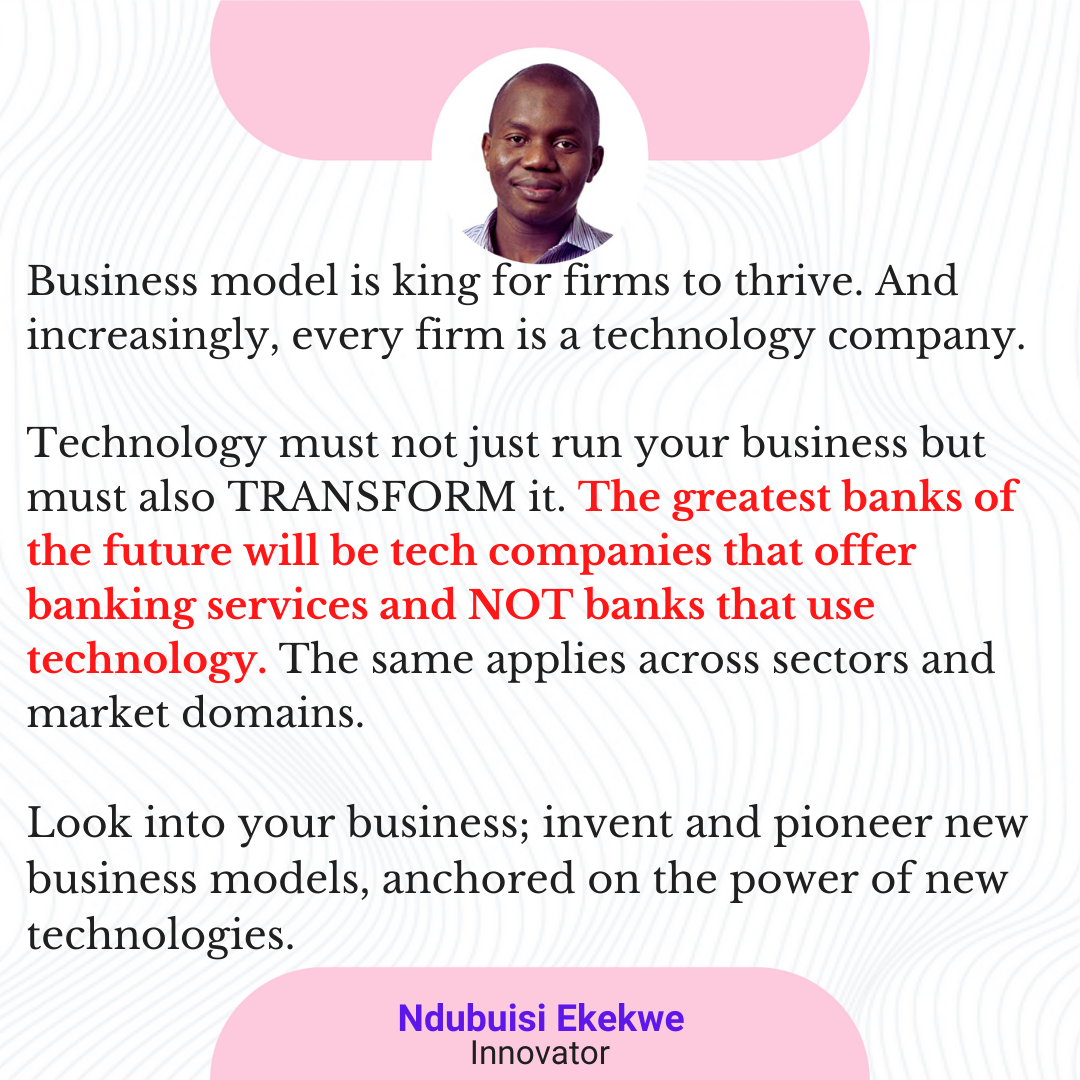



The most important job of a CEO is to design, develop and execute a business model. You can have the same products and services but a different business model can deliver different outcomes. So, pay attention to your business model!
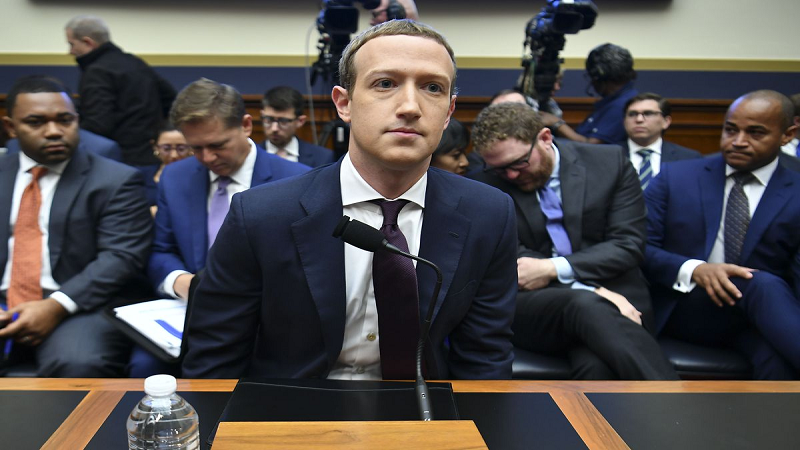
The tide is increasingly turning against the big tech as watchdogs around the world step up regulatory actions that have seen many of the tech giants losing on many fronts recently. Amazon, Facebook, Google, Apple, and Microsoft have been at the receiving end of intensified scrutiny that has interrogated many of the moves the big guys in Silicon Valley are making.
In the US, the appointment of 31-year old trailblazing lawyer, Lina Khan, as the Federal Trade Commission (FTC) chair, is swiftly and unapologetically changing the status quo. In Europe, General Data Protection Regulation (GDPR) has geared up to take on the elephants in the room while in the UK, the Competition and Markets Authority (CMA), is already firing warning shots.
The bottom line is that it’s no longer business as usual for the tech industry. For long, the big tech is said to have had their way, riding on lax antitrust rules to stifle competition and foster monopolistic culture. But the calls to dismantle the status quo is significantly being heeded as the news from the UK, where the watchdog has asked Facebook to sell Giphy, shows.
In a significant push against big tech’s ability to maintain market dominance through sheer buying power, the UK’s competition watchdog has ordered Facebook (Meta) to reverse its acquisition of animated GIF platform, Giphy, TechCrunch reports with some of the investigation details.
The CMA said its phase 2 investigation cemented its earlier competition concerns about the impact of Meta owning and operating Giphy — and it’s now ordering Meta to sell Giphy.
In a statement, Stuart McIntosh, chair of the independent inquiry group heading the CMA probe, said: “The tie-up between Facebook and Giphy has already removed a potential challenger in the display advertising market. Without action, it will also allow Facebook to increase its significant market power in social media even further, through controlling competitors’ access to Giphy GIFs.”
“By requiring Facebook to sell Giphy, we are protecting millions of social media users and promoting competition and innovation in digital advertising,” he added.
The watchdog’s intervention follows an extended investigation of the acquisition that Facebook announced (and completed) in May 2020, with the CMA taking an initial look in summer 2020 — and dialling up its scrutiny over the following months.
It also, in June 2020, ordered a halt to further integration of Giphy by Facebook while the oversight continued.
In another first last month, the regulator fined Facebook almost $70 million for deliberately withholding information related to ongoing oversight of the acquisition — billing the infringement a “major” breach.
The CMA’s preliminary report on the Facebook-Giphy acquisition, this August, concluded that Facebook’s takeover of Giphy raised a number of competition concerns — including that it would harm competition between social media platforms, given the lack of choice in the supply of animated GIFs.
The regulator’s concern was not only that Facebook might simply deny rivals access to Giphy content for their users to reshare but that the data-mining giant might change the terms of access — and could, for example, require rivals like TikTok, Twitter and Snapchat to provide it with more user data in order to access Giphy GIFs.
The CMA appears to have held to its concern on the risk of competitive harm through data extraction from other services, as well as from other more obvious risks — such as Facebook shutting off rivals’ access to the platform — hence rejecting all the tech giant’s proposed alternative ‘remedies’ to selling Giphy as insufficient.
“After consulting with interested businesses and organisations — and assessing alternative solutions (known as ‘remedies’) put forward by Facebook — the CMA has concluded that its competition concerns can only be addressed by Facebook selling Giphy in its entirety to an approved buyer,” the CMA writes in a press release.
In the summer the watchdog had also said it was concerned about the impact on digital ‘display’ advertising — as Giphy had, pre-merger, been offering paid advertising services in the US (and considering expanding to other countries including the UK) which it said had the potential to compete with Facebook’s ad services. However this competition was terminated by Facebook’s takeover.
“The CMA found that Giphy’s advertising services had the potential to compete with Facebook’s own display advertising services,” the regulator writes now. “They would have also encouraged greater innovation from others in the market, including social media sites and advertisers. Facebook terminated Giphy’s advertising services at the time of the merger, removing an important source of potential competition. The CMA considers this particularly concerning given that Facebook controls nearly half of the £7 billion display advertising market?in the UK.”
The regulator’s merger assessment hinges on whether — on a “balance of probabilities” standard — there will be a “substantial lessening of competition” (SLC) should the takeover go ahead. And in the case of Facebook-Giphy that is what it has concluded — finding very limited choice of alternatives to Giphy for (other) social media platforms; and that Facebook has significant market power in display advertising in the UK, among other contributing concerns.
The CMA was particularly interested in Giphy’s potential to develop its paid advertising model, including a potential UK launch, noting feedback from advertisers had been positive about the GIF-based ad format and also that “due to its GIF format, the Paid Alignment model of advertising is subtle and intrinsic to the message, rather than interrupting it” — something its report notes was “reflected in Giphy’s internal documents” and “Facebook’s internal documents also discuss the importance of monetizing messaging”.
It also concluded that Facebook would have an incentive to foreclose rivals’ access to Giphy — which led to another conclusion that the merger “will result in an SLC in social media as a result of vertical effects, in the form of input foreclosure”.
The CMA assessed a number of other potential ‘remedies’ to addressing the competition concerns vs requiring Giphy to be sold — considering and rejecting three options suggested by Facebook.
Facebook’s suggestions were: a) open access — to maintain access to Giphy of existing and new API partners; b) a ‘commingling’ remedy, to remove a restriction contained in Giphy’s ToS against commingling its search results with results of another GIF provider — which Facebook suggested would “enable a potential Paid Alignment provider to increase the attractiveness of its product by allowing it to intersperse Giphy’s GIFs with its own ads”; and c) a white label licensing remedy, that would involve the creation and sale of a white label copy of Giphy’s content library and a license to use its search algorithm for five years.
The CMA describes Facebook’s ‘remedies’ as “behavioral” rather than “structural” — and in rejecting them as unsuitable it’s notable that it highlights the challenge of ongoing compliance monitoring, as well as the proposals themselves not being sufficient to address all its concerns, writing: “Structural remedies are normally preferable to behavioural remedies, as they address the adverse effects of the Merger at source. Although behavioural remedies may be suitable in certain cases, this Merger does not have such characteristics.”
(Notable because the CMA has, in a separate oversight procedure — related to Google’s proposal to deprecate support for tracking cookies — said it is minded to accept a number of behavioral commitments made by Google, such as limits on the data it can use for ads, around the level of transparency it provides to rivals, and the appointment of a monitoring trustee to audit compliance. But of course that’s not a merger review; it’s a competition complaint.)
“In particular, the SLCs that we have found are dynamic in nature and are not time-limited, reducing the likelihood that a behavioural remedy would provide an effective and comprehensive solution,” the CMA goes on in the summary of its final report on Facebook-Giphy. “We also found a number of specific risks with Facebook’s proposed remedy options, including their inability to comprehensively address the SLCs, the challenges in specifying Facebook’s obligations, the risks of Facebook being able to circumvent these obligations, and the difficulties in monitoring and enforcing Facebook’s compliance with these obligations. We therefore found that Facebook’s remedy proposals would not be effective in addressing the SLCs we have found.”
While the CMA has concluded that only a full divestiture of Giphy will be effective, there is some complication here — in that the merger was already completed and Facebook had taken steps to integrate Giphy, including terminating its revenue function and team; the transfer of back office functions to Facebook; and Giphy staff being moved onto Facebook employment contracts.
In order to address these “particular challenges”, the CMA says Facebook must reinstate some of the dissolved business functions and assets — “to ensure that Giphy has the necessary management, technical and creative personnel to enable it to compete effectively throughout and following the divestiture”.
“We anticipate that Facebook will need to provide appropriate financial and other incentives to encourage former Giphy employees to transfer back to Giphy, and to recruit appropriate replacements for any key Giphy staff who choose not to do so. We also anticipate that Giphy will need to be divested with sufficient financial resources to allow it to operate and compete as it would have done had it not been acquired by Facebook,” it adds.
Facebook responded aggressively to the CMA’s provisional findings this summer — denouncing the analysis and questioning the UK regulator’s jurisdiction over its business.
In a brief statement now, in response to the CMA’s final word, a Meta spokesperson said:
“We disagree with this decision. We are reviewing the decision and considering all options, including appeal. Both consumers and Giphy are better off with the support of our infrastructure, talent, and resources. Together, Meta and Giphy would enhance Giphy’s product for the millions of people, businesses, developers and API partners in the UK and around the world who use Giphy every day, providing more choices for everyone.”
If the CMA succeeds in getting Meta to reverse Giphy’s acquisition, it will be the first of its kind and will set off a precedent. However, one thing is clear: the days of big tech flexing financial muscle, acquiring rival companies among other things, at the expense of market competition is nearing its end.

Africa will not rise by cloning what worked for China because what made China great has expired. Africa needs to invent new frameworks for economic development because the competition is not coming from India, Brazil or China, but robots and artificial intelligence (AI). Now is the time to build MINES of knowledge for the ascension of the beautiful continent.
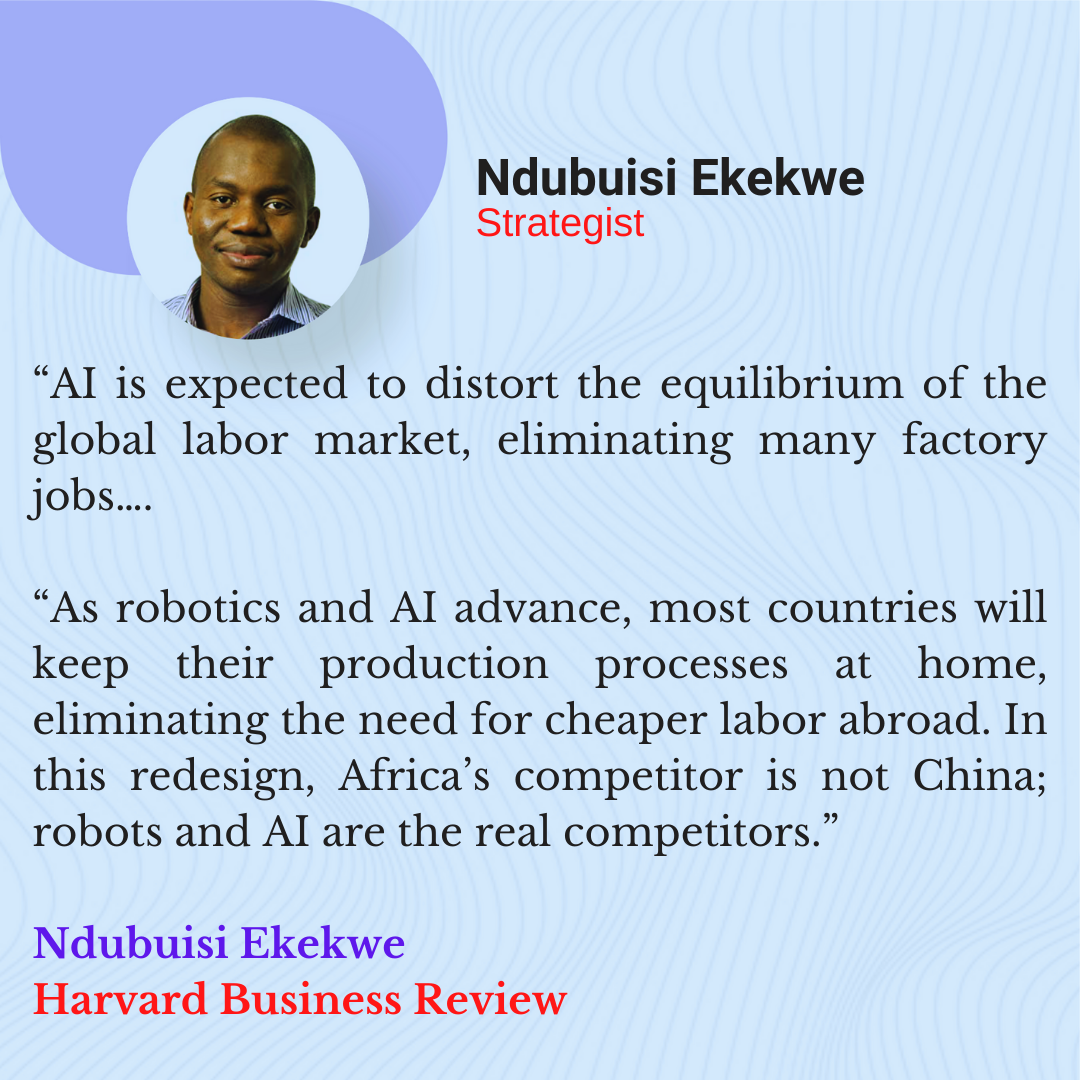
Source: HBR

Mr. Festus Keyamo who is a the minister of state for labour and employment during his media interview with Channels television on Sunday politics on 28th day of November, 2021 did categorically stated that the judicial panel of inquiry set up to investigate cases of police brutality and SARS-related abuses across the country especially that of Lagos state is illegal. This statement is by implication means that whatever result, findings or recommendations that comes out of that tribunal will not be effective as it will be null and void as you can not enforce on illegality.
Mr. Festus Keyamo who is coincidentally a senior advocate of Nigeria (SAN) is by all standard aware of the gravity of his statement declaring that the judicial panel of enquiry is illegal as he was heard to have said “I will answer this question as a Senior Advocate of Nigeria and so, I am entitled to my own opinion.
“For me, that panel was an illegal panel”.
He based his argument on the Tribunal of Enquiry Act of Lagos State which states that the governor only have the power to inquire into the conduct of any person, underline any person and then chieftaincy matters and related matters, and any other matter within that to promote the good of the public within the state. He interpreted s.21 of the Enquiry Act of the Lagos state to mean that it is only people over whom Lagos State has control that they can inquire into their conducts as you cannot attempt to set up a panel to enquire into the affairs and people you have no power or control over. To this effect, according to the learned silk the panel of enquiry is illegal and it’s findings and recommendations are void.
A quick search on various search engines using Nigeria as a keyword would deliver million of information regarding positivity and negativity within the economic, political and social ecosystems. In most cases, search results are current happenings in these ecosystems. In our experience, we have found that leaders and followers do not leave any stone unturned in addressing varied issues and needs using physical and digital spheres.
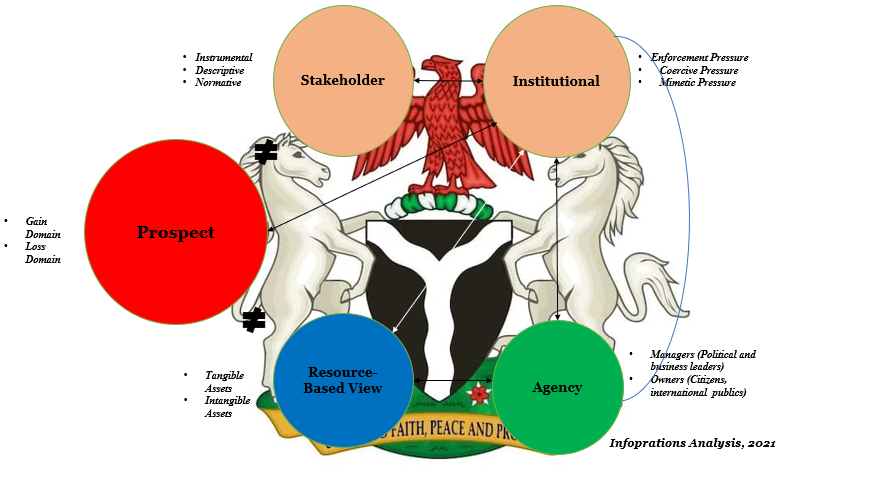
From social to economic and political discourse, Nigerians have had the course of appreciating each other when things went well. They have also had the course of throwing blames when things went wrong. When our analyst wrote his inaugural speech as a data-driven management specialist some months ago and stated that he has read and used over 200 theories with the intent of getting the right processes and people for a country that is in the midst of sticky followership and leadership systems, some readers asked for theories that best capture Nigeria’s current conditions and quest for greatness.
He has picked five for explication of the country’s situations and possible future directions. According to our analyst, it is not difficult to know that Nigeria is one of the most complex countries in the world. Its complexity rests on the inability of citizens and foreign publics to get things done seamlessly in most cases, especially in the public sector. The complexity can also be understood from the perspective of the private sector, where it is possible to meet people would make simple processes for accessing private goods and services difficult.
Nigeria and Nigerians Through Business Lens
In order words, Nigerians constitute the elements that can make or mar your value capturing at personal and business levels. Therefore, they need to prioritised from the outset of planning for business, political and social engagements with them. To do that effectively, our analyst suggests specific consideration of stakeholder theory developed several years ago with the main purpose of understanding primary and secondary stakeholders in organisations and society in general.
You should be able to know who and which organisation would be a stumbling block or a supportive element on your way of capturing value in Nigeria. This is instrumental construct of stakeholder theory. An instrumental stakeholder would be willing to do his or her work professionally without engaging in unethical practices. He or she usually examines job descriptions or tasks critically and ready to execute them considering norms and values of the employer and industry in general.
Institutionally, when it is about business engagement, there are ministries, agencies and departments that one needs to interact with. In most cases, enforcement focused MDAs put pressure on businesses and employees. This is largely due to their constitutional and statutory functions that must be executed towards delivery of financial and non-financial values to the governments, the principals. In terms of resources, Nigeria has a lot of natural and human resources more than home made technological resources. Hence, doing business in Nigeria is simply based on availability of raw materials and skilled people in all industries and sectors.
However, being a business owner should not be seen as an opportunity of swindling clients, customers, employees and governments. As you aim at gaining from your investment, every stakeholder in the social, political and economic institutions in Nigeria equally want to capture value. Despite this, there would be occasions where you and Nigerian(s) you had business with would lose. This could be as a result of internal and external factors such as a partner played “swindling game”. It could also be that the strategies and tactics you both employed to grow the business failed absolutely. Fluctuations in the macro and microeconomic indices are largely external factors that retard business growth in Nigeria.
Nigeria and Nigerians Through Political and Social Lenses
As stated previously, Nigeria is a complex country. Its complexity is more pronounced while dealing with stakeholders in the political and social institutions. Over the years, citizens have had low trust in political leaders and people in charge of social services. Therefore, being a Nigerian or a foreign citizen requires that you understand people who and organisations that would be instrumental to your political and social goods acquisition. Sometimes Nigerians and organisations can make things difficult for you when they engage in unethical practices and activities that are not conform with the national values and norms.
From the perspective of citizens, when stakeholders in the political institution use enforcement and coercive pressures towards making them [citizens] accepting and performing their constitutional-cum policy roles, citizens retaliate by exhibiting violent behaviour or telling their leaders to learn from what others in developed countries are doing. In this regard, citizens usually refer political leaders to their constitutional roles and why they should embrace best global leadership practices in all ramifications.
On several occasions, citizens have had the course of lamenting the failure of political leaders to use available resources judiciously. To them, this has been the key reason the country is losing in critical industries and sectors including. This is also applicable to the international competitiveness of the country within economic and political markets.