DD
MM
YYYY

PAGES

DD
MM
YYYY

spot_img

PAGES

Home Blog Page 5444

Vicarious Liability: a quick tip for every employer

2

Do you know that a master or an employer is held responsible for the actions of the servant or an employee under the employer during the employee’s ordinary course of doing his or her job. 

It is called vicarious liability.

Vicarious liability is a form of strict liability under the common law doctrine in which a secondary liability arises placing the superior responsible for the acts and actions of the inferior and the employers or masters which is said to be the secondary parties can be held indirectly liable for an injury caused by the employee  even though the employer was not directly involved in the act.

This is usually a recurring incident in workplaces whereby an employee commits a tortious act and the employer is strictly and vicariously held liable for the actions and inactions of the employees; for those actions carried out by the employee during an ordinary course of him doing his job or carrying out his assignment. 

The point of vicarious liability is to the effect that an employer is liable for an employee’s negligent actions if they were committed in the course or scope of the employee’s employment or are closely connected with what the employee is authorised by the employer to do. It is the common law that the acts of the employee are authorized by the employer during the course of him carrying out his job description  and therefore, the employer must be held responsible for all the acts carried out by the employee during the course of him doing his job.

For instance, if a company driver while delivering the company goods gets involved in an accident and a bystander dies as a result of that accident, the company driver will be held responsible for the accident so also the employer of the driver which is the company will also be held strictly and vicariously responsible for the death of the bystander which resulted from the accident that the driver got into. 

The Nigerian police force according to this common law principle of vicarious liability will be held responsible for the actions and the inactions of every police officer under their employment because it is presumed that every action of a police officer carried out during the course of his duty is authorized and sanctioned by his employer which is the Nigerian police force.

Be it as it may, there are ingredients or elements that must be present before Vicarious liability can successfully be prayed; firstly, it must be established that a negligent person was employed. Secondly, the negligent person was acting within the scope of his employment or that the employer authorized the employee to act and lastly, that the employer later ratified the employee’s acts.

Just as it is notable that in every general rule of law there must be an exception: there are exceptions to this common law principle of vicarious liability one of which is that the employee acted on frolic of his own and that his actions were outside the scope of his job description, in that way the employer can disassociate himself from the wrongful actions of the employee and won’t be thereby held to be indirectly responsible for the actions and inactions of his employee. 

Niantic, Augmented Reality Platform, Raises $300mln for Real World Metaverse

0

Metaverse is increasingly becoming part of today’s technology discussion, with more companies now working to bring the new idea to life. Facebook seems to be at the forefront of the evolution, but some other companies are beginning to take steps to transform to metaverse, marking the kickoff of another 21st century technology transition.

Facebook CEO Mark Zuckerberg described metaverse as “the next chapter of internet” and “embodied internet where you’re in the experience.” It has gathered a lot of momentum since July, and now, companies are raising money to make it a reality in their products.

TechCrunch reports below, that Niantic, a California-based company has raised millions of dollars aiming to switch its products to the much touted metaverse.

Niantic, the augmented reality platform that’s developing games like Pokémon GO, raised $300 million from Coatue, valuing the company at $9 billion. The San Francisco-based startup, which initially spun out of Google, will use this money to build what it calls the “real-world metaverse.”

As early as August, Niantic founder and CEO John Hanke has referred to the metaverse — at least, the one that renders us bound to VR headsets, like in “Ready Player One” — as a “dystopian nightmare.” Unlike Facebook, which changed its company name to Meta to signal its investment in VR technology, Niantic wants to develop technology that brings people closer to the outside world. Earlier this month, Niantic unveiled its Lightship AR Developer Kit (ARDK), which makes tools to develop AR games publicly available for free to anyone who has a basic knowledge of the Unity game engine.

“At Niantic, we believe humans are the happiest when their virtual world leads them to a physical one,” Hanke said at the time. “Unlike a sci-fi metaverse, a real-world metaverse will use technology to improve our experience of the world as we’ve known it for thousands of years.”

The funding will help expand the ARDK, which has already been used by companies like Coachella, Historic Royal Palaces, Universal Pictures, SoftBank, Warner Music Group and the PGA of America to create augmented reality experiences. So, instead of using technology like VR headsets — which are still inaccessible to much of the population — AR projects mostly use smartphones to encourage people to explore their outside surroundings. You might walk by the same mural every day, for example, but in Pokémon GO, a user-generated Pokéstop description might tell you what that mural actually represents. Niantic says that tens of millions of people play Niantic’s games each month, walking more than 10.9 billion miles in their games since launch.

“Niantic is building a platform for AR based on a 3D map of the world that we believe will play a critical role in the next transition in computing,” said Matt Mazzeo, a general partner at Coatue. “We are excited to partner with Niantic because we see this infrastructure supporting a metaverse for the real world and helping to power the next evolution of the internet.”

The VR metaverse might be “dystopian” in Hanke’s eyes, but like any technology, AR isn’t without its problems. Niantic’s newest game, Pikmin Bloom, is designed around walking, which can be alienating to elderly or disabled players. Pokémon GO has a community of disabled players, but they’ve had to speak out about how certain small in-game tweaks can make the game much more accessible for people with limited mobility.

Still, Niantic’s vision offers an alternative to Meta’s headset-dependent plans. Pokémon GO remains a smash success — it earned over $1 billion in 2020 and is already on track to outpace that revenue this year, according to app analytics firm Sensor Tower. Not all of its games are as beloved — the company recently announced it will shut down Harry Potter: Wizards Unite after in-app consumer spending and global installs dropped 57% year over year. But as independent developers get their hands on Niantic’s Lightship ARDK, we’ll see how far the concept of a “real-world metaverse” can stretch.

Zuckerberg said in July that the metaverse will not be created by one company. It will be built by creators and developers making new experiences and digital items that are interoperable and unlock a massively larger creative economy than the one constrained by today’s platforms and their policies.

“Our role in this journey is to accelerate the development of the fundamental technologies, social platforms and creative tools to bring the metaverse to life, and to weave these technologies through our social media apps,” he said.

Let’s Go – Register for Tekedia Mini-MBA Today

0

Thank you – we are seeing massive registrations for the next edition of Tekedia Mini-MBA. It is the most optimized academic excursion you will experience. Beat the early registration deadline and get the early benefits. A member called Tekedia Live “the best thing on business education in Africa”. We bring founders, business leaders, and policy drivers, and help everyone become better on the mechanics of markets.

Register now for Tekedia Mini-MBA (Feb 7 – May 7, 2022). Cost is US$170 (N90,000 naira) per person. We accept cards (debit, credit), bank transfer, Paypal, Stripe, Bitcoin, etc.

If you do, we will meet LIVE in class thrice weekly on Zoom for 12 weeks. And before those live sessions, pre-recorded courseware by industry best are made available.

Experience it by joining here. Let’s go.

Beat the world’s record >> work as a team

1

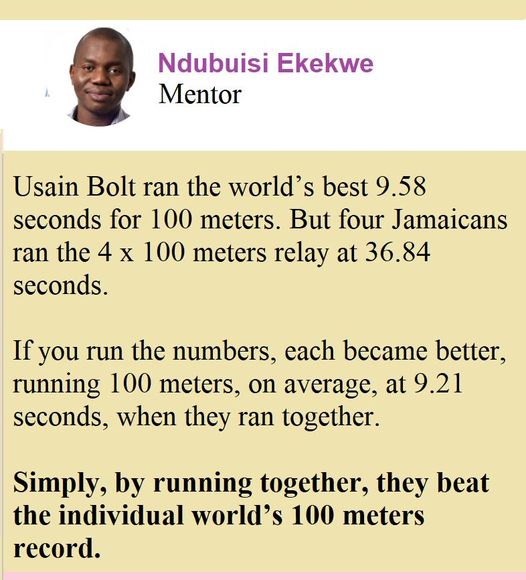
I have used this photo to teach in a military academy, a big bank and a global supply chain company, this month. At Tekedia Institute, we try to build analogies from simple things. Yes, just as the four Jamaicans beat the world’s 100 meters records when they ran together, a great team will outperform any great solo player. Collaborate, partner and work together.


Usain Bolt  ran the world’s best 9.58 seconds for 100 meters. But four Jamaicans ran the 4 x 100 meters relay at 36.84 seconds. If you run the numbers, each became better, running 100 meters, on average, at 9.21 seconds, when they ran together.

Simply, by running together, they beat the individual world’s 100 meters record. Collaborate, partner and advance together.


Beat the world’s record >> work as a team.

Comment on LinkedIn Post

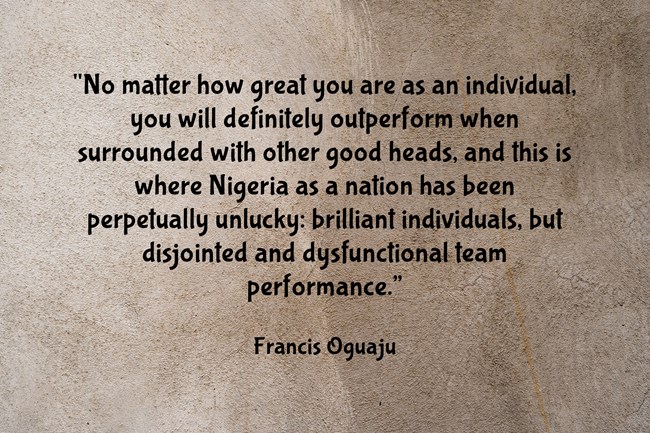
Here, most times, I write to read Francis Oguaju’s comment. Read this comment on the Usain Bolt post – https://lnkd.in/eXT6r7GJ) . Today, Nigeria has scored another own-goal: “Minister of Finance, Budget and National Planning, Zainab Ahmed, has said that Nigerians would get N5,000 per month as a transportation grant after the removal of fuel subsidies.” If you cannot run fuel subsidies well, do you have any chance to distribute N5,000 monthly effectively?

Minister of Finance, Budget and National Planning, Zainab Ahmed, has said that Nigerians would get N5,000 per month as a transportation grant after the removal of fuel subsidies.

According to the Minister, the Federal Government will remove fuel subsidies by 2022 and give the poorest Nigerians a transportation grant of N5,000.

Ahmed said this on Tuesday, at the launch of the World Bank Nigeria Development Update in Abuja, stating that about 30 to 40 million Nigerians, who are the poorest in the country, would have access to the grant.

She said, “The subsidies regime in the [oil] sector remains unsustainable and economically disingenuous


Nigeria’s Unrealistic Affordable Housing Scheme

0

As the Nigerian housing deficit spirals, birthing unaffordable housing on its way. The federal government, under President Muhammadu Buhari, has repeatedly promised to tackle the challenge by building affordable houses for Nigerians across states of the country.

In November, in a bid to make the promise come true, the federal government launched the National Housing Programme (NHP), as a vehicle to facilitate an affordable housing scheme. It also created a portal for the sale of completed houses under the scheme, to make it easier for individuals to acquire homes without the involvement of middlemen.

The NHP offers three choices to intending home owners; mortgage, rent and outright purchase. These, are believed to make home ownership easier – but there is just a little problem – the cost.

Last week, the Minister for Works, Housing and Urban Development, Babatunde Fashola, told the Senate Committee on Housing that the cost of the houses under the NHP has been varied according to states. He explained that the reason is due to the cost of building and topography – and then he let out the scary part that has contradicted everything affordable housing stands for.

Fashola said the costs of the so-called affordable housing is between “N7.2 million and about N16 million, depending on what a person wants”.

But according to the prices available on the NHP portal, a one-bedroom bungalow has a unified cost of N9,268,751, across every state where it is available. On the other hand, the cost of a two-bedroom bungalow is N12,398,460, while that of a three-bedroom costs 16,491,155.

A one-bedroom flat in a condominium available in southern states goes for N7,222,404, two-bedroom apartment costs N9,148,378, while a three-bedroom unit costs N13,241,074.

While these prices are affordable to many, it is unreachable high for its target audience.

As of last year, the cheapest house under the federal government’s Family Homes Fund, was a one-bedroom house in Delta State, at the cost of N4 million. Although much cheaper than the houses under NHP, it’s considered unaffordable. This is because Nigerians’ earning power falls significantly short of the cost.

Half of urban households (13 million) in Nigeria earn less than N100,000 a month, according to data from the Centre for Affordable Housing Finance. This means, using a mortgage that requires 20% down payment, the average Nigerian can only afford housing units cheaper than N2 million.

This worrisome reality is borne out of Nigeria’s state of penury. The most populated African country is the world’s poverty capital, where more than 40 percent of the population live below the poverty line (less than $2 per day).

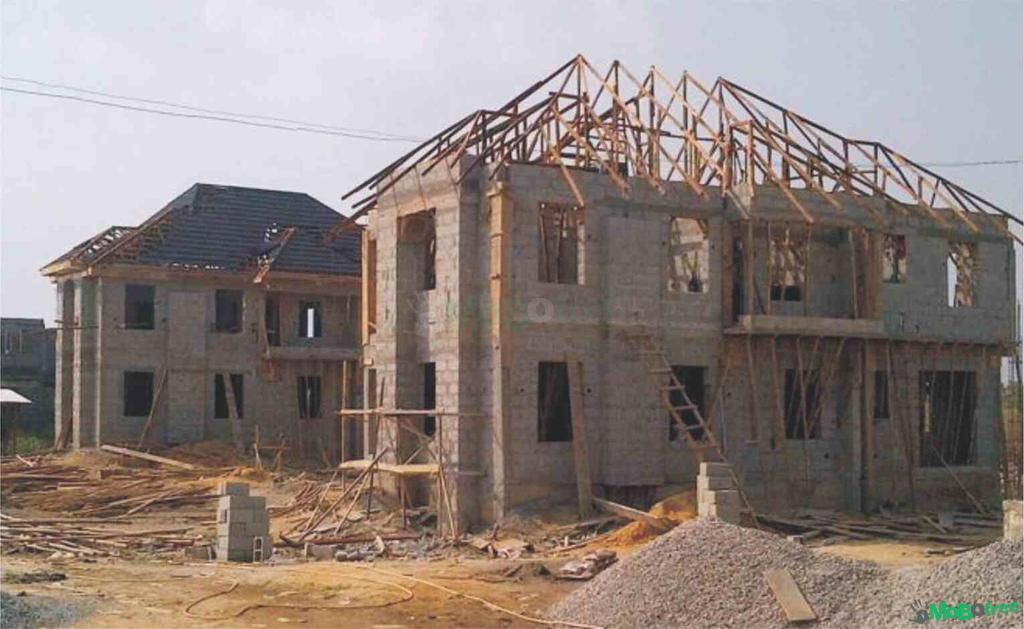
With the cost of the houses far above the earning power of Nigerians, many have been asking if the federal government meant what is written on the NHP portal which reads: “It is a programme borne out of the government’s desire to provide affordable housing for its citizenry.”

Although Fashola said that over 7,000 persons have indicated interest in purchasing the apartments, the majority of Nigerians considered the houses unaffordable. Moreover, many believe they can build better houses on their own with the same amounts set as the housing costs.