Religious organizations in Nigeria and many other countries of the world are not taxed because they are classified as not-for-profit incorporations but if we are being honest to ourselves we will accept the fact that religious organizations are full time money making ventures now, booming industry, an industry filled with money and potentials for easy and quick money. We can even refer to this industry as ‘Religiousprenuership’ with the captains of this multi billion dollars industry as “Religiousprenuers”.
In the spirit of not being hypocritical with ourselves as we always tend to be in topics like this due to the religious proliferation of the society, we all know that religious organizations make so much money on daily bases even more money than companies and taxable organizations not to be giving back to the government in terms of tax, both company tax for the incorporations and personal income tax for the employees of the organizations who earn salary and wages from the organizations.
We tend to shy away from this topic due to the fact that almost everyone in Nigeria claims to identify with one religion or another, hence anybody that brings up a topic like this may be tagged as an unbeliever or an agent of darkness or it may be said to be against sharia or a haram for raising the topic that religious organizations like churches, mosques, monasteries, even traditional religious organizations should be taxed once they have been registered and incorporated with the corporate affairs commission.
But before you tag me an unbeliever, don’t forget that even the Bible which is the holy book of the Christian religion advocated for the church to give back to the government when it says in the book of Mark 12:17 “Give what belongs to Caesar to Caesar”. This statement may be given different wild interpretations using different rules of interpretations but whatever interpretation given to it, the statement was made by Jesus Christ the role model of Christians and therefore should be obeyed as the statement if we use the literal interpretation rule literally means that government should be given back to as Caesar here represents the government.
Government are only able to provide basic amenities for the citizenry like good roads, good educational institutions, power supply, good water, security, health care etc through the money generated from tax and when people and organizations don’t pay tax there won’t be enough money for the government to provide such things.
Churches, both registered and unregistered and mosques have the largest number of followership as some mosques and churches can boast of thousand and millions of members who pay offerings, tithes or zakat, make donations and even sow seeds and we can’t pretend that they don’t make much money on day to day bases.
Religious organizations own properties, massive properties like estates, schools, businesses, lands etc, those properties were acquired from money made from the religious organization and how can a no profit organization acquire so much money to afford such properties. Taxes should be paid on those properties owned by those religious organization and personal income tax paid by employees of religious organizations which receive wages from the organization be it mosque or church.
Although, we cannot push under the carpet the fact that some religious organizations engage in corporate social responsibilities and tend to give back to the societies in some huge and significant ways. Engaging to undertake corporate social responsibilities are impressive but those are more like a moral duty which you may choose to do at your convenience and not a legal duty and they break no law when they fail to do it.
Every citizen must come to this discussion table with an open mind and see the need of religious organizations paying tax as a way of helping the government to help the society and taxing religious organizations is not a way of killing religion as many may think but it’s a way of improving its symbiotic relationship with the government and society.
Emerging technologies like AI would have transformation impacts on Law (source: law.com)
When you register your business, company or organization it becomes a distinct personality at law and can sue and be sued.
Only registered businesses/ incorporations can enjoy governmental benefits like relief funds, government loans, grants etc and its only when your business is registered that you have the legal capacity to bid for contracts and handle projects be it local or international projects, more so, it’s only when your organization is registered, fully incorporated and recognized by the corporate affairs commission that prospective or existing investors and clients can take you serious.
Second scenario;
Imagine losing the brand or trademark you painstakingly built for years and getting bullied for trademark infringement. A stitch in time they say saves a lot and this is the reason you should consider registering your trademark or brand too as you register your incorporations.
The needs of getting your brands trademarked and acquiring your patent rights cannot be overemphasized just as the need of registering your business or organization and you as a serous minded Entrepreneur, CEO, Business owner, Start up owner should consider registering your trademark if you are really in for a roller coaster ride, don’t be like an average Nigerian that leaves everything to chance.
It doesn’t matter if you’ve been using that trademark or brand logo from time immemorial, at law it’s who registers the trademark or brand name/ logo first is the recognized owner as it is the legal principle the first in time takes priority.
In this piece, I argued that every digital platform will become a fintech company. I called it fintechnolization: “Looking at Chinese digital platforms (Tencent, Alibaba) and US counterparts (Google, Facebook), my conclusion is this: every platform will become a fintech company in the end.”
But do not just wait for digital platforms. Yes, every company can indeed be a fintech company: “To ensure the financial inclusion policy of the Central Bank of Nigeria (CBN) becomes a success, TotalEnergies Marketing Nigeria Plc, in conjunction with InTouch and other partners, has deployed “Touch Point” to over 385 stations.
Touch point is a mobile payment financial-inclusion solution which TotalEnergies offers to capture the banked and unbanked populations in rural, sub-urban and urban communities nationwide including Lagos, Abuja, Port Harcourt, Kano, and Kaduna.
In view of the growing need for the integration of banks and other financial institutions with innovators and customers in the financial services space and the increasing adoption of Application Programming Interface (“API”) based integrations in the industry, TotalEnergies has partnered with organizations from different sectors of the economy to provide Touch Point, a robust financial solution that can be enjoyed in more than 385 stations nationwide with the plan to expand our footprint in the nearest future.
There are currently five service bouquets being offered at the stations – Airtime, Data, Bills Payment, Cash Deposit and Cash Withdrawal.”
People, the biggest innovation now in Africa is business model. Why? The technology stacks are becoming increasingly mundane that inventing new business models is where leverageable values could be found.
For TotalEnergies, it makes sense: core competency enshrined by the old Adam Smith division of labour was postulated during the industrial age era when factors of production were exceedingly expensive. Today, anyone can do anything and that is why Amazon is in pharmacy, logistics, retail, etc. Go further, there is nothing Google’s parent company does not do including medical science. Have the foundation stack, and you can keep building on top of it.
This is the age of fintechnolization. My blog, a digital portal, has its own fintech: Tekedia Capital.
Young graduates often make the mistake of not preparing for interviews. Interviews are examinations to be prepared for. Some limits their preparations to technical questions alone, and that has kept them longer than necessary in the job market. Internet is a great blessing to the 21st century because the answer to every question can be found there. A YouTube video on how to answer common interview questions can save the day for you.
My aim for this piece is not to discuss all the common interview questions, but to briefly hit on the question that is often answered ahead of the interview date, yet candidates don’t know it has been answered.
Is no longer news that interviewers do profile the social media platforms of their candidates ahead of the interview. Their objective for doing so is to know their candidates by getting the answer upfront for the question – tell us about your self.
Your social media handles tells the world who you are. Remember, Internet doesn’t forget – your posts ten years ago are still there for anyone to see. So before you click send the next time, take a deep breath and ask your self, if this is a true reflection of who you are. Will you like a potential employer to read this ahead of the interview? Resist the temptation to comment on every “hot” discussion on social media. Silence they say is golden. Avoid the error of wrong social identity, if you don’t want to keep aborting your opportunities in life.
Instead of engaging in unending controversial and provocative arguments on social media, use your social media platforms to announce your skill set to the world. Make an attempt to provide summarized answers to societal issues; which tells a potential employer that you are solution driven. Ensure your posts are devoid of insults and rude words. Volunteering services are ways of telling the world how selfless you can be – good team player. In it all, remember to celebrate your small wins, because its an easy way to tell the world about your passion and how much you can achieve with little motivation and support – goal getter.
For the last three decades, building collapse has been one of the primary critical infrastructure incidents in Nigeria. Out of the 36 states and Abuja, the Federal Capital Territory, Lagos State has always been the only state which records significant number of cases every year. In one of the previous analyses, our analyst reported that the Lagos would continue to have cases, if appropriate measures and controls are not established and followed by every stakeholder. Existing measures and controls, according to our analysts, are not really bad, but the failure of the concerned stakeholders to do the needful whenever the need arises has continued to be the key contributing factor to the incessant building collapse in the state.
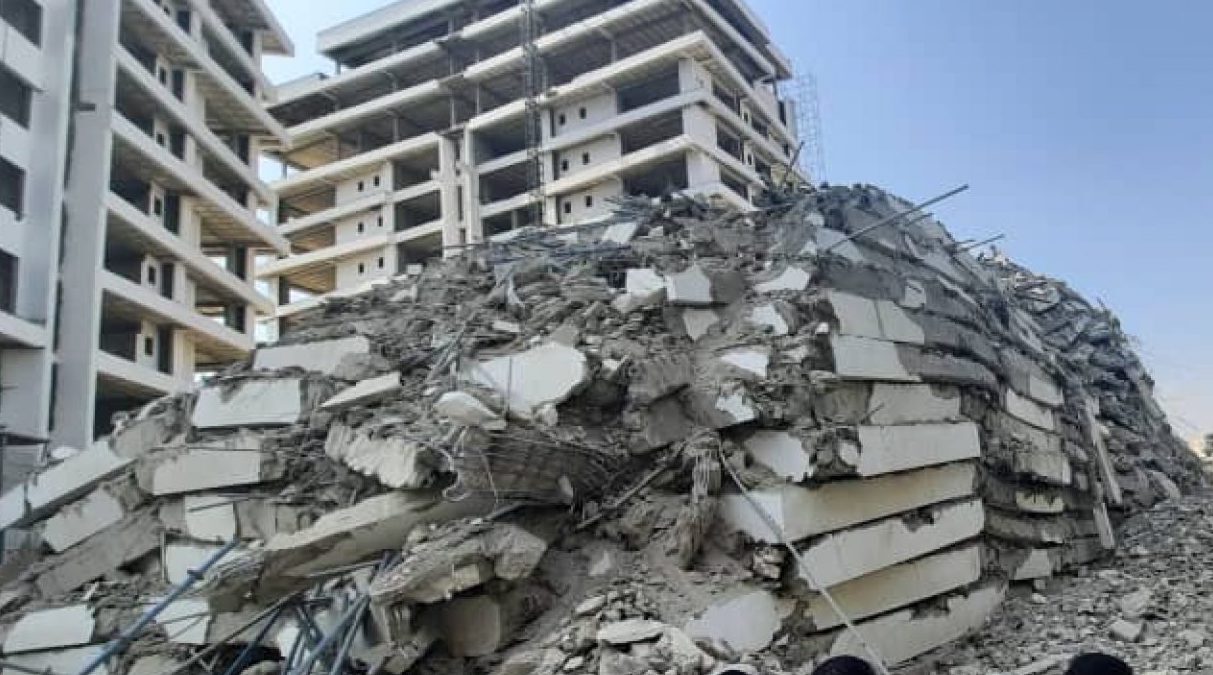
The Ikoyi building, a 21-storey, which collapsed on November 1, 2021, furthers reinforced the call for better processes and qualified people for ensuring sustainable built environment in the state. From the physical to the digital sphere, residents and non-residents expressed their feelings about the building. Several stakeholders were accused of failing those who lost their lives in the building.
This piece is not about x-raying what the conventional newspapers and broadcast stations have reported. The piece aims at pointing out how the state government, concerned public officials and political leaders in the state can explore comment section of the state government’s official Facebook page for ‘instant policy making’ in times of crisis such as building collapse.
From November 1 to November 6, 2021, the early period of the incident, the Lagos State Government used her official Facebook page extensively for disseminating latest happenings about it to the public. Our analysis shows that during the days, the state government posted 10 messages, which most relevant comments to all the messages were 85. The number of comments represents netizens, who reacted to the management of the incident by the state government.
Similar to what is obtainable when governments and other stakeholders in the policy making are seeking the views of the public, our analysis reveals that the netizens vehemently expressed views that were within the critical to high and medium to the low impact on the state’s built environment. With this, our analyst notes that the netizens remind the policymakers how powerful they [netizens] could be telling them [policymakers] what should be done in times of crisis.
The Exchanged Words
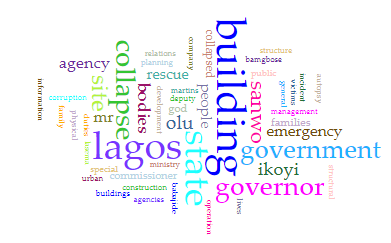
Collective examination of the posts and comments indicates a total of 5,608 words were used by the state government and the netizens during the six days. From the both actors, building, state, Lagos, collapse, governor, site, government, Sanwo-Olu and Ikoyi were predominantly used to narrate the incident, particularly the ordeals of the victims who were trapped under the rubbles. They equally employed these words to pinpoint what should be done and who should be prosecuted.
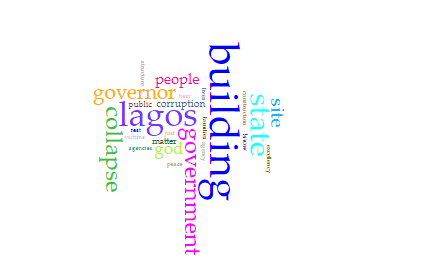
When the views of the netizens were specifically subjected to corpus analysis, it was found that 3,847 words were employed. Building, Lagos State, collapse and Lagos State Government were copiously used to attack the concerned stakeholders in the government, especially the governor and members of the regulatory agencies, including the State Emergency Agency, which according to them failed to organize quick rescue activities on the site. They specifically emphasised regulations, control, emergency and corruption in their views.
Exhibit 1: Emerged Dominant Words in Lagos State Government’s Posts and Netizens’ Comments
Source: Lagos State Government’s Official Facebook Page, 2021; Infoprations Analysis, 2021
Exhibit 2: Emerged Dominant Words in Netizens’ Comments
Source: Lagos State Government’s Official Facebook Page, 2021; Infoprations Analysis, 2021
What Netizens Told Lagos State Government During Early Stage of Managing Ikoyi Building Collapse
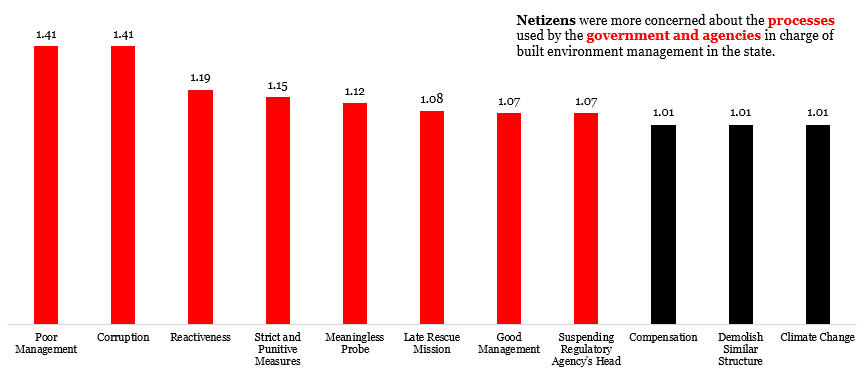
From our analysis, poor management, corruption, reactiveness, strict and punitive measures, meaningless probe, late rescue mission, good management and suspending regulatory agency’s head were the salient issues among the netizens. When they mentioned poor management, they vehemently referred to how the regulatory agency failed to ensure proper checks of the site and give approval based on the ability and capacity of the developer to handle such building.
Apart from these, poor management also referenced to the failure of the government in handling of the emergencies during the rescue operations. They largely noted corruption among the professionals, regulatory agencies and individuals as the core issue of incessant building collapse in the state. In our data, we also learnt that the netizens considered visitation of the governor, deputy governor and political leaders as reactive. According to them, the leaders failed to act when it is necessary, that is, ensuring proper management of regulation and control of the built environment in the state.
Ordering and setting up probe panel were also considered as reactive by the netizens, our analyst examined. Late rescue mission as a salient issue to the netizens was mainly found to be associated with the ways the state emergency agency handled rescue operations. They were of the view that the responders responded late. However, our checks of the state emergency agency’s Facebook page reveal a number of efforts of the responders on the site. The agency posted series of activities of its personnel on the site. Despite this, analysis shows low communication of supportive and collaborative messages to the public, which are usually needed during emergency situations such as the Ikoyi building collapse.
Exhibit 3: Netizens’ Early Salience Issues about Ikoyi Building Collapse
Source: Lagos State Government’s Official Facebook Page, 2021; Infoprations Analysis, 2021
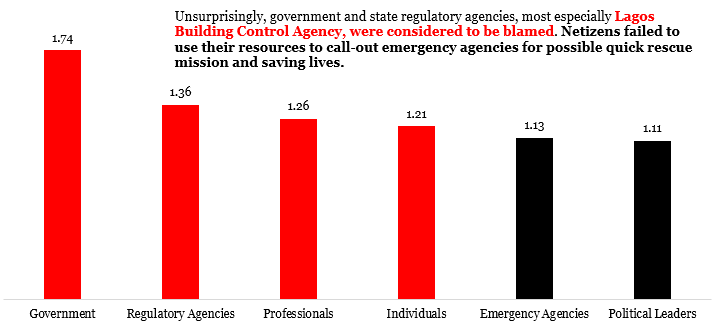
Who should be blamed for the incident? In our analysis, we discovered government, regulatory agencies, professionals and individuals as the stakeholders who failed to do the needful at one point or the other. As it is applicable to every state or national issue, especially an issue that connects with the political elites and public servants, the state government was fingered as the main stakeholder worthy of blame during the early stage of the crisis. According to our analyst, it is really surprising that the netizens considered the Lagos State Building Control Agency as the second stakeholder.
The astonishment lies with the fact that an agency saddled with approval of building construction should be first seen as the culprit before considering the state government. However, the netizens position could be viewed from the issues that have been identified with the agent-principal relationships over the years in management. It means the agent prioritised its own benefits over the benefits of the state government and the residents of the state.
Exhibit 4: Blame Worthy Stakeholders
Source: Lagos State Government’s Official Facebook Page, 2021; Infoprations Analysis, 2021
In what context did the netizens consider these stakeholders blameworthy? Our analyst explored this question with the examination of the posts of the state government. When their salient issue was reactiveness, they mentioned the state government more than 3 times before considering professionals, which was less than 1 time.
Unsurprisingly, the state government was referenced more than 7 times when poor management was the brunt burner issue before referencing emergency agencies, which was more than 4 times. While the emergency agencies were not seen as critical stakeholders worthy of blame within the poor management issue, the netizens predominantly referenced the agencies, especially LASEMA more than 14 times before mentioning the state government.
It is really surprising that the netizens failed to mention the state government as the main stakeholder that should ensure strict and punitive measures in the built environment. Instead, they deployed their resources towards significant identification [more than 8 times reference] of the state government when corruption was the salient issue to them followed by professionals and regulatory agencies. Considering the impact of the collapse and public outcry that trailed it during the period of the analysis, our expectation that the head of the regulatory agency would be copiously referenced was not met.
Salience Issues in Which Contexts
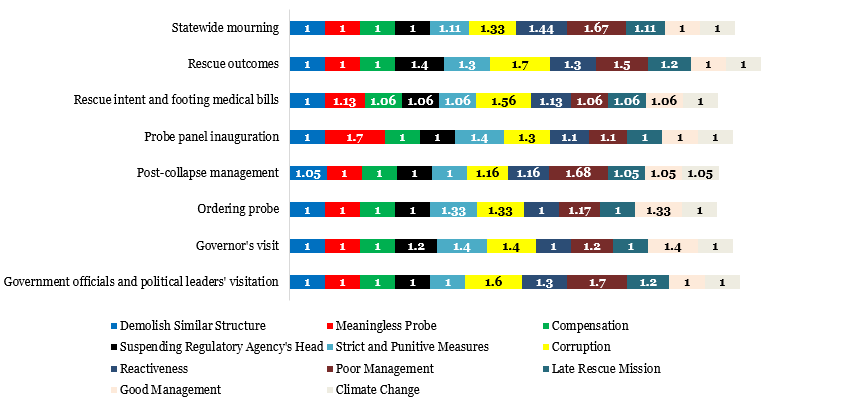
Similar to the contexts in which the netizens found the stakeholders worthy of blame, our analyst also examines the contexts in which the netizens used to express the salient issues. Demolish similar structure, climate change and poor management were significant issues to the netizens when the state government disseminated information that addresses post-collapse management. In our data, the state government mainly posted messages that established specific information about casualties in the hospital and activities of the emergency agency.
Meaningless probe was an issue when messages that focused on the probe panel inauguration, and rescue intent and footing medical bills were posted by the government. Suspending regulatory agency’s head was an issue when rescue outcomes, and rescue intent and footing medical bills were the most appropriate by the state government to communicate. As captured in Exhibit 5, it is obvious that the netizens utilized the state government’s intended elements and meanings before expressing their salient issues.
Exhibit 5: Contexts appropriated by Netizens for agendas setting
Source: Lagos State Government’s Official Facebook Page, 2021; Infoprations Analysis, 2021
The emerging insights have several implications for the policy making in the state and Nigeria in general. Our analysis has shown that political leaders and public servants have numerous benefits to gain from exploring netizens’ behaviour in times of crisis for early management strategy development and execution.
One of the significant implications is that rescue mission could be initiated and coordinated via social networking sites. In terms of posting messages, the state government performed well. However, the handlers of the Facebook page failed to react to the comments of the netizens. This is not a behaviour that should be exhibited and nurtured in terms of crisis.