

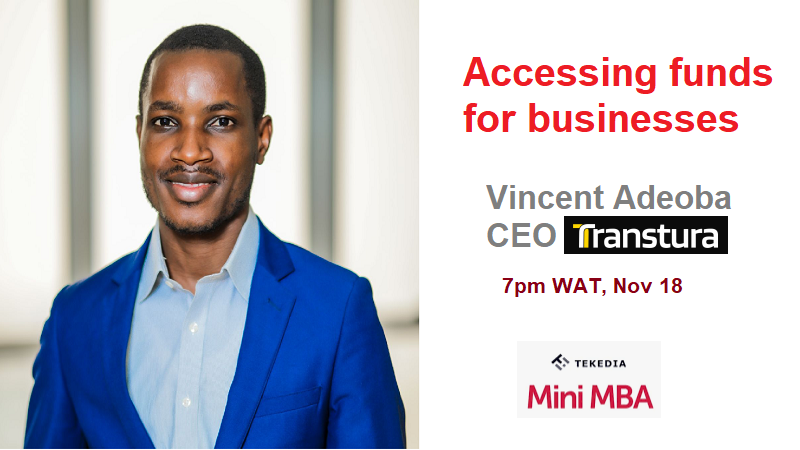
Tekedia Institute welcomes the CEO of Transtura, a mobility startup, to Tekedia Mini-MBA Live. Vincent Adeoba will be speaking on raising capital for businesses. The ex-PwC consultant has many experiences in this domain, as a consultant and as an entrepreneur. Time is 7pm WAT today; Zoom link in the Board
As New York Continues To Wait For Jumia

What is going on in Jumia? For Q3, the ecommerce commerce reported revenue of $42.7 million, which was up 8.5% year over year. That was a very poor result! Yet, the numbers keep growing, now 7.3 million active customers. But that was partly possible because it spent $26.8 million on sales and marketing in H1 2021; $24 million in Q3 alone. That crystallized to heavy losses: “ $64 million operating loss in Q3 and a $156 million operating loss through the first three quarters of this year.”
As I have written: the most important innovation in business is the Business Model. Jumia needs to evaluate its business model and not just its operational efficiency and execution. The most valued ecommerce in Nigeria and Africa by 2023 will not be Jumia because some B2B ecommerce are growing at high double digits, in the same market Jumia operates. That tells you where Jumia needs to spend more effort.
But for all, the double play strategy is working: JumiaPay is an opportunity. It would be worth more than the whole value of Jumia if it is now a separate company. Watch out for investors to make that case by 2023!
The Cola Battle In Nigeria – Pop Cola vs Coca Cola On Trademarks

Coca Cola goes after Pop Cola, filing that the beverage upstart is infringing on its intellectual properties: “the defendant (Mamuda Beverages Nigeria limited) is distributing and advertising it’s Pop cola products in get up that consists exclusively of a combination of all of the elements that comprise the applicant’s famous Coca-Cola trade dress”, reports Kano Focus.
.“The defendant’s use of the trade marks ‘Ribbon device’ and ‘Pop-cola’ in special script amounts to an infringement of applicant’s right of exclusivity of use of the marks ‘Coca-Cola’ script and ‘dynamic ribbon device’ and is liable to create confusion to the general public, foreign and international, as to the likelihood of an association between the applicant and the defendant.”
It therefore seeks an order of interim injunction “restraining the dependant, it’s employees or agents from using, affixing or displaying on any beverage product, vehicle, stationery, advertisement, putting to commercial use in any manner or form for the purpose of commercial benefit or otherwise, the ‘ribbon device’ and the special script in which the ‘pop-cola’ has been depicted on its advertising materials that is similar to ‘coca-cola (script)’ and ‘dynamic ribbon device’ trade mark pending the determination and hearing of motion on notice.
People, I am not sure this helps Pop Cola. Bigi Cola remains a standard on how upstarts can find their domains in contested markets with big incumbents. You win through innovation!
Pop Cola could possibly survive any litigation in Nigeria. But I am not sure if it has any plans to expand beyond Nigeria. If not, more lawyers may be needed.
Young Nigerian Entrepreneurs and Career Developers may consider: What is my end-game strategy for online metaverses?

This post came about from two completely different trains of thought. The first was a post Ndubuisi Ekekwe did in 2018. ‘The Best Possible Business Idea in Nigerian Telecom for Entrepreneurs’
These were the posts I liked from Prof. the most, where he wrote very detailed business analysis of multifaceted circumstances and issues, from a position of impartiality and no personal interest.
I reflected on how things have changed since then… firstly in the extent to which business affairs issues have moved on, and secondly the noticeable reduction in Prof’s fielding of this kind of content on LinkedIn.
These days, his time on the platform seems more limited, and his plate seems full with covering the standard announcements for Tekedia Institute, and doing the needful for the promotion of Tekedia Capital Start-ups.
The second train of thought concerns a poll post from one Clare Caroll who posed a question about what LinkedIn is.
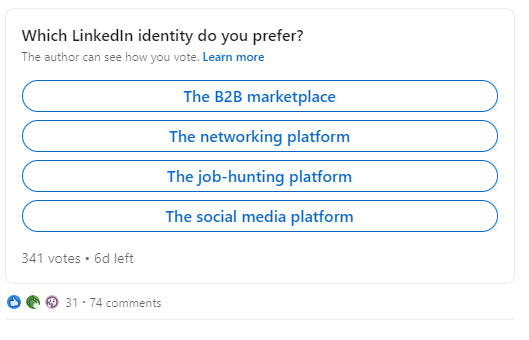
Which I answered like this:
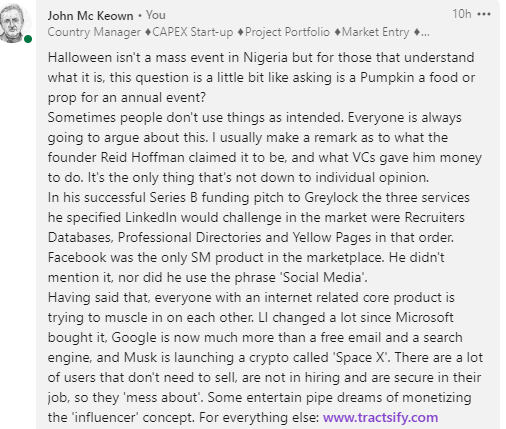
Ultimately it doesn’t really matter how you identify with any product in the ‘Universal Metaverse’
The important thing is that people have a strategy.
While it is important for everyone, it is probably even more important for the young and ‘yet-to-achieve’ because there is so much life ahead, and that is a life that needs a concious effort to self-manage.
This means time spent online should have strategic objectives.
Gaining traction online in itself isn’t an objective. It does not project you forward. It needs to be part of an ‘aggregation strategy’
Aggregation is about consistently doing something which in itself doesn’t generate value, but which then makes something else possible, which is the one that finally delivers the value.
Trying to build huge numbers of connections, and then get loads of followers with the aim of becoming an ‘influencer’ with no ‘aggregation strategy’ plan in place may be a fools errand.
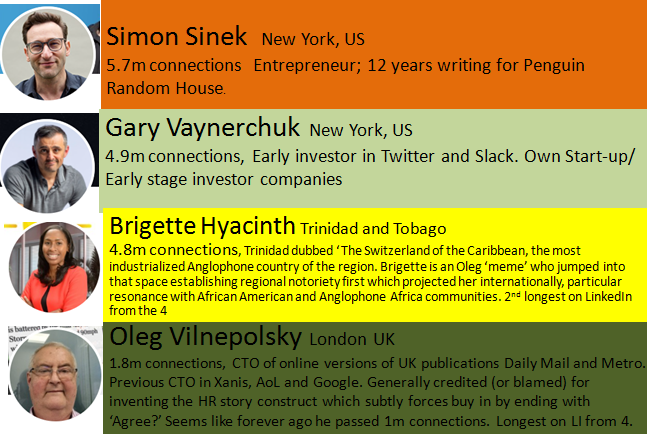
Generic ‘influencing’ is now a ‘Red Ocean’ pursuit. I’ve picked four people to make an illustration. I’ve deliberately avoided celebrities of such profile that their achievements would completely eclipse any additional benefit they could get from online media exposure, such as Bill Gates, Elon Musk, Mark Zukerberg, Richard Branson, Michael Dell, Alan Sugar etc.
The featured folk have all invested somewhere between six and twelve years to get their networks to where they are.
There is a great example from Ndubuisi Ekekwe on how Tiktok entered the market and found a USP over existing players in the segment. If your ‘aggregation plan’ has a dependency on weight of numbers then you may equally need to find a USP to outflank competition. On numbers alone, there are so many that are light years ahead, and they are accelerating away from us at exponential rates. Relative relevance on numbers alone, a 5000 LinkedIn network now will have lost 90% of its relative relevance by the time it is at the invitation threshold of 30k, and a 50k network will see a comparable collapse by the time it is 100k
‘Influence’ is rapidly translating from a sellers market to a buyers one UNLESS a very unique USP set can be applied just like Tiktok.
You will also need to build in some flexibility. Keep abreast of new developments in different parts of the Metaverses. Clare Caroll mentions the new ‘Creator Mode’ coming to LinkedIn
Career coach Martin Buckland often warns of behavioral changes that can suggest people have become desperate for a job. Employers often chase what they can’t get, and run a mile from anybody that has an odour of desperation. He says we need to be consistent.
But we also need to define what consistent means.
Returning to the earlier part of this piece, I bring a reprise on the change in Ndubuisi Ekekwe’s contribution behaviour. I may notice these changes but I am not privy to his ‘endgame strategy for your participation in the online metaverses’ The contribution behaviour may not be the endgame strategy itself but just symptoms of it. Sticking to the plan and being consistent may involve an evolution of contribution behaviour.
We also have SMO (Social Media Office) Regimes in global companies that we may serve or work with from time to time. An endgame strategy will need to be sufficiently robust to absorb changes in contribution behaviour dictated by different SMO regimes that we may flow though.
Summary:
- Have an endgame strategy for our participation in the online metaverses
- Develop, know and understand our aggregation plan
- Be flexible enough to absorb technical changes in metaverse elements and contribution behaviour modifications as a result of changing SMO regimes we flow though.
- Do not get caught up in a humdrum like chasing of metrics.
- Set achievable goals that support continuity – be an eternal flame, not a firework.
Ref:
linkedin.com/posts/ndubuisi-ekekwe-36068210_the-lesson-from-tiktok-on-facebook-and-mr-activity-6830583984037117952-CHNv
linkedin.com/posts/clare-carroll-digitalmarketing_contentangel-digitalbyclare-ugcPost-6866363578375528448-M8Ie
www.tekedia.com/the-best-possible-business-idea-in-nigerian-telecom-for-entrepreneurs/
Apple Introduces Self Service Repair
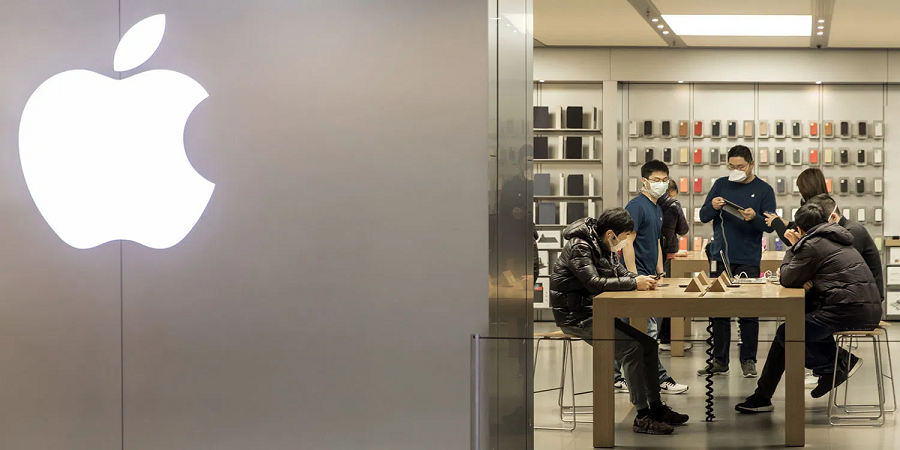
Apple on Wednesday announced Self Service Repair, which will allow customers who are comfortable with completing their own repairs access to Apple genuine parts and tools, for the first time.
Right-to-repair has been a controversial topic, for years, with repair shops and lobbyists advocating reforms that will enable individual iPhone or Mac owners to fix their devices while Apple kicked against it, citing concerns about the safety of third-party parts.
Succumbing to users’ demand, Apple is making available repair parts for customers. The service will be available first for the iPhone 12 and iPhone 13 lineups, and soon to be followed by Mac computers featuring M1 chips, Self Service Repair will be available early next year in the US and expand to additional countries throughout 2022, the company said.
Apple has more than 5,000 Apple Authorized Service Providers (AASPs) and 2,800 Independent Repair Providers, who have now been joined by customers to access repair parts, tools, and manuals.
Apple said the initial phase of the program will focus on the most commonly serviced modules, such as the iPhone display, battery, and camera. The ability for additional repairs will be available later next year.
“Creating greater access to Apple genuine parts gives our customers even more choice if a repair is needed,” said Jeff Williams, Apple’s chief operating officer. “In the past three years, Apple has nearly doubled the number of service locations with access to Apple genuine parts, tools, and training, and now we’re providing an option for those who wish to complete their own repairs.”
Biden’s administration and the watchdog, Federal Trade Commission (FTC) have upped the anti-monopoly ante, a signal Apple seems to have caught to bend its rigid repair rules.
Apple builds durable products designed to endure the rigors of everyday use. When an Apple product requires repair, it can be serviced by trained technicians using Apple genuine parts at thousands of locations, including Apple (in-store or by mail), AASPs, Independent Repair Providers.
Self Service Repair
However, the self-service repair poses a challenge for individual users without repair certification, who may want to fix their devices at home without contact with Apple. To address this challenge, Apple provides the guidelines below.
To ensure a customer can safely perform a repair, it’s important they first review the Repair Manual. Then a customer will place an order for the Apple genuine parts and tools using the Apple Self Service Repair Online Store. Following the repair, customers who return their used part for recycling will receive credit toward their purchase.
The new store will offer more than 200 individual parts and tools, enabling customers to complete the most common repairs on iPhone 12 and iPhone 13.
Self Service Repair is intended for individual technicians with the knowledge and experience to repair electronic devices. For the vast majority of customers, visiting a professional repair provider with certified technicians who use genuine Apple parts is the safest and most reliable way to get a repair.
Apple did not say how much the repair parts will cost. However, the move is suggesting that the smartphone maker is increasingly compromising its rigid rules to avoid a penalty from the FTC.