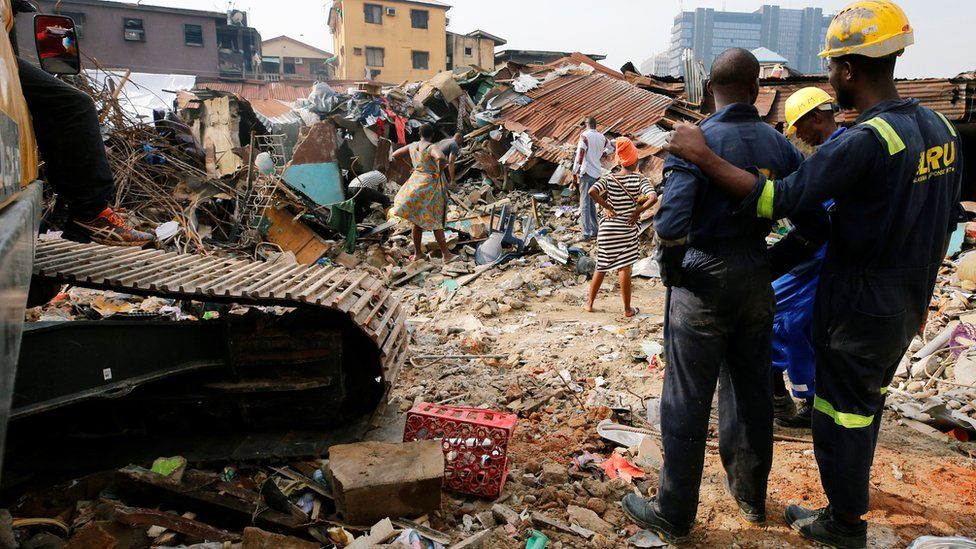
Over the last two decades, building collapse has remained a phenomenon that exhibits tremendous worry and concern in contemporary Nigerian society.
The aberration, which has claimed hundreds of innocent souls, maimed thousands as well as rendered scores of families homeless, has caused a colossal harm to not just the engineering-technology sector but Nigeria at large. In some quarters, it has made most residents to now sleep with one eye open on a daily basis.
On 13th March 2019, Nigerians were shocked to their bone marrow when notified that a certain 3-storey building situated on the Victoria Island of Lagos State abruptly collapsed, thereby claiming about twenty lives and inflicting different degrees of injury on countless others.
It was consequently reported that the third floor of the collapsed structure was being occupied by primary school pupils who were already unfortunately present for their usual studies prior to the bad omen.
Barely forty-eight hours after the ugly and unspeakable incident, it was learnt that another 3-storey building in Ibadan, the Oyo State capital equally collapsed unannounced, injuring a lot of Nigerians, though no life was reportedly lost.
Statistics indicate that within the aforementioned period, countless buildings situated across Nigeria have collapsed unceremoniously as if a structure can be brought to the ground at any time by mere breeze or thunder storm.
In March 2006, the top nine floors of a 21-storey building belonging to the Bank of Industry, located on the famous Broad Street – still on the Lagos Island – caved in, killing two and injuring twenty-three others.
In August 2010, a 4-storey uncompleted building at Ikoli Street in Garki, Abuja brings the Federal Capital Territory’s name into the list, thus reportedly claiming not fewer than twenty-one lives and endangered nine.
Survey reveals that between 2012 and 2016 alone, Nigeria recorded about fifty-four building collapses. Though the unfortunate situation is not peculiar to the country, its recent alarming rate calls for an apt and urgent attention.
To duly tackle the societal menace, the concerned authorities must comprehend the rudimentary factors that invariably constitute the quagmire. Building collapse is mainly attributed to substandard products, quackery, mediocrity, cheating, and/or soil texture cum topography, coupled with other environmental factors, as the case may be.
The dangers inherent in the use of substandard building materials cannot be overemphasized. These materials such as brick blocks, cement, sand, and rods, are not in any way meant to be used in constructing mere boys’ quarters let alone deploying their services in storey building constructions.
Regarding blocks, it’s either the cements used in the moulding weren’t good enough, or the sand utilized was nothing to write home about. There are specified sands meant for moulding but most block industries don’t bother going for them, probably owing to the cost of conveying it to the moulding site.
Since people, especially those residing in cities are often in a hurry, they are invariably left with no option than to patronize such block firms as stipulated above, hence posing danger for the proposed structure.
Quackery and mediocrity cannot be left out. It’s worth noting, perhaps shocking, that most of those who claim to be structural engineers, architects, or what have you, never attended any engineering or architectural class even for a day let alone becoming professionals. These amateurs go about causing avoidable harm in their respective jurisdictions.
They are just mere quacks parading themselves as chartered technologists. Pathetically, some of them who had the privilege to pass through a higher institution didn’t obtain the required training or expertise, thereby constituting structural defects when contracted to handle a certain building project.
A sound and qualified contractor is expected to thoroughly inspect the site for the proposed building, adequately advise the prospective landlord, tactically implement the project, complete it within a stipulated period, as well as know what to do while converting a mere bungalow to a storey building. When any of these professional functions is missing, it becomes a burden to the affected building when purportedly completed.
Away from substandard products and quackery, soil texture or topography, as might be the case, has equally been a thing of great concern while discussing building collapse in Nigeria. Houses are usually built on swampy sites in reverie areas like Lagos and Port-Harcourt without carrying out the required preliminary design, thus leading to collapse in the nearest future.
The aforementioned type of land is not strong. They are sandy or loose, but contractors build on them using templates that are meant for better compacted lands. Sometimes the contractor would know what to do but rather than doing the needful, would be only interested in his money or what he stands to gain as long as the contract lasts. This aspect of cheating or insincerity is currently on the rampage in the present days’ Nigeria.
Similarly, an architect is expected to thoroughly ascertain the nature of the land where the proposed building is to be sited before putting up the required design. The kind of structure to be erected on a certain site is directly dependent on the type of soil or land topography. It’s even more appalling to realize that most of these structures are erected without a building plan.
There must be a plan before a proposed house or building is eventually built. An eligible civil engineer is needed to inspect the design or building plan before it would be implemented by the site contractor who should be a builder or structural engineer. These professionals are meant to work hand-in-hand towards erecting a formidable structure.
The Standards Organization of Nigeria (SON) in collaboration with the Nigeria Customs Service (NCS) must take a drastic and severe step toward ensuring that substandard materials are no longer smuggled into the country as it has reportedly been the case in recent times. Hence, the various borders need to be holistically strengthened headlong. The SON ought to also properly regulate the locally made ones.
On the other hand, relevant professional bodies, including the Council for the Regulation of Engineering in Nigeria (COREN), Nigerian Institute of Building (NIOB), Nigerian Society of Engineers (NSE), and Nigerian Institute of Architects (NIA), ought to respectively employ a stiff measure towards addressing the crisis.
When any building is under construction, they should in their, individual or collective, capacity endeavour to ascertain the contractor handling the project to ensure his credibility as well as inspect the site and plan being utilized.
If a building eventually falls, they must ascertain the root causes of the collapse and not hesitate to issue the apt sanction to the affected contractor if found guilty. They should equally go beyond sanctioning; any culpable individual ought to be arraigned without any fear or favour, so that he will squarely face the wrath of the law.
Inter alia, the authorities on physical planning or development control situated in the various states across the federation must be very proactive and professional in their respective dealings with prospective landlords and developers.
It has been reported in various quarters that most of these government agencies oftentimes pay attention to frivolities to the detriment of priorities. The concerned governments must therefore look inwards with a view to addressing this kind of illegitimate and uncalled for acts.
Intending landlords are also advised to consult aptly whenever they intend to erect a building. Don’t just jump to any so-called contractor you find on your way. If you succeeded in contracting any, endeavour to confirm his/her authenticity or background by enquiring from the relevant authorities.
Eligible structural contractors, on their part, ought to feel free to consult their colleagues for any professional assistance when need be. And, they should also regularly be research-oriented towards enhancing their expertise at all times.
All in all, every structural professional mustn’t be reminded that foundations and pillars, as well as decking in the case of storey building, remain the basic factors that determine the validity or wellbeing of any building, thus should be taken very seriously at all cost.
Like this:
Like Loading...