DD
MM
YYYY

PAGES

DD
MM
YYYY

spot_img

PAGES

Home Blog Page 5538

Congratulations McPherson University Champions for Graduating from Tekedia Institute

0

Good People, join me to congratulate some McPherson University final year students for graduating from Tekedia Institute CollegeBoost. I want to wish all of you an amazing future ahead. We thank MCU leadership for this partnership which makes it possible for us to co-learn with the workforce of the future. McPherson #Champions, the future is full of abundance; good luck and congratulations.

.

On Nigeria’s Moribund Textile Industry

0

A few decades ago, Nigeria as a nation could boldly and proudly boast of a globally-recognized textile industry, which was then conspicuously the pride of the citizenry, economic wise.

Nigeria’s textile industry, which was the third largest on the African continent – following Egypt and South Africa, used to employ over 350,000 individuals when all the textile mills were functional.

The aforementioned figure as regards workforce was about 25% of the overall workers in Nigeria’s manufacturing sector. It was of an indisputable note that the said industry was then the second highest employer of labour, following the country’s civil service.

Between 1985 and 1991, record has it that the sector had an annual growth rate of 67%. Survey showed that the number of mills in operation as at then was about 180 and they were all reportedly doing very well, especially the Kaduna Textile Limited (KTL) and Nigerian Textile Mills (NTM) in Lagos, which were the oldest having been established as at 1957.

It’s therefore needless to assert that the now comatose textile industry was one of the booming subsectors of the nation’s economy during the post-independent era. The current pathetic state of the industry could not be unrelated to the level of neglect experienced by it in recent times owing to the overwhelming dependence on oil revenue.

The obvious decline in, or depreciating effect of, the textile industry could be aptly traced to influx of cheaper textile fabrics from China and India, among others, sold at prices the local mills can’t compete with. This ugly trend has resulted in a drastic downfall of the industry.

It would be recalled that in 2010, the Goodluck Jonathan-led Federal Government (FG) placed a ban on importation of textile fabrics. This approach – like other restrictive trade policies as at then – failed to yield the needed result.

Rather than bringing relief in the industry as expected, the above measure regrettably ended up causing the ‘smuggling industry’ to grow more wings. This unfortunate resultant effect made it possible for continued influx of textile materials into the country. It’s noteworthy that at the moment these materials have virtually zero revenue for the government’s coffer.

In a bid to alleviate the excruciating effects of the present realities, in early March 2019, the Central Bank of Nigeria (CBN) led by Mr. Godwin Emefiele made a frantic move on the moribund textile industry by adding textile materials to the list of the currently restricted items regarding foreign exchange (forex).

It would be recalled that 41 items were initially on the list, not until late 2018 – precisely December 10 – when the apex bank announced to the public that it had yielded to recommendations to add fertilizer to the existing list, and the item was consequently added making the total number as at then to be 42. This implies that by subsequently including textile materials to the list, the items barred from direct access to forex increased to 43.

In his words while disclosing the plan to the textile industry stakeholders during a meeting, Mr. Emefiele informed that the restriction would awaken the sleepy industry and ensure the required growth was actualized.

The CBN’s boss, however, disclosed that – as part of the apex bank’s intervention for the industry – it would currently support the importation of cotton lint for use in textile factories with a view that the concerned importers shall start sourcing all the needed cottons locally, commencing from 2020.

He further stated that as part of the CBN’s Anchor Borrowers’ Programme, the bank would also assist local growers of cotton towards enabling them meet the entire need of the textile industry domiciled in the Nigerian State. Additionally, he notified that the apex bank would support Nigeria’s cotton farmers to source high yield cotton seedlings with a view to meeting global benchmarks.

It’s worthy of note that the Nigeria Employers’ Consultative Association (NECA), alongside the Senior Staff Association of Textile (SSAT), applauded the Emefiele-led CBN over its restriction of forex to textile importers, saying it would go a long way in rejuvenating the moribund industry.

In a related reaction, the Lagos Chamber of Commerce and Industry (LCCI) however cautioned the FG over the strong move. In his statement, the Director-General of the body Mr. Musa Yusuf opined that there was need for a strategic approach before such policy pronouncement was made.

Mr. Yusuf argued that given the position of Nigeria in Africa as a leader in fashion, the range of fabrics being produced by the Nigerian textile industry could not favourably support the industry in terms of the quantity and quality required by the consumers. He therefore urged the government to reconsider the CBN’s move, which he described as ‘harsh’.

In his swift response to the argument, Mr. Emefiele clarified that the measures as announced by the apex bank were targeted to revive the Cotton, Garment and Textile sector. According to the boss, “the measures were well thought out to reposition the sector for job creation and economic growth”.

To assert the least, the inclusion of the textile materials into the list of the restricted items regarding forex couldn’t have come at a better time than now. The textile industry is almost going into extinction and the era when the FG is apparently intensifying its diversification mantra.

It suffices to enthuse that the frantic move was, without equivocation, a welcome development and a round peg in a round hole. I’m even of the candid view that the austerity measure ought to have been implemented long before it came on board.

Meanwhile, it’s appalling that two years down the line, absolutely nothing is being felt as regards improvement of the said sector, perhaps owing to lack of policy direction and insincerity on the part of the concerned authorities.

Knowing full well that epileptic power supply has hitherto been an overwhelming plight in the manufacturing sector at large, it’s preposterous to remind the FG that efforts need to be thoroughly intensified towards boosting the said source of energy. This will help tremendously to encourage the prospective cotton millers.

Similarly, towards encouraging the cotton growers, the farmers ought to be made to easily assess funds or low-interest loans to enable each of them purchase the needed machinery. It’s not anymore news that the continual deployment of crude pattern of cultivation and harvest has overtime bedevilled Nigeria’s agricultural sector.

In the same vein, the governments at all levels should equally assist in providing adequate irrigation systems for the farmers domiciled in their respective jurisdictions. The enabling environment must holistically be provided by the governments for business to strive.

Inter alia, acknowledging that policies of this kind are often, in the long run, frustrated by the forex black markets littered all over the country as well as importation smugglers, the FG must seriously implement measures to tactically checkmate these markets and our various borders, respectively.

The CBN’s move to resuscitate Nigeria’s moribund textile industry is a lofty one, but the relevant authorities mustn’t hesitate to do the needful towards making the policy yield a concrete result in the nearest future. 

Beyond The Vice President’s Proposal; Only Factories and Warehouses Will Save Naira, not CBN!

2

Sometimes you wonder if Vice President Prof Osinbajo is part of Nigeria’s national government. I write that because he has many GREAT ideas but yet translating those ideas into actions remains the missing link. He has written on independent power generation but yet men who work “partly” for him seem not to be listening; it must be frustrating indeed. The latest is a brilliant hypothesis on our exchange rate. I agree with Mr. Vice President – the official rate of the naira to USD makes no sense.

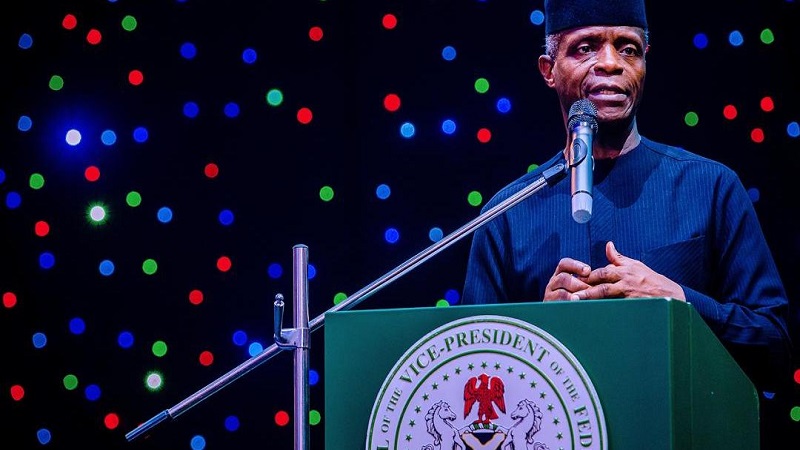
The Vice President said this on Monday during a speech at the Midterm Ministerial Performance Review Retreat which was held at the Banquet Hall, Presidential Villa, Abuja. He noted that Nigeria’s official exchange rate is “artificially low”, asking the CBN to rethink its strategy in tackling the forex crisis.

“As for the exchange rate, I think we need to move our rates to be more reflective of the market as possible. This, in my own respectful view, is the only way to improve supply. We can’t get new dollars into the system when the exchange rate is artificially low. And everyone knows by how much our reserves can grow.

“So I’m convinced that the demand management strategy currently being adopted by the CBN needs a rethink. All those are issues, I’m sure, that when the CBN Governor has time to address, he will be able to address in full,” he said.

There is no way you would expect me to invest at N410/$ and cash out at N570/$. Oh yes, you are talking of devaluation which means Naira has to be devalued to say N480/$ – a number I think is a possibility by next quarter. And that will happen and another cycle will come, and come, but that will not fix anything until Nigeria begins to ramp up production.

So that takes me to the national budget which was pegged at N410/$. Privately, I noted to some friends that our national budget is already off by more than 30% in absolute purchasing/expendable value because the exchange rate is not realistic.

Yet, it is not easy as the apex bank looks at many things to make these calls. It has cogent reasons for its strategy. But get it from me: there is nothing CBN, President Buhari, Vice President Osinbajo, etc will propose that will work if Nigeria does not begin to make things. We need to stimulate production for both factories of the old and the modern ones. That is the only way the Naira will rise. If not, the paralysis will continue for Naira because the strength of Naira comes from warehouses and factories, and not from CBN headquarters.

Update – The Office of the Vice President has clarified his statement

The Office of the Vice President put this statement, according to the News Agency of Nigeria:

“Our attention has been drawn to statements and reports in the media mis characterising as a call for devaluation, the view of the vice president that the Naira exchange rate was being kept artificially low.

“Osinbajo is not calling for the devaluation of the Naira; he has at all times argued against a willy-nilly devaluation of the Naira.

“For context, the vice president’s point was that currently the Naira exchange rate benefits only those who are able to obtain the dollar at N410, some of whom simply turn round and sell to the parallel market at N570.

“It is stopping this huge arbitrage of over N160 per dollar that the vice president was talking about; such a massive difference discourages doing proper business, when selling the dollar can bring in 40 per cent profit,” he said.

“It is a well-known fact that foreign investors and exporters have been complaining that they could not bring foreign exchange in at N410 and then have to purchase foreign exchange in the parallel market at N570 to meet their various needs on account of unavailability of foreign exchange.

“Only a more market reflective exchange rate would ameliorate this; with an increase in the supply of dollars, the rates will drop and the value of the Naira will improve.

“The real issue confronting the economy on this matter is how to improve the supply of foreign exchange, but this will not happen if we do not allow mechanisms like the importers and exporters window to work.

“If we allow this market mechanism to work as intended, we will find that the Naira will appreciate against the dollar as we restore confidence in the system,’’ he said.

(NAN)

Allow Forex Rates to Reflect Market Realities – Vice President Osinbajo Tells Central Bank of Nigeria


Allow Forex Rates to Reflect Market Realities – Vice President Osinbajo Tells Central Bank of Nigeria

0

Following the accelerating free-fall of the naira that has compounded Nigeria’s forex crisis, Nigeria’s Vice President Yemi Osinbajo has asked the Central Bank of Nigeria (CBN) to allow market forces to determine forex rate.

The Vice President said this on Monday during a speech at the Midterm Ministerial Performance Review Retreat which was held at the Banquet Hall, Presidential Villa, Abuja. He noted that Nigeria’s official exchange rate is “artificially low”, asking the CBN to rethink its strategy in tackling the forex crisis.

“As for the exchange rate, I think we need to move our rates to be more reflective of the market as possible. This, in my own respectful view, is the only way to improve supply. We can’t get new dollars into the system when the exchange rate is artificially low. And everyone knows by how much our reserves can grow.

“So I’m convinced that the demand management strategy currently being adopted by the CBN needs a rethink. All those are issues, I’m sure, that when the CBN Governor has time to address, he will be able to address in full,” he said.

Last month, the CBN accused an online forex rate aggregator, AbokiFX, of manipulating parallel market prices to the detriment of the naira. The apex bank had vowed to go after the media outlet, forcing it to shut down the forex rates publishing aspect of its business.

However, the development has changed nothing in the Nigeria’s forex market. Currently, the exchange rate remains $1/N570 and above in the parallel market, though the central bank’s rate remains N410.

Experts have pointed at insufficient dollar liquidity as part of the reasons the naira is depreciating. Data from the CBN shows $116 billion to be the total dollar inflow to Nigeria’s economy in 2020, which compared to 2019’s $142 billion and 2014’s $160 billion, has 20% and 30% drop in dollar inflow to the economy respectively. The drop in oil prices, which is Nigeria’s dominant source of revenue, is largely responsible for dollar scarcity in Nigeria. There is also the massive drop in diaspora remittances as people switch to cryptocurrency for cross-border transactions.

However, like Osinbajo, experts have advocated that the CBN allow market realities to determine naira’s fate. Last month, former CBN deputy governor Kingsley Moghalu, said the financial regulator should stop subsidizing the naira.

“As I have said before, and say again, we have two options. One is to let the Naira find its level in the market. In order, words, the central bank should stop subsidizing the currency. While there will likely be an immediate spike in the price of the dollar, this move will have two advantages. The first is that, because Nigeria has a big, profitable economy and market, dollars will likely swamp the market seeking profits for investors. When this happens, the laws of demand and supply will work in favor of the Naira. Alongside this, maintaining different exchange rates for different kinds of transactions must end. This is called rate convergence,” Moghalu said.

With many voices calling on the central bank to change its forex regulatory approach, as every measure it has taken so far has failed to yield the needed result, all eyes are on the governor, Godwin Emefiele, to make a shift from the status quo. However, there is a strong belief that removing the naira’s subsidy will amount to further depreciation reflecting Nigeria’s current economic situation.

UAV Application in Agriculture

0

Just going through one of the finest courses I have ever watched on UAV (unmanned aerial vehicle) application for agriculture. Thank you Nnadozie Onyeukwu,  Victoria Madedor and African Farmers team for preparing that for Tekedia Institute Practice of Agriculture