DD
MM
YYYY

PAGES

DD
MM
YYYY

spot_img

PAGES

Home Blog Page 5626

A Jumia Playbook for $7 billion Valuation

1

Jumia has assets and some of the best in continental Africa. But Jumia also has natural competitors when its best customers are being pulled down by economic gravity. For Jumia to outperform, it has to deal with the double whammy of economic paralysis in its major market (Nigeria) and currency deterioration affecting marketplace players who import most of the things listed therein. 

As the customers become pulled down by economic weights, they move informal, patronizing open markets, which  most times do not charge VAT, artificially making their products cheaper. These factors continue to affect the results.

Jumia Technologies (NYSE: JMIA), the e-commerce leader in Sub-Saharan Africa, missed revenue estimates for the second quarter by 7%, showcasing revenue of $40.2 million, and slightly beat the loss prediction of analysts. Jumia reported losses of $0.41 a share for the quarter. Wall Street had predicted a loss of $0.44 per share on revenue of $43.3 million for the quarter.

I see three key areas in Jumia business: JumiaPay, fashion and food delivery. If I have to speak to the Jumia board, I will ask it to make JumiaPay its core double play, feeding from the one oasis of the Jumia marketplace. 

My proposal would be to have a holding company where Jumia can run JumiaPay as a quasi-fintech which becomes open to non-Jumia customers. With a microfinance bank license, it would become a digital bank. The goal is total fintechnolization of the Jumia platform where lending and other financial services can happen at scale.

African-focused e-commerce giant Jumia reported revenues of $40.2 million in Q2 2021, up 4.6% year-over-year. Jumia’s operating loss, which declined in Q1 2021, increased 24.7% to $51.6 million in Q2 2021. The company says transactions on JumiaPay increased by 12% from 2.4 million in the second quarter of 2020 to 2.7 million in the second quarter of 2021, making it the fastest transactions growth rate over the past four quarters. (Techloy)

If Kuda has 1.4 million customers and is valued at $500 million, Jumia with an excess of 10 million customers should be more than the current $1.84 billion valuation. If you feed Jumia logistics, food delivery and fashion (wigs, etc) into JumiaPay, agnostic of platform, you have one of the largest fintechs in Africa. That alone should be more than $2 billion. Then add the pieces and you have a great holdco which Wall Street will connect.

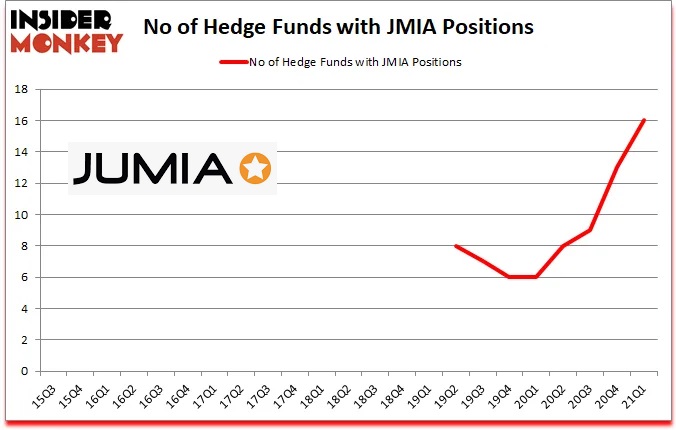
The hedge funds think this company can outperform. I do believe it since Jumia added JumiaPay. But it needs to allow that piece to fly. And if it does, Jumia will have a great party. No one has made money directly on ecommerce in the emerging world; you always use it to capture value via other verticals.

Jumia should be worth at least $7 billion in America!


LinkedIn Comment on Feed

Comment #1: Although Jumia has the core advantage of the eCommerce platform to draw traffic to its payment application, the truth is that the space JumiaPay operates in is one of the most competitive in the Nigerian fintech space – a space where most big players primarily have strong customer acquisition points, but rarely a distinctive unique value proposition.

Customer Apathy is a real thing, and while JumiaPay may look promising, there’s nothing that guarantees that people who download the app for eCommerce purposes will use it for payments also, considering they already have what they originally use and eCommerce is really not something you do everyday.

In the long run, I see Jumia’s logistics business as it’s core advantage, with a good network and a couple of partnerships here and there, Jumia could position itself as the logistics operating system for all things eCommerce in Nigeria, and probably Africa.

The logistics space is Lagos is saturated, however, most players can’t properly connect Nigeria and this is where Jumia can position itself. Gokada is probably one of the smartest players in the Lagos logistics space; real time tracking, strong B2B model etc. Jumia can borrow some leaves from their booklet and connect nationally.

My Response: Get a microfinance license, send N500 awuuf for anyone to click a button to have a Jumia bank account, tomorrow report that your digital bank has 10 million users. Offer 10% discount for paying with a Jumia Bank account instead of Visa/Mastercard cards. Save those fees. That loop will feed food delivery which happens often, logistics, etc. Thenopen it for other players. If they use, their users save 5% via in-merchant fees. This is fintechnolization: JumiaPay will have the largest customers in Africa and will become the category-king on day one. It has brand recognition already.

Comment #2: Great point, but incomplete picture?

Jumia’s brand assets are built on customer relationship, and Jumia has a very low brand score on this.

Jumia borrowed Amazon’s playbook to play locally, but Jumia missed what made Amazon Amazon – CUSTOMER FIRST. Ask the so-called “online Nigerian buyer” to choose between between “faraway Amazon” and “backyard Jumia”, and they will choose Amazon without blinking an eye.

Jumia is a great company, but I think they missed out Amazon’s page on “customer first.” For reasons unknown, Jumia has allowed “bad sellers” to corrupt its “customer relationship engine.”

Customers are still complaining bitterly on how they bought a particular product spec, colour and size on Jumia, only to receive something totally different from what they ordered.

To make Jumia Jumia, Jumia should:

1) Take out the bad apples by creating some sort of quality assurance/ customer service feedback program.
2) Apologize to the millions of customers they’ve hurt or allowed to be cheated by these bad sellers.
3) Get customers to verify this – thanks to cheap social media.

Until they do this, Jumia will only be casting a long shadow…

One that might come back to haunt it.

Like Beowulf’s monster…

Response: “Jumia borrowed Amazon’s playbook to play locally, but Jumia missed what made Amazon Amazon – CUSTOMER FIRST.” – that may not be fair. Unlike Amazon, Jumia runs its own postal service, security, waterboard, etc and does not get free cash via Amazon Prime. Jumia is doing well; try to run a business in Nigeria where some of these delays can be caused by Lagos 5-hour traffic for a trip planned for 25 minutes. While Jumia has to improve but I tell you one thing: running a delivery business in Nigeria without a postal service cannot be like America with a working postal service.


Can an Africa NFT Metaverse fuel an Africa wide wealth explosion?

1

In an interesting twist on ‘virtual value’ a British artist, Damien Hirst, launched a series of 10,000 artworks and non-fungible tokens (NFT) to conduct an experiment that forces buyers to choose between possession of the physical artwork or its blockchain-based version.

The artworks have ‘banknote’ type security features – every artwork is signed, numbered, watermarked, and features an embedded hologram, making them very difficult to copy or forge.

Owners will have to decide whether to keep the NFT or the physical artworks, which are being kept in a secure vault.

At 3 pm. BST on July 27, 2022, if collectors have not opted for the physical version, their print will be burned and they will retain only the NFT version. Otherwise, should they chose physical format, the corresponding NFT will be deleted from the blockchain.

In February, the first ‘Crypto Fashion Week’ happened and Versace went ‘digital’ for Milan fashion week. The rise of ‘Virtual Fashion’ NFTs has come out of a broader move by big fashion names to create virtual products aimed at the super-rich.

Exclusible is a new NFT marketplace which is the brainchild of Thibault Launay and Romain Girbal. The marketplace is tailored to these kinds of high end, limited edition virtual products.

‘The NFT market has witnessed a dramatic increase in value over the last few years. The market cap has increased almost ten times from 2018 to 2020, and in 2020 alone, its value increased by 299%’ – Thibault Launay

Damien Hirst

Recalling my article on Tekedia in November last year – ‘From Broke to Successful Entrepreneur, in Nigeria, You Need More Than an Idea and a Piece of Paper’ … I stated: ‘From ten year old boys begging on roadside with radio controlled models fashioned from painted cardboard, to adults with curious motorcycle, plane and helicopter contraptions, the problem is that while our hearts sink at the lack of outlet for the obvious creativity, we can see there is neither an obvious application for their creation as a product, nor an obvious path within the culture of typical matrix organisations, for a career opportunity’

But can the NFT route be a new means to monetize these curious and very unique contraptions?

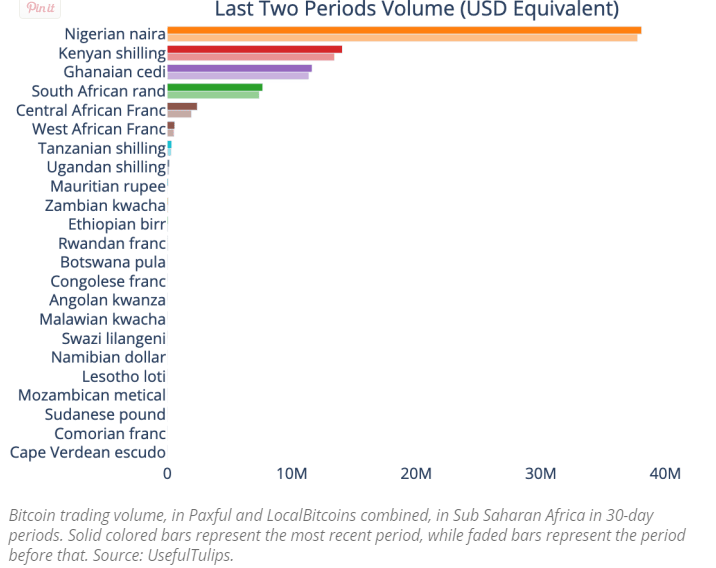
An article for Bitcoin Magazine said that despite the ban brought out by FGN earlier this year, Nigeria’s insatiable appetite for virtual assets shows no signs of abating.

From July 4 to August 4, 2021, Nigerians have traded a USD equivalent of $38,083,688 in two P2P platforms, Paxful and LocalBitcoins. In the previous 30-day period, from June 4 to July 4, bitcoin trading in the main P2P markets in Nigeria amounted to $37,761,748.

But here’s the thing – Cryptocurrency trading is illegal in Nigeria! and while a way is obviously being found around it, why not take interest in the developing NFT market instead?

For sure if the Bitcoin Magazine quoted analytics platform ‘UsefulTulips’ can find out what is going on, no doubt FGN can.

All of the weird and wonderful home-made contraptions made in Africa can find a special place in the NFT world. Previously they have had no route to an international market as physical products… but as virtual ones?

Gucci and Versace may be making limited editions of Luxury NFTs but these home-made items made from salvage are not just limited, they are Unique! When each one is birthed the mould is broken!

How much more potential success can they enjoy then, if marketed as NFT’s according to the Damien Hirst model?

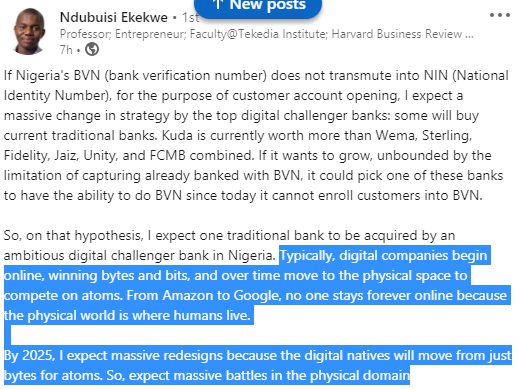
Prof Ndubuisi Ekekwe’s words – ‘Typically, digital companies begin online, winning bytes and bits, and over time move to the physical space to compete on atoms. From Amazon to Google no one stays forever online, because the physical world is where humans live.

By 2025, I expect massive redesigns because the digital natives will move from just bytes to atoms. So, expect massive battles in the physical domain…’

Well… this creates a new paradigm.

Yes, Ovim Village Boy 2.0 will be the one to send things back the other way and create massive value by making atoms become bytes.

Welcome to the NFT world of Africa Metaverse!


References and Acknowledgements (not in the main text body) : 

www.linkedin.com/pulse/nft-market-overview-digital-asset-markets-data-thibault-launay/

www.exclusible.com/

decrypt.co/75914/damien-hirst-forces-buyers-make-choice-physical-art-nfts

hackernoon.com/the-rise-of-virtual-fashion-and-the-very-first-crypto-fashion-week-x54937uk

bitcoinmagazine.com/markets/nigeria-40-million-bitcoin-trading-p2p

tinyurl.com/Idea-piece-of-paper


.


Poly Network’s $600m Crypto Heist and the Questions of Crypto Exchanges’ Security

0
Bitcoin is soaring

In another breach of a cryptocurrency platform, more than $600 million in digital tokens has been stolen by hackers on Wednesday, adding to the culminating cyberheist stories gracing the digital asset market, which raises questions about the security of crypto exchanges.

The platform, Poly Network, which facilitates peer-to-peer transactions announced the heist Wednesday on Twitter and posted details of digital wallets to which it said the money was transferred, urging people to blacklist tokens from those addresses.

Crypto trade publication The Block, said the value of the tokens in the wallets cited by the platform was just over $600 million at the time of the announcement.

Since 2011, hackers have stolen more than $8 billion worth of cryptocurrencies. According to a report from Amsterdam-based blockchain analytics firm Crystal Blockchain, over $2.8 billion was stolen through exchange security breaches that totaled 113 as of last year, and has increased following a number of heists in 2021.

In 2014, the Mt. Gox exchange based in Tokyo, collapsed after losing half a billion dollars in bitcoin. The Coincheck breach of 2018, which saw hackers made away with $535 million worth of NEM coins, was top of it until Wednesday’s Poly Network’s $600 million heist.

The platform, with the warning that it planned to take legal action, urged the hackers to return the stolen funds to several of its digital addresses.

The warning seems to be yielding results, with around $4.8 million in stolen tokens returned by Wednesday afternoon, according to public blockchain records and crypto tracking firm Elliptic. Analysts have attributed the move to the hurdles involved in moving such a huge amount of stolen crypto as it may give the hackers away.

In June, the Federal Bureau of Investigation (FBI) pulled off a first-of-its-kind operation to recover the $4.4 million paid in ransom through cryptocurrency to a criminal gang responsible for a ransomware attack on a US oil company, Colonial Pipeline. The operation sends a clear message that blockchain’s DeFi (decentralized finance) is no longer a guarantee that its transactions cannot be traced or reversed especially when it involves huge sums.

“There’s so much public attention on this, and exchanges will be on the lookout for customer deposits linked to this theft,” Tom Robinson, Elliptic co-founder said. “This demonstrates that even if you can steal crypto assets, laundering them and cashing out is extremely difficult, due to the transparency of the blockchain and the broad use of blockchain analytics by financial institutions.”

However, the FBI’s breakthrough doesn’t answer the worrisome question about hacks and breaches of crypto exchanges, which is among the reasons for increased calls for regulation of crypto operations.

DeFi platforms allow financial transactions, usually in cryptocurrency, without traditional gatekeepers such as banks or exchanges. The sector has boomed over the last year, with platforms now handling more than $80 billion worth of digital coins. The increasing volume of transactions on DeFi system exposes technical flaws and weaknesses in the code many platforms use, leaving it vulnerable to hacks and heists.

But the security lapses boil down to many other factors that border also on the lack of regulations and guidelines for exchanges.

“Their security policies are neglected because these new services cannot (financially) afford to pay as much attention to such security issues, whereas well-established entities are in a better position to ensure and prioritize security,” Said Kyrylo Chykhradze, a product director of Crystal Blockchain  in an email to Coindesk. “This results in newer services becoming cherry-picking opportunities for bad actors who can spot those vulnerabilities.”

The chief technology officer of Tether, a stablecoin or type of cryptocurrency usually backed by real-world world assets, said on Twitter the company had frozen $33 million connected with the hack, and top management at large crypto exchanges responded to Poly on Twitter saying they would try to help. But it’s all reactive and doesn’t proffer a proactive solution to the problem that has got a lot of investors worried.

“It is a massive hack … as large as Mt. Gox,” said Bobby Ong, co-founder of crypto analytics website CoinGecko, although he noted the fallout had not yet hurt major crypto prices. “This project is finished in my opinion. (It is) going to take a lot to regain confidence.”

While it’s difficult for hackers to launder stolen crypto worth millions of dollars, it will barely get noticed when the sum is in thousands, and that leaves many investors vulnerable.

Welcome Toll Gates On Nigeria’s Federal Roads

2

Finally, it has happened: toll gates are coming back on federal roads in Nigeria: “The federal government of Nigeria has approved reintroduction of toll gates on federal highways across the country. The approval was made during the Federal Executive Council (FEC) meeting held on Wednesday.” That is checked as expected. The next one to watch is the privatization of most federal universities. I have written that by 2029, the Nigerian government will put most on sale. While many general hospitals have been abandoned across local government areas, they will not abandon universities as there are great paying customers. Simply, they will flip and exit!

The plan to reintroduce tolling on federal highways in Nigeria was conceived in 2019, as the effects of dwindling oil revenue hit home.

“One of the highlights of today’s Federal Executive Council (FEC) Meeting (Wednesday, August 11, 2021) is the APPROVAL of a Federal Roads and Bridges Tolling Policy and Regulations.

The biggest shame remains the abandonment of Isuikwuato General Hospital, a premier hospital, many years ago. IGH served Ovim, Eluama, Isuochi, Uturu and many communities in Abia state. Check the GH in your state, it is possibly gone unless you were born in Lagos, Abuja or PHC. Systematically, Nigeria dismantled and abandoned one of the most critical national infrastructures: relative quality healthcare in rural communities.

People, things used to work. As a kid in Ovim, we used to mock those working in Ovim Veterinary Clinic, opposite the police station. Yes, no one understood why they needed a clinic for cats and dogs. That thing has since gone – everything is going, and gone.

The biggest illusion in Nigeria is the thinking that Nigeria is rich. Because of that, no one is doing what is necessary. A great leader in Nigeria is one who will recalibrate that thinking. This is the fact: South Africa’s health budget alone will be more than Nigeria’s total annual budget. Yet, South Africa is less than 60 million people when we are excess of 210 million. Did I write that South African citizens are not even happy with what they get because they want more?

Welcome toll gates: hope they will fund the roads.

Reading Is Fundamental for Success

1

Reading is fundamental: students should read well beyond what was assigned at school, it pays.

Personally, I observed something very common among my colleagues in school. Many seem not to enjoy reading outside what was assigned at school. They don’t want to read and process nor do they want to follow and analyse situations as they unfold. All they wanted is to read academic textbooks and pour back to the lecturer for grades.

Reading, today, has become a difficult task and boring exercise that many of my friends (mostly students) avoid. Many of my colleagues in school during leisure prefer to play games, watch movies, follow TV shows and party to reading books on personal development and gain little extra knowledge that will liberate their entire life. Students of this generation are losing track of this vital value that is fundamental to intellectual development.

When I think back, neither of my parents read but are very influential in my love for reading(though my parents are driven by excellent academic performance only). My love of reading beyond what was assigned at school came from a church brother (Tobi Odelabi) who at some point started a small book selling business. It appears that I am very lucky to have (or for me to find) someone who will allow me to buy books on credit. Also, part of his job after buying on credit is to encourage me to read and grow in personal knowledge (little did I know those exercises were cumulative).

What most students fail to understand is that nobody will beg you to be disciplined, intentional, consistent and excellent. Only by reading good books can you develop those qualities.

For the longest time, I have always had a dogged attitude and mindset about reading and it came one day when I heard Bishop David Oyedepo say the following:

– Reading Is Understanding The Promises Of Life.

– Reading Is Escaping The Traps Of Average Living.

– Reading Is Refusing Existence But Embracing Living Life.

– Reading Is The Process Of Planting The Seed Of Life Into Your Good Heart On Purpose. You Nourish The Seed By More Reading, More Reading For Watering, More Reading For Cultivating And More Reading For Harvesting.

Every time I think about this, I say to myself that, “Eyitayo, never be lazy to read, it’s an easy way to help yourself.”

This statement is weighty and can be a scary one to say to yourself, but it changes everything.

The day you deeply understand that one of the easiest ways to help yourself is to read, then your actions, choices, and decisions will change.

You will stop giving up easily because of petty reasons and you will stop leaving your personal development in the hands of school or blaming people for the challenges in your life. You will have a stronger resolve to win more than the excuses that come with playing small and swimming in mediocrity. But all of these can only come when you read and process. Read and analyse. Read and project.