Communicate with a higher purpose and build a tribe of innovators & growth makers as you pursue your business mission. More people will join you on a mission to the “moon” than to go and dig a ground in your village.
I want to “unite African payment” is far better than I want to have a “platform for people to pay”. I want to “help people live fuller and healthier lives” is better than “I want to build a clinic”. That distillation anchors many things.
If you cannot communicate, you go alone. Unfortunately, that may be the end of the mission. Raise the mindsets of your team, make them see a future unbounded by their individual capabilities. Give them a PURPOSE and never a role! A role is scalar (action magnitude) but a PURPOSE is a vector (action with direction).
GREAT COMPANY = Awesome products + superior execution.
You get great executors when you have men and women on a purpose.
Do you know the future? What does the future look like? Have ever wondered if the future and the present have any difference?
Well, the future of Bitcoin and Cryptocurrency is one that will surprise the world, including you and me.
Have you ever imagined if Bitcoin becomes $500,000 in the future what you will do? Well, this may sound weird and not possible but that is far from being weird and impossible.
Ark Invest CIO, Cathie Wood has predicted based on her experience that BTC has that latent potential.
What I will do when Bitcoin becomes $500K is what I have been doing. It is to continue to work on the levers of education and innovation to accelerate the adoption of Crypto.
As I have been telling you, the Blockchain and Crypto industry has the potential to add trillions of dollars to the global GDP, when it happens your life will be transformed economically. However, the future will benefit those that create it.
Therefore, the next wave of Bitcoin will partly be determined by three players, Jack Dorsey, Elon Musk and Michael Saylor.
I will be showing you how in this article.
Jack Dorsey of Twitter
How Jack Dorsey will Determine the Next Wave of Bitcoin
One of the special attributes of tech leaders is that they can spot the trends. According to CNBC Jack Dorsey said, “if he were not working on Twitter and Square, he would be working on Bitcoin”. He believes that Bitcoin will become the native currency of the internet.
Here are the two ways he will contribute to the next wave of BTC.
B-Word Conference and Initiative
According to Decrypt Jack Dorsey created the B-word initiative with the core aim of educating institutional investors to embrace Bitcoin. One of the levers to leverage for the mainstream adoption of crypto is education.
This is also at Trenndify core leveraging strategy. The B-word conference is to come up on July 21st, 2021 where Cathie Wood will be a guest and Elon Musk who is Bi-curious will also feature.
What this will do is that it will help to re-educate the investors’ community about Bitcoin thereby promoting an increase in adoption. The next thing Jack Dorsey is doing for the Bitcoin community will amaze you.
Square and Jack plan for Bitcoin
Jack Dorsey has some impressive plans to scale the adoption of Bitcoin. He believed that Bitcoin is the hope for the financial inclusion problems of developing countries.
Square will be creating a non-custodial wallet for Bitcoin and there are other innovations that will be integrated with Bluesky that are aimed at making Bitcoin gain increased adoption. For instance, innovation such as Lightning Network can scale massive adoption because it promotes microtransaction.
What if this is integrated into Twitter?
Now, Michael Saylor initiatives will inspire you. Here they are;
How Michael Saylor will contribute to the next wave of Bitcoin
One of the Bitcoin adoption proponents is Michael Saylor, he is a major force in the community. He is a futurist, who believes that wealth cannot be preserved in gold, bonds or financial derivatives but instead in Bitcoin.
Here are the two things he is doing that will impact the next wave of Bitcoin positively.
Micro Strategy investment
Michael Saylor is the chairman and the CEO of Microstrategy, an enterprise software company. Over the years he has converted part of the company balance sheet to Bitcoin and he has continued to buy more dip.
For instance, during the miner capitulation due to China Crackdown on Bitcoin mining activities, the price of Bitcoin dipped to $29k, he bought. This has helped the demand side of the Bitcoin market that works based on the free market mechanism.
He has since then been teaching others his Bitcoin investment playbook and strategy. This will go a long way to help increase adoption. That does not end there; he is doing more to help the community.
Saylor and the Bitcoin Mining Council
A sustainable environment is a core UN principle and the adoption of renewable energy is important. Concerns erupted from investors, government and policymakers over Bitcoin mining electricity consumption, that it has a negative impact on the environment.
Therefore, Elon Musk who previously invested and announced that Tesla will be accepting BTC for payment said they will stop until a sustainable solution is found. In reaction to this, Michael Saylor formed the Bitcoin mining council to promote transparency and to educate the public about Bitcoin and Bitcoin mining.
This will help to report the hashrate and electricity consumption data of Bitcoin mining.
Finally, is the Elon Musk effect still effective or has it decayed like the concept of radioactive decay?
As Tesla freezes on BTC, the coin may have a challenge
How Elon Musk will Contribute to the Next Wave of Bitcoin
Elon Musk is the world second-ranking billionaire based on the Bloomberg Billionaire Index. He has wielded great power in the Bitcoin community as his tweets tend to impact the demand and supply of Bitcoin thereby causing a rising or dipping of coins.
Here is how he could further contribute to the next wave of Bitcoin;
Tesla Acceptance of Bitcoin for Payment
Elon tweeted that Tesla would stop accepting Bitcoin for payment due to energy concerns. He charged the miner community to consider renewable or sustainable energy, and that Tesla would start accepting Bitcoin when great progress is made.
Great progress has been recorded as the Miner council reported a 56% sustainable energy mix in the second quarter of 2021.
What that means is that Bitcoin mining is now environmentally friendly. So, will Tesla resume accepting Bitcoin as a payment method? If it does, the price of Bitcoin may return to $62k in a short time or attain a new all-time high (ATH).
The best part is this…
Elon Musk Effect and Radioactive Decay
Elon musk has perfected a marketing strategy that he can use to influence anything. His fans believe his words, and apart from the mere belief they act on his tweets.
The way he tweets and what he tweets have significantly affected the Crypto market and the stock market likewise. While Doge has been favoured by his tweets, BTC has been impacted negatively due to energy concerns.
If he becomes positive about Bitcoin, then it may have a positive impact on the price of Bitcoin. But, the Bitcoin community wants the Elon Effect to fade, and not to have much power as it has been.
However, the best thing to do is to create the future you want. For Bitcoin the future is already being created. Through the activities of these great figures, the future of Bitcoin is promising. As Satoshi said, Bitcoin is a peer to peer currency, the internet native currency.
Here are related articles that will improve your knowledge.
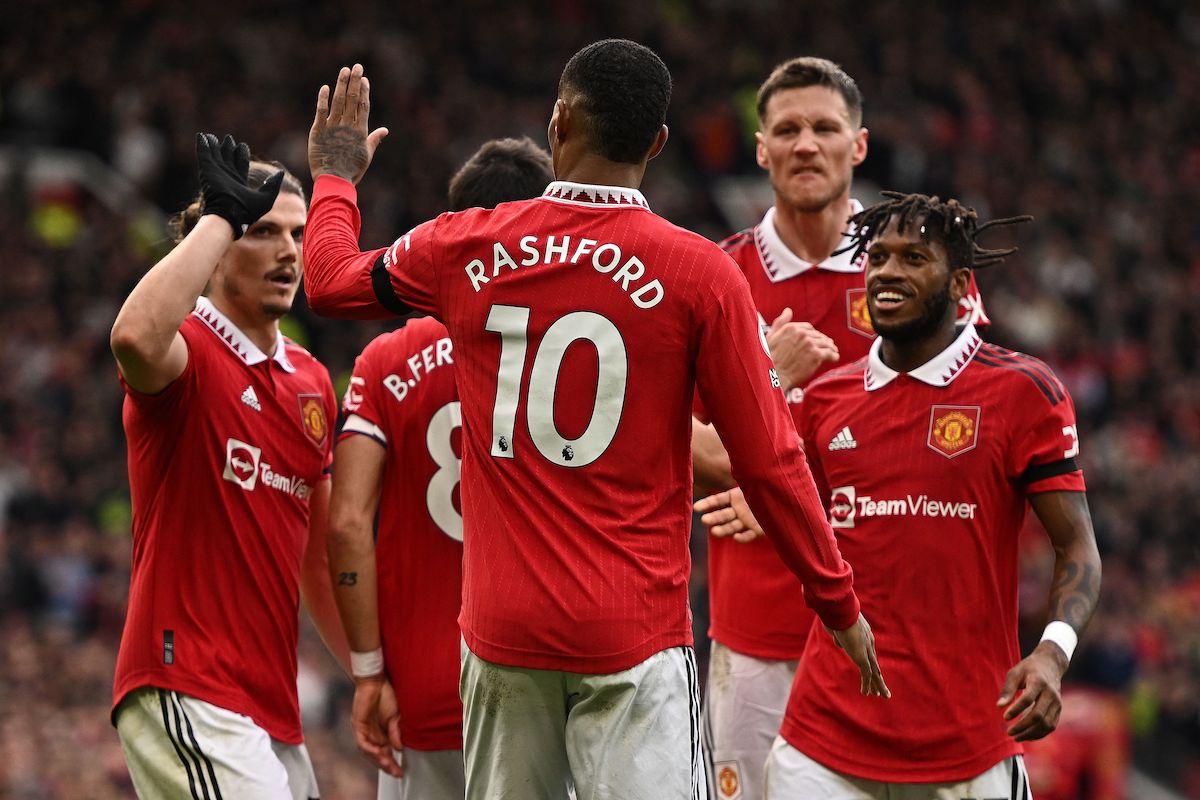
Manchester United's English striker Marcus Rashford celebrates scoring the opening goal during the English Premier League football match between Manchester United and Leicester City at Old Trafford in Manchester, north west England, on February 19, 2023. - RESTRICTED TO EDITORIAL USE. No use with unauthorized audio, video, data, fixture lists, club/league logos or 'live' services. Online in-match use limited to 120 images. An additional 40 images may be used in extra time. No video emulation. Social media in-match use limited to 120 images. An additional 40 images may be used in extra time. No use in betting publications, games or single club/league/player publications. (Photo by Oli SCARFF / AFP) / RESTRICTED TO EDITORIAL USE. No use with unauthorized audio, video, data, fixture lists, club/league logos or 'live' services. Online in-match use limited to 120 images. An additional 40 images may be used in extra time. No video emulation. Social media in-match use limited to 120 images. An additional 40 images may be used in extra time. No use in betting publications, games or single club/league/player publications. / RESTRICTED TO EDITORIAL USE. No use with unauthorized audio, video, data, fixture lists, club/league logos or 'live' services. Online in-match use limited to 120 images. An additional 40 images may be used in extra time. No video emulation. Social media in-match use limited to 120 images. An additional 40 images may be used in extra time. No use in betting publications, games or single club/league/player publications. (Photo by OLI SCARFF/AFP via Getty Images)
“It’s coming home” “it’s coming home” was a chorus echoing in and outside England in the build up of UEFA Euro 2020 final match between Italy and England.
The mantra, which is based on football’s English origin, stamped the long held hope of the English national team bringing a trophy home for the first time since 1968. The Three Lions had shown exceptional performance from the start of the tournament, challenging the failure stereotype that has followed it in other outings and hyping the hope of fans.
Alas, in the end, it didn’t come home. It stopped short at the doorpost, shattering the hope of millions and throwing Black members of the English team open to racism.
The Sunday night game went into penalty shootout after the match ended 1-1, following Italy’s Bonucci’s 67th minute comeback goal which canceled England’s Shaw two minute early 1-0 lead.
It was England’s first major final in 55 years. Being played in Wembley, the fans had gathered in thousands in the squares, defying covid warnings. Their wait for victory turned sour when Bukayo Saka, 19, Jadon Sancho, 21, and Marcus Rashford, 23, all Black players, missed their penalties.
It was a defining moment that England’s coach Gareth Southgate can reckon with. He had missed a similar penalty in 1996, and was quick to console the youngsters. In football, these things happen, they’re part of the game – losing and winning. But to English fans, the Black players were culpable, their skin color made England lose.
“It’s coming home until the ni**ers ruined it,” an English fan wrote on social media.
“Every ni ** er missed a pen. Rashford, Sancho, Saka go kill yourselves ni ** ers monkeys, or return to your natural habitat of growing bananas. Fu**ing slaves,” another wrote.
Although there has been resounding support for the embattled players who have given their best to bring England to the final, the racial attacks targeting the Black players have once again exposed the depth of racism in England. Recently, England players started taking a knee before the kickoff of matches. A practice that has attracted mixed reactions. It was notable in England’s opening match against Croatia, where boos were drowned by applause.
Southgate assembled a very young diverse team, who by their performance, toppled the woeful memories of the past. Prime Minister Boris Johnson said “they have done the nation proud and deserve great credit,” an assessment many others believe.
However, in the end, expectation does not determine what happens in the field. So once again, it did not come home. But unlike France and other national sides with diverse teams, who have learnt to a great extent, to keep skin color away from the beautiful game, English fans’ racial tantrums show England still has a deep-seated race problem.
England wanted to party but football happened. Now, three young men are blamed. Saka, Sancho and Rashford all missed penalties against Italy during Sunday’s Euro 2020 finals; Italy took the cup home. The young men are united by one thing: they are African-Europeans.
Sure, what does it have to do with a Nigerian or Nigeria? It has to do with many who are praying that Nigeria does poorly in the Tokyo Olympics Basketball because mainly southerners are representing the nation in the basketball game
This is the fact: for all the greats of England, they have not been this close for decades in football tournaments. And some of their greats have missed penalties. There is no need to bring racism into this and diminish what these young men have accomplished.
And Nigerians hoping for our team to mess up should grow up: there are more important things to pray for than asking God or Allah to make a team lose a game!
I thought I was going to do finance, while in banking, before I switched back to engineering. But while in banking, all my academic studies focused on Currency and Trade. Even as a PhD student in Johns Hopkins University, I was attending summits of economists, working with African Union and World Bank. This morning I made a comment on the challenges of AfCFTA and the potential welfare losses on a single currency, even in ECOWAS. Some questions via inmails. Here is a lead paper I wrote and delivered in the African Union Congress, making a case that prior convergence of our regional economies is important before anything continental.
Our markets are evidently heterogeneous with pockets of dominant nations in each block. For example, in ECOWAS, if we have a supranational bank, controlling the monetary policies of all the nations (each country will lose the autonomy of its central bank), one of the most important tools, at national levels, will go. Take Nigeria, the ability to devalue the naira during severe oil price misalignment will vanish.
So without the Central Bank of Nigeria being in existence to do that, any shock Nigeria is experiencing will ripple through to other small nations like Ivory Coast and Benin Republic even though they have nothing to do with oil.
So a nuanced and careful implementation is necessary before Nigeria’s mess becomes ECOWAS mess, and in that process makes Nigeria the denominator. Yet, the AfCFTA is a necessary initiative as Africa needs to trade more closely. But rushing to any currency union would be a mistake.
We have pockets of currency unions but they have not delivered any special miracle. If you do not improve productivity, your currency efficiency gains become marginal. I listed some pertinent enablers in this Harvard Business Review piece.
Comment: I find it interesting you suggest convergence of regional heterogeneous economies, before anything continental can occur, while simultaneously explaining the importance monetary policy has on dominant nations like Nigeria to affect currency values to offset fluctuations in commodity prices – all the while advocating for a single currency. In one hand you’re saying dominant nations need the autonomy to control their own currency, then in the other hand you’re saying they don’t (“each country will lose the autonomy of its central bank”).
China’s success is because they had sole ability to affect their currency. Keeping their currency artificially low allowed massive amounts of FDI inflows to invest in industrialization, and as you mention, ultimately AI. But creating one currency for the entire 54 nation trading block will be extremely difficult and will have unbalanced affects throughout the continent. One of the reasons Brexit occurred is because England wanted complete autonomy over their own currency value decisions.
AfCFTA’s implementation and success is hugely important to the continent but a single currency is not mandatory for the agreement to be successful. We only have to look at other successful trading blocks..
USMCA(NAFTA), AEC, and APEC to name a few. Those trading blocks are successful and do not have common currencies. It is true that a common currency will remove some inherent barriers for intra-continental trade but may have negative affects (reduced FDI for example) on smaller nations who’s comparative advantage is a lower currency value – as you point out, “The smaller economies affected could experience welfare losses, making them worse off than before the integration.” I wonder if you would advocate for a single continental currency if you were from Sierra Leon and not Nigeria.
You also mention improving infrastructure and education as ways to advance the continent. Of course, these are low hanging fruits. But I submit that according to Maslow’s Hierarchy of Needs, one can not obtain or concentrate on higher level needs until the lower level has been achieved/satisfied. With secure, consistent, and nutritious food being the lowest level. One can’t attend school while searching for food, or concentrate in class on empty bellies. First and foremost Africa needs to develop sustainable agribusiness. the level of agriculture in much of Africa is hundreds of years behind that of advanced nations all around the world.
Currently Africa sells its natural resources to obtain capital to spend on food. They are a net importer of food. This has to stop. Africa should be a net exporter not importer. Capital inflows from resource sales should be used to invest in infrastructure, (Instead loans from external governments, like China, are used for infrastructure) and investing in creating a sustainable and profitable agribusiness sector and to protect REGIONAL currencies. Loans should be used to create industries that attract FDI and investment in value added products that support continued operational revenue and ultimately accumulate wealth. Only with the elimination of wide spread poverty, and uplifting millions, can Africa realize their own sustainable industrial and technological revolutions like China.
Focusing only on Intra-African trade serves to recycle the same currency throughout the continent. Without capital inflows there will be no growth for sustainable business sectors.
-Resource sales for agribusiness, infrastructure, & currency value hedging.
-Loans to produce industry, value added products, & increased FDI.
=Sufficient food for the continent, greatly increased employment & drastic decrease in poverty.
My response: good points there. I must confess that all the options have challenges and I am not saying that any option is easy. Looking at my paper in the African Union, I had argued that if we MUST have a single currency, we must stabilize the regions first before we move continental. Yet, we will struggle to stabilize the regions if the dominant economies continue to struggle. For example, under ECOWAS, if we have one monetary union, the impact of Nigeria will become asymmetric, neutralizing anything Gambia, Benin Republic etc do.
Nonetheless, because things are not well optimized currently, I also do think we need to do something since we are underperforming. So, we could take risks even though they could be extremely “economically suicidal” if things get out of hand. But in all, I do not think these initiatives will matter if Africa does not improve productivity. But I recognize that some do argue that AfCFTA can indeed improve productivity. The debate continues…