DD
MM
YYYY

PAGES

DD
MM
YYYY

spot_img

PAGES

Home Blog Page 5718

Overview of Tekedia Practice and the Tracks

0

He called me from Atlanta where he is setting up an office. He runs a shipping business and is expanding to the United States. But he needed a license to quickly finish the setup so that he could get back to Lagos. He contacted Tekedia Institute, and immediately, we put him in touch with another learner in the US who already has a freight and logistics license. They spoke and agreed to work together. If you need shipping services from US to Nigeria, we can connect you to him!

We have seen how our programs are changing businesses and people. So, in January, we began testing Tekedia Practice. Simply, a member goes through a curated domain-specific training, and follows it up with an internship in a company. The results look very promising, and now, we want to make it public.

Tekedia Practice works via our Advanced Diploma program and will focus in these areas:
– Practice of Agribusiness
– Practice of Renewable Energy Business
– Practice of Digital Business

It will involve 2 months of studies and 4 months of internship. The goal is to provide skills which can help young people get employed.

  • Locations covered: internship could be in any location.
  • Internship Placements: members will be responsible for finding locations but Tekedia will give them letters to help them. Tekedia has many partners to place members but no guarantee.
  • Requirement: Minimum of secondary school education
  • Internship structure: The hosting companies could also pay the interns but we cannot guarantee.
  • Timeline: Aug 9, 2021 – Feb 4, 2022
  • Registration is OPEN: go here and register.

Sample certificate to be issued to learners

Stripe Launches Stripe Tax to Boost Services with Sales Tax in More than 30 Countries

0

As the fintech market booms, competition among players is on the rise, pushing each company to create extra avenues to stay on top of the game.

Stripe, one of the biggest names in the fintech industry is introducing taxation, an addition it hopes will complement its payment services and help it stay ahead of the competition. TechCrunch has the report.

On the heels of acquiring sales tax specialist TaxJar in April, today Stripe is making another big move in the area of tax. The $95 billion payments behemoth is launching a new product called Stripe Tax, which will provide automatic, updated sales tax calculations (covering sales tax, VAT and GST) and related accounting services to Stripe payments customers initially in some 30 countries and across the U.S.

Stripe Tax is a separate service from TaxJar, but the two are not unconnected. As Stripe Tax was being built out of Stripe’s offices in Dublin over the last several months, Stripe’s business lead for EMEA Matt Henderson told TechCrunch that the team had identified TaxJar as a strong company in the field. That ultimately led to M&A between them.

Sales tax — and specifically a more seamless way to deal with charging and tracking sales tax — is a painful issue for people doing business online.

Digital and physical goods are taxed in over 130 countries, Stripe said, and within that there can be a huge amount of variation and compliance complexity, since codes get updated all the time, too. Mishandled sales tax, meanwhile, can result in pretty hefty fines, sometimes up to 30% interest on past-due amounts.

Unsurprisingly, a sales tax tool has been the most-requested feature from Stripe’s customers, Henderson said, a call that presumably only got louder in the last year, as e-commerce and digital transactions went through the roof with COVID-19.

Arguably, that makes Stripe Tax one of the company’s more significant product launches, not to mention the first since announcing its monster funding round earlier this year.

Previously, Stripe customers would have resorted to using a third-party service (like TaxJar) to work out sales tax. Or, more typically, those Stripe customers would have opted to limit the number of places they sold goods and services, in order to minimize the pain of dealing with multiple, complex and usually quite localized tax codes.

“No one leaps out of bed in the morning excited to deal with taxes,” said John Collison, co-founder and president of Stripe in a statement. “For most businesses, managing tax compliance is a painful distraction. We simplify everything about calculating and collecting sales taxes, VAT, and GST, so our users can focus on building their businesses.”

Stripe said that a survey of its customers found that two-thirds of respondents said the challenge of implementing sales tax actually limited their growth.

TaxJar has built a strong system for handling that, but the company — based out of Massachusetts but with a remote team — is primarily focused on the U.S. market, which has sales tax that is complicated enough (there are 11,000 different tax jurisdictions in the country).

That leaves a lot on the table for building out sales tax tools for the rest of the world: The wider focus of Stripe Tax thus fills a particular geographical gap for the company, regardless of how well TaxJar and Stripe integrate over time.

There is another key difference worth noting between the two.

TaxJar came to Stripe’s attention with an established operation — 23,000 customers at the time of the announcement. Stripe (wisely) bolted that on as a standalone business, which means that new and existing customers that use TaxJar can continue to use it as is. That is to say, at least for now, they do not need to be Stripe payments customers in order to use TaxJar, even if the integration between the two platforms will only improve over time.

Stripe Tax, on the other hand, is being built from the ground up as a product aimed specifically at increasing touchpoints and stickiness with Stripe customers.

Stripe Tax provides real-time tax calculation based on customer location and product sold; transparent itemizing for customers; tax ID management in areas (like Europe) where business customers can provide their code and get a reverse charge on tax if they are under a certain turnover threshold themselves; and reconciliation and reporting across all transactions to make filing and remittance easier.

But there is for now no way to use Stripe Tax outside of Stripe payments.

This could pose some problems for some customers. These days, many of the strongest retailers will take an “omnichannel” approach that might cover selling through marketplaces, selling through websites, selling through social media and more — and not all of those experiences may be powered by Stripe. It will be worth watching whether future iterations of Stripe Tax can account for that.

Stripe’s most significant product launch prior to Stripe Tax — Stripe Treasury last December — underscores how the company is currently very focused on diversifying outside of its basic payments business and opening the platform to much wider, more scaled transactions.

Treasury, which is still in invite-only mode, saw Stripe partner with established banks to provide a business banking service, providing a way for its customers to handle money that they generate from their Stripe-powered businesses.

The full country list where Stripe Tax is launching is Australia, Austria, Belgium, Bulgaria, Croatia, Cyprus, Czech Republic, Denmark, Estonia, Finland, France, Germany, Greece, Hungary, Ireland, Italy, Latvia, Lithuania, Luxembourg, Malta, New Zealand, the Netherlands, Norway, Poland, Portugal, Romania, Slovakia, Slovenia, Spain, Sweden, Switzerland, the United States and the United Kingdom.

US Senate Working on A Bill to Curtail Big Tech Acquisition Flex

0

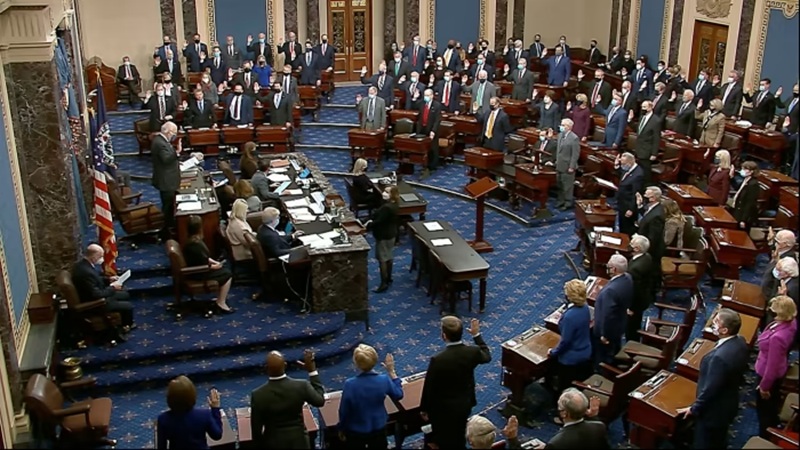
The fight to limit the intimidating power of the big tech has continued several months after it appeared to die down. The big names in the US tech space have been at the receiving end of government’s criticisms for using their financial power and influence to muzzle competition.

Prior to 2020 US elections, Democrat Senator Elizabeth Warren was at the forefront of the campaign to tame the ability of Google, Facebook, Microsoft and Amazon to bully competitors with their financial muscle. The campaign, which has become more like a moral cause, wants the giants to be held accountable on every move that results in stifling competition and promoting monopoly.

After many antitrust hearings and fines involving the big tech, debates on the best way to curtail their excesses have gone on in and outside the Congress for long. Now, members of Congress are working on a bill that will stem the tide, at least, one aspect of it.

The antitrust bill being pushed by a group of House Democrats, would force the biggest tech companies to change parts of their business models and curtail large acquisitions, according to copies obtained by CNBC.

CNBC reported that while the drafts could still change significantly prior to their introduction, as currently written, they could require business model overhauls for Apple and Amazon by limiting their ability to operate marketplaces for products and apps while selling their own goods and apps on those same stores.

They would also make it harder for those companies plus Facebook and Alphabet (Google’s parent company) to complete large mergers, and would force them to make it easier for users to leave their platforms with their data intact.

The draft bills come after a 16-month investigation by the House Judiciary subcommittee on antitrust into the four companies, which culminated in a nearly 450-page report from Democratic staff last fall. While Republicans on the subcommittee diverged from some of the Democrats’ more extreme proposals, several agreed with the main findings of monopoly power and anticompetitive behavior in the Democratic report and on the need to rein in Big Tech’s power with antitrust reform.

Facebook, Google, Amazon and Microsoft have all been caught in questionable acquisitions that stirred antitrust inquiries.

Democrats have been spearheading the push to curtail the influence of the big tech, while Republicans have been sitting on the fence, not openly supportive of their colleagues’ efforts nor the big tech.

The drafts don’t indicate whether any Republicans are supporting the bills.

What the draft bills say

Specifically, the five discussion drafts would prevent platforms from owning businesses that present a conflict of interest, bar large platforms from favoring their own products over those of competitors that rely on their sites, make it harder for large platforms to complete mergers, raise filing fees for acquisitions and mandate ways for users to transfer their data between platforms.

One of the bills, sponsored by Rep Joe Neguse, D-Colo., appears to be companion legislation to the bipartisan Merger Filing Fee Modernization Act in the Senate, which passed in that chamber on Tuesday as part of a larger $250 billion tech and manufacturing bill. That bill would raise the fees companies pay to notify the Federal Trade Commission and Department of Justice Antitrust Division of large mergers with the goal of raising money for those agencies.

The other four drafts obtained by CNBC include:

Ending Platform Monopolies Act: Sponsored by Rep. Pramila Jayapal, D-Wash., the vice chair of the subcommittee, this bill would make it unlawful for a platform with at least 500,000 monthly active U.S. users and a market cap over $600 billion to own or operate a business that presents a clear conflict of interest. The draft defines an unlawful conflict as one that incentivizes a business to favor its own services over those of a competitors’ or disadvantage potential competitors that use the platform. Lawmakers have previously expressed concern that both Amazon and Apple, which run their own platforms for sellers and developers, respectively, could undermine competition due to a conflict of interest for their own competing products or apps.

Platform Competition and Opportunity Act: This proposal from Rep. Hakeem Jeffries, D-N.Y., would shift the burden of proof in merger cases to dominant platforms (defined with the same criteria as the previous bill) to prove that their acquisitions are in fact lawful, rather than the government having to prove they will lessen competition. The measure would likely substantially slow down acquisitions by dominant tech firms.

Platform Anti-Monopoly Act: This bill, proposed by Subcommittee Chairman David Cicilline, D-R.I., would prohibit dominant platforms from giving their own products and services advantages over those of competitors on the platform. It would also prohibit other types of discriminatory behavior by dominant platforms, like cutting off a competitor that uses the platform from services offered by the platform itself, and ban dominant platforms from using data collected on their services that isn’t public to others to fuel their own competing products, among several other prohibitions.

Augmenting Compatibility and Competition by Enabling Service Switching (ACCESS) Act: This proposed bill from Rep. Mary Gay Scanlon, D-Pa., would mandate dominant platforms maintain certain standards of data portability and interoperability, making it easier for consumers to take their data with them to other platforms.

It is not clear if the bill will get the backing of Republicans, it will put a permanent nail to one big part of American tech industry antitrust issues.

Join Me Tomorrow As I Keynote FinBiz2030

0

Good People, remember to join me for Finance and Business 2030 (FinBiz2030) tomorrow. Launched in London, FinBiz2030 is a joint initiative of One Young World and Chartered Accountants Worldwide. Nigeria’s high priest on keeping good balance sheets and  P&Ls,  The Institute of Chartered Accountants of Nigeria (ICAN), is the Nigerian host.

Join us on Saturday, 12 June 2021 for a conversation on business sustainability, resilience and innovation. Nations rise when pioneering innovators emerge! And we want them to run the playbooks sustainably. Register free here.


Agrific Launches Platform To Facilitate Agro-Commodity Trading in Africa

0

We welcome the Block Process Limited team to Tekedia Mini-MBA even as they announce the launch of Agrific – a technology-driven agro-trading market place for agriculture commodities in Africa.

Agrific is a B2B2C platform that offers on-demand commodity supply-chain, connecting producers and offtakers with a platform that supports a fair exchange of value.  Agrific’s platform serves to build relationships between local farmers and major processors, aggregating commodities while paying attention to the unique specifications of the buyers. The system allows off-takers to fund the process of buying and selling what farmers have already harvested. This will give every farmer that has produced high quality farm produce, the opportunity to sell to major buyers through Agrific’s portal

Agrific firmly commits to the transformation of food and agriculture to achieve the SDG’s, by build an all in one import and export portal to facilitate international trade between Nigeria and the rest of the world  riding on a model that matches farmers to processors and off takers by eliminating several layers of intermediaries. By doing this, Agrific optimizes market access to African farmers and also improves their income by at least 45%.

Agrific’s unique proposition lies in its end-to-end integration, firmly consolidating all value chain actors in one platform inclusive of logistics, quality assurance, payment protection and insurance of all traders through its trusted partners.

The central system of the platform is a pipeline through which agro-commodities agreed to be sold, accessed and certified to be of the quality assured. Sellers have the luxury of customizing their catalogue with an alert system that enables them to engage real-time with potential buyers who are interested in the commodity they aggregate.

Buyers, depending on the quantity or quality needed, can either trade on the central system or use the demand-supply feature of the platform to buy their desired product.

To learn more about Agrific, please visit https://agrific.co

At Tekedia Institute, we are co-learning with Agrific Team and Linda I.A Obi as they begin this playbook for Africa. Welcome to the Institute.