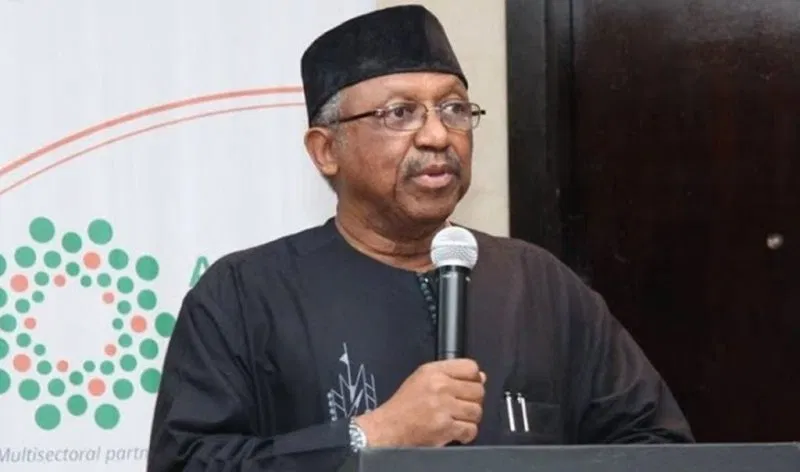
The Federal Government has reintroduced COVID-19 restrictions across all 36 states and the Federal Capital Territory (FCT). A member of the Presidential Steering Committee (PSC) on COVID-19, Dr Mukhtar Mohammed, said this new directive is to take effect by midnight of Tuesday,
Mohammed, who is the Head of Technical Secretariat of the PSC, made the announcement while briefing reporters on Monday in Abuja.
The new restrictions means mass gatherings in public spaces have been restricted to 50 people at any given time.
Access to government institutions would also be denied to anyone not wearing a face mask while government meetings and travels have been limited to the virtual platform.
Mohammed said the government has directed that bars and nightclubs should remain closed and the nationwide curfew will be in force until further notice.
He added that only essential international travels would be encouraged, and all existing protocols must be strictly adhered to.
As an exemption, Mohammed stated that the restriction does not apply to intrastate travel, that Nigerians are allowed to move from one state to the other.
On his part, the Secretary to the Government of the Federation (SGF), Mr Boss Mustapha, said returning foreign passengers who fled the quarantine facilities and violated the compulsory requirement would not go unpunished.
He noted that the committee has received reports that some persons who recently returned to the country violated the mandatory quarantine requirement under the advisory by escaping from the facilities.
Mustapha, who is also the PSC Chairman, condemned the violation of the nation’s laws and hospitality, noting that the committee was awaiting the report of ongoing investigations and would impose appropriate sanctions on the violators.
He revealed that the PSC has considered several pre-emptive measures to be taken to mitigate the likely impact of the variants of COVID-19, should they get imported into Nigeria.
The SGF explained that the step became important in view of the fragile state of the nation’s health systems, the disruption to the delivery of vaccines, and the lack of compliance with the extant public health measures and social measures contained in the Coronavirus Disease (COVID-19) Health Protection Regulations 2021.
According to him, it is imperative to reinstitute the various public health measures that were put in place under the health protection regulations.
But as precautionary as the decision is, it throws Nigeria open to further economic hardship. The hospitality industry has been one of the hardest hit sectors of the economy, and has been slowly emerging from the strains of the previous restrictions that nearly turned the sector players to beggars.
Following the adjustments in restriction’s protocols, bars, restaurants, clubs and event centers were allowed to open to limited capacities, putting food back on people’s tables. With this new restriction, things are likely going to hit rock bottom for many, especially as food inflation, currently at 23%, is still burgeoning.
On the other hand, the possibility of COVID third wave buzzes a warning of disaster that the government is not equipped to handle. The situation appears like choosing between the devil and deep blue sea. With the alarming rate of COVID cases in India, compounded by new more deadly variants, many believe it is better the government errs on the side of caution.
I will be speaking with BBC Focus on Africa this week. It is going to be a conversation on economic systems and indigenous frameworks to advance the prosperity of nations. I have put some postulations on the necessity for Nigeria (and Africa) to look inwards to invent and refine new economic architectures because anything out there could be out of phase to our current needs. Yes, technology continues to bring new perturbations in market systems, requiring nations to innovate to drive shared prosperity.
As most of our members in Tekedia Mini-MBA already know, I am a big believer that models are extremely catalytic for economic advancements. Yes, like in business, the business model you commit to execute could determine how far you can go.
Take Microsoft as an example, the difference between that $1.86 trillion business of today and Steve Ballmer’s era of sub-$400 billion market cap was largely Satya Nadella (Microsoft CEO) bringing new models, on largely the same products and services. Yes, a new model turned a sub-$400 billon business into $1.86T in less than seven years!
Nations can have the same impact and that is why I push for Nigeria to look deeper on its model because if you have the wrong models, you will struggle to effectively utilize your factors of production and broad citizenry resources.
“The greatness of a man is not in how much wealth he acquires, but in his integrity and his ability to affect those around him positively” – Robert Nesta Marley (aka Bob Marley)
Robert Nesta Marley (6 February 1945 – 11 May 1981) was a Jamaican singer, songwriter, and musician. He was considered, in many circles, as one of the pioneers of reggae, whose musical career was marked by fusing elements of reggae, ska, and rocksteady, as well as his distinctive vocal and songwriting style.
Some commentators have also attributed to him the status of “a global symbol of Jamaican music and culture and identity, and was controversial in his outspoken support for the legalization of marijuana, while he also advocated for Pan-Africanism.”
So that is my main focus in this tribute – his love of Africa and the unity of the continent. I would try to keep this post brief considering that any attempt to provide a detailed account of his thoughts, words and deeds, would not do justice to whom he was. Consequently, my focus in this tribute will be based on a 2×2 matrix, excerpting the lyrics from two of his songs – Africa Unite and War; and attempting to profile the man from two interesting articles – “Bob Marley’s relationship with dictator Bongo’s daughter helped him strengthen his African roots“; and a more recent one “Bob Marley’s journey to justice, joy and (ultimately) to Christian faith.”
Africa Unite (excerpted lyrics)
The lyrics from Africa Unite go thus:
Afri, Africa unite, yeah!
Unite for the benefit (Africa unite) of your people!
Unite for it’s later (Africa unite) than you think!
Unite for the benefit (Africa unite) of my children!
Unite for it’s later (Africa uniting) than you think!
Africa awaits (Africa unite) its creators!
Africa awaiting (Africa uniting) its creator!
Africa, you’re my (Africa unite) forefather cornerstone!
Unite for the Africans (Africa uniting) abroad!
Unite for the Africans (Africa unite) a yard!
Main highlights from the lyrics converge around the need for African unity both at home (yard) and in the diaspora (abroad) for the benefit of the people. In case it wasn’t clear there are a few quotes from the man himself dotted over the internet. The following two would be appropriate at this stage.
My music fights against the system that teaches to live and die.
Me only have one ambition, y’know. I only have one thing I really like to see happen. I like to see mankind live together – black, white, Chinese, everyone – that’s all.
While the lyrics in “Africa Unite”, resonate with the move towards stronger African unity has been captured with the coming into force of the African Continental Free Trade Area, those in “War”, seem very much a raging situation on the continent. Conflict continues to ravage Africa from Tigray, Cabo Del gado to Somalia, Mali and the Sahel (even Nigeria is not spared), as we would soon find out in the second profiled song, “War”.
Love for Africa
Bob Marley’s relationship with dictator Bongo’s daughter helped him strengthen his African roots
As Olivier Marbot recently documented in The Africa Report:
In “Bob Marley and the Dictator’s Daughter”, French journalist Anne-Sophie Jahn looks back at the passionate love affair between reggae star Bob Marley and Pascaline Bongo, the daughter of Gabon’s former president Omar Bongo. This relationship helped the singer to strengthen his African roots.
Pascaline invited Bob to perform in Libreville (capital of Gabon) in early 1980, which made Bob Marley and the Wailers ecstatic considering that “for years they had been singing about pan-Africanism, declaring their love for their ancestors’ continent, calling for unity – the cover of their album Survival, which was released in October 1979, was a patchwork of the continent’s flags – but paradoxically, none of these Jamaicans from the slums of Kingston had ever set foot in Africa.”
As Marbot further highlights:
This trip to Gabon – which was followed by another to Zimbabwe, to celebrate the new independence of what remained known as Rhodesia until 1980 – is at the heart of Jahn’s book, whose title – Bob Marley and the Dictator’s Daughter – clearly sets the tone of the book.
Early Experiences
Two experiences in the 1960s transformed his artistic vision. In 1966, Marley stayed in Wilmington, Delaware (I don’t need to tell you whose hometown that is), to which his mother emigrated in 1962. There he honed [an] intimacy and vulnerability, weaving the edge of the evangelical call into his message. The second experience, when he went back to Nine Mile in 1967 to cultivate the land, allowed him to incorporate a new apocalyptic arc.
Bob Marley embraced the Rastafari movement, which re-narrated the colonial system as “Babylon” and enveloped it in messianic upheaval that would exalt the oppressed. Marley now spoke not just to contemporary issues but to all times and places, making him bigger than history.
“Chant Down Babylon,” both the song from the album Confrontation and the idea itself, promised emancipation from all destructive and oppressive forces, yet remained intensely personal.
It was something that the world had never quite seen before. Marley exploded onto the global scene in the mid-70s, becoming the voice of the seismic changes in the postcolonial world. In the words of Timothy White, Marley was “quoted like a poet, heralded as the Mick Jagger of reggae, the West Indian Bob Dylan, even the Jamaican Jomo Kenyatta.”
As Damian Costello only recently commented from the second article:
Marley died young, at the age of 36, depriving the world of decades of potential spiritual evolution. But he lives on, in some ways more powerful. Through his early death, the Spirit raised Marley up, keeping him forever young, unencumbered by the ambiguity of daily life and what comes from continuing public exposure.
Talking about wars emanating from social injustice from race:
Until the philosophy which hold one race superior
And another inferior… Is finally and permanently
Discredited and abandoned… Everywhere is war …That until there no longer first class and second class citizens of any nation… Until the colour of a man’s skin is of no more significance than the colour of his eyes …Me say war
It goes on to human rights and strong institutions (notably legal):
That until the basic human rights are equally guaranteed to all… Without regard to race…
That until that day, dream of lasting peace, world citizenship …Rule of international morality… Will remain in but a fleeting illusion to be pursued, but never attained…
With two interesting articles matched by two equally significant songs, it makes me confident to argue that had Bob been alive today, he would have been a United Nations Ambassador for the Sustainable Development Goals considering his unwavering fight for social justice, peace and security, poverty and hunger among many others. So, I end with yet another quote of his – albeit with an addendum.
We don’t have education, we have inspiration; if I was educated I would be a damn fool.
I guess a bit of both or balanced mix of both couldn’t hurt anyone.
Happy to announce that Joseph U. Ibeh Ibeh, a satellite industry analyst with Northern Sky Research, USA, joins Tekedia Institute faculty and will be working with us on a new course we are developing for Tekedia Mini-MBA. Mr. Ibeh is one of the leading satellite industry analysts with focus on Africa.
Before joining NSR, he was a Senior Analyst at Space in Africa where he covered all segments of the African commercial space industry and national space programs. He co-authored the African Space Industry Annual Reports and the NewSpace Africa Industry Reports, and provided business advisory to global space companies looking to enter the African market.
The new course is titled “Satellite Broadband Age in Nigeria, Africa: Business Opportunities, Mapping New Markets and Rural Economies”.
John Enoh, the founder of a satellite company in Texas called BeepTool is already on board.
This course is coming after the redesign which SpaceX Starlink is bringing to Nigeria and Africa. Just as GSM unlocked new business opportunities when it came, satellite broadband will seed new markets and advance rural economies across the continent. Our goal is to examine the industry and explore how opportunities could emerge in this emerging sub-sector.
The course is already in the June – Sept edition of Tekedia Mini-MBA. Register here and join.
Just connecting into the studio of RadioNow 95.3 FM to speak with Todah and Ohumu. Let’s have a conversation on technology and economic development on radio.