DD
MM
YYYY

PAGES

DD
MM
YYYY

spot_img

PAGES

Home Blog Page 582

Trump’s Tariff Appeal Introduces Significant Uncertainty, Likely Sustaining Crypto Market Volatility in the Short Term

0

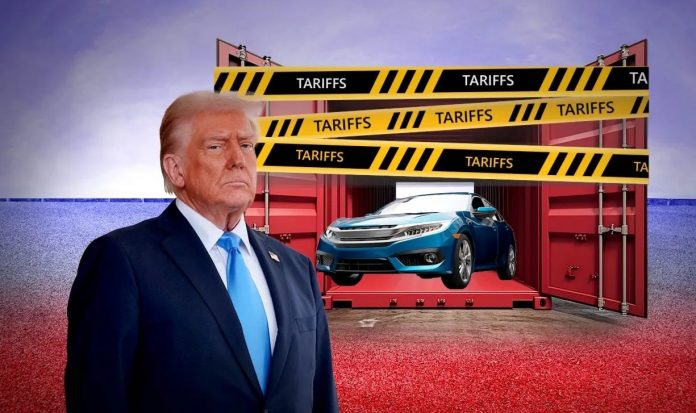
President Donald Trump’s tariff policies have introduced significant volatility into global financial markets, including cryptocurrencies, as outlined in various analyses from early 2025.

His tariff appeal, following a federal appeals court ruling that deemed some of his tariffs’ illegal under the International Emergency Economic Powers Act (IEEPA), continues to create uncertainty with potential ripple effects on crypto markets.

Market Volatility Due to Uncertainty

Trump’s tariff appeal, particularly after the May 2025 court ruling against IEEPA tariffs, has heightened economic uncertainty. The U.S. Court of Appeals allowed tariffs to remain in effect until at least October 14, 2025, pending a Supreme Court appeal, keeping markets on edge.

Cryptocurrencies, often treated as risk assets, have experienced sharp declines during tariff-related announcements. For instance, in early February 2025, Bitcoin dropped to $91,281 and Ethereum to $2,143, with the total crypto market cap contracting by 8% to $3.2 trillion in a single day following tariff announcements targeting Canada, Mexico, and China.

A 90-day tariff pause announced on April 9, 2025, led to a brief recovery, with Bitcoin rising 5%, Ethereum 9%, and XRP 9%, but volatility persisted as markets remained sensitive to policy shifts. Cryptocurrencies have shown increasing correlation with traditional markets like the S&P 500 and Nasdaq, which fell significantly (e.g., S&P 500 dropped 6% on April 2, 2025) during tariff escalations.

This correlation amplifies crypto price swings when tariff news disrupts equities. Investors often shift to safer assets like gold or U.S. bonds during tariff-induced uncertainty, reducing demand for volatile assets like crypto.

Dollar Strength and Crypto Prices

Tariffs initially strengthened the U.S. dollar due to safe-haven demand, which can depress crypto prices as investors favor dollar-based assets. However, prolonged tariff disputes could weaken the dollar if trade deficits widen or global confidence in USD erodes, potentially boosting Bitcoin as an alternative store of value.

Some analysts argue that tariffs could weaken the dollar’s global dominance over time, creating space for Bitcoin as a decentralized alternative. Experts like Zach Pandl from Grayscale and Matthew Sigel from VanEck suggest that a fractured global reserve system could elevate Bitcoin’s role as a hedge against economic instability.

If the Federal Reserve cuts interest rates to counter tariff-induced economic slowdown, increased liquidity could favor Bitcoin, as seen in past low-rate environments. Tariffs on Chinese goods, such as a 50% levy effective February 2025, could increase costs for Bitcoin mining equipment and semiconductors, critical for crypto infrastructure.

This may raise operational costs for miners, potentially reducing profitability and affecting market dynamics. Conversely, tariffs could incentivize domestic production of mining equipment, reducing U.S. reliance on foreign suppliers and potentially strengthening the crypto sector long-term.

Despite tariff turmoil, Trump’s administration has signaled a pro-crypto stance, with potential regulatory clarity and support for stablecoins. This could bolster investor confidence in the long term, offsetting some negative tariff effects. However, ongoing legal battles over tariffs introduce uncertainty, which could deter institutional investment in crypto until resolved.

While short-term volatility is a concern, some experts remain bullish on Bitcoin. Anthony Pompliano and Michael Saylor argue that crypto’s borderless nature could shield it from tariff impacts, predicting new all-time highs by year-end 2025. As of September 2025, Bitcoin has been trading in a range, reflecting a tug-of-war between bullish and bearish forces. Analysts suggest monitoring the 109,000–109,300 support zone for Bitcoin, with a breakout above 114,000 signaling potential upside.

The Supreme Court’s ruling on Trump’s tariff appeal will be critical. If tariffs are struck down, markets may rally, but new tariffs under alternative authorities (e.g., the 1974 Trade Act) could still disrupt crypto. Investors should watch Federal Reserve policies, inflation data, and global trade negotiations, as these will influence crypto’s trajectory alongside tariffs.

Crypto markets remain highly sensitive to macroeconomic shifts, and tariffs amplify this. Investors should be cautious, diversify, and focus on long-term fundamentals. However, long-term prospects for Bitcoin and other cryptocurrencies could improve if tariffs weaken the dollar’s dominance or spur domestic crypto infrastructure growth.

The outcome of the Supreme Court appeal and broader economic policies will be pivotal in shaping these impacts. For now, investors should monitor key support levels, regulatory developments, and global trade dynamics to navigate this turbulent landscape.

Argentina’s Congress Summoned Hoskinson of Cardano To Testify on LIBRA Token Scandal

0

Argentina’s Congress has summoned Charles Hoskinson, the founder of Cardano, to testify in an investigation into the LIBRA cryptocurrency scandal, which centers on allegations of fraud and market manipulation tied to President Javier Milei’s promotion of the token.

The scandal erupted after LIBRA’s value surged dramatically following Milei’s social media endorsement on February 14, 2025, only to crash by 85% within hours, resulting in approximately $250 million in losses for nearly 75,000 investors. The congressional committee, led by opposition lawmaker Maximiliano Ferraro, is probing Milei’s involvement and has cited 19 individuals, including Hoskinson, for their knowledge of the matter.

Hoskinson’s inclusion stems from his public criticism of the LIBRA project and his participation in the Argentina Tech Forum in October 2023, where the token was discussed.

He alleged that organizers, possibly including Mauricio Novelli and Manuel Terrones Godoy, promised a meeting with Milei that never materialized, instead offering only a handshake and a photo. Hoskinson also claimed he was approached with bribery requests to secure access to the president, which he discussed in a livestream following the token’s collapse.

Despite his skepticism about the investigation’s political motivations, Hoskinson has expressed support for Milei, stating, “President Milei has been a force for good for the people of Argentina, and I believe that his accomplishments and record stand for themselves.”

The investigation, approved by Argentina’s Chamber of Deputies on April 8, 2025, with 128 votes in favor, also involves summoning high-ranking officials like Economy Minister Luis Caputo and Chief of Staff Guillermo Francos. While Milei has been formally summoned to provide written testimony, Hoskinson and others await a citation schedule expected to be released soon.

The probe is not criminal, but failure to respond could lead to further actions, such as law enforcement assistance, though all cited individuals are entitled to due process. The LIBRA scandal, dubbed “Cryptogate,” has sparked significant political and legal fallout, with allegations of a “rug pull” scam linked to Kelsier Ventures and its CEO, Hayden Davis, who is also under scrutiny in U.S. courts.

The controversy has raised questions about Argentina’s crypto regulation and Milei’s administration, with opposition lawmakers aiming to undermine his credibility ahead of the 2025 midterm elections. Hoskinson’s testimony is seen as critical due to his insider perspective on Argentina’s crypto sector and his vocal stance on the LIBRA launch.

The LIBRA scandal, with President Javier Milei’s alleged endorsement at its core, threatens his administration’s credibility. The investigation, led by opposition lawmakers, could be leveraged to weaken Milei’s libertarian agenda ahead of the 2025 midterm elections.

If Hoskinson’s testimony implicates government officials or reveals improprieties, it could escalate political pressure on Milei, potentially undermining his economic reforms and public support, especially among his crypto-friendly base.

Argentina has been a hub for cryptocurrency adoption due to its history of economic instability and currency devaluation. The LIBRA collapse, with $250 million in losses for 75,000 investors, risks eroding public trust in digital assets.

Hoskinson’s testimony could shed light on systemic issues, such as inadequate regulation or fraudulent practices in Argentina’s crypto sector, potentially prompting stricter oversight. This might stifle innovation but could also push for clearer frameworks to protect investors.

As Cardano’s founder, Hoskinson’s involvement in the investigation could affect the blockchain’s perception, particularly in Latin America, a key growth region. His public criticism of LIBRA and allegations of bribery attempts may bolster his image as a principled figure, but any negative revelations during testimony could harm Cardano’s market position.

Conversely, his insights could reinforce his influence in shaping global crypto policy discussions. The LIBRA scandal highlights the risks of celebrity or political endorsements in volatile crypto markets, potentially prompting regulators worldwide to scrutinize similar cases.

Hoskinson’s testimony could expose broader issues like market manipulation or “rug pull” schemes, influencing investor sentiment and tightening regulations in other jurisdictions. This could impact the valuation and adoption of other cryptocurrencies, including Cardano.

The investigation’s outcome could set a precedent for how governments handle crypto-related fraud. If Hoskinson’s testimony reveals connections between LIBRA’s promoters and political figures, it might lead to legal actions against entities like Kelsier Ventures or its CEO, Hayden Davis, already under U.S. scrutiny.

Milei’s pro-crypto stance was part of his broader economic liberalization plan. The scandal could undermine his narrative of fostering innovation, especially if Hoskinson’s testimony suggests government complicity or negligence. This might force Milei to pivot toward stricter crypto policies, potentially alienating his libertarian supporters while failing to appease opposition critics.

Hoskinson’s testimony could significantly influence Argentina’s political landscape, its crypto regulatory framework, and global perceptions of cryptocurrency reliability. The outcome may either catalyze reforms to protect investors or deepen skepticism about crypto’s role in emerging economies, with ripple effects for Cardano and the broader blockchain industry.

Adeleke’s Three-Year Projects: On Allocation and (In)Equality

0
Osun local government

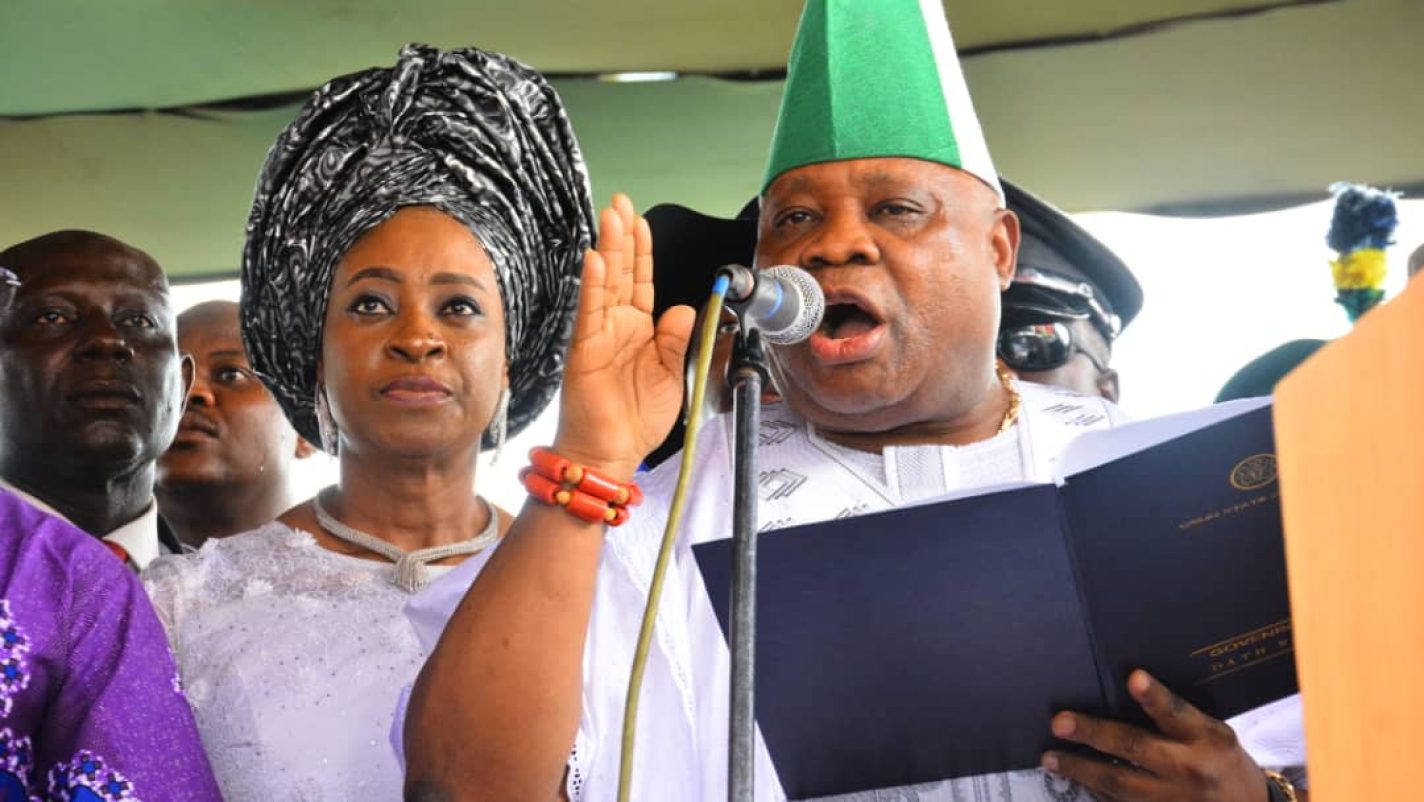
When Senator Ademola Jackson Adeleke took office as governor of Osun State in November 2022, expectations for rapid development were high. Almost immediately his administration announced water provision in all 332 wards, a promise designed to signal that even the most remote communities would feel a change in daily life. Within his first year, a N100 billion infrastructure plan was rolled out. It included new flyovers, forty-five township roads, rehabilitation of thirty-one schools and extensive upgrades of primary health centres across the state.

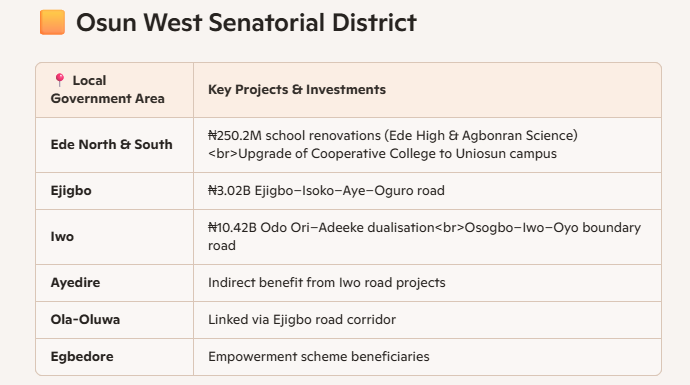
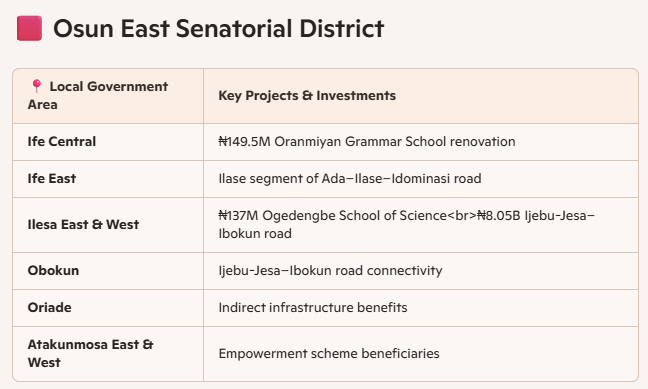
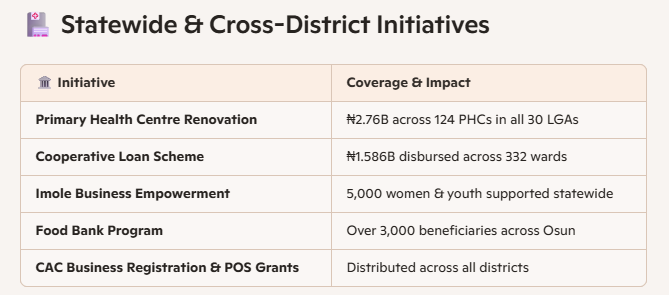
In March 2025 the government unveiled Phase Two of its infrastructure programme valued at N159 billion. This second phase earmarked over N101 billion for road construction, N2.76 billion for the refurbishment of 124 primary health centres and precise figures for a handful of high-profile schools. Ede High School Hall and Pavilion was allocated N50.2 million, Agbonran School of Science in Ede South N200 million, Ogedengbe School of Science in Ilesa N137 million and Oranmiyan Memorial Grammar School in Ile-Ife N149.5 million. The Imole Agropreneur initiative, launched in late 2024, promised to open 31,000 hectares to mechanised farming and agro-processing, a signal that agriculture remains central to Osun’s long-term economic vision.

Distribution Across the State

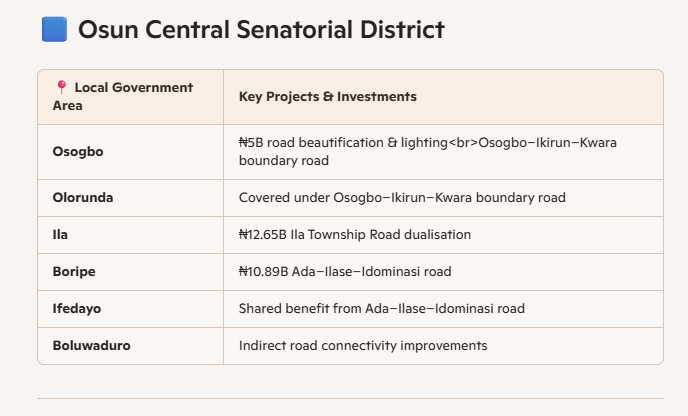
A closer look at where projects are sited reveals both a wide reach and recognisable patterns. Osun Central has benefited from significant carriageway work. The Osogbo–Ikirun–Ila-Odo road remains the flagship corridor linking the capital to key markets, while township arteries such as Oja-Oba and John Mackay Street have been resurfaced. In Boluwaduro the Iresi Township road has been rehabilitated, providing relief for agrarian communities.

Osun East has witnessed improvements on a smaller but notable scale. In Ile-Ife, the Enuwa–Oniyangi–Ita-Osun link has improved local traffic, while Ilesa has seen work on the Atakunmosa Market road and Obiteni–Omo Ofe route. Two major secondary schools in this zone, Ogedengbe and Oranmiyan, have secured explicit allocations for full renovation.

Osun West has attracted dense urban attention. Ede North and South boast a cluster of resurfaced roads, including Akankan–Obada, Anu-Olu–Obada–Alusekere and Ogberin–Akala–Oloki, alongside the Akoda–Ido-Osun dual carriageway stretching roughly twenty-three kilometres. Iwo has received the Ansarudeen Junction–Hospital Road upgrade and a planned dualisation linking Odo-Ori to the palace area. The borehole initiative claims to touch every ward across all thirty local government areas, though assessments of functionality have been mixed.

Balancing Equality and Equity

On paper these investments suggest that the administration has attempted an even hand. In practice the distribution reflects population density and political calculus. Osogbo, as the capital, absorbs the lion’s share of major carriageways and beautification. Ede, the governor’s hometown, is heavily represented in road resurfacing and school renewal. Iwo and Ila benefit from new dualised corridors while some smaller local governments appear only in aggregated project lists with few headline announcements.

Equity sometimes justifies unequal spending when economic hubs require heavier investment. However, perceptions of fairness matter in a state with diverse constituencies. Residents in Oriade or Ifedayo occasionally point to limited visible footprints, fuelling quiet concerns that resource flows tilt toward the inner ring of LGAs. A statewide commitment to balanced visibility will determine whether the narrative remains one of inclusion or of quiet grievance.

Transparency and the Way Forward

One persistent gap is the lack of detailed contract disclosure. Apart from select school figures and the primary health centre totals, there is little itemised cost information per kilometre of road or per project site. Citizens are left to piece together press statements rather than access a public dashboard of spending and completion rates. In an era when open governance strengthens trust, such opacity can erode otherwise genuine achievements.

Adeleke’s administration deserves credit for packaging road, education, health and agricultural interventions into coherent phases. The focus on Osogbo’s urban competitiveness and the bold agricultural pivot can create long-term growth if consistently funded. Yet the next frontier is evidence-based equity. Publishing ward-by-ward audits of borehole functionality, real-time road progress reports and transparent contract sums would convert political messaging into verifiable fairness.

The governor’s first three years prove that ambition is not lacking. The real test lies in demonstrating that every naira has translated into concrete, evenly spread development. Equality of access will not be declared by press releases alone but by clear, accessible data showing that communities from Iwo to Ifedayo share in the dividends of public investment.

A Look At Warnings From Max Keiser and Robert Kiyosaki About Europe’s Economic and Social Decline

0
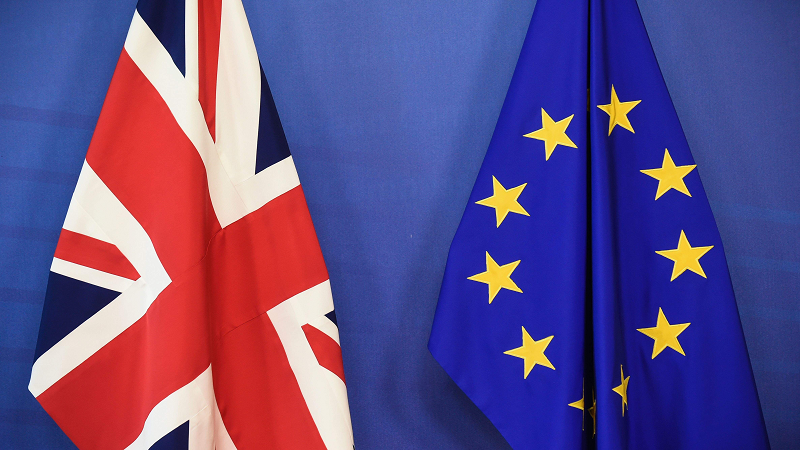
EU and UK has been policing US digital firms

Robert Kiyosaki, author of Rich Dad Poor Dad, has warned that Europe is facing severe economic and social turmoil, citing collapsing bond markets, failing energy policies, and rising unrest in countries like France, Germany, and the UK.

He claims France is on the brink of bankruptcy, Germany’s manufacturing sector is crippled by energy issues, and UK bonds have dropped over 30%. Kiyosaki argues that the traditional 60/40 portfolio (stocks and bonds) is no longer safe, urging investors to turn to gold, silver, and Bitcoin to protect their wealth.

He also notes a global loss of confidence in Western nations’ ability to manage debt, with Japan and China reportedly selling US Treasuries in favor of precious metals.

Max Keiser, a Bitcoin advocate and advisor to El Salvador’s President Nayib Bukele, amplifies Kiyosaki’s warnings, framing Europe’s struggles as part of a “Fourth Turning,” a generational cycle of systemic crisis.

Keiser suggests investors move their wealth to Bitcoin and consider relocating to El Salvador, the first country to adopt Bitcoin as legal tender, as a safe haven from collapsing fiat systems. He highlights El Salvador’s progress, including a 98% drop in homicides and President Bukele’s 92% approval rating, positioning it as a stable, Bitcoin-friendly hub.

Some crypto educators, like NianNian Academy, acknowledge these concerns but advocate for a balanced approach, questioning whether the world faces a “monetary reset” or a deeper crisis first. Critics on X have drawn parallels to historical empire collapses, citing excessive debt, wars, and detached leadership as recurring themes.

However, skepticism exists about Keiser’s claims, with older posts from 2021 accusing him of misleading statements, such as claiming to have bought a home in El Salvador when it was allegedly in Costa Rica.

While Kiyosaki and Keiser’s warnings reflect real economic pressures—bond market declines, geopolitical tensions, and debt sustainability issues—their apocalyptic tone and Bitcoin-centric solutions are debated. El Salvador’s Bitcoin experiment, including its strategic reserve and new laws allowing banks to hold crypto, is seen as innovative by supporters but risky by others.

Kiyosaki’s claim that the 60/40 portfolio (stocks and bonds) is failing reflects real pressures in bond markets, with UK bonds reportedly down over 30% and European markets facing volatility. This suggests declining confidence in fiat-based assets, pushing investors toward alternatives like gold, silver, and Bitcoin.

Investors may need to reassess risk in traditional portfolios, potentially diversifying into hard assets or cryptocurrencies. However, Bitcoin’s volatility introduces its own risks, requiring careful due diligence.

Keiser’s push for Bitcoin aligns with El Salvador’s adoption of it as legal tender and its strategic reserve policies. If global distrust in fiat currencies grows, Bitcoin could gain traction as a decentralized store of value. Increased adoption of cryptocurrencies may accelerate, but regulatory crackdowns or market crashes could undermine this trend.

Keiser’s call to “flee to El Salvador” suggests a shift of wealth to jurisdictions with crypto-friendly policies and perceived stability. El Salvador’s falling homicide rates and Bitcoin integration make it attractive to some. Wealthy individuals or institutions may explore relocating assets or operations to countries like El Salvador, but logistical challenges and skepticism about Keiser’s motives warrant caution.

Kiyosaki’s assertion that Europe is “toast” and Keiser’s “Fourth Turning” narrative point to a broader decline in Western financial systems, exacerbated by debt, energy crises, and geopolitical tensions. Reports of Japan and China selling US Treasuries suggest a shift in global economic power.

Emerging markets or crypto-friendly nations like El Salvador could gain influence if Western economies falter. However, this risks destabilizing global trade and alliances, potentially fueling protectionism or conflict.

El Salvador’s Bitcoin adoption, low crime rates, and Bukele’s high approval rating position it as a potential model for small nations seeking economic sovereignty. New laws allowing banks to hold crypto further this narrative.

Warnings of collapse and calls to flee to Bitcoin or El Salvador could amplify public fear, especially amid real issues like inflation and energy costs in Europe. X posts comparing current crises to historical empire collapses fuel this narrative.

Keiser’s suggestion to move to El Salvador could appeal to crypto enthusiasts or digital nomads seeking low-cost, stable environments. El Salvador’s safety improvements and crypto infrastructure make it a candidate. A niche but growing trend of “crypto migration” could emerge, reshaping demographics in places like El Salvador.

Document Your Tekedia Mini-MBA Journey: Request Your Verified Certificate

0

My Fellow Co-learners, congratulations again for completing Tekedia Mini-MBA yesterday. The certificates are now ready, and you can request yours. This is one thing we do not fully automate here. Yes, we want you to write and request for it, and until you do, you will not get it.

Remember: the graduation is not just the end of the program; it is the beginning of a new chapter in the lives of innovators, builders, and leaders. At Tekedia Institute, we remain humbled by the journey our learners have undertaken. For months, you immersed yourself in the mechanics of markets, the constructs of strategy, and the evolving frontier of Artificial Intelligence. Today, as a graduate of Tekedia Mini-MBA, you are equipped with the capabilities to lead, redesign sectors, and create value across economies.

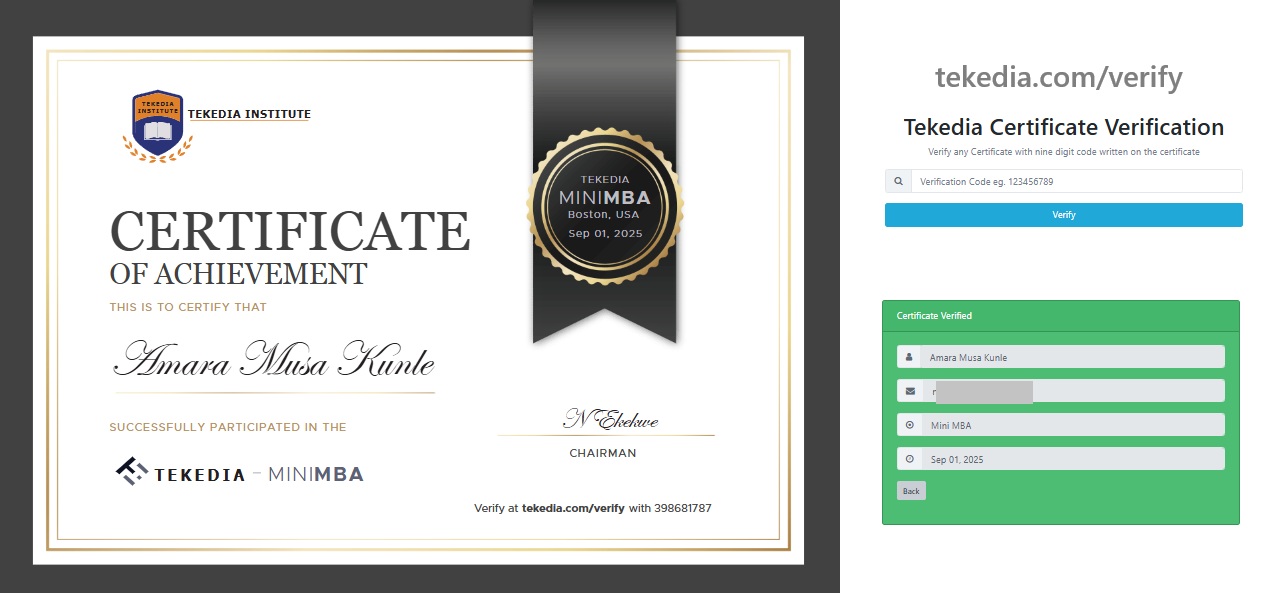
The next step is to document that journey with a tangible symbol – your Tekedia Mini-MBA certificate. This certificate is more than paper; it is a credential engineered for the modern business age. Each certificate carries a unique code, enabling employers, partners, and collaborators to instantly verify its authenticity. In a world where trust is currency, Tekedia ensures your achievements are protected and verifiable.

We invite all graduates to request their certificates. The process is seamless, and once received, you hold not just proof of completion, but also a lifelong marker of professional advancement. At Tekedia, we design for the future, and our auto-verifiable certificates exemplify that future where credentials travel across borders with credibility.

Request yours today. Celebrate your learning. Document your achievement on your LinkedIn profile. And let the world know: you are Tekedia-trained, and you are #ready2lead. Congrats again.