At Tekedia Mini-MBA, this week focuses on Marketing, Sales Management & Business Objectives. The following faculty members are teaching us:
Developing and Executing An Effective Enterprise Marketing Plan – Onyinye Ikenna-Emeka, General Manager, Enterprise Marketing, MTN Nigeria
Mastering The Art of Sales Excellence – Ferdinand Ibezim, MD/CEO, Selling Skills Support Services Limited
Consumer Marketing in FMCG – Emmanuel Agu, Group Marketing Director, Jotna (the LaCasera Company)
Sales Management, Marketing and Growth – Moby Onuoha, Queen’s
For Tekedia Live, we have the following:
Tue, March 30 | 7 – 8.00pm WAT | Organizational psychology for business growth – Anthony Alagbile, President, Institute of Industrial & Organizational Psychology
Thur, April 1 | 11am – 12noon WAT | Personal Finance & Wealth Management – Japheth Jev, Founder, Japheth Consulting
Sat, April 3 | 7 – 8.30pm WAT | Building Modern Investment Portfolios in Africa, General Topic – Ndubuisi Ekekwe
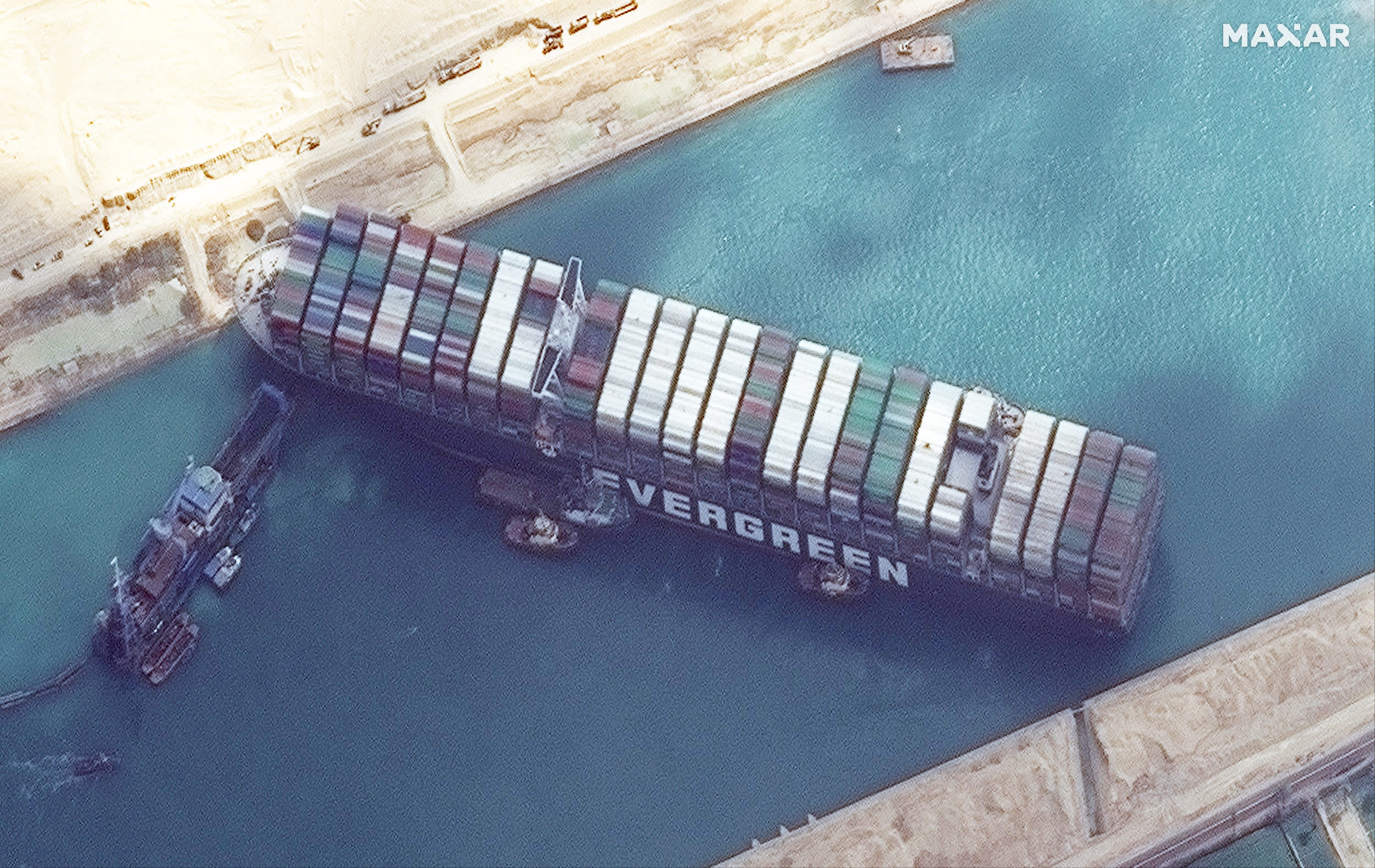
The battle to get the 224,000-ton container ship blocking the Suez Canal appears to have been won, but the victory came with accumulated economic losses and heavy impact that will further exacerbate the scarcity of goods and services.
The pandemic created a global supply chain disruption that the world is still grappling with, stoking the cost of goods and services and limiting the availability of needed items. With the monster lasting days at the Canal, the global supply chain is about to see further disruption. The obstruction created a massive traffic jam at the cost of $9 billion each day in global trade.
The problem started when the ship, MV Ever Given, a Panama-flagged vessel operated by Taiwanese company Evergreen and owned by Shoei Kisen Kaisha Ltd of Japan, became wedged sideways across the canal on Tuesday, March 23, due to strong winds.
While the massive efforts to clear the passage way have paid off, the impact could last for months.
The Canal, which is 120-mile long between the Red Sea and the Mediterranean separates Africa from Middle East and Asia and is also the shortest route between Asia and Europe.
Roughly 30% of global container traffic flows through the canal annually. That means, the blockage of the Suez Canal could affect 10%-15% of world container throughput, according to analysts from Moody’s Investors Services.
“Very high consumer and industrial demand, a global shortage of container capacity and low service reliability from global container shipping companies… has made supply chains highly vulnerable to even the smallest of external shocks,” they said in a note on Friday.
In that context, the timing of this event could not have been worse, they added.
There are more than 367 vessels now waiting in the Suez Canal due to the blockage.
A busy traffic in the Suez Canal underscores a shift from the strict restriction that characterized the earlier approach to the pandemic. And just when it’s about to get even, a single vessel tends to reverse the progress made so far.
A temporary closure of the Canal such as this would compound the already strained global supply chain. The delays become expensive as ships get diverted to other routes, which heightens the pressure of container shortage that businesses are already facing.
The ordeal of Ever Given has increased stalling shipments of consumer goods from Asia to Europe and North America, and agricultural products moving in the opposite direction. In addition, it is fanning the soaring cost of freight service that has upped significantly due to the pandemic.
Globally, the average cost to ship a 40-foot container rose from $1040 last June to $4,570 on March 1, according to S&P Global Platts. S&P Global Panjiva said in February, that container shipping costs for seaborne US goods imports totaled $5.2 billion, compared to $2 billion during the same month in 2020.
With this surge in cost of freight services, consumer items are expected to rise accordingly. More than 80% of global trade by volume is moved by sea, which means incidents like the blockage of Suez Canal, even for a day or two will impact the global supply chain, especially as the effects of the pandemic take further toll on industries.
Europe is likely going to be affected more than other regions. Since 2020, China has overtaken the United States as Europe’s top trade partner, increasing freight services from Asia to Europe through the Suez Canal.
“Vessel utilization has been at full capacity on the Asia-Europe trade route because of heavy demand from European importers, with terminals in Europe experiencing labor shortages due to coronavirus-related measures,” said Greg Knowler from consultancy HIS Markit.
Factored also in the crisis is the delay in returning empty containers to Asian exporters, which is expected to further exacerbate the current shortage of containers, according to the consultancy.
For ships taking alternate routes to avoid the Suez standstill, it means longer trip and higher cost. For instance, alternate routes such as the Cape of Good Hope in South Africa, adds up to 10 more days to their journey.
Moody’s Investors Service said Europe’s manufacturing industry and auto sector, including auto suppliers, will be hit hardest as a result of the delays.
“This is because they operate ‘just-in-time’ supply chains, meaning they do not stockpile parts and only have enough on hand for a short period, and source components from Asian manufacturers,” they said.
The longer routes also present other concerns; African waters are infested with pirates, and there is fear that detouring ships will be attacked by pirates.
Although there has been significant progress in dislodging the Ever Given, the ship was moved 30 degrees from left and right by tugboats on Saturday, and on Monday, Canal service firm said the ship has been set free, the damage has been already done.
Moody’s Investors said even if the situation is resolved quickly, port congestion and further delays to an already constrained supply chain are inevitable.
Sumit Agarwal, economics professor at the National University of Singapore said there is going to be a global consequence as a result.
“My view is that this will cause problems for a lot of countries and industries around the world in the short run,” he said.
Two of the most difficult technology sub-sectors to make money are ecommerce and ride-hailing. They look increasingly easy to start but once you begin, you will realize one thing: accumulating leverageable factors is hard, and attaining efficient marginal cost positioning largely hopeless. So, what great companies do is to use those vehicles as one oasis and quickly activate double plays where they can capture value. Without AWS, Amazon would not be a $1.54 trillion plus business, if it has relied only on ecommerce.
Ecommerce is hard especially in Africa where marginal cost challenges make it an offline business. Yes, if the cost of logistics still dominates the transaction/distribution cost, making the operations bounded by geography, it is nothing truly online. As I noted years ago in the Harvard Business Review, we have a long way to go before we can fix most of the frictions in the sector. My summary is that ecommerce is a wasteful venture at this time in Africa unless you have free money to be throwing at it before things improve. And do not call it an online business because there is nothing in it that is truly online: serving an extra customer does not end with a click. It costs real money to reach that person in an area with no postal services.
So, the news today is that China’s Didi Chuxing is coming to Cape Town, South Africa to battle Uber and Bolt. As we already know, most local ride-hailing companies in Africa have exited or severely diminished. They have struggled to make money and without unlimited funding treasury, mainly possible in China, Europe and US, most pivoted.
DiDi South Africa is part of the world-leading transportation platform DiDi Chuxing, which offers a full range of app-based transportation services to more than 600 million users across Asia, Latin America & Russia.
DiDi South Africa understands the challenges communities and the transportation industry face with the evolution of urban mobility (rideshare) and as a result is committed to creating the freedom and convenience to go places, open up horizons and give access to new experiences through our platforms.
Our mission is driven by a dedicated team, who understand the operational landscapes of the rideshare industry. DiDi exists to help South Africans move freely and to unlock their potential and that of the cities they live in.
Ride hailing has limited IP-anchored moat and requires massive scale to trigger the virtuous accelerating returns. If you have options, do not waste time on it, unless you are using it to support a one oasis which you want to remain a category-king (think of Innoson Motors starting one in Nigeria)! But as a pure play business in Africa, it looks dimmed as Uber, Bolt and now Didi converge.
Those companies know what they are doing: I have called it geographical positioning where if Amazon invests $1 billion in India, Wall Street investors add $20 billion market cap for its Indian exposure even though it may not be making money therein. Jumia did the same when it battled Konga as it ramped up expansion in Africa, while losing money, and over time, investors stopped funding Konga, because they felt that Jumia had won! Typically, having access to that truckload of money is not common for most African startups. So, that makes such a playbook challenging: you do not need a business where after raising $400 million, you will still need more money to show results!
I have predicted that by 2030, up to 80% of richest Nigerians would come from one core sector. You can extrapolate that to continental Africa. We have entered the app utility era in Africa, an economic Cambrian moment; new vistas are being unlocked daily. This Saturday, at Tekedia Mini-MBA Live (7-8.30pm), our Zoom session will focus on Building Modern Investment Portfolios in Africa.
Within an academic scene, we will examine how the empires of the future would look like. This is not going to be BUY this, Sell that. Rather, we will discuss market systems under the academic purity of pursuit of knowledge, biased with practicality!
If you have registered for Tekedia Mini-MBA edition 5 (June 7 – Sept 1), and want to join, please tell Admin to send you access. For prospective members, you can register here and join us.
Car start button on dashboard. Innovation start writes on push button. Horizontal composition with copy space and selective focus.
Good People, early bird registration for Tekedia Mini-MBA edition 5 (June 7 – Sept 1, 2021) closes soon. There are many benefits including having immediate access to our books and free course at facyber.com on different tracks of cybersecurity. Tekedia Mini-MBA is an innovation management program.
It runs online with thrice weekly live sessions, anchored by leading business leaders from global and local companies you admire. This Saturday, I will anchor one on “Building Modern Investment Portfolio in Africa”. Ask our members, our sessions TRANSFORM. I have got people who have prepaid for 5 years like Emmanuel S Akintunde.
Click to register for our self-paced program (it will not affect your work schedules as everything is recorded and archived); cost is $140 or N50,000 per learner.