DD
MM
YYYY

PAGES

DD
MM
YYYY

spot_img

PAGES

Home Blog Page 5841

Marginal Cost And Unit Economics [Video]

4

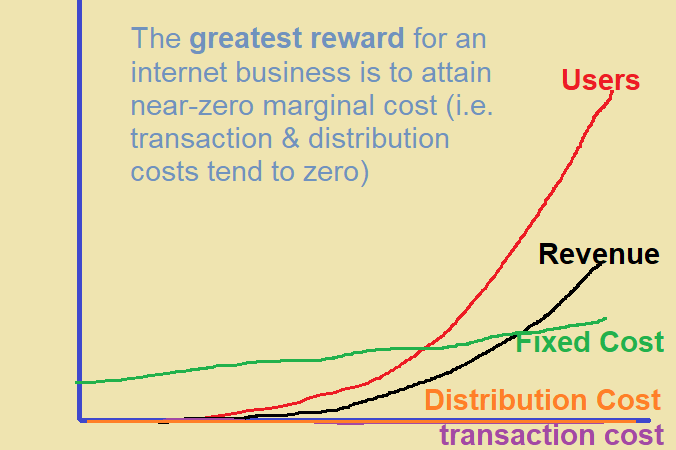
In a perfect internet market, the marginal cost of a digital product is zero. But no market is perfect, so, what we have in reality is that the marginal cost tends towards near-zero. What that means is that the transaction and distribution costs stay low even as output increases. Whenever you attain that positioning, your unit economics improves since you are essentially having accelerating returns which keep compounding. 

Unit economics is defined as the “direct revenues and costs associated with a particular business model, and are specifically expressed on a per unit basis”. Some even go so far as say that unit economics are the fundamental or basic financial building blocks of a business.

In theory, you can just keep growing, unlimited by the typical industrial age marginal cost which begins to go low, but quickly ramps up with output (recall your average fixed cost shape in secondary school economics) thereby restricting growth. 

If you do not understand how marginal cost affects your business, you cannot drive growth in that business. Make time and study marginal costs. In Tekedia Mini-MBA, we have a course on marginal cost. It is the most important cost you must understand if you want to develop a growth playbook.


The Mastery of Marginal Cost is the Mastery of Digital Business Growth


https://youtu.be/P75hzh3e190

Where Is the Person Who Has Helped You?

0

Many years back as a fresh graduate of the University of Nigeria Nsukka, UNN, I was doing my clearance in order to be shortlisted for the next batch of the National Youth Service Corps. One of the conditions to be cleared by the school is the presentation of receipts of all financial obligations from first to final year. I could not find my reparation fee receipt. This was the money we paid when some students rioted and destroyed the school’s assets in my second year. I only needed to get a duplicate of my payment from the bank. For two years (from 2nd to 4th year) I was frustrated. They always asked me to return next week or next month. Just that I was in financial straits after losing my Dad otherwise I would have just paid a second time. 

On this fateful day my helper located me. After a transaction, the teller asked me if there was something else she could do for me and I told her about my trouble. She left her cubicle, held my hand and took me to the man that has frustrated me all this while. She stooped and whispered in his ears: “Please help my friend.” With a parting caress on his back she left me with him. And in less than five minutes I got what I couldn’t get for two years. 

Imagine your life without helpers. If no one had helped you secure that job or contract. If no one had helped you with your school fees, feeding, house rent, transportation, avenge your enemies, put in a good word for you, and no one had helped you when you were frustrated and depressed. Where would you be today? 

Life answers to careful application of principles. This makes the world a complex but interrelated web of principles. One of such principles is giving and receiving. When we are bestowed with favor and we do likewise, we keep the cycle unbroken. And what perpetuates and strengthens this flow is the expression of gratitude. But ingrates will have theirs run dry. 

‘So Jesus answered and said, “Were there not ten cleansed? But where are the nine? Were there not any found who returned to give glory to God except for this foreigner?” ‘(Luke 17:17-19). Just like Jesus, everyone who shows favor expects some form of appreciation from the beneficiary. It is a natural response that will make the giver be pleased and probably do more.  “Arise go your way. Your faith has made you whole.” This is the reward to the one that showed appreciation. He will never be leprous again because it is possible for one to lose his miracle due to ingratitude and exposure to what caused it in the first place. The nine exhibited entitlement mentality.

Let us consider the case of Moses and Jethro’s daughters at a well in Exodus 2:15-21. After murdering an Egyptian in defense of his fellow Hebrew, Moses fled for his life to the land of Median as a fugitive. Now thirsty, hungry and homeless, he needed help. And when the situation presented itself, he relegated his needs to help the women fight off the bully shepherds and watered their flock. These are nomadic aggressors in the like of Fulani herdsmen in present day Nigeria. Moses didn’t exploit the weakness of the women to satisfy his needs before helping as some would do today. 

“Why is it that you have left the man? Call him that he may eat bread.” This was the reaction of their father after his daughters shared their encounter with Moses. His daughters never remembered to show appreciation. You would think Zipporah being the eldest would have noticed that he was a stranger in need of help. If not for her father’s foresight she probably wouldn’t have married Moses. Her name would not have been recorded in history for posterity. 

And Moses by that singular selfless act got not only his urgent need of food and shelter, but also, a wife, a family, a shepherd’s job for forty years, and most importantly, his mission of leading the Israelites out of Egypt. Think, what if he had not helped the women? They surely wouldn’t have mentioned him to their father. There wouldn’t have been an invite to dine. He might not have found a good wife in Zipporah. He probably wouldn’t have become a shepherd which made him see the burning bush the way he did. 

And think if Jethro hadn’t shown gratitude to Moses for his kindness to his daughters, he might not have had two additional men (Moses and Gershom, his son) in his household to defend them. He would not have had the opportunity to bequeath the world with his concept of Delegated Authority. He would not have been remembered by history if he had not remembered to show gratitude. 

I will conclude by asking you two questions and also give you a task to do. Where are the people that have helped you in your life’s journey thus far? Where have you left them? Make a list today of everyone you can remember that has helped you and show gratitude in every way possible.

Week 7 Courseware & Zoom Links Posted – Logistics & Supply Chain Management

0

For this week at Tekedia Mini-MBA, we are learning Logistics & Supply Chain Management. Find below the modules:

  • Supply Chain & Logistics Management – Ayodele Adenaike, COO, GIG Logistics
  • Supply Chain Management – Luiz Barreto, Graduate of MIT Supply Chain Management
  • Ecommerce & Logistics – Olufemi S. Aiki, Co-Founder, Foodlocker
  • Product Case: Logistics – Samuel Akinniyi Ajiboyede, CEO, Zido Logistics

More so, Tekedia Live zoom links are in the Board.  Please note the time for Tuesday is at 11am WAT.

  • Tue, March 23 | 11am – 12noon WAT | Building Impactful Gender-Anchored Companies – Ifeoma Uddoh, Founder, Shecluded
  • Thur, March  25 | 7 – 8.00pm WAT | Effective Project Management – Taiwo Abraham, Program Manager, Horizant Canada
  • Sat, March  27 | 7 – 8.30pm WAT | Career Diversification & Insurance, General Topic –  Ndubuisi Ekekwe

Have a great co-learning week at Tekedia Institute.

Nigerian Gig Drivers Move to Sue Uber, Bolt Over ‘Independent Contractors’ Status

0

Following UK’s Supreme Court ruling last month, mandating Uber to classify its drivers as workers, Nigerian ride-hailing drivers are planning to institute a lawsuit against the country’s major app-based ridesharing companies, Uber and Bolt.

The group known as National Union of Professional App-based Workers (NUPA-BW), said they’re working on a class-action lawsuit against Uber and Bolt.

The gig economy model, which Uber, Bolt and other ridesharing companies are built on, has come under threat since the London’s Supreme Court ruling.

“We like to use this opportunity, seeing what’s happening in the UK and South Africa to start our class action against Uber and Bolt operations in Nigeria. We want them to respect the Nigerian constitution and labor law. This is an opportunity for the Nigeria government especially the ministry of labor and productivity and the ministry of transport to do the needful,” Comrade Ayoade Ibrahim, President of NUPA-BW told TechNext.

The gig economy’s ordeal started in 2016, after two Uber drivers, Yaseen Aslam and James Farrar, who were later joined by 22 others, filed a lawsuit against Uber for denying its drivers basic work rights.

It has since then become a growing movement, cutting across continents.

Uber, Lyft and other gig platforms have been fighting to define themselves as tech platforms serving only as intermediaries between drivers and riders, which should not be seen as employers of labor. In its home market California, Uber had argued that counting drivers as employees will significantly affect riding cost, as the state’s AB-5 means that drivers will be paid minimum wage.

However, the prop.22 ballot which took place Nov. 3, allowed people to decide if they want Uber to continue with the gig economy through votes, since the court had earlier ruled against the taxi app. The people voted for the gig economy, saving Uber California, its biggest market. But the story has been different outside the United States.

Earlier this month, the Spanish government announced legislation that classifies food delivery riders as employees of the digital platforms they work for. The legislation is as a result of Spain’s Supreme Court ruling last September that classified delivery drivers as employees not independent contractors, following a case brought by a former Glovo driver.

In February, South African drivers also filed a lawsuit against Uber, challenging their status as independent contractors.

The drivers’ win in Spain and the UK has ignited a passion for similar lawsuits even in unlikely places like Nigeria, where the labor laws are deemed lax and unprotecting. But this wouldn’t be the first time Uber will have to face a class action in Nigeria. In 2017, some drivers had sued the ride-hailing giant, asking for workers benefits.

For Uber, the argument has always centered on what the majority of the drivers want. The ride-hailing app had repeatedly argued that most of its drivers want the ‘independent contractor’ status as it offers them flexibility. And on that account, majority of the drivers are expected not to support the lawsuit.

But Ibrahim said that the number of drivers who support the lawsuit doesn’t really matter, citing the UK’s legal action.

“If you check UK legal action, only 20 App-based drivers started it. Two people at most are the leading claimants. So it doesn’t matter if we didn’t get 100% of drivers. We have the support of the majority and we’re working on the modalities. We start the class action against them soon,” he said.

While the number of drivers who support the suit doesn’t really matter, the real challenge lies on how the court interprets Nigeria’s Labor Act.

Section 91(d) of the Nigeria’s Labor Act describes “worker” thus: “any person who has entered into or works under a contract with an employer […] but does not include […] (d) representatives, agents and commercial travellers in so far as their work is carried on outside the permanent workplace of the employer’s establishment.”

Based on this interpretation, the odds are against the drivers. Moreover, as TechNext noted, while contrary ruling may place both Uber and Bolt in financial strains, it will also mean that the drivers will earn N30,000 monthly minimum wage, which is around what they earn weekly as gig workers.

Add A New Strand In Your Business DNA

0

We turn sole proprietors into entrepreneurs, salespeople into growth makers, project leads into project champions, and small businesses into startups. Passing through our program adds a new strand called GROWTH in the DNA of your business. Experience Tekedia Live, hosted 3x weekly by Ndubuisi Ekekwe. Join us here.