DD
MM
YYYY

PAGES

DD
MM
YYYY

spot_img

PAGES

Home Blog Page 5867

Alas, Olympic Games Without Spectators

0

One of the devastating impacts of COVID-19 pandemic has been keeping sports activities indoor; denying fans the contagious pleasure that comes from watching games in large numbers in stadia.

Last year, the Tokyo Olympic Games was postponed following precautionary safety protocols to contain the spread of the virus. The aim was to wait on the hope that the pandemic will be defeated early enough to give way to formal Olympic events that will involve spectatorship in 2021.

Although the wait partially paid off, the 2021 summer Olympics and Paralympics will be held after all despite having been so close to cancellation, the problem of spectatorship remains.

The host nation Japan has made a decision to hold the big sports event without overseas spectators. For home spectators, Prime Minister Yoshihide Suga said a decision on spectators would be made by the end of March.

“The organizing committee has decided it is essential to hold the ceremony in the northeastern prefecture of Fukushima behind closed doors, only permitting participants and invitees to take part in the event, to avoid large crowds forming amid the pandemic, Japanese local media Kydo News reported on Tuesday.

The Olympic is scheduled to hold July 23 to Aug. 8 and the Paralympics from Aug. 24 to Sept. 5.

Japan is one of the nations most infected by COVID-19. The Asian country has so far recorded more than 441,000 and the organizing committee said rate of infection is an integral factor in their decision making.

“A decision would be made based on factors including the state of infections in Japan and other countries, possible epidemic-prevention measures, and expert scientific advice,” the committee said.

The torch relay, which is also going to be held without spectators, will hold on March 25, and Tokyo 2020 president Seiko Hashimoto said she wants the decision made before the relay.

In the 2016 summer Olympics in Rio de Janeiro (Rio 2016), there were 60,000 spectators in the stadium as the games opened. Spectatorship has always been a major part of the games, not only because it cheers athletes up, but also because the organizers derive huge revenue from the ticket sales.

In Rio 2016, 88% of the 6 million tickets were sold, while the London Games 2012 and Beijing Games in 2008 recorded 90% ticket sales. Local ticket sales had in the past accounted for 70-80% of the ticket sales. For instance, local fans accounted for 80% of all ticket sales in the last Olympic Games, the Winter Games in Pyeongchang, South Korea.

Sebastian Coe who headed the 2012 London Olympics, and currently the president of World Athletics, said the goal has always been to ensure the best possible games for the athletes and having full stadiums of passionate people.

“With all the work being done around vaccinations and the huge sacrifices large parts of the world have made over the last year, I would hope the fans (both home and overseas) will be able to attend. Of course it would be better,” he told Reuters.

“However, if local communities are concerned, then athletes will accept that and it is a trade-off they are prepared for it,” he added.

A survey carried out by a newspaper, Yomiuri showed that the majority of Japanese people don’t want spectators at the games.

The survey showed 77% of respondents voting no to allowing foreign fans to attend the games while 18% voted yes. On the other hand, 48% voted against allowing any spectators into game venues while 45% voted in favor.

Ticket sales have been expected to yield $800 million, accounting for 12% of the organizing committee’s budget, according to figures released in December.

But Japan has recorded more than 8359 COVID-19 deaths since the beginning of the pandemic and Tokyo is still under state of emergency. Therefore, the locals are concerned that allowing foreign spectators will aggravate the third wave of the pandemic that the country is currently grappling with.

However, Japan and the Olympic committee will have to accept the huge loss emanating from indoor games, if the choice of the locals is to be accepted.

Thank You – Go and Register for Tekedia Mini-MBA And Advance Your Career

0

Good People, thank you so much. We just received our 197th registration since we announced the unveiling of the 5th edition of Tekedia Mini-MBA (June 7 – Sept 1, 2021) a few hours ago. I want us to get it to 500 co-learners by Friday. There is no risk; we refund 100% within the first two weeks if for any reason you do not like our program.

Tekedia Institute offers an innovation management 12-week program, optimized for business execution and growth, with digital operational overlay. It runs 100% online. The theme is Innovation, Growth & Digital Execution – Techniques for Building Category-King Companies. All contents are self-paced, recorded and archived which means participants do not have to be at any scheduled time to consume contents.

It is a sector- and firm-agnostic management program comprising videos, flash cases, challenge assignments, labs, written materials, webinars, etc by a global faculty coordinated by Prof Ndubuisi Ekekwe.

Check the amazing testimonials, from Singapore to India, from Central African Republic to Dubai, from Ghana to Nigeria, and beyond.

Again – go and register, we already have a daily record, but we can push it. Attend the best school, attend Tekedia Mini-MBA and learn from the world’s best professionals. Begin here.


Tekedia Mini-MBA (June 7 – Sept 1, 2021) OPENS Registration

0

Good People, we have opened registration for the 5th edition of Tekedia Mini-MBA (June 7 – Sept 1, 2021).  Tekedia Institute (Boston, USA and Owerri, Nigeria) offers Tekedia Mini-MBA, an innovation management 12-week program, optimized for business execution and growth, with digital operational overlay.

It runs 100% online. The theme is Innovation, Growth & Digital Execution – Techniques for Building Category-King Companies. All contents are self-paced, recorded and archived which means participants do not have to be at any scheduled time to consume contents. We also have optional thrice weekly Zoom sessions.

Our Faculty members come from MTN, Shell, Microsoft, Amazon, Flutterwave, Nigerian Breweries, KPMG, Amazon, Infoprive, Bank of Industry, Kendor, Trusbanc Capital, etc, and are coordinated by Prof Ndubuisi Ekekwe. Our Learners come from 36 countries and have great things to say about our world-class program here.

Tekedia Mini-MBA remains $140 (or N50,000 naira) per person and we have many payment options (bank transfer, Paypal, etc). Register today (see payment details below).

Final Day To Register for 5th Edition of Tekedia Mini-MBA (Jun 7 – Sept 1, 2021) is Monday, June 21

5 Components of Emotional Intelligence

0

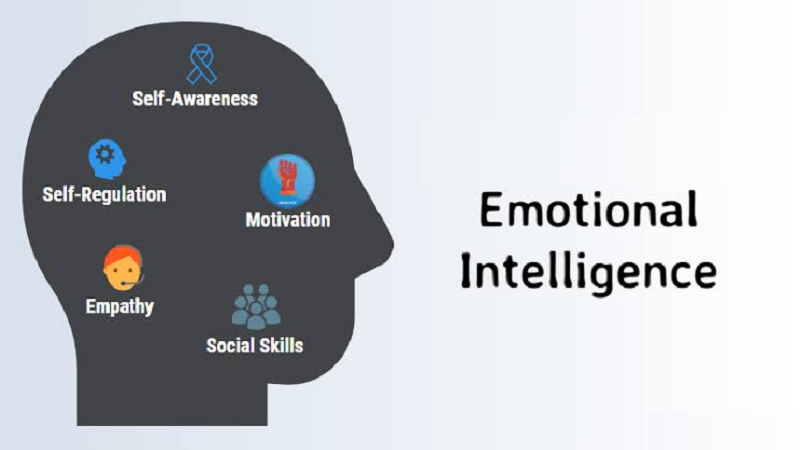
Emotional intelligence is the ability of a person to manage his emotions and that of people around him. It involves being able to control your feelings at dire moments. A person is said to be emotionally intelligent if he doesn’t lose his temper at the slightest provocation. Hence, people that lack emotional intelligence are those that pick offences easily and waste no time to react.

The importance of emotional intelligence is too great to be enumerated. Its benefits can never be over-emphasised. People that have mastered this skill have been able to prevent harming themselves and those close to them. The skill is needed by everyone irrespective of who they are or what they do. Some people think that it is not necessary to develop this skill because “if you don’t say ‘I am’, nobody will say ‘you are’”. They believe that tolerating ‘nonsense’ leads to more ‘nonsense’. So they lash out immediately at people that trigger them. But what people with this kind of mindset fail to understand is that exhibiting violence never pays. Instead of this sort of attitude attracting respect for the person, it attracts hate and loneliness.

Developing emotional intelligence helps people to build good relationships, grow their businesses, build their careers, and improve their leadership skills. It also attracts respect, as mentioned previously, and companionship. The simple truth is that no one wants to relate with a person that easily blows his top. No one wants to be cautious while dealing with his fellow man. So, there are only two options open for everybody: to become emotionally intelligent and grow, or to lack the skills and stagnate.

Developing emotional intelligence is not an easy game. It never comes easy. Some people, naturally, keep their cools irrespective of circumstances but some are easily triggered. For members of the latter group to control their outbursts, they need to evaluate themselves critically, regulate their emotions, develop social skills, become empathetic, and find factors that will motivate them.

a. Self-Awareness: This simply means knowing yourself. It means analysing yourself critically to ascertain what you are capable of. This, here, is the first stage towards developing emotional intelligence. If you notice that you are easily “pissed off” by what others say, it means you lack this skill. If you find out you can’t “tolerate bullshit”, this essay is for you. If you don’t understand why you’re easily agitated by other people’s words and actions, you need to develop this skill as soon as possible. So, start by being honest with yourself. Don’t excuse your actions by blaming the other party. Accept your shortcomings and be ready to work on them.

b. Self-Regulation: This stage is where you actually begin to hold yourself accountable for your outbursts. Set values and make efforts to stick to them. For instance, you can tell yourself you will never argue with your supervisor even if he was wrong and make efforts to stick to that. You need to make efforts to develop self-control. But remember, that Rome wasn’t built in a day. So don’t expect you can master this skill by putting in little effort within a short time.

c. Develop Social Skills: You need to learn how to interact and communicate with people. Remember that your facial expressions, tones, gestures, voice pitch, turn-taking skills, listening skills, eye contacts, and so on add to your message. Make efforts to develop these skills so your audience doesn’t misjudge you.

d. Empathy: Sometimes understanding other people’s feelings and perspectives goes a long way in preventing unnecessary drama. This is most important for people that felt they are being insulted or overshadowed when their ideas or submissions are challenged or they are asked for clarifications. The easiest way you can achieve empathy is by putting yourself in someone else’s shoes. If you can feel where it bites them, you may understand where they are coming from.

e. Find your Motivation: Motivation here means finding out why you need to acquire emotional intelligence. If you need that skill because you are tired of losing customers, that’s your motivation. If you need it because you want to maintain good relationships, that’s your motivation too. The good thing about motivation is that it spurs you on when your interests or desires begin to wane. So, find the reason, or reasons, you want to become emotionally intelligent and allow it to stimulate you.

In Oct 2020, I Predicted That “Flutterwave should be worth at least $1 billion”

1

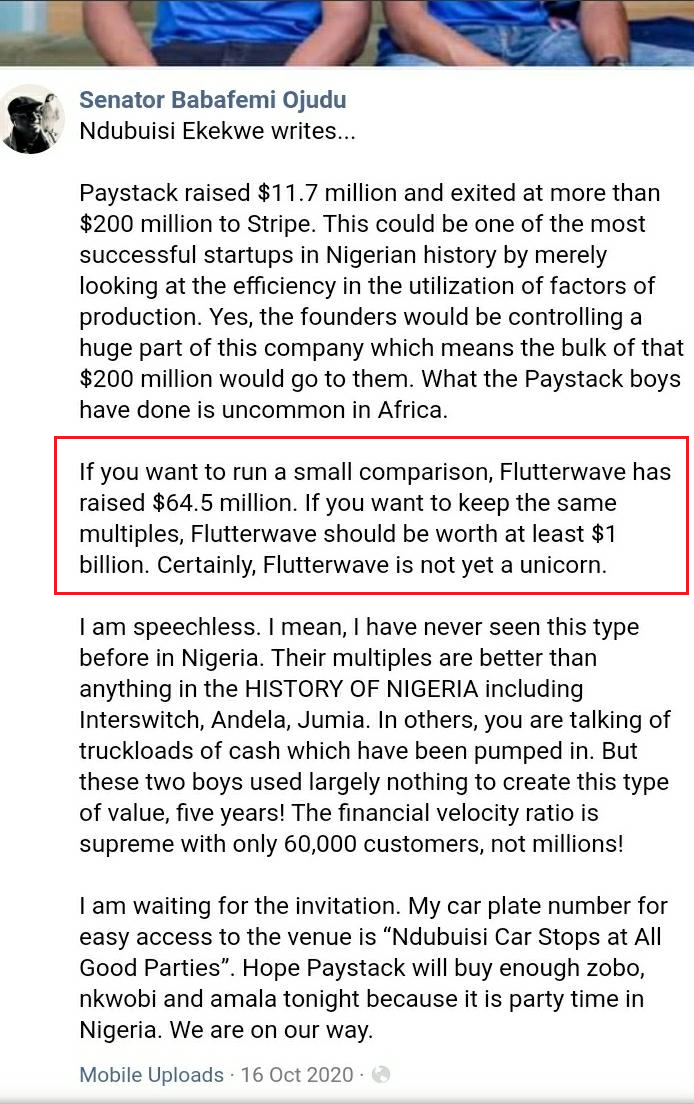
In October 2020, I wrote “If you want to run a small comparison, Flutterwave has raised $64.5 million. If you want to keep the same multiples, Flutterwave should be worth at least $1 billion. Certainly, Flutterwave is not yet a unicorn.” I had used Paystack numbers to extrapolate on the valuation of Flutterwave. That number came close to $1 billion but I quickly held by noting that Flutterwave was not yet $1 billion. But when it raised $170 million, this week, it completed.

Read this comment from Ladi:

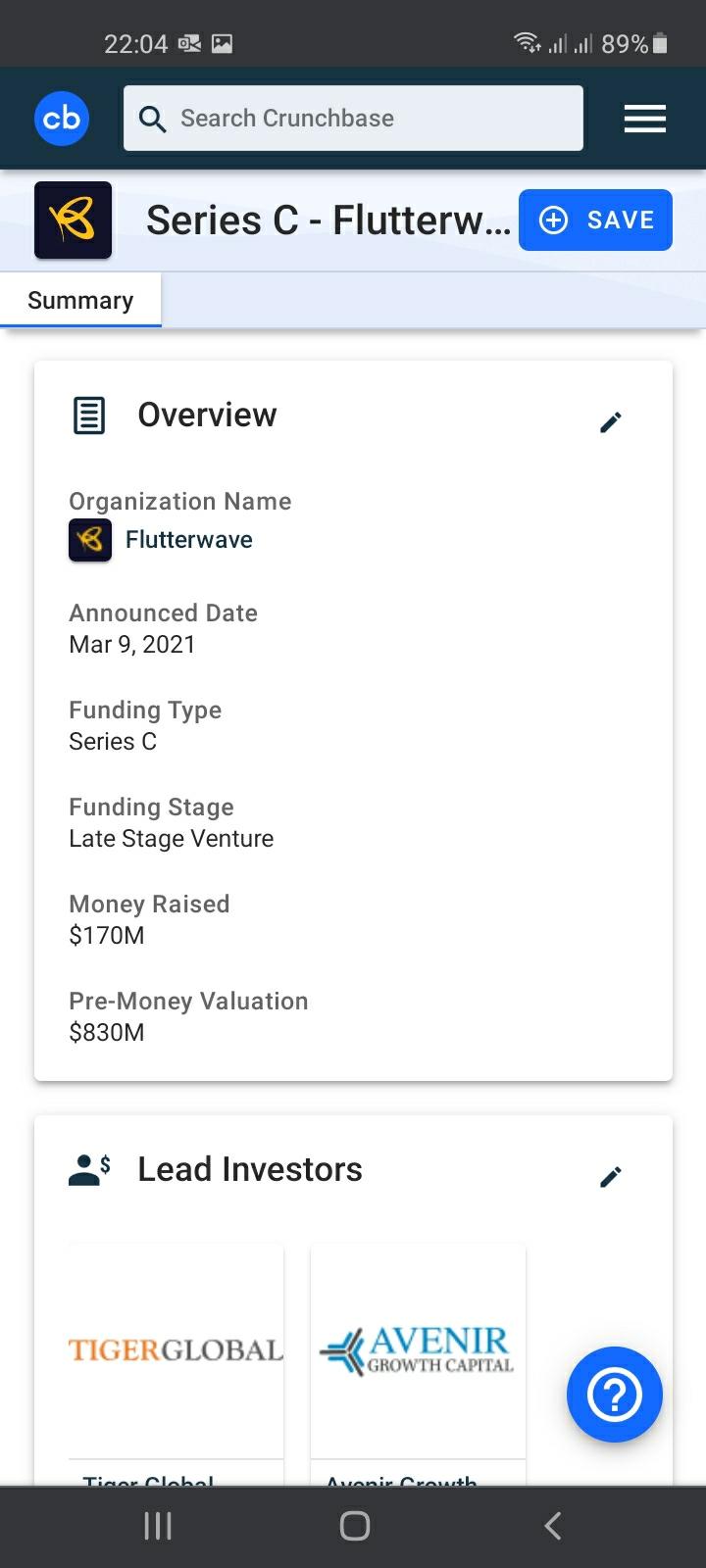
The recent $170m Series C funding (Total Funding = $234.7m) informed the $1 billion at 10 March March 2021 valuation ($830m before the $170m Series C Funding) – see attached as exhibit.

Your comments around October 2020 refers to Series A and B funding ($64.5m) only.

This critical factor was absent at the time of your submission and basing a company”s valuation on parallel (black) market exchange rate to USD is a fantasmal joke that’s not even funny at all.

It clearly seems that you’re trying to retrospectively fit the $1 billion valuation into a 2021 conjecture – by fire and by force Prof.

Velocity, Harvard Business Review or One Oasis valuation modelling have nothing to do with black market valuation; the $170m Series C funding fully explains causality ($830m + $170m).


He was referring to this post which was copied by a Senator

My response: “That makes me a zen master if I predicted months ago that Flutterwave should be worth $1 billion. I have even forgotten I wrote that. Thanks for sharing. So, I need to celebrate that call. I did say it was not $1b, so, the $170m completed it. I do not see what to fault there. I wrote that many months ago after extrapolating from Paystack number!

Another comment: Well done. The image above fully accounts for the difference. You have not yet demonstrated any model efficacy – One Oasis. Please do and don’t refer to black market valuation please.

My response: I do not know which image. You hard pre-money $830m which the $170 completed to $1b. I wrote it was $1b but quickly noted, it was not a unicorn. That $170M completed it. On model efficacy, you have no basis to judge. So, I leave it that way.

On black market, it is a number and we use it provided you declare it. You can also use official provided you declare it. They are numbers, just make it clear which one you are using. Bloomberg, Reuters, etc use black market rates and that I am using it should not be a taboo.

Yet, picking an Oct 2020 article to challenge one with more insights you have in March 2021 is another black market deal. You could have challenged me then. Do you not think an official rate would have focused on March 2021 and leave Oct 2020 alone? Read the full article which Senator Ojudu shared here – https://www.tekedia.com/paystack-is-the-most-successful-nigerian-tech-startup-on-large-value-creation-for-investors/ . I think I did very well, predicting March 2021. A hedge fund would have been happy to extend my contract.


Comment on the article: Uber and Lyft raised billions which continues to be debt their debt burden and they are still operating in the red. People should question what a business that’s on the market needs infusion of capital for. I dont consider funding as profit. A business that is on the market should be able to expand from market adoption, without such large infusion of cash, unless it is building infrastructure to meet demand. Lets just stop seeing fund raising as success. It’s not.

My response: You have a point but it misses how digital companies are valued and modelled. You are using an industrial age mentality to examine digital native companies. Amazon is worth $1.54 trillion today but was profitless for ages as it pursued that inflection point to make it a category-king.

Until you get to that state, no steady state has been reached as the golden virtuous circle of network effect cannot set in at scale with near-zero marginal cost. To assure that the money Uber raised is not lost, it did not drop to zero on IPO day. In other words, it created value after all “mass investors” have looked at it.

Next time I visit Nigeria, I plan to visit Nigerian Senate to have a chat on how we need to look at digital firms. It is not about profit. Amazon, an online firm, is America’s second largest employer.

Wish President Buhari can see this. We need to change how we look at these things in Nigeria. We can create 10 million in 4 years and employ everyone!