DD
MM
YYYY

PAGES

DD
MM
YYYY

spot_img

PAGES

Home Blog Page 5868

The Dangote Refinery’s Request and Grand Disintermediation Playbook

1

If you are in the business of importing crude refined products, there is a disintermediation on the way. Yes, Dangote Refinery is pushing that “license to import any product shortfalls should be assigned only to companies with active refining licenses. Import volume to be allocated between participants based on their respective production in the preceding quarter. ’’

Punch had reported that Dangote Group has desired  for inclusion in the Petroleum Industry Bill a requirement that the license to import petroleum products should be given only to companies with active refining licenses. The company does think that by having that requirement, companies will invest in local refining business.

But that is a very tough one since some people can actually get licenses just for the rights to import fuel. I mean, if Dangote Refinery thinks that will stop traders, they would be shocked. As things stand, the House of Representatives  is investigating the alleged missing of “5.2 million barrels of crude oil allocated to local refineries under the Direct Sales Direct Purchase (DSDP) – DSDP allows sales of crude oil to refiners, who will in turn supply the Nigerian National Petroleum Corporation (NNPC) with an equivalent worth of petroleum products’, Premium Times reports.

So, the problem is not just refiners importing, the problem is that some could become exporters. Yes, they get the local crude oil and they simply export it! The Petroleum Industry Bill  must fix these loopholes with criminal penalties.

Yet, from Dangote Refinery to local refiners, this petroleum business should not be seen as a long-term playbook. The Vice President was forced to make a case that the European Union should continue to fund gas projects in Nigeria as the region plans to freeze such projects globally. Simply, you can wake up in the morning and observe that investors have pulled funds as the tobacco-lization of fossil fuels continues.

The forthcoming deployment of the five million solar power connections, targeting 25 million households across the country under the Economic Sustainability Plan (ESP), reaffirms Nigeria’s commitment to the global green energy initiative.

“A just transition to net-zero emissions, probably one where gas as a fossil fuel is still supported, especially for those of us in this part of the world, is absolutely important, especially as it will enable us to phase-out more polluting fuels such as coal and diesel,” according to Vice President Yemi Osinbajo.

Mr Osinbajo made the submissions Tuesday during a meeting with a delegation of the European Union (EU) led by its Executive Vice President, Valdis Dombrovskis, maintaining the advocacy that the international community should preserve financing for gas projects in Nigeria and other developing countries, during the transition to net-zero emission.
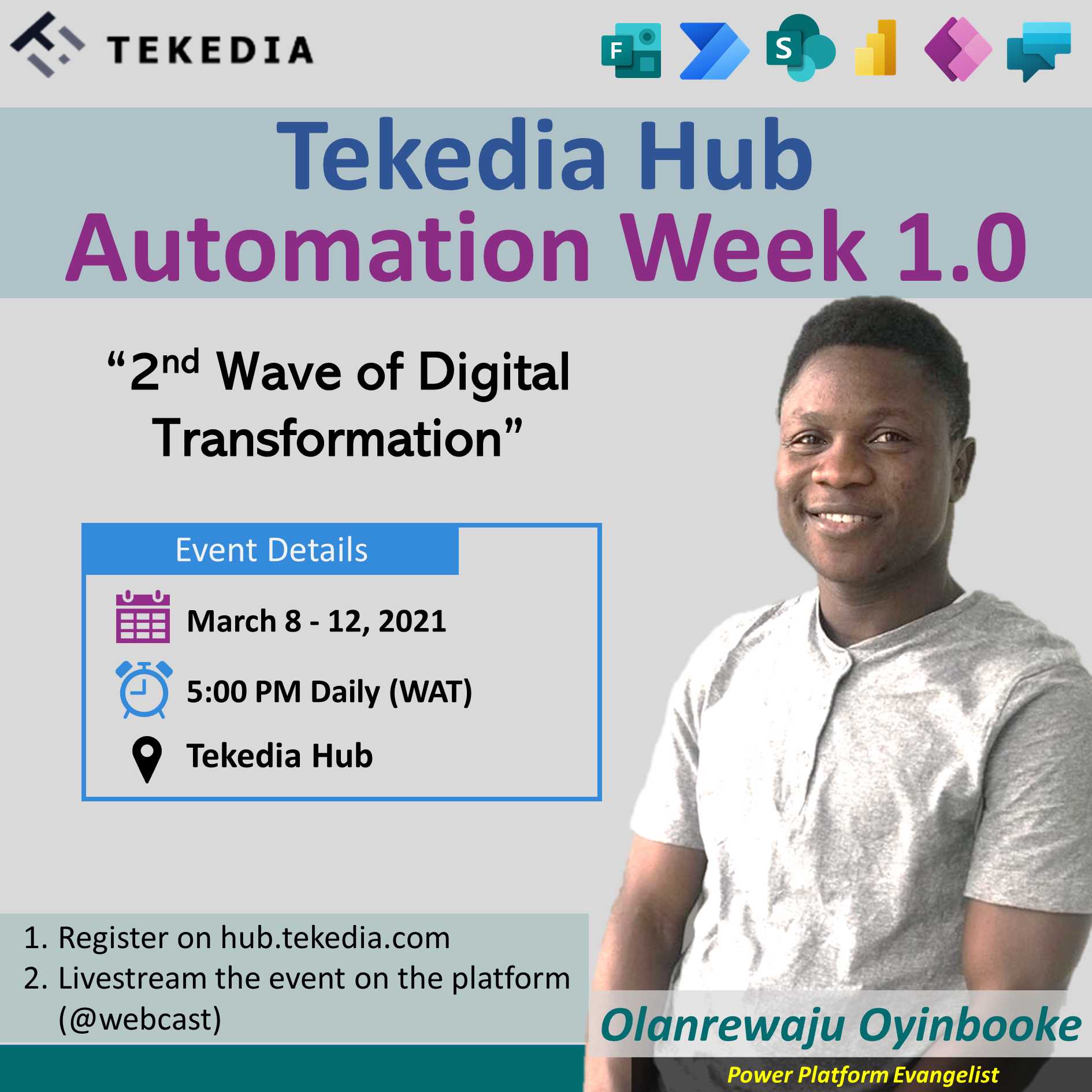
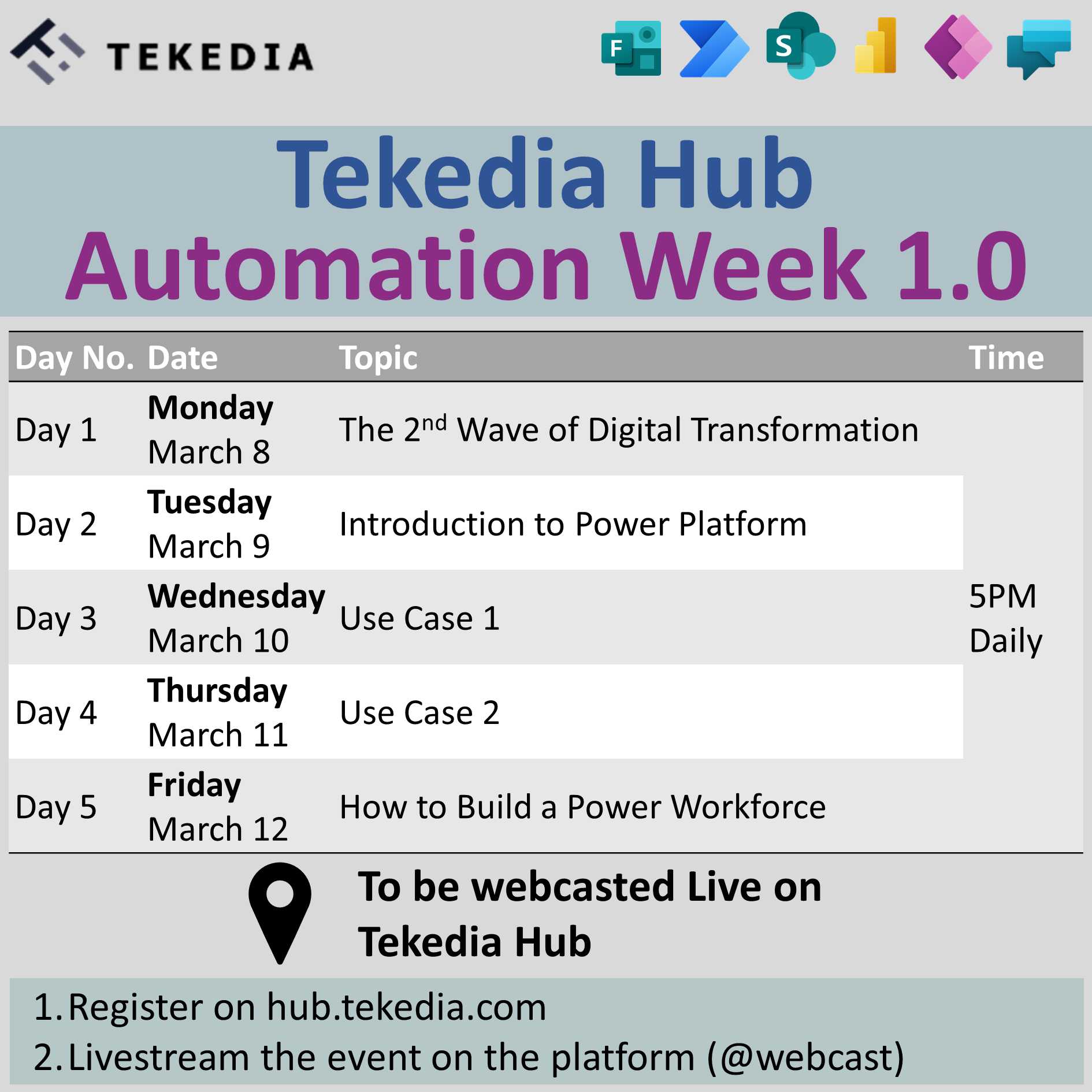
You Are Invited To Tekedia Hub Automation Week

0

As we experience the second wave of digital transformation, a reset is currently taking place as old technologies are giving way for new ones. Individuals and organizations need to find a way to leverage on this new wave to further optimize their business model and drive productivity. At Tekedia Automation Week, we will explore the direction of this new wave and how you can ride on it as an individual or organization.

Good People, I am inviting all to Tekedia Hub Automation Week with Olanrewaju Oyinbooke, MCT, mMBA. Join free for the week-long program at hub.tekedia.com. It is scheduled for 20 minutes daily.

  • Days: Mon-Fri, March 8-12.
  • Time: 5pm WAT
  • Link: https://hub.tekedia.com/webcast

This is part of Tekedia Hub Learning Series.

OPay Processed GTV of $2 Billion in Dec, Making It Nigeria’s Fastest Growing Brand

3

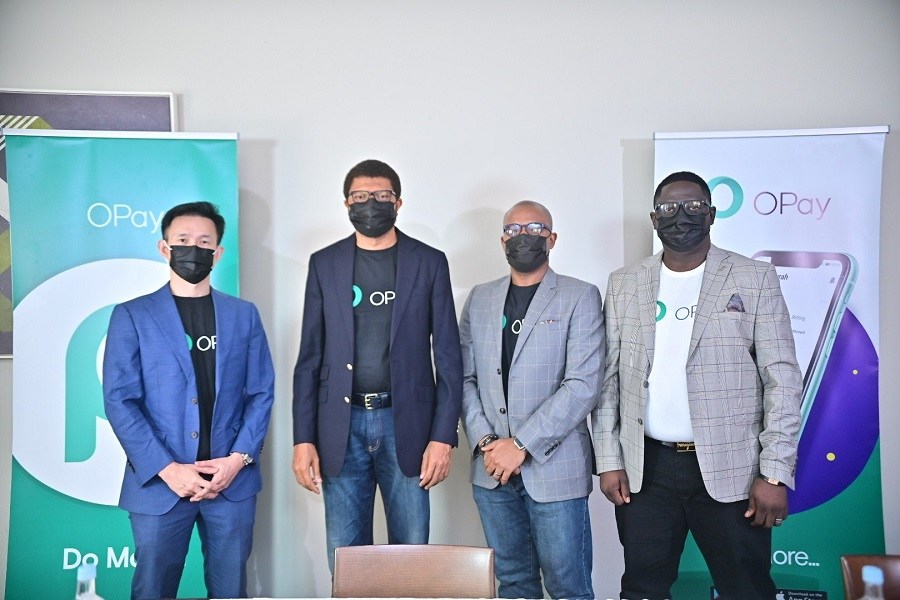
Opera controls OPay, and from Opera’s earnings call, “In December OPay processed a gross transaction value of $2 billion on its platform compared to $1.4 billion in October, or a 43% increase in just over two months. Further, OPay’s revenue is increasing quite rapidly while the company is able to achieve profits right around breakeven despite the growth. We expect this growth to continue as OPay continues to scale in Nigeria and expands to an additional country in Africa.” Yes, OPay, the fintech company, which has Nigeria as its main base grossed $2 billion on transaction value in December 2020, hitting 43% growth from October numbers.

Simply, OPay is Nigeria’s biggest mobile payment solutions provider and you can call it the fastest growing customer brand in any sector in Nigeria. The OPay’s Invisible Layer Strategy is working at scale.

People, marginal cost of zero has come to the paytech sub-sector of Nigeria’s fintech sector. Yes, OPay is running what I call the Invisible Layer Strategy. The Invisible Layer Strategy is a strategy where a company builds a product utilizing critical infrastructure of another competing company, in the same product line, but finds a way to under-cut that company on cost of services to end users. Today, OPay offers zero fee to customers who use it to pay for DStv services in Nigeria. It utilizes and relies on Nigeria’s banking infrastructure. But if the same customers use banks, directly, they would be charged fees, by banks. Largely, OPay has invented an invisible layer which makes it possible to handle those payments at zero cost that even the banks themselves cannot do. It is important to note that OPay is not absorbing any cost to acquire customers; there is no cost whatsoever in the value chain, and that means even in the long-run, it can process payments in Nigeria at absolute zero fee.

OPay is now well positioned to even battle telcos if they decide to come into the mobile money domain at scale. This company has provided a textbook case study on how to win  consumers in Nigeria: pile losses and keep making losses and keep running losses. One day, everyone will come to your party. Of course, you need reserves, tons of reserves I must note, to run that playbook. Hey, China Unlimited makes everything look easy.

Nigeria is now an OPay nation! By operating at the edges of the smiling curve, they have a promise to capture huge value.

Interestingly, this could become one of the most dominant financial institutions in Nigeria, and Iniabasi Akpan, the Country Manager, explained it clearly. Yet, there is more room to grow: Nigeria’s consumer GTV is estimated at $301 billion and more than 80% of that remains out of digital networks, and that means, there are lots of values to be pursued and captured as digital transformation happens. You may then ask – did Paystack exit very early? But you need to understand that $200 million is a lot of money in Nigeria!

“Due to the visible brand of ORide – including its iconic green helmets – and its frequent everyday use, many customers gradually gained an impression that OPay is a ride-hailing company. We just want to take the time today to clarify and emphasise that OPay was and remains a payment and financial service company – a Payments Fintech. Our businesses are licensed and regulated by Central Bank of Nigeria – like any established financial institutions – and OPay is today one of the leading Fintechs in Nigeria.”

Bring Orthogonal Thinking, New Basis of Competition And Lead Your Market

0

Always remember: focus on the incentives and not the form to deliver them. Yes, banks could be competing among themselves as they work to offer financial services to customers. But you could avoid being a bank, and still offer some of those services. If you do that, you may not experience those competitive forces. Think orthogonal to the current forms in markets, and deliver a new basis of competition. Build and Thrive!

Once you build with that mind, the possibility of becoming a category-king emerges. Here are the features:

  • Perceptively innovative: you are always innovating. You never rest, always pushing for better products, services and experiences. You outperform competitors with new solutions for unmet needs.
  • Evidently inspired: you inspire your users. You are modern, trustworthy and inspirational, you have a larger purpose, helping people live out their own values and beliefs.
  • Ruthlessly pragmatic: your customers depend on you and you have their backs, making life easier by delivering consistent experiences. You make good on your promises.
  • Customer obsessed: customers cannot imagine living without you. You know what matters to customers, finding new ways to meet their most important. needs.


Intel Hit with $2.18b Patent Judgment Amidst its Many Troubles

0
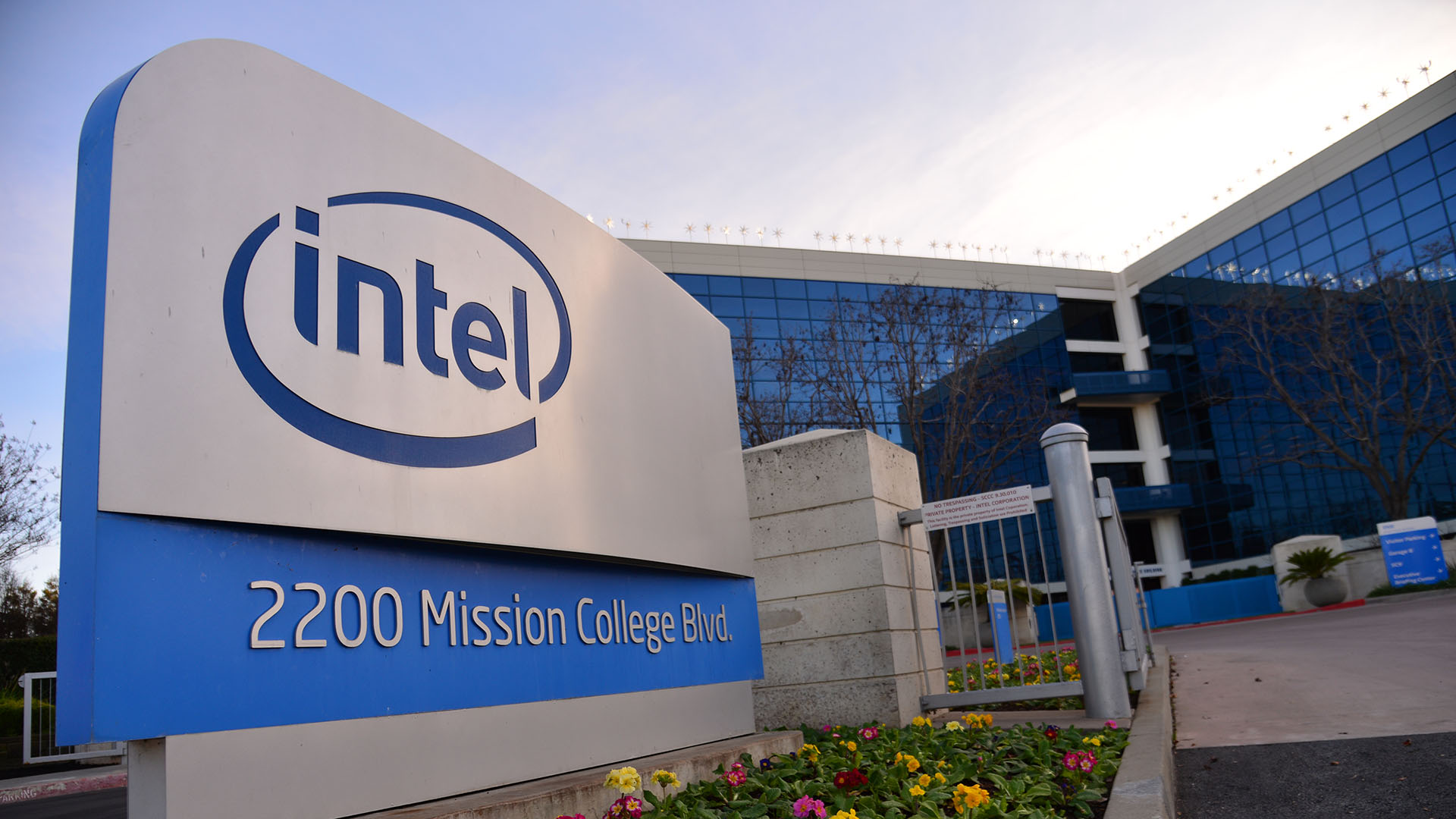
The Robert Noyce Building in Santa Clara, California, is the world headquarters for Intel Corporation. This photo is from Jan. 23, 2019. (Credit: Walden Kirsch/Intel Corporation)

Intel has been ordered by a Texas jury to pay $2.18 billion in damages for two patents infringements. The judgment was delivered following a lawsuit filed by VLSI Technology LLC.

Ars reported that the patents in question were previously owned by NXP Semiconductors, a Dutch company that was created from Philips in 2006. NXP acquired the patients in 2015 when it bought Freescale Semiconductor.

The report explains that the two patents focus on methods for minimizing the power consumption of computing chips. One way to do it is by varying the system voltage: setting a higher voltage when performance is needed, then lowering the voltage to conserve power afterward.

One patent claims the concept of storing information about a memory chip’s minimum voltage in nonvolatile memory so the system can ensure that the memory circuit has a high enough voltage. The VLSI’s other patent focuses on altering clock frequencies as a power-saving technique. Once again, raising the clock frequency of an electrical bus can increase system performance but consume more power. NXP’s second patent is based on the clock frequency when it needs faster performance.

Intel Inside

Intel argued at the trial that it hadn’t copied these techniques from NXP or Freescale and that, in fact, it had invented more sophisticated techniques to accomplish these tasks.

The trial judge, Alan Albright found Intel’s defense not convincing and ruled in favor of the plaintiff. But the case is not over; Ars noted that Intel may ask the judge to find that the jury misapplied the law. If that fails, Intel will then have the opportunity to appeal the ruling.

With $2.18 billion, if the ruling is upheld by the Appeal Court, it will be one of the largest patent judgments in US history. It will also compound Intel’s woes.

Intel has seen many troubles since last year. The semiconductor company was dropped last year by Apple after the iPhone maker developed its own chip that was announced in June. Apple said it’s moving its Macs from Intel processors to its own chips, a move the CEO Tim Cook called “the game changer.” Intel was one of Apple’s biggest chip suppliers, making the development a major setback in Intel’s supply chain.

A month later, Nvidia overtook Intel as the US most valuable semiconductor company. The turbulence of COVID-19 also came hard on Intel with the unprecedented changes it brought on the semiconductor industry. Intel competitors developed new designs that fit into the new market emerging from COVID-19 exigencies, putting them ahead of the competition.

In August 2020, Nvidia moved to acquire Arm, an English tech company with a great reputation in chip making. It makes chips for modern devices including smartphones, an area where Nvidia is yet to find foothold. The deal was opposed by Intel and other players in the industry who have demanded assurances that a new owner would continue providing equal access to ARM’s instruction set.

The acquisition would give Nvidia control over a critical supplier that licenses essential chip technology to the likes of Apple Inc., Intel Corp., Samsung Electronics Co., Amazon.com Inc. and China’s Huawei Technologies Co.

It is a wind of misfortune blowing toward Intel’s chances of staying afloat in the semiconductor industry. In January 2021, Intel announced it’s parting ways with its CEO Bob Swan, to bring back its former CTO Pat Gelsinger, effective Feb. 15. The move signals the chipmaker’s intent to return to engineering.

With all these troubles on the list, a $2.18 billion patent judgment is the last thing Intel wishes to start the year with.