DD
MM
YYYY

PAGES

DD
MM
YYYY

spot_img

PAGES

Home Blog Page 5872

Nigeria’s Central Bank Crypto Policy Is A Bad Policy – BICCoN

0
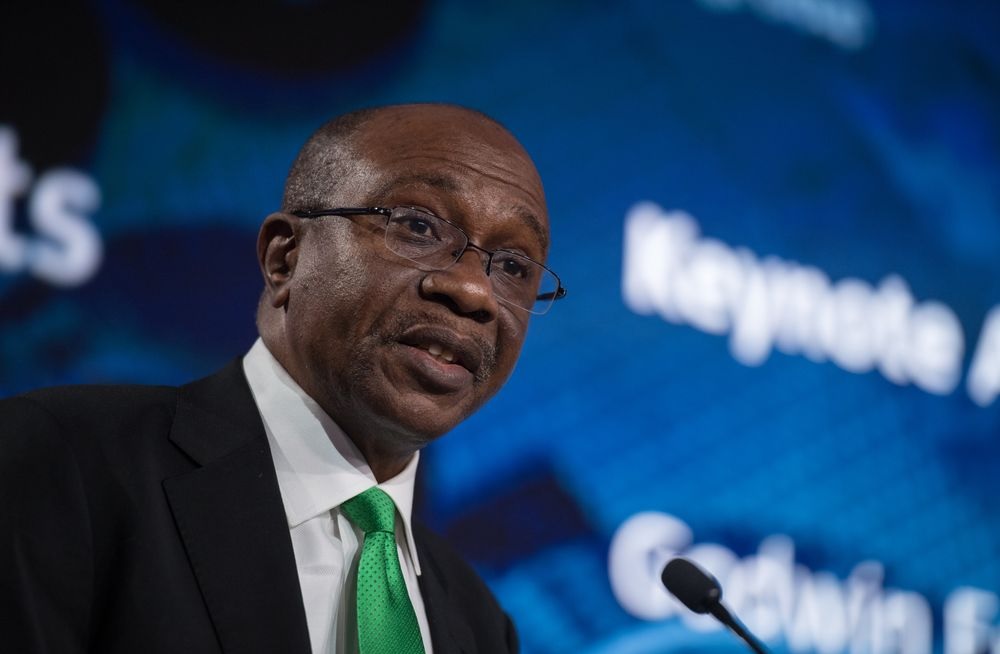
CBN Governor

In January 2021, on a mission to provide an intercommunity approach to blockchain technology adoption towards achieving a more collaborative, innovative, and safer blockchain ecosystem in Nigeria, the Blockchain Industry Coordinating Committee of Nigeria (BICCoN) was formed in January 2021. Little did we know that the Central Bank of Nigeria (CBN) had other plans—cut out the entire cryptocurrency industry from Nigeria’s banking and financial system. Shocking. This is coming at a time when industry stakeholders have been working closely with the Nigerian government on the proposed National Blockchain Adoption Strategy and the treatment and classification of digital assets in Nigeria’s capital market.

On 13 February 2021, BICCoN issued a press release responding to the CBN circular of 5 February 2021 and press statement of 7 February 2021. Below is an abridged version:

  1. Nigeria’s blockchain & crypto industry is shocked by the directive in the CBN circular.

Firstly, it is with shock that the emerging blockchain & crypto industry in Nigeria received the news of the directive in the CBN circular of 5 February 2021.

Secondly, the CBN circular of February 5, 2021 did not a mere reiteration of the CBN circular of 12 January 2017. The 12 January 2017 letter prohibited DMBs, NBFIs, and OFIs from using, holding, trading and/or transacting in cryptocurrencies but the CBN permitted these DMBs, NBFIs, and OFIs to provide banking services and other financial services to virtual currency exchangers/customers subject to ensuring that these exchangers/customers have effective Anti-Money Laundering and Combating the Financing of Terrorism (AML/CFT) controls. The latest circular completely cuts out the entire crypto industry from access to banking and other financial services in Nigeria.

Thirdly, though the CBN as the financial industry regulator has the statutory authority to delimit banking operations, ordering banks and other financial institutions to close or freeze accounts and discontinue relationships with customers involved cryptocurrencies may not be supported by law. This is because there is currently no legislation by the National Assembly criminalizing or illegalizing trade in cryptocurrency in Nigeria. Therefore, it is questionable whether the CBN has the statutory power to order the (permanent) closure or freezing of these accounts. These are the accounts of an entire emerging industry being closed by virtue of their involvement in cryptocurrency trading or services, a lawful business. By the way, the CBN circular—while shocking and disappointing—should have at least stipulated a reasonable period within which affected customers’ accounts should be closed.

Lastly, the CBN’s sudden and drastic directive was neither without any prior engagement with industry players nor notice.

  1. Emerging technologies, financial technology (FinTech), blockchain, cryptocurrency, bitcoin, and adoption across the world

The 4th Industrial Revolution is driven by technological innovations, including emerging technologies. These emerging technologies include artificial intelligence, Big Data, blockchain, Internet of Things (IoT), quantum computing, and others. In a data-driven global economy, blockchain  technology will increasingly play a key role. Regulators should be manifestly seen leveraging on innovative technologies to boost Nigeria’s global competitiveness through regulatory approaches that make our investment climate friendly.

  1. The growth of Nigeria’s crypto industry to No. 1 in Africa and a global leader in terms of crypto adoption and market volume

Nigeria is Africa’s largest cryptocurrency market and one of the world’s fastest-growing cryptocurrency markets in terms of bitcoin volume at the time of writing this statement. In 2020, estimates from BuyCoins showed that total volumes of bitcoin traded in Nigeria stood at $200 million monthly. According to Useful Tulips, Nigeria’s daily trading volume of over $2.8 million on Paxful,  a peer-to-peer bitcoin marketplace, tops the rest of African countries, with South Africa ranking over $400,000 and Kenya ranking over $700,000.

By mid-November 2020, according to Coin Dance, a crypto-statistics platform, Nigeria has traded 60,215 bitcoins ($566 million) in the last 5 years. This figure represents the second largest volume on Paxful, next to the United States. As captured by Quartz Africa, since May 2015  to mid-November 2020, bitcoin trade in Nigeria has increased at a minimum yearly rate of 19% in volume since 2017.

In the wake of the CBN circular, crypto trading in Nigeria is expected to be pushed to peer-to-peer crypto platforms, a decentralized world further away from regulation.

  1. The crypto industry’s contributions to Nigeria’s economy and competitiveness on the global crypto maps
  • Stimulation of Economic Activity: From local and foreign crypto-wallet services to crypto exchanges; crypto-remittance services to crypto investments; crypto education services to crypto advisory services, the crypto industry in Nigeria has witnessed growth particularly in the last 4 years.
  • Enabling and expanding financial inclusion: Cryptocurrencies are enabling and expanding access to finance to millions of people across Africa, including Nigeria. With relatively high fees, poor digital identity, and low trust in the traditional financial system, cryptocurrencies particularly Decentralized Finance (DeFi), an open, community-driven, and peer-to-peer alternative to centralized finance (CeFi), offer amazing opportunities for enabling and expanding financial inclusion in Nigeria.
  • Job creation: In a number of the local and global brands in the industry, Nigerians are chief executive officers (CEOs), chief technology officers (CTOs), country directors, marketing managers, community managers, legal & compliance officers, etc. Local blockchain & crypto authors, educators, forensic experts, journalists, lawyers, presenters, programmers, reporters, researchers, software developers, writers, etc. have also emerged, bringing about an ecosystem of innovation, collaboration, and growth.
  • Foreign Direct Investments (FDIs): Apart from funding through Initial Coin Offerings (ICOs), a number of foreign-owned crypto businesses carry out business in Nigeria. A number of Nigerian crypto startups get funding through foreign investors or from Nigerians in Diaspora. While regulation will help Nigeria take better stock of blockchain- and crypto-related FDIs into Nigeria, banning will most likely limit it to the informal economy.
  • Equipping and empowering the knowledge economy: From zero blockchain developers in Nigeria a few years ago, the country now has a number of indegenous blockchain developers, thanks to investments in learning and capacity building in blockchain technology and development.
  • Social developments: A number of crypto brands in the space, through their charitable and philanthropic initiatives, continue to contribute to education, healthcare, and poverty alleviation in the country.
  1. Legitimate threats and risks of cryptocurrency adoption and the regulatory approach to mitigating them

We acknowledge the CBN’s critical role in the Nigerian financial system and the Nigerian economy. As responsible industry stakeholders, we also acknowledge the risks that transacting in cryptocurrencies portend, such as illicit fund flows, money laundering, terrorism financing, and other criminal activities. However considerable the risks cryptocurrencies portend may be, these risks are not peculiar to cryptocurrencies. Fiat currencies continue to be used globally to fund the same fraudulent and illegal activities. Compared to cryptocurrency-related crimes, the latter is titanic. The problem therefore is not the cryptocurrency or the fiat currency, but the actors and users of cryptocurrency and fiat currency. And this is where a risk-based regulation comes in.

While the CBN has made some strong points about the threats and risks associated with cryptocurrencies, we believe that if supplied with a superior argument based on the latest knowledge on blockchain technology, its application to cryptocurrencies, and recent developments on innovation, policy, and regulation across the world, the CBN might reconsider most of its position on the threats and risks associated with cryptocurrencies. Our position regarding this is contained in our full press release.

  1. Opportunities Nigeria and Nigerians will miss with the CBN ban and unintended negative consequences

We appeal to the CBN to review its position. The CBN circular is capable of setting Nigeria’s global competitiveness as leading crypto industry back by at least 5 years..

If not reviewed or reversed, the CBN hostile policy may make Nigeria lose out on the following opportunities:

  • Become a powerhouse for global blockchain & crypto industry, attracting investments into the country and creating jobs for the ever-growing young and innovative population of Nigeria;
  • Boost remittances to Nigeria by adopting an innovative, risk-based regulation of cryptocurrencies in other to better capture cryptocurrency inflows into the country;
  • Become a business-friendly hub for blockchain & crypto innovations from all across Africa;
  • Leverage on cryptocurrencies to enable and expand financial inclusion in the country;
  • Encourage and challenge Nigeria to invest in research in blockchain & cryptocurrency use cases in the financial services industry, including cross-border transactions, clearing and settlements; crowdfunding; credit reporting; digital identity verification against fraud; stock exchange and share trading; syndicated lending; accounting, bookkeeping, and audit; peer-to-peer transfers; and trade finance platforms;
  • Encourage and challenge Nigeria to invest in learning, capacity building, and development, underscoring the need for a national blockchain policy in order to achieve economic competitiveness; and
  • Make Nigeria better prepared and positioned for a new global system of CBDCs, stablecoins, and other applications of blockchain & cryptocurrency innovations.

If not reviewed or reversed, the CBN ban may have the following unintended consequences:

  • Eventual death of centralized cryptocurrency exchanges in Nigeria, particularly indigenous cryptocurrency exchanges who should be getting regulatory support to become globally competitive;
  • Job losses, directly and indirectly;
  • Stifling crypto innovations across the entire ecosystem;
  • Limiting crypto trading to wholly unregulated decentralized platforms where unenlightened and unsuspecting members of the public will be more vulnerable to scams, making the Nigerian crypto space a den of criminals;
  • Pushing all crypto-based remittances to the informal economy, away from the formal economy that would have benefited the country;
  • Cutting out transaction fees for DMBs, NDMBs, and OFIs who should be facilitating cryptocurrency transactions for customers who wish to buy or sell cryptocurrencies or other virtual assets through centralized exchanges;
  • Cutting out centralized cryptocurrency exchanges who are the traditional gateway to the cryptocurrency world and who should be the most reliable ally to regulators for the purpose of AML/CFT regulations and customer identification, verification, and monitoring;
  • Practically illegalizing and criminalizing cryptocurrency trading and cryptocurrency exchange services, resulting in further discrimination, harrassment, extortions, and unlawful arrests by ill-advised, unethical, and opportunist law-enforcement officers;
  • Opening DMBs, NDMBs, and OFIs to avoidable litigations in a country where justice administration continues to suffer the plague of delayed justice, lack of rule of law, and lack of trust in the judicial system;
  • Foreign blockchain & crypto businesses will move out of Nigeria to other countries where the business and investment climate is less hostile or more friendly to crypto innovations;
  • A number of indigenous blockchain & crypto businesses will shut down completely while others may explore setting up their businesses offshore, costing Nigeria not only loss of income but also loss of its talents to other countries;
  • Increase in cybercrimes due to lack of economic opportunities available to young people to channel their energy, innovation, and talents positively; and
  • many more.

We should not send an emerging and legitimate industry to an unregulated market but develop the regulations needed. Also, rather than shut cryptocurrency exchanges out of the banking and financial system, the CBN should consider integrating these cryptocurrency exchanges into its risk-management system. This will  ensure that relevant regulators have effective control and management of cryptocurrency transactions in the financial system. BICCoN is open to working with the CBN to help drive the implementation of such risk-management policies in the crypto industry.

  1. Availability of industry stakeholders for a dialogue with the CBN in Nigeria’s best interest

While we commend the CBN for its innovations in the areas of payment systems, open banking, and regulatory sandbox for innovative financial products, we appeal to the CBN to adopt a risk-based regulation, not an outright ban on DMBs, NBFIs, and OFIs from providing its services to Africa’s no. 1 crypto industry by volume and a leading market in the world.

We are available for a dialogue with the CBN. We are ready to work with the CBN to ensure that its management of the risks of cryptocurrencies do not affect the stability of Nigeria’s financial system.

Also, with the National Assembly’s intervention in this vital matter, we at BICCoN will be happy to appear before the Committees on Banking, Insurance and other Financial Institutions, ICT and Cybercrimes, and Capital Market set up to determine the opportunities and threats of cryptocurrency on the nation’s economy and security.

The CBN crypto policy in Nigeria—however well-intended—is an attempted abortion in the 9th month.

Senator Ihenyen

General Secretary

BICCoN

Congrats, Madam WTO – Ngozi Okonjo-Iweala

0

Nigeria’s Ngozi Okonjo-Iweala was appointed Monday as the first female and first African head of the World Trade Organization, at a special general meeting.

gozi Okonjo-Iweala has been appointed the new chief of the World Trade Organization, becoming the first woman to ever lead the Switzerland-based institution and the first African citizen to take on the role. However, this is not the first time that Okonjo-Iweala makes history.

Born in Nigeria, Okonjo-Iweala graduated from Harvard University in 1976 and then earned a PhD from MIT. She then became the first woman to take on the Nigerian finance ministry and the foreign ministry too. She was also the first female to run for the World Bank presidency, where she spent 25 years.

In October, her WTO candidacy was supported by all geographic regions at the trade body apart from the United States, where the then-Trump administration said it would continue backing the Korean candidate. However, Okonjo-Iweala’s appointment was cleared when President Joe Biden announced a few days ago his support for the 66-year old.

“WTO members have just agreed to appoint Dr. Ngozi Okonjo-Iweala as the next director-general,” the global trade body said in a statement, adding that the former Nigerian finance minister and World Bank veteran will take up her post on March 1.

We want to wish her solid execution and service to the world of trade. May her policies improve the huge trades in Oriendu Market in Abia state, Nigeria, from palm oil to garri.

The world has just got ngozi (“blessing”); expect great things to happen. Congrats, Madam WTO.

BICCoN on the Nigeria’s Central Bank Crypto Policy: Making a Potential Breadwinner a Black Sheep in the Fintech Family.

0
Nigeria's Central Bank boss

This is an excerpt from the press release issued by the Blockchain Industry Coordinating Committee of Nigeria (BICCoN) 13 February 2021 as its response to the Central Bank of Nigeria (CBN) circular of 5 February 2021 and press statement of 7 February 2021.

BICCoN is the intercommunity working group in Nigeria’s emerging blockchain industry whose mission is “to provide an intercommunity approach to blockchain technology adoption towards achieving a more collaborative, innovative, and safer blockchain ecosystem in Nigeria”. The excerpt that follows below borders on the threats and risks which the CBN identified in its press statement.

Legitimate threats and risks of cryptocurrency adoption and the regulatory approach to mitigating them

We acknowledge the CBN’s critical role in the Nigerian financial system and the Nigerian economy. It is the CBN’s objective to ensure monetary and price stability, issue legal tender in Nigeria, maintain external reserves to safeguard the international value of the legal tender currency, promote a sound financial system in Nigeria, and act as a banker and provide economic and financial advice to the Federal Government.

As responsible industry stakeholders, we also acknowledge the risks that transacting in cryptocurrencies portend, such as illicit fund flows, money laundering, terrorism financing, and other criminal activities. However considerable the risks cryptocurrencies portend may be, these risks are not peculiar to cryptocurrencies. Fiat currencies continue to be used globally to fund the same fraudulent and illegal activities. Compared to cryptocurrency-related crimes, the latter is titanic. The problem therefore is not the cryptocurrency or the fiat currency, but the actors and users of cryptocurrency and fiat currency. And this is where a risk-based regulation comes in. We believe that the purpose of regulation is to essentially maximize the opportunities that innovations provide while minimizing the threats they portend, not stifle innovation.

Firstly, contrary to the CBN’s assertion that cryptocurrencies are completely banned in China, it is not illegal to buy, sell, or hold cryptocurrencies in China. Individuals and entities who buy, sell, and hold cryptocurrencies still have access to banking services. In fact, the People’s Bank of China (PBOC) and other government agencies continue to explore application of blockchain technology for the purpose of making China’s financial system globally competitive. Though China banned ICOs and cryptocurrency exchanges, it is developing its own Digital Yuan, a Central Bank Digital Currency (CBDC). Similarly, in Canada, it is noteworthy that neither the central bank nor any government agency restricted cryptocurrencies in Canada. The reported bans were the independent decisions of a number of banks who wished to protect themselves. In fact, Royal Bank of Canada (RBC), the largest bank in Canada by market capitalization with over 16 million customers, was reported in 2019 to be opening a cryptocurrency exchange. Also, while the Saudi Arabia Monetary Authority (SAMA) banned cryptocurrencies, the central banks of Saudi Arabia and the United Arab Emirates (UAE) have concluded a digital currency (CBDC) pilot, which found that distributed ledger technology can improve cross-border transactions and meet the demands of financial privacy in a digital economy. 

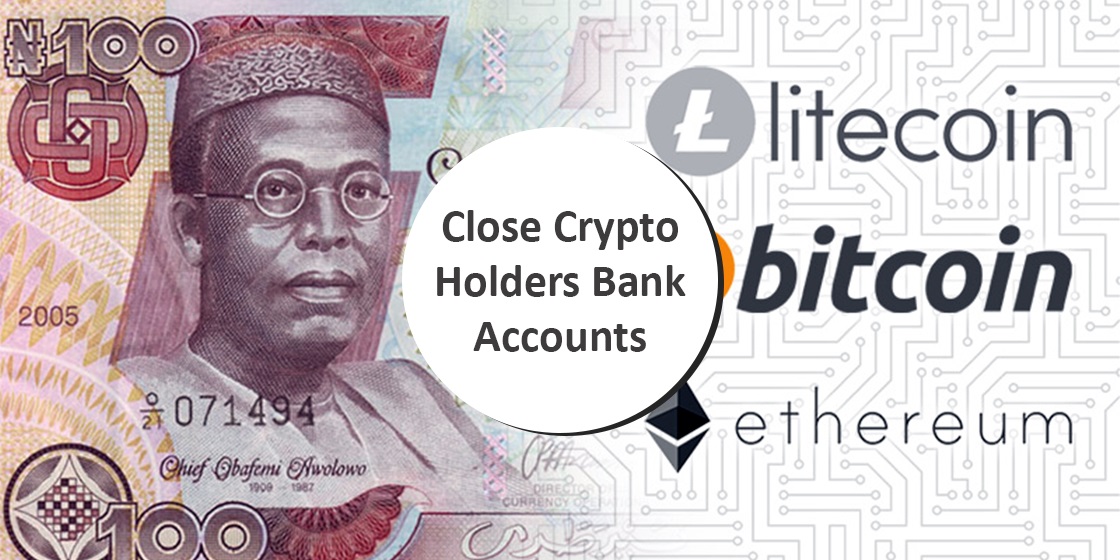
Nigeria has banned crypto from its banking systems

Secondly, while we respect Warren Buffet’s investment principles and decision regarding bitcoin, it may be worth pointing out that bitcoin recently surpassed Buffet’s own Berkshire Hathaway’s net value when bitcoin market value hit $544 billion, $1 billion above Buffet’s multinational company’s capitalization. Earlier last year, the same “rat poison” and “gambling device” surpassed JPMorgan Chase and Mastercard Inc, and it is recently more valuable than Visa Inc. Also, note that:

  1. at least eight publicly-traded companies, including Grayscale Investments, MicroStrategy, CoinShares have bought billions of dollars in bitcoin and select cryptocurrencies;
  2. Paypal announced in late October 2020 that its over 300 million active customers will be able to buy, hold, and sell bitcoin (BTC) and other virtual assets using their Paypal accounts;
  • Mastercard will allow merchants to accept select cryptocurrencies on its network later this year;
  1. Tesla announced in a SEC filing this week that it has bought $1.5 billion worth of bitcoin and would start accepting payments in bitcoin; and
  2. Many more institutional adoption of bitcoin and select cryptocurrencies.

Thirdly, the issue Andrew Bailey, the Governor of the Bank of England, has with cryptocurrencies is whether due to their price volatility they are safe to perform the function of money. Bailey prefers that cryptocurrencies be regulated. In ‘Reinventing the Wheel (with more automation)’, a speech by Bailey in a Brooking Institution virtual event on 3 September 2020, Bailey stated:

Innovation is a good thing. As authorities and regulators it is not in our interest – the broad public interest – to stop innovation. Moreover, when supported by clear standards and expectations, innovation can support the pursuit of public interest objectives such as greater inclusivity and network resilience. Making such standards clear early is much preferred to attempting to claw back the ground later, and particularly if that comes after things go wrong.” [page 2] 

We have reached the point in the cycle of innovation in payments where it is essential that we set the standards and thus the expectations for how innovation will take effect. It should not happen the other way round, with the standard setting playing catch up. The answer is not to strangle innovation, and it does therefore require a strong dialogue between the parties, which I think we have.” [page 10]

The statements above resonate with the position of the Central Bank of England under Mark Carney, former Governor, when he said: “[a] better path would be to regulate elements of the crypto-asset ecosystem to combat illicit activities, promote market integrity, and protect the safety and soundness of the financial system.” [‘Carney calls for crackdown on crypto-currency ‘mania’’, BBC, 2 March 2018]

Fourthly, concerning the CBN’s assertion that the use of cryptocurrencies in Nigeria contravenes existing law in Nigeria, this is with due respect not very correct. While the CBN is of course statutorily empowered to issue the legal tender by virtue of section 2(b) of the CBN Act, by the very meaning of a “legal tender” cryptocurrencies are not legal tender. Consequently, the fact that a cryptocurrency is accepted by voluntary parties as a means of payment in Nigeria does not make it a legal tender. Besides, the fact of the Naira being stipulated by the CBN Act as legal tender does not exclude the adoption of other media or exchange between contracting parties. Parties may decide to exchange goods and services for cryptocurrencies or even for nonmonetary considerations without contravening the provisions of the CBN Act relating to the Naira as legal tender. This is why the proviso in section  20(5) of the CBN Act has given the CBN “the powers to prescribe the circumstances and conditions under which other currencies may be used as medium of exchange in Nigeria” [emphasis ours].

Fifthly, concerning the CBN’s assertion that the anonymous nature of cryptocurrencies is a deliberate design for illegality, this is also incorrect. Essentially, most cryptocurrencies are pseudonymous rather than anonymous. Besides, “anonymity” in cryptocurrencies essentially serves the purpose of privacy and security. Digital signatures serve as identities of the parties involved in cryptocurrency transactions. These digital signatures are essentially composed of the private key and the public key. With these keys, transactions can be signed. Because different identities are created for the same person for different transactions, a lot of people wrongly think that the real identities of users may not be linked to the transactions. Contrary to that wrong belief, real-life identities can be linked to addresses of these cryptocurrencies and transactions. In other words, wallet addresses act as a placeholder for the wallet owner’s identity. Silk Road emphasized this point when Robert Ulbricht was eventually arrested and convicted. In the FBI complaint against Ulbricht, it stated: “bitcoins are not illegal in and of themselves and have known legitimate uses”. This is a strong statement about the legality of bitcoin. Bitcoin’s immutable and transparent ledger provides a record of every transaction, enabling law enforcement to track illegal transactions. Bitcoin and most other cryptocurrencies are not untraceable. At BICCoN, we set up an industry-wide Anti-Scam Task Force in January 2021 to come up with a framework for preventing and checking crypto-related scams in Nigeria. This is an effort that supports ongoing collaboration with the SEC  and industry stakeholders on addressing the risks posed by cryptocurrencies. Upon the CBN’s invitation, we will be happy to share our insight and be of any assistance towards keeping our industry and Nigeria’s financial system safe.

Central Bank Governor, Nigeria

Sixthly, while it may be true that today a number of cryptocurrencies including bitcoins are mainly used as a speculative investment and not as an alternative currency or medium of exchange, adopters are not a “conglomeration of desperate, disparate, and unregulated actors”. In the 2017 bull run, JPMorgan’s chairman and CEO, Jamie Dimon, once dismissed bitcoin as a “fraud”. JPMorgan presently banks two of the largest United States cryptocurrency exchanges, Coinbase and Gemini. By the way, it must be a misunderstanding of fact when the CBN claimed that ether fell from US$320 to US$0.10 in June 2017. The flash crash only happened on GDAX cryptocurrency exchange and lasted a second. According to GDAX, this was due to stop-loss orders and margin-funding liquidations on the exchange. In any case, where cryptocurrencies are considered by the CBN as speculative investments and not alternative currencies, this falls under the regulatory purview of the SEC. Commendably, the SEC has been doing some work in collaboration with relevant stakeholders, leading to the SEC’s statement on the classification and treatment of digital assets in Nigeria 11 September 2020. In that statement, the SEC classified cryptocurrencies as crypto assets to be treated as commodities if traded on a Recognized Investment Exchange and/or issued as an investment. Sadly, the SEC has suspended, as one of the many consequences of the CBN circular, its Regulatory Incubation Framework and Regulatory Incubation Guidelines for fintech firms. Indeed, this is just one of the far-reaching, negative effects of shutting out an entire industry from access to banking and other financial services.

Lastly, the CBN’s position that cryptocurrencies do not have intrinsic value and therefore are unlike fiat currency which are backed by the “comfort of a country or Central Bank ” deserves a note. Fiat currency such as the Naira or Dollar has no intrinsic value either. Fiat currency  is a government-issued currency that is not backed by a physical commodity, such as gold or silver. The value of such fiat currency is derived from the relationship between supply and demand and the stability of the issuing government. Similar to fiat currency, most cryptocurrencies do not have intrinsic value because they are not also backed by gold, silver, or any other commodity. The value of any currency essentially comes from the level of trust that people have in them. Cryptocurrencies, including bitcoin, run on blockchain which is essentially a trustless technology. Bitcoin, for example, may be said to derive its value from its three components: (i) database or ledger comprised of transaction records which are distributed across a peer-to-peer network without a central authority; (ii) peer-to-peer network comprising participants whose job is to validate transactions before those transactions are recorded and added to the chain; and (iii) a cryptocurrency which is a form of electronic cash that is not minted by any central bank but mined using cryptographic or mathematical algorithms. Therefore, bitcoin—to borrow the CBN’s words—is accompanied by the full faith and comfort of a community or network that trusts it.

Availability of industry stakeholders for a dialogue with the CBN in Nigeria’s best interest

While we commend the CBN for its innovations in the areas of payment systems, open banking, and regulatory sandbox for innovative financial products, we appeal to the CBN to adopt a risk-based regulation, not an outright ban on DMBs, NBFIs, and OFIs from providing its services to Africa’s no. 1 crypto industry by volume and a leading market in the world.

At a time when the Federal Government’s national policies include growing Nigeria’s digital economy and improving financial inclusion, the CBN circular has effectively denied banking services—one of the most critical services in any modern economy—to an entire set of persons and/or entities which make up Nigeria’s emerging crypto industry. The rapid growth of Nigeria’s blockchain & crypto industry is a development that should be studied and understood in line with the desire of the Federal Government to develop a digital economy and diversify the Nigerian economy.

As the blockchain & crypto industry’s intercommunity working group, we are available for a dialogue with the CBN. We will be happy to share insights that will hopefully assist the CBN in reviewing its policy on cryptocurrencies in Nigeria, helping our dear nation maximize the opportunities while minimizing threats. We are ready to work with the CBN to ensure that its management of the risks of cryptocurrencies do not affect the stability of Nigeria’s financial system.

Also, with the National Assembly’s intervention in this vital matter, we at BICCoN will be happy to appear before the Committees on Banking, Insurance and other Financial Institutions, ICT and Cybercrimes, and Capital Market set up to determine the opportunities and threats of cryptocurrency on the nation’s economy and security.

Beyond crypto, this is about the future of this country. Nigeria must not make a potential breadwinner a black sheep in the fintech family.

Senator Ihenyen

General Secretary

BICCoN
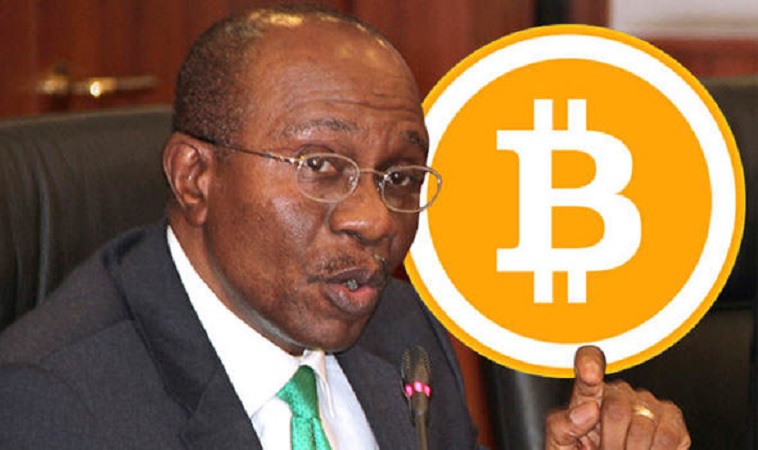
Bitcoin Nears $50,000 As Its Mainstream Acceptance Grows

1
Nigeria has banned crypto from its banking systems

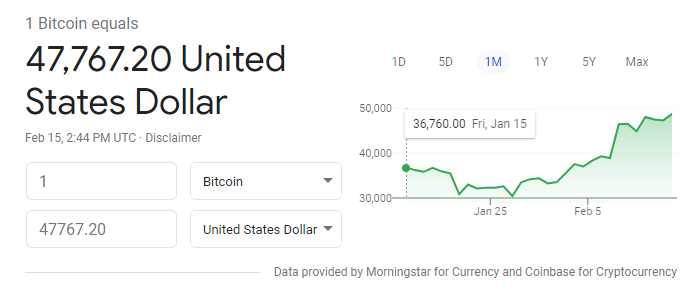
Bitcoin is nearing a $50 000 record, maintaining its rally from late last year, following growing acceptance by Wall Street and Main Street moguls.

On Sunday morning, the cryptocurrency rose up more than 3% to $48,700, after trading as high as $49,714 earlier in the day.

Bitcoin is up 70% year to date following increasing mainstream acceptance. Big corporations and traditional financial firms that previously shunned the cryptocurrency are now embracing it.

More companies have shown interest in bitcoin after Elon Musk’s Tesla revealed last week it has invested $1.5 billion and would accept the coin as a form of payment.

BNY Mellon said last week it has formed a new unit to help clients hold, transfer and issue digital assets. Canada’s Ontario Securities Commission, on Friday, approved the launch of Purpose Bitcoin ETF, according to Toronto-based asset management company Purpose Investment Inc. The approval makes it the first North American Bitcoin ETF.

“Bitcoin has been one of the best performing asset classes on a 1-year, 3-year, 5-year and 10-year basis, both absolute and risk-adjusted. Given Bitcoin’s historical track record and future potential, along with its portfolio diversification properties, we are looking forward to offering investors exposure to the asset class in an easy-to-use, low-cost ETF,” Accelerated Financial Technologies CEO Julian Klymochko said.

The firm said the fund will offer units denominated in both United States and Canadian dollars with a 0.7% management fee, and it had applied to list ABTC units on the Toronto Stock Exchange.

In the US, it’s a race to get involved by both companies and authorities. Miami Mayor Francis Suarez said on Friday the city is looking to adopt bitcoin in transactions in hope that it will attract tech companies. BlackRock Inc., world’s largest asset manager had in January added bitcoin as an eligible investment to two funds.

MasterCard said it will allow customer-to-merchant payments in cryptocurrency this year, without the need to settle in fiat.

“Our change to supporting digital assets directly will allow many more merchants to accept crypto – an ability that’s currently limited by proprietary methods unique to each digital asset. This change will also cut out inefficiencies, letting both consumers and merchants avoid having to convert back and forth between crypto and traditional to make purchases,” the payment platform said in a statement.

Bitcoin is soaring

Although MasterCard already works in partnership with crypto payment firms such as BitPay and Wirex on cryptocurrency debit cards, the move underscores a shift to enable cryptocurrencies, particularly bitcoin, to be used directly for transactions through its network.

CEO of Uber, Dara Khosrowshahi told CNBC on Thursday the ridesharing giant is considering accepting cryptocurrencies including bitcoin as form of payment.

Twitter CEO Jack Dorsey has announced he is teaming up with rapper Jayz to create “Trust”, a blind bitcoin development trust. Dorsey had earlier invested in bitcoin using his payment company Square. The Trust is worth 500 BTC ($23.7m) and will focus on India and Africa for a start.

Dorsey said they are looking for three people to make up the board members. The application form for board members said the goal is to “make bitcoin the internet’s currency.”

However, the Trust is facing a big speed bump as India is reportedly working to completely ban cryptocurrency. Sources told Bloomberg that the Asian giant is giving users a 3-6 month grace period to liquidate their holdings. In Nigeria, the central bank last week directed all regulated financial institutions to close accounts used for crypto transactions.

India and Nigeria are huge crypto markets. Nigeria was the second largest crypto market last year, after the US, and India has a growing large population of crypto enthusiasts. The move by their respective authorities to stop the asset investment will undermine plans such as Dorsey’s.

Notwithstanding, these interests indicate the growing mainstream acceptance of bitcoin, suggesting that Nigeria will lose a large share of the more than $1 trillion market if it doesn’t change its stance on cryptocurrency now.

Welcome To Tekedia Mini-MBA, Performex Consulting Cameroon

0

Let me welcome PERFORMEX CONSULTING LIMITED (Douala Cameroon) to Tekedia Institute Mini-MBA. Performex Consulting is a Maintenance Engineering firm that has made the optimization of asset management processes its core business. From the land of the Indomitable Lions of Cameroon, we welcome this amazing African business. We thank you for choosing the best school. We will co-learn and advance for the beautiful continent.