Tekedia Institute is excited to invite you to join our Lead Faculty, Prof Ndubuisi Ekekwe, at a Fidelity Bank conversation series, as he speaks on investments and banking policies, in Nigeria.
Also speaking are the Governor of Central Bank of Nigeria (Godwin Emefiele), the Vice President of Federal Republic of Nigeria (Prof Yemi Osinbajo), Chairman of Afreximbank (Prof Okey Oramah), Prof Olawale Sulaiman, and Hon Abike Dabiri-Erewa.
We saw the challenge and realized that a playbook to make it easier for people to attend Tekedia Mini-MBA is very important. Despite awarding hundreds of scholarships, we have thousands on the waiting list. So, a market oriented-approach is necessary. Today, I am happy to announce that Tekedia Institute has signed a partnership with innovative fintech startup, FinQuest Finance, which will make it possible for people to attend Tekedia Mini-MBA, at zero-interest rate loan, with a payment plan of three months.
Yes, this loan comes at no extra charge, and it is repayable over 3 months and can be accessed by all; Entrepreneurs, Intrapreneurs, Students, Working Professionals, etc.
More companies will attend Tekedia Institute this year than any university or training institution in Africa. And more learners will finish from our school than any entity in the continent. We have built a reputation of excellence and are very confident that this partnership will open doors for more members to experience “the best school”.
The next edition of Tekedia Mini-MBA opens in days; we invite you to apply at FinQuest if you would need a loan to attend –www.finquestfinance.com/apply . The fees remain the same; you can check hereschool.tekedia.com
FinQuest is run by an extremely brilliant team: first class graduate of OAU, Azeezat Adetunji ACA, ACCA Affiliate, and Ridwan Taiwo.
“When Jesus came to the region of Caesarea Philippi he put this question to his disciples, ‘Who do people say the Son of man is?’ And they said, ‘Some said John the Baptist, some Elijah, and others Jeremiah or one of the prophets.’ ‘But you,’ he said, ‘who do you say I am?’” (Matt. 16: 13 – 15)
The above excerpt, as you can accurately guess, is from the Bible (The New Jerusalem Bible, to be precise). Many people have interpreted it as a test of the disciple’s spirituality, especially regarding their faith. For instance, if you continue reading down the verse, in the Bible that is, you will see where Peter professed his understanding of who Jesus is and the reward he got for that. But this essay is not looking at the spiritual aspect of that excerpt; its focus is on how that passage teaches us the best evaluation method.
Unknown to many, this passage in question encompasses all aspects of human endeavour. It may be in the Bible but it is not talking to Christians alone. This is simply because every human being needs to submit himself for evaluation, criticism, reprimand, and improvement. Hence, the passage speaks to each and every one of us, irrespective of our religion, faith, or ideology, because it can also be applied in the secular world.
As you must have noticed, Jesus submitted himself for evaluation in that passage. He assessed his works, leadership skills, teaching method, and relationship with others. By critically analysing each of these mentioned aspects, you will see how Jesus revealed the best way to assess oneself.
Evaluation of Works: Jesus came into this world for a purpose. As a result, he needs to ensure that his works are meeting that purpose. So, after working for some time, he carried out a survey to ascertain how his work was going. He collected feedback through his disciples by asking them to describe how people see his works and the assumptions they made about him. That way, he could tell if he was getting closer to his goals or not.
What Jesus did here could be likened to what business owners do when they ask for market surveys. The same way they send their employees to collect customers’ feedback is exactly what Jesus did. Of course, we were not told that he sent his disciples out for surveys but he knew they mingle with people and that they could easily gather data. Hence, he taught, through this passage, that the best way to obtain honest feedback from customers is through employees, who receive direct criticisms and recommendations from customers.
Team at work
Evaluation of Leadership Skills: Jesus is often referred to as “rabbi”, which means “teacher” and “master/leader”. So, when he asked his disciples to submit their feedback, his leadership qualities were also tested. In the first place, only a good leader checks the effects of his leadership style on his followers. Secondly, assessing one’s leadership skills provides room for improvement. Hence, when Jesus asked for candid information from his followers, he was checking whether he was a bad leader or not as well as where he should work on.
Evaluation of Teaching Method: Remember Jesus was also a teacher. His disciples were his students. He taught them for some time and then assessed them to find out if he is doing well as a teacher or not. If you notice, the last question in the excerpt, “But you, who do you say I am?”, tested both their knowledge and his teaching method. If they’d had no correct answer to that question, it means he was teaching well. It takes a good teacher to pass on knowledge to his students.
Judging from what that passage revealed, the best way teachers can assess their teaching methods is by asking their students to furnish them with objective evaluations. In fact, if you want to find out whether you are a good teacher or not, ask your students to write anonymous essays about you. Tell them to say what you do well and the ones you don’t. Encourage them to give the works to other people to copy out so you don’t guess who wrote what through their handwriting. And then, provide a suggestion box, where they can drop the essays in your absence. This will give you a clear picture of who you are as a teacher and what you need to work on.
Evaluating Relationship with Others: In this passage, Jesus tested his relationship with his disciples and the people that had come across him. He must have desired to be a good friend, neighbour, and mentor. So when he asked for insider information, regarding how people see him, he needed to know if he was building up a good relationship with his disciples, who were his friends, and others out there.
As mentioned earlier, this passage touches on a crucial aspect of human life. Though it could be interpreted differently, based on the context of use, its focal point still remains seeking evaluation intentionally. It teaches that, even if you engage in personal appraisal, you need to seek for those done by others. That way, you can decide how well you are doing and how well you need to do.
If you are in the business of importing crude refined products, there is a disintermediation on the way. Yes, Dangote Refinery is pushing that “license to import any product shortfalls should be assigned only to companies with active refining licenses. Import volume to be allocated between participants based on their respective production in the preceding quarter. ’’
Punch hadreported that Dangote Group has desired for inclusion in the Petroleum Industry Bill a requirement that the license to import petroleum products should be given only to companies with active refining licenses. The company does think that by having that requirement, companies will invest in local refining business.
But that is a very tough one since some people can actually get licenses just for the rights to import fuel. I mean, if Dangote Refinery thinks that will stop traders, they would be shocked. As things stand, the House of Representatives is investigating the alleged missing of “5.2 million barrels of crude oil allocated to local refineries under the Direct Sales Direct Purchase (DSDP) – DSDP allows sales of crude oil to refiners, who will in turn supply the Nigerian National Petroleum Corporation (NNPC) with an equivalent worth of petroleum products’, Premium Timesreports.
So, the problem is not just refiners importing, the problem is that some could become exporters. Yes, they get the local crude oil and they simply export it! The Petroleum Industry Bill must fix these loopholes with criminal penalties.
Yet, from Dangote Refinery to local refiners, this petroleum business should not be seen as a long-term playbook. The Vice President was forced to make acase that the European Union should continue to fund gas projects in Nigeria as the region plans to freeze such projects globally. Simply, you can wake up in the morning and observe that investors have pulled funds as the tobacco-lization of fossil fuels continues.
The forthcoming deployment of the five million solar power connections, targeting 25 million households across the country under the Economic Sustainability Plan (ESP), reaffirms Nigeria’s commitment to the global green energy initiative.
“A just transition to net-zero emissions, probably one where gas as a fossil fuel is still supported, especially for those of us in this part of the world, is absolutely important, especially as it will enable us to phase-out more polluting fuels such as coal and diesel,” according to Vice President Yemi Osinbajo.
Mr Osinbajo made the submissions Tuesday during a meeting with a delegation of the European Union (EU) led by its Executive Vice President, Valdis Dombrovskis, maintaining the advocacy that the international community should preserve financing for gas projects in Nigeria and other developing countries, during the transition to net-zero emission.
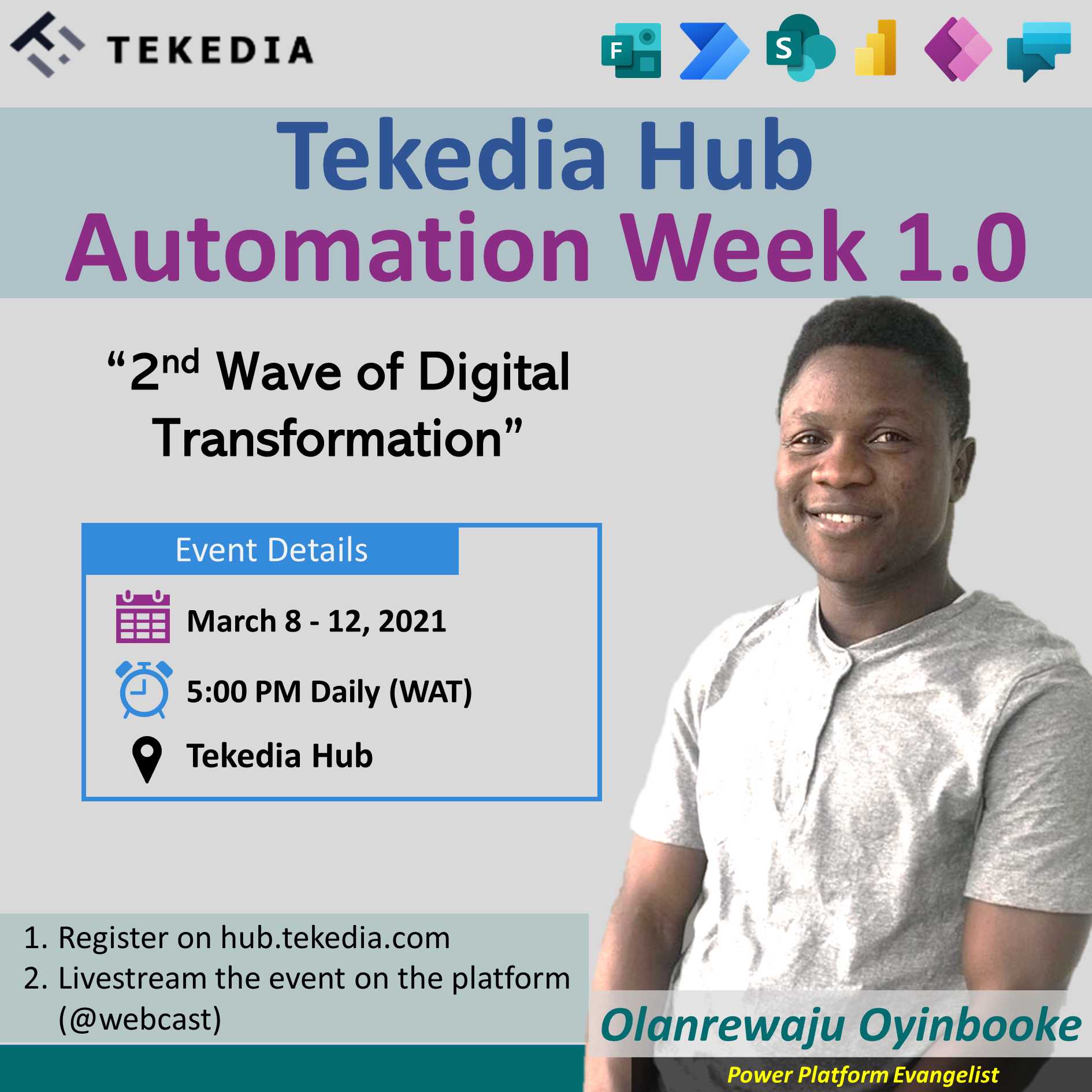
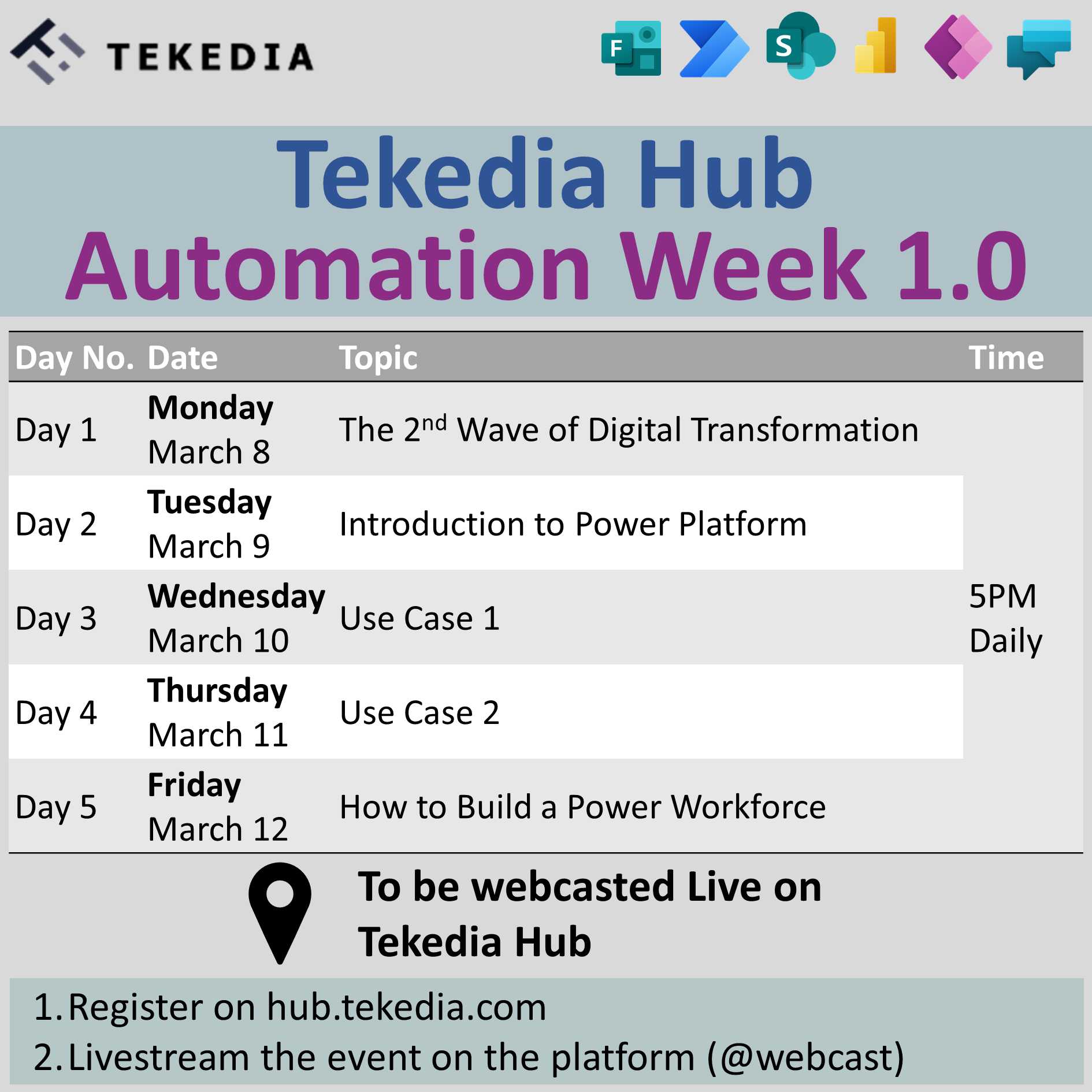
As we experience the second wave of digital transformation, a reset is currently taking place as old technologies are giving way for new ones. Individuals and organizations need to find a way to leverage on this new wave to further optimize their business model and drive productivity. At Tekedia Automation Week, we will explore the direction of this new wave and how you can ride on it as an individual or organization.
Good People, I am inviting all to Tekedia Hub Automation Week with Olanrewaju Oyinbooke, MCT, mMBA. Join free for the week-long program at hub.tekedia.com. It is scheduled for 20 minutes daily.