DD
MM
YYYY

PAGES

DD
MM
YYYY

spot_img

PAGES

Home Blog Page 5887

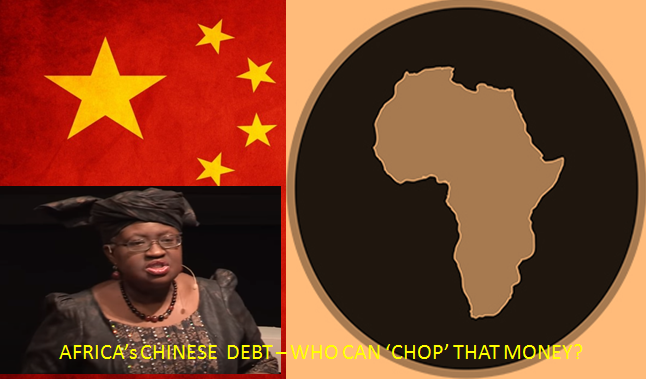
Africa’s Chinese Debt – Who Can “Chop” That Money?

1

By now the world fully realizes that the ex Nigerian Finance Minister Ngozi Okonjo-Iweala has been confirmed to the top job in the World Trade Organisation (WTO).Though congratulations continue to pour in, perhaps now we need to move beyond that to deliberate on what this new era for this critical global agency is going to bring to Africa and indeed the World.

Media coverage would have us believe the world has turned a corner catalyzed purely by a change of leadership in one country – The United States of America.. or has it?

For sure, US has a huge influence on the socio-economic health of nations globally. At the recent African Union Summit 2021, hosted from Addis Ababa, President Biden said:

“The United States stands ready now to be your partner in solidarity, support and mutual respect,”

The problem with being a US President with a global focus is that ultimately, no President wants to be perceived as not doing their best by the American People. Biden needs leaders in global structures who can push back with integrity as much as they can concur and co-operate. In this way, an American leader with aims as a Global Statesperson can discretely arrive at planned global outcomes, with ‘hard won’ results that are domestically palatable, and without appearing to have given concessions or making compromises that were not hard pressed for. Ngozi Okonjo-Iweala appears to be a mould breaker for the person this agenda needs.

White house tweet, February 5.

Prime KBS Institute Limited said on LinkedIn:  ‘She will lead the charge for a revival of multilateralism, in the negotiating chambers of the WTO and for a better deal for developing economies’

Ngozi Okonjo-Iweala is former chair of the Global Commission on the Economy and Climate, is a board member of Standard Chartered Bank, has served the World Bank for twenty-five years, and has been Finance Minister of Nigeria (2003–2006, 2011–2015). There are many other stellar career accomplishments.

Clearly Biden sees her as someone that will hoist the ‘African’ flag, were it that there is such a thing.

The big question is, what shape will that take in a China context?

‘…WTO has also failed to police China for its intellectual property offenses that involve companies sharing sensitive technology as a prerequisite for investing. The global trade body’s outdated classification method means that China, the world’s second-largest economy, continues to enjoy concessions by classifying itself as a “developing country.” –  DW Business.

But the real question is, how will the new WHO regime reign in China’s Economic Colonialism (psedo slavery) of Africa?

Nairametrics –  ‘Chinese policy of using Chinese banks to issue grants to developing economies, is deliberately designed to capitalise on their global financial infrastructure to rival the IMF and the World Bank.’

While Chinese money appears on the surface of it to offer preferential T&C to ‘western’ institutions, Chinese development programs associated with the loans involve a mass influx of project labour, imported materials, and management services, so the loan is repatriated while it remains outstanding. In essence, the African country repays twice.

In Nigeria, specifically, Political Capital does not always translate to wellbeing of the citizenry on the long term, as high profile infrastructural achievements from such loans gain media promotion for the incumbent while subsequent regimes and the population at large, have to later, pay the piper with much pain.

At the Ehingbeti Summit in Lagos yesterday, Dr. Okonjo-Iweala said  ‘ A successful Africa, and a successful Lagos State is one that creates jobs for its citizens… about how we create modern, decent jobs for our young people… while Dr. Adesina said.. fiscal incentives (need) to be provided to the private sector’

However, we have been here before with statements in bright lights, and a populist objective.. what is always absent is the clear nitty-gritty details of the journey in between, one of financing, policing and value maximization of project resources, unwavering commitment to enforcement of progress milestones, and, above all else, sensitivity to, and welfare of impacted local communities.

Reverting to the loan issue –

In October 2005, with Okonjo-Iweala as finance minister, Nigeria and the Paris Club announced a final agreement for debt relief worth $18 billion and an overall reduction of Nigeria’s external debt stock by $30 billion.

However… Chinese debt is a world away from the ‘Paris Club’

‘Chinese lenders tend to set more onerous borrowing conditions – higher interest rates, shorter maturities – than multilateral development banks. In April 2020, Tanzanian President John Magufuli reportedly threatened to cancel a $10 billion project launched by his predecessor, because the Chinese funding came with conditions that “only a drunkard” would accept.

Moreover, most of China’s bilateral lending is carried out by so-called policy banks and state-owned commercial banks, which may be controlled by the Chinese state, but operate as legally independent entities, not as sovereign lenders. So, unlike the members of the Paris Club of major sovereign creditors, they often require collateral for development loans. About 60% of their total lending to developing countries is subject to collateral. When a country applies for debt relief, its Chinese creditors can claim the rights to assets held in escrow.’ – Paola Subacchi, Professor of International Economics at the University of London’s Queen Mary Global Policy Institute, and author of The Cost of Free Money (Yale University Press, 2020).

Don’t trivialise corruption, tackle it: Ngozi Okonjo-Iweala at TEDxEuston -2014 –

As an intro – the  ex- Nigerian Finance Minister dancing to a sax solo interpretation of a song called ‘Chop My Money’ – A simple case of ‘You couldn’t make this up?’ or a prophecy of what is really to come!
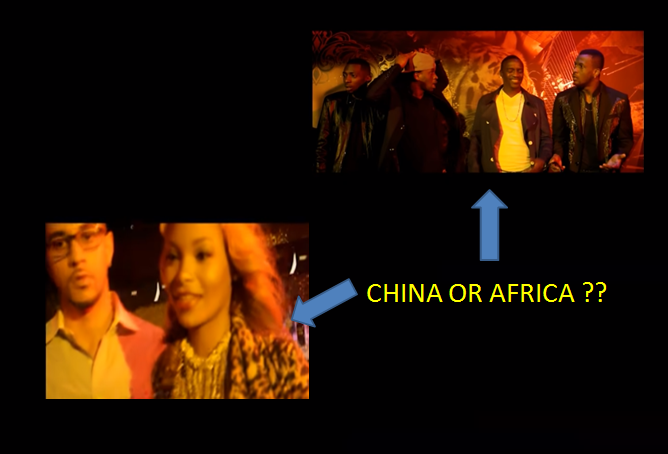
Screenshots from P-Square – Chop My Money Remix (Official Video) ft. Akon & May-D – but which character(s) in the video could be personified as Africa or China?

‘If you spend so much time trivializing an issue, when the evidence is there in front of you, that is not giving a good service’ – Dr. Ngozi Okonjo-Iweala 2014.


To be successful at the mammoth tasks she has set herself…, Dr. Ngozi Okonjo-Iweala may have to trade her trademark ichafu for aju… Fashion needs to make way for combat fatigues…because heavy is the head that wears the crown, and this is a head that will come under some considerable weight in the days and months to come.

When Ban Ki Moon from South Korea, China’s southern neighbour, took over from Kofi Annan at the UN, he famously sang live on camera. It was his own rendition of Santa Claus Is Coming To Town, inserting his own name.

China needs to be aware Dr. Ngozi Okonjo-Iweala is already in town and paying in-person visits soon. She won’t need any chimney. She will come straight in the front door.

Ngozi in her native Igbo means ‘Blessing’. She is indeed a blessing not only to Igbos but Nigeria, all of Africa, and perhaps the world.


Referenced content/acknowledgements  (others as per main article body) :

https://time.com/5938816/ngozi-okonjo-iweala-wto-climate-change/

https://www.dw.com/en/daunting-challenges-await-wto-chief-ngozi-okonjo-iweala/a-56581993

https://www.independent.co.ug/chinas-debt-grip-on-africa/https://www.brookings.edu/blog/africa-in-focus/2020/04/20/china-and-africas-debt-yes-to-relief-no-to-blanket-forgiveness/

https://dailypost.ng/2018/09/12/okonjo-iweala-spent-years-getting-nigeria-debt-back-buharis-ex-minister/
Pay for News Publishers: Canada Moves to Copy Australia As Coalition Against Facebook, Google Looms

0

Following the step of Australia, Canadian government said on Thursday it will enact a law that will force Facebook to pay publishers for their content even if it will end in the social media platform shutting down its services in Canada like it did in Australia.

Australia proposed a legislation that will make Facebook and Google pay for news contents that provide links to their platforms. The new legislation means Facebook and Google will have to bargain with newsrooms either individually or collectively – and will have to enter arbitration if the parties can’t reach an agreement within three months.

In response to Australia’s proposed new Media Bargaining law, Facebook said it will restrict publishers and people in Australia from sharing or viewing Australian and international news content on its platform.

Canadian Heritage Minister Steven Guilbeault, who is leading the charge to craft the bill, said Facebook made the wrong choice cutting off news services in Australia, and that wouldn’t deter Ottawa from pursuing Australia’s line of action.

“Canada is at the forefront of this battle … we are really among the first group of countries around the world that are doing this,” he said.

Recently, governments and media organizations are confronting Facebook and Google for using their monopolies to rake in billions of dollars in ad revenue while paying little to publishers who provide the contents their use to serve the ads.

The confrontation has been fueled by the COVID-19 pandemic which saw Google halve AdSense earnings, further depleting the already poor revenue of news publishers.

In 2019, the European Union enacted Copyright Laws that require search engines and social media platforms to share revenue with publishers if their contents are displayed. The increasing push by these countries to protect media outlets from Google and Facebook’s rip-offs is believed to be the reason Google came up with the News Showcase idea, a $1 billion program designed to compensate publishers for their contents.

France was the first country in Europe to implement the EU Copyright Laws by getting Google to reach a compensation agreement with French publishers.

Guilbeault said Canada may adopt either the French or Australian option.

“We are working to see which model would be the most appropriate,” he said, adding that he spoke to his French, German, Australian and Finish counterparts last week about working together on ensuring fair compensation for web content.

Facebook was defiant with Australia; the social media giant said news makes up less than 4% of the content people see in their News Feed in Australia, and generated only about AU $407 million last year, which makes business gain from news in the country minimal.

But with the momentum garnering to involve more countries, the social media app may be facing a war it did not see coming.

“I suspect that soon we will have five, 10, 15 countries adopting similar rules … is Facebook going to cut ties with Germany, with France?” Guilbeault asked, adding that at some point, Facebook’s approach would become “totally unacceptable.”

Reuters reported a University of Toronto professor, Megan Boler, who specializes in social media, saying that Facebook’s action [in Australia] marked a turning point which would require a common international approach.

“We could actually see a coalition, a united front against this monopoly, which could be very powerful,” she said.

While Facebook appears lax in addressing the pay-for-news controversy, Google is putting foot forward. The web search giant has signed agreements with about 500 media outlets across more than 12 countries, including Australia, and it said to be in talks with Canadian news organizations.

Despite these efforts, Guilbeault said Google will also be governed by the Canadian new law, as Ottawa seeks a fair, transparent and predictable approach.

However, Michael Geist, Canada Research Chair in Internet and e-commerce Law at the University of Ottawa, said following the Australian model may mean loss to both Facebook and Canada, and the North American country should aspire to Google’s approach.

“If we follow the Australian model … we’ll find ourself in much the same spot,” he said. “Everybody loses. The media organizations lose … Facebook loses.”

Canada is expected to enact the News Law in coming months and EU member states are expected to implement the EU Copyright Law before its June 7 deadline, which will see more countries towing the path of Australia or France.

With this mounting pressure, Facebook, who is already at crossroads with regulators around the world, and Apple for restricting its access to iPhone users private data, will have a “coalition of countries against Facebook” challenge to deal with.

Understanding the Difference Between Schooling and Education

1

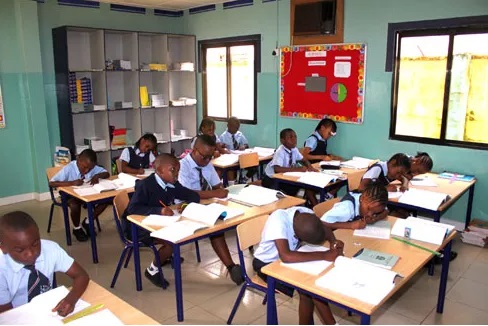
I saw a post of a young Nigerian lady, carrying a placard to advertise her “vacancy”. It’s brave for someone to boldly declare that she is unemployed and needs a job. It is braver when this is done in the public. But the bravest thing here is that she gave herself the opportunity to trend on the internet. This is a good marketing strategy that should be adopted by everyone. However, her action showed the deep gap between being educated and being schooled.

The young lady in question has a BSc in Mass Communication and an MSc in Marketing Communication. These two qualifications, in today’s world, can take her anywhere if she knows her onions. As much as I don’t know this lady, I can tell you, from what happened today, that she went back to school for masters because she believed it would give her an added advantage in job hunting. This is the misinformation most Nigerians have that hits them immediately they leave school with a certificate they know not what to do with.

But back to the main theme of the day, what is the difference between education and schooling? Understanding this will help every Nigerian discover himself and how he can make a living without depending totally on the government.

Schooling, according to Oxford Advanced Learner’s Dictionary, is “education received at school” while education, from the same source, is “a process of teaching, training and learning, especially in schools or colleges, to improve knowledge and develop skills.” Hence, schooling only takes place in school while education can occur anywhere. Further, for education to take place, there must be a process, which must be completed for knowledge and skills development to take place. If this process is in any way broken, or if one its stages is omitted, knowledge and skills development become incomplete and incompetency results. In the case of the lady described above, it is possible some stages in the process of her education were omitted while she was in school. As a result, what she did was going to school and not getting educated. To deepen people’s capabilities, experts at customwriting.com do help many develop skills on writing, and that is also part of being schooled even as one is educated

A person that is educated would have been taught what to do with the knowledge passed to him and the skills he acquired. In the instance given above, there are many private freelance jobs and businesses someone with such marvellous qualifications could set up without requiring much capital. One good thing the government has done for Nigerian graduates before throwing them into the harsh reality of the labour market is sending them on one year compulsory youth service. Most corps members have accommodations provided for them by their recruiters. Some live with their relatives. Many have even redeployed to stay with their parents’ or husbands’, and hence, do not need to spend their “allowee” on accommodation or feeding. This would have provided them, if they know what they are doing, with the opportunity to save up money as seed capital to start up business of their own when they pass out. Many do this; but most don’t. This comes to prove that many Nigerians go to school without becoming educated.

I used to blame Nigerian education system that does not prepare graduates for the harsh reality of life after school. I used to hold the system responsible for the confusion Nigerians face when searching for jobs. But then, as much as I still blame the system, I also blame the students for failing to educate themselves despite having access to the best source of informal education: internet and social media.

It is good that many young Nigerians are learning what their schools didn’t teach them through the internet and social media. But the majority don’t. Some Nigerian youths think the internet and social media are for gossip, “hyping”, and “catching cruise”. They fail to see positive uses of these sources and refuse to be directed by those that know better. However, many are utilising their free time in school to educate themselves informally in addition to the ones their teachers/lecturers do. This way, they do not only go to school but are also educated.

Nigeria Exits Recession as GDP Records 0.11% Growth in Q4 But Inflation is at 16.47%

0

In the Q4 2020 report, The National Bureau of Statistics (NBS), says Nigeria’s GDP grew by 0.11% from the 6.11% contraction in Q3, signaling a gradual exit from recession.

NBS said the report represents the first positive quarterly growth in the last three quarters.

“Though weak, positive growth reflects the gradual return of economic activities following the easing of restricted movements and limited local and international commercial activities in the preceding quarters.

“As a result, while the Q4 2020 growth rate was lower than the growth rate recorded the previous year by –2.44 per cent, it was higher by 3.74% compared to Q3 2020.

“On a quarter-on-quarter basis, real GDP growth was 9.68% indicating a second positive consecutive quarter-on-quarter real growth rate in 2020, after two negative quarters,” the report noted.

The NBS said overall, in 2020, the annual growth of real GDP was estimated at –1.92%, a decline of –4.20% when compared to the 2.27% recorded in 2019.

It said in the quarter under review, aggregate GDP stood at N43.564 billion in nominal terms.

This performance, the bureau said was higher when compared to Q4 2019, which recorded a GDP aggregate of N39.577 billion, representing a year-on-year nominal growth rate of 10.07%.

The report shows varying performance in the oil and non-oil sectors of the economy.

For the oil sector, the average daily oil production of 1.56 million barrels per day (mbpd) was recorded in the fourth quarter.

This was lower than the daily average production of 2.00 mbpd recorded in the same quarter of 2019 by -0.44 mbpd and Q3 2020 by –0.11 mbpd.

The real growth of the oil sector was –19.76% (year-on-year) in Q4 indicating a decrease by –26.12% relative to the rate recorded in the corresponding quarter of 2019.

“Growth decreased by –5.87% when compared to Q3 2020, while quarter-on-quarter, the oil sector recorded a growth rate of –26.27% in Q4.

“For 2020, the oil sector grew at –8.89% compared to 4.59% in 2019,” the report stated.

It added that the oil sector contributed 5.87% to total real GDP in Q4, down from the corresponding period of 2019 and the preceding quarter, where it contributed 7.32% and 8.73% respectively.

For the non-oil sector, there’s growth of 1.69% in real terms in the quarter under review, slower than the 2.26% recorded in the corresponding quarter the previous year, the NBS said.

The Bureau however, said it was better than the –2.51% growth rate recorded in the preceding quarter.

It explained that for the full year of 2020, the non-oil sector grew by –1.25% compared to 2.06% in 2019. And the growth in the sector was driven by information and communication (Telecommunications and Broadcasting).

Other drivers were agriculture (crop production), real estate, manufacturing (food, beverage and tobacco), mining and quarrying (quarrying and other minerals) and construction, accounting for positive GDP.

“In real terms, the non-oil sector contributed 94.13% to the nation’s GDP in Q4 2020, higher than the share recorded in Q4 2019 (92.68%) and Q3 2020 (91.27%).

“For 2020, the non-oil sector contributed 91.84% to real GDP, higher than 91.22% recorded in 2019,” the NBS report said.

The major drivers are: Information and Communication which contributed 14.70%; Agriculture, 3.42%; Health & Social Services, 3.05%; Real Estate, 2.81%; Water Supply, 1.92%; while Public Administration and Construction recorded 1.80% and 1.21% respectively.

Meanwhile, Nigeria’s inflation rate has climbed to a 33-month high, as it rose from 15.75% to 16.47% in January, according to data from NBS. The report noted that food inflation rose from 19.56% in the previous month to 20.57% in January, while core inflation leaped from 11.37% in December to 11.85% in January.

It is the highest rate of inflation recorded by Nigeria since 2008 July, when food inflation hit 12.9%. The NBS attributed the rise to increases in prices of bread and cereals, potatoes, yam and other tubers, meat, fruits, vegetables, fish, oils and fats.

The Bureau said the composite food index rose from 17.38% in September 2020 to 18.30% in October.

Nigeria has been grappling with inflation since late 2019, following the decision of the federal government to close land borders. Although the borders were reopened in December, plummeted oil revenue and shocks from COVID-19-induced lockdown have kept the inflation on the rise.

Innovators & Visionaries, Tekedia Live begins tomorrow.

0

Innovators & Visionaries, Tekedia Live begins tomorrow. That is the core beginning of our academic festival in Tekedia Mini-MBA. If you have not joined, time is running out to join. I will begin the excursion with “Innovation and Growth – The Path to Category-kIng”. Register here today; it’s time.

Tekedia Institute offers an innovation management 12-week program, optimized for business execution and growth, with digital operational overlay. It runs 100% online. The theme is Innovation, Growth & Digital Execution – Techniques for Building Category-King Companies. All contents are self-paced, recorded and archived which means participants do not have to be at any scheduled time to consume contents.

It is a sector- and firm-agnostic management program comprising videos, flash cases, challenge assignments, labs, written materials, webinars, etc by a global faculty coordinated by Prof Ndubuisi Ekekwe.