DD
MM
YYYY

PAGES

DD
MM
YYYY

spot_img

PAGES

Home Blog Page 589

EU Slams Google With $3.5B Fine in Ad-tech Antitrust Case, Trump Vows Retaliation With Tariffs

0
The US is after Google also

The European Union (EU) has slammed tech giant Google with a fine of 2.95 billion euros ($3.5 billion), over anti-competitive practices in its adtech business.

The commission noted that Google favoured its online display technology product, which helped its advertising exchange (AdX) role in the adtech supply industry. This allowed the company to charge high fees for the services at the detriment of its competitors and other online publishers.

The EU further ordered the U.S. tech giant to end its “self-preferencing practices” and stop “conflicts of interest” along the advertising technology supply chain. It mandated that the company submit compliance plans within 60 days and provide an additional 30 days for implementation details.  

“Digital markets exist to serve people and must be grounded in trust and fairness. And when markets fail, public institutions must act to prevent dominant players from abusing their power,” the commission said. 

This is the fourth time the E.U. has sanctioned Google with a multibillion-euro fine in an antitrust case, in a wider battle with regulators that dates back to 2017. These actions stem from investigations into Google’s alleged abuse of its market dominance in violation of EU competition laws.

This fine comes from Alphabet, Google’s parent company, which successfully avoided a breakup in a landmark antitrust case brought by the U.S. Department of Justice (DOJ), marking a significant moment in the ongoing scrutiny of Big Tech’s market dominance. The case, United States et al. v. Google LLC, filed in October 2020, accused Google of illegally monopolizing the search engine and search advertising markets

Google’s search engine handles nearly 90% of web searches globally, processing an estimated 8.5 billion queries daily. This dominance according to the filing, was allegedly used to stifle competition and innovation by limiting rivals’ access to key distribution channels. The DOJ argued that Google’s practices prevented competitors from gaining traction, reduced consumer choice, and harmed innovation in the search market.

Following the ruling, the DOJ proposed aggressive remedies during a remedies trial in April-May 2025, aiming to dismantle Google’s dominance and prevent similar monopolistic behavior in emerging fields like artificial intelligence (AI). The proposed remedies included forcing Google to sell its Chrome browser, which handles nearly 40% of U.S. search volume and provides valuable user data for targeted advertising.

The DOJ’s proposals were described as “radical” and aimed at fundamentally reshaping Google’s business model to foster competition. Google, led by CEO Sundar Pichai, argued that these measures were excessive, potentially harming consumers, innovation, and U.S. technological leadership. Pichai called the data-sharing proposal a “de facto divestiture” of Google’s core intellectual property.

On September 2, 2025, Judge Mehta issued a 223-page ruling that rejected the DOJ’s most severe proposals while imposing significant but less drastic remedies. Google was not required to divest Chrome or Android, a decision seen as a major win for Alphabet. Mehta argued that a breakup would cause “substantial downstream harms” to distribution partners like Apple and consumers.

At a recent White House dinner with tech executives, President Donald Trump congratulated Google CEO Sundar Pichai and co-founder Sergey Brin following Alphabet’s favorable antitrust ruling on Tuesday.

“Well you had a very good day yesterday,” Trump said, calling on Pichai at the Thursday evening dinner.

I’m glad it’s over,” Pichai responded to Trump, causing an eruption of laughter from the other table guests. “It’s a long process,” Pichai said. “Appreciate that your administration had a constructive dialogue, and we were able to get it to some resolution.” 

Alphabet this week added $230 billion to its market cap after avoiding a breakup in a landmark antitrust case brought by the U.S. Department of Justice in 2020.

Trump Threatens to Retaliate EU’s $3.45bn Google antitrust fine with tariffs

The latest $3.45bn fine slammed on Google by the E.U. has spurred U.S President Donald Trump’s response.

In his reaction, President Trump termed the fine as  “unfair” and “discriminatory”. He also vowed to personally take the matter up with the EU. Trump, who has hit Europe with trade tariffs, will likely retaliate with the same measures. 

“We cannot let this happen to brilliant and unprecedented American Ingenuity and, if it does, I will be forced to start a Section 301 proceeding to nullify the unfair penalties being charged to these Taxpaying American Companies,” Trump wrote on his Truth Social post. 

Analysts suggest Trump’s tariff threats were partly motivated by a desire to protect U.S tech giants, which he described as brilliant and unprecedented American ingenuity.

Looking Ahead

Google argues that the decision by the EU was wrong and that its services are not anticompetitive. The search engine giant has vowed to appeal the EU antitrust commission’s verdict. 

BlockDAG’s $0.0013 Entry Stands Out as VeChain (VET) Market Analysis & Pi Coin Price Reveal Diverging Crypto Market Paths

0

In today’s fast-shifting digital economy, the search for the top crypto projects has narrowed to a few names shaping entirely different narratives. VeChain (VET) market analysis shows a blockchain tied to enterprise adoption, with Walmart China and luxury brands testing its supply-chain solutions. Pi Coin price hovers near $0.34, under technical pressure as September unfolds, making this month critical for a breakout above resistance or a risky retreat.

Then comes BlockDAG. Starting at just $0.001 in Stage 1, and currently at $0.0013, its hybrid DAG plus Proof-of-Work model combines what Kaspa, Solana, and Ethereum proved separately. With $400 million raised, 3 million miners, and 312,000 holders, BlockDAG is quietly positioning itself as the standout of the three.

Why VeChain Could 10x by 2030

VeChain (VET) isn’t just another crypto project; it’s built for enterprise. Its blockchain enables businesses to track goods, verify sustainability, and fight counterfeiting with real systems already in place. Think Walmart China scanning produce, luxury brands verifying authenticity, and accountants backing ESG claims with certified data.

Reaching $1 by 2030 would value VeChain at nearly $87?billion. That’s a leap, but not one based on hype. It hinges on real corporate adoption driving massive use of the network. The tech backs it too: VeChain’s efficient, validator-based system supports the transparency and stability businesses actually need.

So if large companies begin operating on VeChain at scale, demand could explode. That makes it one of those rare cryptos where fundamental business use, not speculation, is the growth engine.

Can Pi Coin Bounce Back in September?

Pi Coin is hanging close to $0.34 as September kicks off, under pressure after a recent slide from its $0.38 high. Chart watchers say a sustained move above $0.38–0.40 could spark a strong rally toward $0.42 or more. But failing to hold the $0.32–0.33 range risks another dip. This range makes September a potential make-or-break month for Pi’s price.

Despite murky short-term momentum, the project’s ongoing upgrades and potential exchange listings offer catalysts worth watching. If adoption grows, Pi Coin could quietly climb higher later. That said, thin liquidity and a crowded altcoin market make this a cautious buy rather than a sure thing. For long-term believers, September may represent one of the last low-entry windows before conditions change.

BlockDAG at $0.0013: The Next Big Crypto Fusion

Kaspa showed the world that Directed Acyclic Graphs (DAGs) can work in real-time. Solana proved that high throughput draws developers in large numbers. Ethereum proved that ecosystems win the long game. Now BlockDAG is taking pieces of all three and merging them into something bigger. By combining Kaspa’s DAG foundation with Solana’s performance and Ethereum’s EVM compatibility, BlockDAG is positioning itself as a technology built for scale, adoption, and endurance.

The numbers back it up. Starting at just $0.001 in Stage 1, BlockDAG has already created massive wealth for its earliest buyers. Today, with the Deployment Event price fixed at $0.0013, the upside to $1 reflects an eye-widening 76,815% ROI potential. That is not theory, it is math. Add to this a base of 3 million X1 mobile miners, 312,000 holders, and whales buying in with multi-million allocations, and the story becomes clear.

For investors wondering where the next Ethereum-style growth curve could emerge, BlockDAG makes a compelling case. Quietly, it has raised nearly $400M without leaning on hype cycles, showing demand is already there. The window at $0.0013 will not last. Those who wait for listings will likely see a very different entry point.

BlockDAG Stands Tall Among Top Crypto Projects

The contrast between these three projects is striking. VeChain (VET) market analysis underlines its enterprise value but its growth hinges on sustained corporate adoption, not market-driven speculation. Pi Coin price reflects volatility more than conviction, with thin liquidity making each movement magnified. Both coins have niches, yet BlockDAG offers something broader.

With roots in Stage 1 pricing at $0.001 and a current Deployment Event price of $0.0013, it holds a clear runway to a projected $1, giving it an unmatched 76,815% ROI window. Its blend of Kaspa’s DAG validation, Solana’s throughput, and Ethereum’s ecosystem strength is already backed by real traction: 3 million miners, whales pooling millions, and $400M raised. For investors seeking the best of the top crypto projects, BlockDAG defines the category.


Presale: https://purchase.blockdag.network

Website: https://blockdag.network

Telegram: https://t.me/blockDAGnetworkOfficial

Discord: https://discord.gg/Q7BxghMVyu

The Disconnect Between Incarceration and Public Curiosity in Africa

0

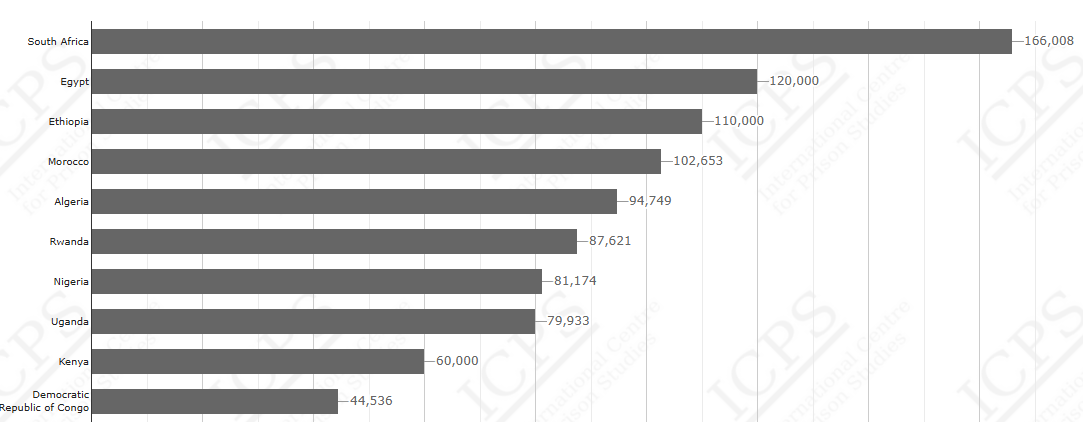
Across Africa, the way people think and talk about crime and justice is changing. Not just in government offices or courtrooms, but online, where search engines have become a window into public concern. Analysis of top 10 African countries with the highest number of people in prison by Infoprations indicates that the number of people in prison doesn’t always match how much people are searching for information about crime or prisons.

Take South Africa, for example. It has the highest prison population on the list, with over 166,000 people behind bars. But Nigeria, with less than half that number, shows the most online interest in both crime and prisons. That tells us something important: people’s curiosity and concern about justice aren’t just shaped by how many people are locked up. They’re shaped by what’s happening in society, what’s being reported in the news, and how free people feel to ask questions.

This gap between prison numbers and public interest challenges the idea that bigger problems always get more attention. In reality, attention is driven by awareness—and awareness is often driven by access, freedom, and a desire for change.

What the Numbers Are Really Saying

When we compare the data, a few patterns stand out. Countries with more people in prison don’t always have more people searching about prisons or crime. In fact, some countries with smaller prison populations, like Nigeria and Morocco, have much higher search interest than expected. That means people in those places are actively thinking about justice, even if the prison system isn’t the largest.

Exhibit 1: African countries with the highest number of people in prison

Source: World Prison Brief, 2025

On the other hand, countries like Rwanda and the Democratic Republic of Congo have relatively high prison populations but very low search interest. That could be due to limited internet access, fewer news stories about justice, or cultural factors that make people less likely to search for these topics.

One thing is clear: when people search for information about crime, they often also search about prisons. These two topics go hand in hand. It shows that people aren’t just curious about what’s happening on the streets, they’re also thinking about what happens afterward, in the justice system.

Why This Matters for Leaders and Citizens

Search behavior might seem like a small thing, but it reflects what people care about, what they worry about, and what they want to understand. In countries where search interest is high, it’s a sign that people are engaged. They’re asking questions, seeking answers, and trying to make sense of the world around them.

That’s an opportunity. Governments, journalists, and civil society groups should pay attention to where curiosity is growing. These are the places where public education can make a difference, where reform efforts might gain support, and where transparency can build trust.

In places where search interest is low, it’s worth asking why. Is it because people don’t care or because they don’t feel safe asking? Is it because they lack access to information, or because the topic feels too distant from their daily lives? These questions matter, especially for those working to make justice systems more fair and responsive.

Turning Curiosity Into Change

The data shows that people are thinking about crime and justice. They’re searching, reading, and trying to understand. That’s not just a trend, it’s a signal. It means the public is ready to be part of the conversation. Leaders should respond by making justice systems more open and easier to understand. That includes sharing data, explaining policies, and listening to public concerns. It also means investing in digital access and civic education, so more people can join the conversation.

Researchers and journalists have a role too. They can turn numbers into stories, highlight what’s working and what’s not, and give voice to those who are often left out. When curiosity meets good information, change becomes possible.

OpenAI Hires Team Behind AI-Powered Xcode Tool Alex in Latest Acqui-Hire Move

0

Acqui-hires are fast becoming a staple of Silicon Valley’s AI arms race. The latest example came Friday, when the small team behind Alex — a Y Combinator–backed tool that integrated AI models into Apple’s Xcode development suite — announced they are joining OpenAI.

In a post on X, Alex founder Daniel Edrisian said the group will move to OpenAI’s Codex division, which is working on the company’s AI coding agent.

“When we started out, Xcode had no AI. Building a ‘Cursor for Xcode’ sounded crazy, but we managed to do it anyway,” Edrisian wrote. “And, over time, we built the best coding agent for iOS & MacOS apps.”

From Independent Tool to OpenAI Fold

Founded in 2024, Alex aimed to fill a gap by letting developers use AI models directly within Xcode. Its pitch — essentially a coding copilot for Apple developers — attracted early adopters and a spot in Y Combinator’s accelerator program.

However, momentum shifted when Apple itself introduced AI integrations for Xcode earlier this year, including support for ChatGPT and other third-party models. While Edrisian didn’t cite that as a reason for joining OpenAI, Apple’s move clearly narrowed Alex’s differentiation.

According to a blog post from the startup, Alex will continue supporting existing users but will no longer be available for download after October 1. No new features will be added, though the team pledged to keep maintaining the product for as long as users remain active.

A Three-Person Team, Now Part of Codex

Alex’s Y Combinator listing shows the startup employed three people, though it remains unclear if all of them are moving to OpenAI. What is clear is that OpenAI is scooping up specialized talent rather than the company itself — a classic acqui-hire move.

OpenAI did not immediately comment on the news.

Acqui-Hires as Strategy

The deal follows a familiar pattern: rather than acquire whole startups, OpenAI has increasingly focused on bringing in small, specialized teams to accelerate development. Just this week, it announced the $1.1 billion acquisition of Statsig, a product testing startup, in what it called an effort to strengthen its infrastructure for rapid experimentation.

The Alex acqui-hire highlights a complementary play: absorbing niche technical expertise in coding tools. With Codex at the center of OpenAI’s push into developer assistants, integrating a team that has already built an Xcode-native agent could give it an edge with Apple’s massive developer ecosystem.

Echoes of Past Silicon Valley Playbooks

Silicon Valley giants have a pattern of using acqui-hires to secure scarce technical talent and cement their position. Companies like Facebook (now Meta) routinely bought small startups whose products were often shelved, while their engineering teams were absorbed into core projects.

The trend has resurfaced amid the AI arms race. Meta and Google in particular made a string of team-driven acquisitions, some involving startups like Scale AI’s alumni-led ventures, as a way to bring in machine learning talent quickly before rivals could. OpenAI’s moves mirror this strategy, balancing billion-dollar infrastructure acquisitions like Statsig with leaner acqui-hires such as Alex.

For Alex’s founders, the shift underscores how quickly the ground can move in AI. In less than a year, a scrappy tool seen as “crazy” became mainstream enough for Apple itself to build in-house, and valuable enough for OpenAI to bring its team on board.

For OpenAI, it shows a dual-track strategy that echoes past consolidation waves in tech: deep-pocketed buys for scale, and acqui-hires for speed and expertise. If history is any guide, these kinds of moves tend to reshape not just product roadmaps, but the competitive balance of the industry itself.

Gold Reaching $3560 Reflects Its Appeal As A Safe-Haven

0

Gold reaching $3,560 reflects its appeal as a safe-haven asset amid economic uncertainty, likely driven by factors like geopolitical tensions or inflation fears, as seen in recent market trends.

The retreat in global government bond yields from recent highs, such as the U.S. 10-year Treasury yield easing to 4.22% on September 3, 2025, suggests a pause in the bond market sell-off, possibly due to expectations of central bank rate cuts or stabilizing economic data.

Central bank policies, such as interest rate decisions, quantitative easing, or tightening, have profound implications for economies, markets, and individuals. Given your mention of gold prices at $3,560 and retreating global bond yields.

Implications of Central Bank Policies

When central banks like the Federal Reserve or ECB raise rates to combat inflation, borrowing costs increase, slowing economic activity. This typically strengthens currencies (e.g., USD) but pressures equities and non-yielding assets like gold, as seen in gold’s recent pullback from $3,560. Higher rates also push bond yields up, as observed earlier this week before the retreat.

Rate cuts, often used to stimulate growth during slowdowns, reduce bond yields, making non-yielding assets like gold more attractive. The recent easing of global bond yields (e.g., U.S. 10-year at 4.22% on September 3) suggests markets anticipate looser policy, potentially from expected Fed rate cuts in 2025, boosting gold’s appeal.

Tight policy curbs inflation but risks recession, while loose policy fuels growth but may reignite inflation. For example, markets expect a 25-50 basis point Fed cut by late 2025, per recent analyses, influencing asset prices. Central banks purchasing bonds injects liquidity, lowering yields and supporting equities and commodities like gold. This was evident during post-2020 recovery phases, driving gold to highs.

Selling bonds or reducing balance sheets, as the Fed has done since 2022, tightens liquidity, raising yields and pressuring risk assets. The recent bond yield retreat may reflect pauses in aggressive tightening. QE supports asset bubbles, while QT can trigger market corrections, affecting investor confidence and portfolio allocations.

Tightening strengthens currencies (e.g., USD under Fed hikes), making gold, priced in dollars, cheaper for non-USD holders, potentially increasing demand. Conversely, rate cuts weaken currencies, raising gold prices, as seen in its $3,560 peak.

Currency fluctuations influence trade balances and global investment flows, with emerging markets sensitive to USD strength. Tight policies aim to curb inflation, which remains a concern with U.S. CPI at 2.9% in July 2025. This reduces purchasing power but supports gold as an inflation hedge.

Loose policies risk overheating economies, spurring inflation, which further drives gold demand. Persistent inflation erodes real wages, while deflationary pressures from overtightening could trigger economic stagnation.

Impacts on Key Stakeholders

High rates increase borrowing costs for firms, compressing valuations, especially for tech stocks. Rate cuts could spark rallies, as seen in 2023 post-Fed pauses. Rising rates lower bond prices, while falling yields (as recently observed) boost bond values, benefiting fixed-income investors.

Gold thrives in low-yield, high-uncertainty environments. Its $3,560 peak reflects bets on rate cuts or geopolitical risks, per recent X posts. Tight policy often hurts speculative assets like Bitcoin, while easing supports them, though volatility persists.

Higher rates raise borrowing costs, squeezing margins for debt-heavy firms, especially in real estate or tech. Rate cuts would ease financing, spurring investment. Tightening reduces consumer spending, hitting retail and discretionary sectors, while loose policy boosts demand.

High rates increase mortgage and loan costs, reducing disposable income. U.S. 30-year mortgage rates near 7% in 2025 strain housing affordability. Rate cuts lower borrowing costs but may fuel inflation, eroding savings unless wages keep pace (U.S. wage growth ~3.5% in 2025).

Rising yields increase debt servicing costs for governments. The U.S. debt-to-GDP ratio, over 120% in 2025, faces pressure from high yields. Loose policy allows cheaper borrowing but risks currency depreciation and imported inflation for smaller economies.

Divergent policies (e.g., Fed tightening vs. ECB/BoJ easing) create currency volatility, impacting trade. Emerging markets face capital outflows during USD strength. Synchronized rate cuts, as hinted by recent yield retreats, could stabilize global growth but risk coordinated inflation spikes.

Gold and Bond Yields

Central bank signals of potential rate cuts (e.g., Fed’s 50% chance of a 50-bp cut by Q4 2025, per market data) and geopolitical risks (e.g., Middle East tensions) drive gold’s rally. Its pullback aligns with short-term yield spikes or profit-taking.

The drop from recent highs (e.g., U.S. 10-year at 4.22%) suggests markets pricing in slower growth or policy easing. This supports gold’s safe-haven status and reflects expectations of central banks like the Fed or ECB pausing aggressive hikes.

Central bank policies shape asset prices, economic growth, and inflation dynamics. The recent gold surge and bond yield retreat reflect market bets on looser policy amid slowing growth signals. Investors should monitor central bank statements, jobs data, and geopolitical developments, as these will drive gold, bonds, and broader markets.

Gold’s pullback could be tied to profit-taking or rising yields earlier in the week, which often pressure non-yielding assets like gold. Keep an eye on upcoming U.S. jobs data and Federal Reserve signals, as they could further influence both gold prices and bond yields.