DD
MM
YYYY

PAGES

DD
MM
YYYY

spot_img

PAGES

Home Blog Page 5948

Biases and Stereotypes Against Female Managers

0

Research has revealed that, despite the good natural qualities and finesse possessed by women, many people do not want them as bosses and superiors. The amazing thing here is many women have reported preferring male bosses to female ones. Cases of people resigning because they were reprimanded or criticised by their female bosses have also been reported. It is common knowledge that the instructions of female superiors and bosses, including that of female CEOs, are usually ignored by their subordinates, especially the males. Research has revealed that people do not prefer female managers because of societal biases against them as well as the bad ways they treat their subordinates.

Reasons Female Bosses are Not Preferred
Research has shown that the attitudes of female managers put off their subordinates. According to a survey conducted by and published in Forbes to ascertain people’s preferences regarding the gender of their superiors, out of the 25 respondents, all females, that participated in the survey, 19 preferred male managers. The reasons provided by these respondents revealed that many female managers are academically qualified; however, their attitudes towards their subordinates were nothing to write home about.

Further, another survey conducted by Rajeshwari Ogirala shows there are biases against women’s abilities to take up and handle leadership positions. Some of these biases are unfounded and stereotyped but they must have contributed to the small number of women found in managerial positions. Getting rid of these biases might be difficult because they have been around for ages and are still strongly believed by many.

Biases against Female Managers
According to the survey conducted by Ogirala, both male and female employees believe women are naturally incompetent to handle managerial positions. This survey reveals that people assume women suffer from “analysis-paralysis”, have lesser ideas, are unapproachable, attack their subordinates (especially the female ones), and show partiality towards their female colleagues. It is also believed that family demands and ties prevent women from performing their managerial duties efficiently. Of course, the respondents must have stereotyped their ideas concerning their female bosses because not all female bosses are the way they described. Further, the descriptions given above could match that of many male bosses but people hardly talk about them. The problem with this stereotype is female bosses might need to work extra hard to prove they are different and capable.

Also, a survey conducted by Martin Abel reveals that both male and female employees do not react to criticisms from female superiors the same way they do with those from male bosses. While they cordially accept those from male superiors, they frown, deeply, when female bosses correct them. Though the reason for the differences is unclear, it is believed that it is as a result of the assumption that women do not belong to the career world but to the kitchen. The survey revealed that men are regarded as the rightful owners of managerial thrones. Hence, female managers are seen as intruders, who occupy positions meant for men.

Reported Negative Attitudes of Female Managers
According to Forbes, many women prefer male bosses to their female counterparts because of their sad experiences with female managers. Among the reasons given are women’s inclinations towards engaging in “catfights”, allowing their emotions to get the best of them, “conniving and backstabbing while giving you a nice-nasty smile”, feeling threatened by their subordinates and colleagues (especially the female ones), and being high-handed (sometimes) because of low self-esteem. It is revealed that because female managers compete with their female subordinates, they do not mentor or support them. It is also made known that female managers create a gulf between them and their subordinates, which makes them unapproachable. Of course, when a boss makes her subordinates uncomfortable around her, they are bound to brand her negatively.

Are Female Bosses Truly Bad?
As implied earlier, some of the reasons for negatively branding female managers are stereotypes. This is simply because both male and female managers have been found guilty of the mentioned attitudes. Apart from that, many of them are unfounded. It is also possible that employees look out for what does not exist in their female bosses or assume the worst of them because of popular opinion. But one certain thing here is because the society is yet to get used to seeing women, who were supposed to be domesticated, taking up leadership positions reserved for men, it is reacting in whatever way it could to stall the changes. This is not to say female bosses should not evaluate themselves and work on their managerial skills or make appropriate changes, but they should not be held liable for ‘crimes’ committed by male as well as female managers. More women should be encouraged to take up the mantle of leadership in their various careers because leadership is not destined for any gender in particular.

WhatsApp New Policy Could be the End of India’s WhatsApp Pay

0

The blowback following WhatsApp updated user-policy has become a threat that may not only reduce its user-base unprecedentedly but also kill the potential of the messaging app’s digital payment – WhatsApp Pay.

On January 4, the chat messaging app announced that the new policy will require collecting some private information for ad and marketing purposes, and any user who declines to provide the information will not be able to create an account.

“You must provide your mobile phone number and basic information (including a profile name of your choice) to create a WhatsApp account. If you don’t provide us with this information, you will not be able to create an account to use our Services. You can add other information to your account, such as a profile picture and “about” information,” the new policy says.

The policy is geared toward collecting user information for targeted ads by WhatsApp’s parent company, Facebook. Ever since it was announced, there has been a mass exodus of WhatsApp users to other instant messaging apps – Telegram and Signal. The exodus which was fueled by the recent decision of social media platforms to ban US president Donald Trump, and misinformation that WhatsApp is reading and sharing users’ messages with Facebook has become a global movement.

On Tuesday, Dubai-based Telegram said it added 25 million users in three days, pushing its users to over 500 million. Silicon Valley-based Signal added nearly 1.3 million users on Monday; a surge that eclipsed its 50,000 downloads a day last year.

Facebook founder and properties

While more bigwigs in North and South America are throwing their weight behind the “quit WhatsApp” movement, it is in India that Facebook will likely have major problem.

In November, the Indian government announced the approval of WhatsApp Pay, a product Facebook has tried to launch in Brazil, but was met with government’s resistance. With its push to enter the payment market, the approval was the blessing Facebook needed, considering India’s market size.

More than 400 million people use WhatsApp in India than anywhere else in the world, an advantage Facebook is counting on to disrupt the market where Google Pay, Walmart’s PhonePe and Alibaba’s backed Paytm are already dominating.

Last year, Facebook invested $5.7 billion in the digital unit of Reliance, an oil-to-tech Indian conglomerate on a digital transformation mission in India. The success of a huge part of the investment depends on a large number of WhatsApp users accepting and using WhatsApp Pay.

WhatsApp is expected to move into payment, etc

While the new WhatsApp privacy policy doesn’t cover its payment services, it has not stopped the concern about the news generated in India. Internet research firm TopVPN said Signal has become the most downloaded free app in India on both Apple’s iOS and Google’s Android.

Signal downloads rose to 7,100,000 between Jan. 5 and Jan. 12, from about 15,000 earlier, and Telegram downloads surged 40% while WhatsApp downloads tumbled 30% within the period, according to data from analytics firm Sensor Tower.

Although WhatsApp has gone on an ad campaign to discredit the misconception that it reads and shares users’ messages with Facebook, it has done little to quell the exodus.

On Thursday, a lawsuit was instituted against WhatsApp over the new privacy policy in New Delhi High Court. The petition said WhatsApp was jeopardizing national security by sharing, transmitting and storing user data in another country with the information thus governed by foreign laws.

The petition said the Feb. 8 WhatsApp has given users to agree to its new terms has “made a mockery of our fundamental rights to privacy.”

“This type of arbitrary behavior and browbeating cannot be accepted in a democracy and is completely ‘ultra vires’ (beyond its powers) and against the fundamental rights as enshrined in the Constitution of India,” the petition added.

As the backlash escalates, WhatsApp rivals are hinging on it to push forward.

“Here in India WhatsApp/Facebook are abusing their monopoly and taking away millions of users’ privacy for granted,” Vijay Shekhar Sharma, chief executive of Paytm tweeted. “We should move on to @Signalapp Now. It is up to us to become victim or reject such moves.”

Bipin Preet Singh, CEO of MobiKwik, another digital payment firm in India told Reuters that he has decided to shift business communication from WhatsApp to Signal and Google.

“I’m making myself unavailable on WhatsApp and I’ve advised senior executives to do the same,” he said.

With the outrage gaining momentum in India, Facebook’s big bet on the market as a vehicle to spur WhatsApp Pay might have just hit a rock.

The Nigeria’s BIG Yard Sales

5
Nigerian past and present rulers

Nigeria wants to sell  or lease some non-oil assets to fund the 2021 budget. This should not be surprising as I noted that by 2025, Nigeria will sell some university campuses to fund its bloated budgets.

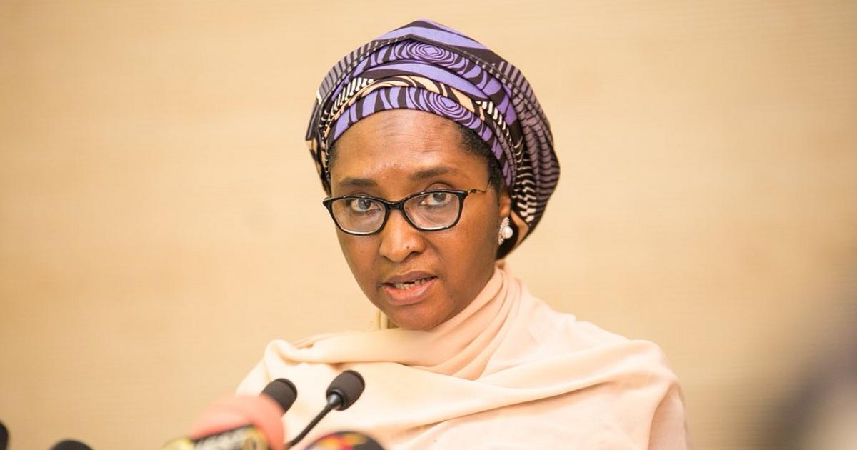
The federal government has confirmed it plans to sell off some non-oil assets of the Federation to fund the 2021 budget. Finance Minister, Zainab Ahmed, made this known to stakeholders in a budget presentation made in Abuja this week.

The document of the presentation, titled, ‘Public Presentation of 2021 FGN Approved Budget – Breakdown and Highlights’ dated Jan. 12 was obtained by Premium Times.

[..]

Government’s recent move to borrow funds from unclaimed dividends and dormant bank accounts also underscores its search for sources to borrow from. Ms. Ahmed said that the government is targeting about N850 billion from unclaimed dividends and dormant bank deposits.

Government’s plan to sell and lease assets comes at a time when its habit of borrowing to fund the budget has been repeatedly condemned.

The document said the government intends to fund the budget by selling and concessioning government-owned properties and non-oil assets.

Although the document does not specify the assets the government is considering to sell, Premium Times report noted an earlier event indicating some of the assets.

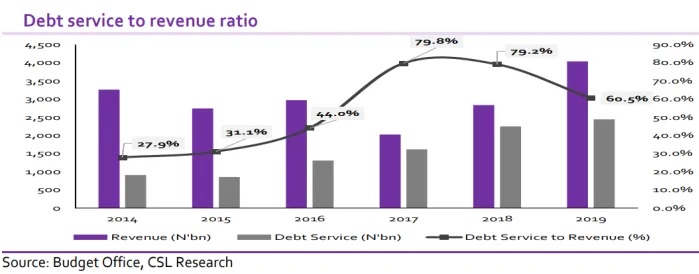
The fact is this: Nigeria is a poorly run entity and I am not saying this because I have better ideas. I am simply reporting a statement of facts. When the cost of your capital is 60% of your revenue, your future as an entity is not certain.

debt service ratio
Nigeria data

Nigeria can sell everything, collect pension funds, borrow dividend funds, pick dormant bank balances, tax remittance, etc, but the outlook will not change until it reforms its economic architecture. We have no incentives for intra-competition across state lines and we do not reward hard work in the ways we compensate states. So, at the end, everyone is doing siddon-look with no inventiveness.

People, it is a big yard sale – and everything is discounted. Check here and see if some items will appeal to you.

Comment from LinkedIn Feed

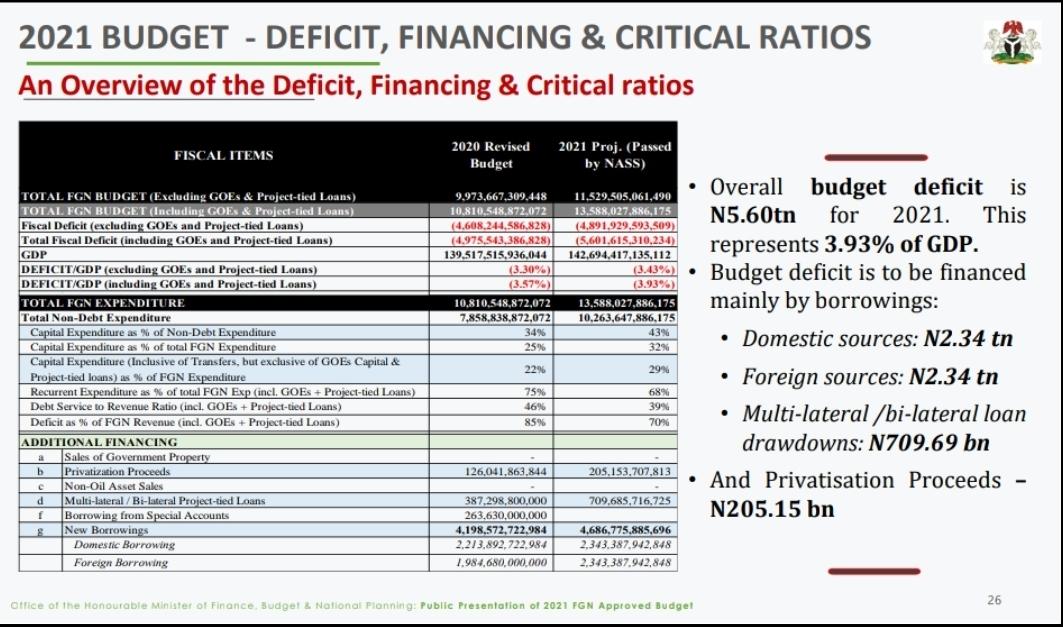
Nigerian 2021 Budget (N13.58 trn) – Deficit, Financing and Critical Ratios

President Muhammadu Buhari had on December 31, 2020, signed the N13.58 trillion budget for the 2021 fiscal year – about N505 billion higher than the budget proposed in October, 2020.

In the approved budget, about N496.5 billion was approved for statutory transfers and N3.3 trillion was approved for debt services. The recurrent expenditure was put at N5.6 trillion with capital expenditure at N4.1 trillion and fiscal deficit at N5.2 trillion (5,196,007,992,292).

The overall budget deficit is N5.60trn for 2021, which represents 3.93% of the country’s GDP, and it’s to be financed mainly by borrowings:
-Domestic sources – N2.34trn
-Foreign sources – N2.34trn
-Multi-lateral/bi-lateral loan drowdowns- N709.69bn
-Privatisation proceeds – N205.15bn

With about N7.97 trillion is available to fund the 2021 budget as stated by the finance minister

Nigerian Government Confirms Plan to Sell/Lease National Assets to Fund 2021 Budget

Nigerian Government Confirms Plan to Sell/Lease National Assets to Fund 2021 Budget

0
Nigeria leaders

The federal government has confirmed it plans to sell off some non-oil assets of the Federation to fund the 2021 budget. Finance Minister, Zainab Ahmed, made this known to stakeholders in a budget presentation made in Abuja this week.

The document of the presentation, titled, ‘Public Presentation of 2021 FGN Approved Budget – Breakdown and Highlights’ dated Jan. 12 was obtained by Premium Times.

President Buhari presented the appropriation bill of N13.082 billion to the National Assembly in October, but it was increased by N505.61 billion to the total amount of N13.588 trillion which he signed into law in December.

A breakdown of the budget shows that recurrent expenditure will gulp N5.64 trillion, capital expenditure N4.125 trillion, debt servicing N3.324 trillion and statutory transfer N496.528 trillion.

Consequently, the approved budget was greeted with criticism as the federal government said it plans to engage in foreign and domestic borrowing to fund it. Ms. Ahmed said there is only about N7.97 trillion available to finance the budget.

The federal government said it would borrow N5.6 trillion from domestic and foreign sources to make up the total deficit of the 2021 budget. Ms. Zainab disclosed that Nigeria will borrow money from the World Bank, the Islamic Development Bank and countries like Brazil to finance the budget.

Finance Minister, Nigeria

Government’s recent move to borrow funds from unclaimed dividends and dormant bank accounts also underscores its search for sources to borrow from. Ms. Ahmed said that the government is targeting about N850 billion from unclaimed dividends and dormant bank deposits.

Government’s plan to sell and lease assets comes at a time when its habit of borrowing to fund the budget has been repeatedly condemned.

The document said the government intends to fund the budget by selling and concessioning government-owned properties and non-oil assets.

Although the document does not specify the assets the government is considering to sell, Premium Times report noted an earlier event indicating some of the assets.

In November 2020, the Senate Committee on privatization headed by Senator Theodore Orji was presented with documents which show plans by the government to sell off some properties and assets of the federal government. Some of the assets include the Integrated Power Plants in Geregu, Omotosho, and Calabar, designated to be sold for N434 billion in 2021.

The documents also revealed plans to concession the National Arts Theatre, Tafawa Balewa Square, and all the River Basin Development Authorities at N836 million while National stadium in Lagos, the Moshood Abiola Stadium, Abuja, and two others were to be leased for N100 million.

The dispute between the Senate Committee on Privatization and the federal government has also been settled. The Committee said during the 2021 budget defense in November that it was not aware of the government’s plan to sell or concession some assets through the Bureau of Public Enterprise (BPE), and the chairman Orji said the BPE Director General Alex Okoh has refused to carry them along. The Clerk of the panel Sadia Abdullahi told Premium Times that the issue has been resolved.

She explained that Okoh reappeared before the panel to submit the necessary documents containing the list of national properties that are up for sale or concessioning as well as their prices. Ms. Abdullahi added that the committee, the BPE and the federal government are now all on the same page.

Apart from the plan to sell and lease assets, the government is also considering borrowing from special accounts. Last year, the federal government was seeking approval from the National Assembly to borrow from the pension fund, and it seems the plan is still alive as budget deficit remains a challenge in 2021.

Other means the government plans to use to finance the budget include the privatization of some public assets at N205.1 billion.

There are also Multilateral/Bilateral project-tied Loans put at N709.68 billion and New Borrowings of N4.7 trillion that involves N2.34 trillion domestic borrowing and N2.34 trillion foreign borrowing.

The government also plans to use N2.01 trillion share of oil revenue, N208.5 billion of NLNG Dividend, N2.65 billion from Mineral and Mining and N1.48 trillion non-oil revenue to fund the budget.

Apart from these, the government is counting on Company Income Tax (CIT) to generate N681.7 billion, Valued Added Tax (VAT), N238.4 billion, Customs N508.2 billion and Federation Account levies N60.5 billion to finance the budget.

The Ten Commandments of FMCGs Marketing

0

Get ready for LaCasera, a famous drink for active and moving people across West Africa. Yes, the Group Marketing Director of Jotna (the LaCasera Company), Emmanuel Agu. FNIMN, FIMC, FIPMA, MSC, MBA, Ashridge Alumnus, a Tekedia Institute Faculty, will teach a course – Effective Consumer Marketing in the FMCGs industry.

But you may read in the Board – The Ten Commandments of FMCGs Marketing. Mr. Agu is a veteran of FMCGs world; he ran marketing and portfolio desks in Guinness, Heineken and others. They’ve called him the sage for knowing what moves markets and how to get users to open the bottles!

To all SMEs, startups and players in the FMCGs, you cannot miss this course. It is scheduled for Week 8 of Tekedia Mini-MBA which begins Feb 8.

I have a 76-page document here which in my opinion is the best work I have ever seen in this industry for Africa. You will have it as part of the course. BEGIN and register here.