DD
MM
YYYY

PAGES

DD
MM
YYYY

spot_img

PAGES

Home Blog Page 5973

From Hunger to Mental Health: Nigerians Groan as Economy Worsens Under COVID-19 Strains

0

Poom! And the man fell facedown, causing pandemonium, disrupting the bubbling sunny afternoon in Oshodi Lagos. A crowd gathered and carried him off to the roadside. They brought a bag of pure water (sachet water), and the people didn’t waste time emptying it on the man who’s now lying supine. He didn’t move a hand, only that he had a pulse. 

“Let’s take him to the hospital,” some suggested. “No, wait. Let’s get him food first,” others said. And the dying man raised up his hand in agreement, “food first.” As they brought him a plate of food, he eased up and ferociously devoured it, not even his trembling hands could restrain him. The crowd shook their heads as they watched him eat, not because they were surprised, but because hunger has become the unfortunate norm that millions of Nigerians are, without choice, reckoning with.

In June 2018, Nigeria overthrew India to assume the world headquarters of abject poverty. This means, according to the World Bank, that 87 million Nigerians, approximately 45 percent of her population, live below the poverty line of $1.90 per day. It is a milestone of a situation that’s virtually effective in the stomach of every Nigerian except for a few. 

But there was hope that the figures will change for better in the nearest future based on government economic policies. In June 2019, the figures did change, but not for the better. The World Poverty Clock reported then that over 4 million more Nigerians had been added to the already existing 87 million, bringing the number to a staggering 91 million and counting, who were not thinking of buying cars or houses, but the necessities of life – food, clothing, and shelter. 

These basic needs rest on $1.90 that is sometimes not assured, and the results are better imagined than experienced.

“I can count the number of times that I have eaten in four years,” said Stanley, a Lagos resident who has been without a job since 2016. “I’m not talking about clothing and shelter, those are luxury. I could wear one clothing for weeks, sleeping here today and there tomorrow.” It sounded like an exaggeration, but Stanley insisted on what he disclosed.

With his shirt hanging loosely on his skeletal body, you wouldn’t doubt if he is telling the truth. And his pathetic story of survival through unrivalled hopelessness resonates with so many others.

There was a report of a young man living with his parents because he couldn’t get a job years after graduation, and he decided to start a petty business and settle down. Eventually, the business turned bad, hunger came, and his wife left him.
Nigerian leaders

Since 2015, Nigeria has recorded an unprecedented rate of job loss, spiking her unemployment and hunger rate. 

Nigeria’s Bureau of Statistics (NBS) put the unemployment rate above 27% in its Q3 2020 report. During this period, the Nigerian government was putting measures which include Trader Moni, N-Power, Farmer Moni, and Market Moni schemes in place to alleviate the rising strains of penury. It was hoped that in time, Nigeria would drop the ‘world poverty capital’ tag as the economic policies of the government yield positive results. 

Unfortunately, things took a further dive down the drain, escalating the already bad situation. In early 2020, following the outbreak of the COVID-19 pandemic, a new wave of economic challenges hit Nigeria, as oil prices plummeted due to the impact of safety measures taken by governments around the world to contain the spread of the virus; the measures included lockdowns and travel restrictions that grounded economic activities globally. Like other countries, Nigeria initiated a lockdown that lasted from March to June. 

Nigeria’s GDP fell 23% during the lockdown. 

Agri-food system GDP also slumped 11%, as the hospitality sector was most affected by the restrictions. The culminating impact of the lockdown plummeted household income by a quarter, leading to a nine percent increase in the national poverty rate.

Consequently, the pandemic ushered in a new phase of economic hardship which dragged the hope that many will be lifted out of poverty, further down the abyss of misfortune. According to the World Poverty Clock, the number of people living in extreme poverty in Nigeria moved up more than 87 million, representing 43% of the population.

For people like Stanley, it means the chances of seeing food have become slimmer.

“Sometimes it takes as long as two days before I could eat, so I go to where they sell food and beg people buying food to buy for me. I don’t need meat. I only want food in my stomach,” he said.

“Some will ask me to eat what I want; others will wave me off or tell me that they don’t have the money.” 

Job loss and economic hardship emanating from COVID-19 birthed a situation that plunged many Nigerians into a deeper food crisis, generally described as a “hunger virus” with its depth exposed few months after the lockdown was lifted. Following the #EndSARS protests, a campaign against police brutality in Nigeria, vandalism orchestrated by hoodlums led to the discovery of warehouses filled with food palliatives sponsored by private sector-led Coalition Against COVID-19 (CACOVID-19), as part of private sector donation geared toward easing the strains of the pandemic. 

The CACOVID food palliatives were believed to be hoarded by the authorities in different states across Nigeria, who were supposed to distribute them to the people. Following the discovery, there was an unprecedented invasion of the warehouses by Nigerians looking for food. In places like Jos, Plateau State capital, the alarming number of people who besieged the food warehouse gave the impression that everyone in the city has no food to eat. In the Gwagwalada area of Abuja, where stampedes resulted in deaths. It was the same story of starvation being demonstrated through desperation for food even in the face of a possible danger of some of the foods being unhealthy for consumption.
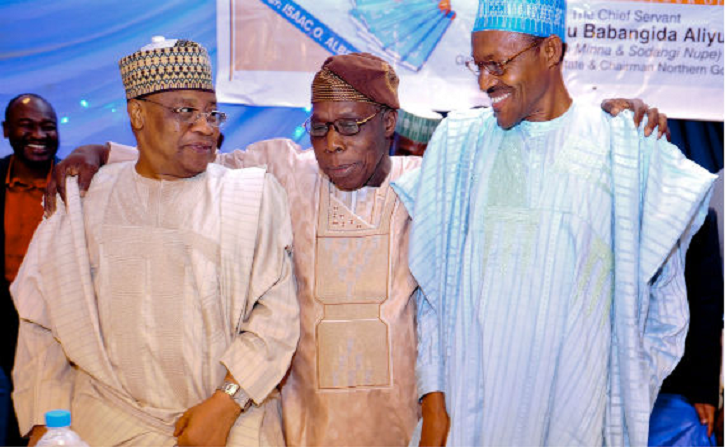
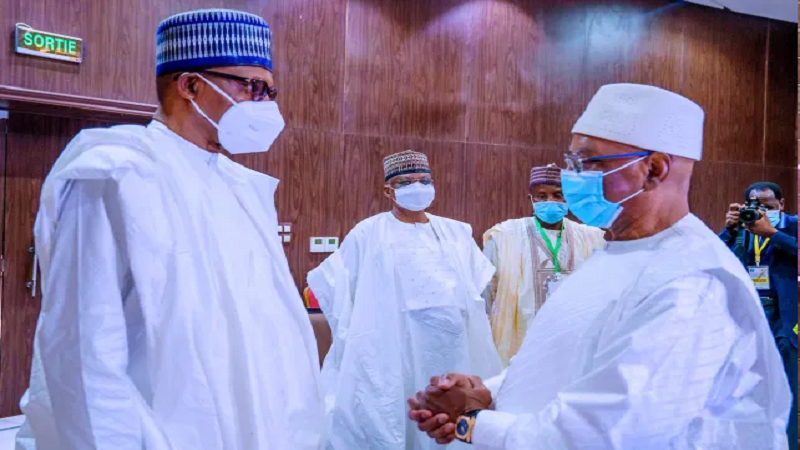
Nigerian past and present rulers

“We need our palliatives. It is our right. My neighbour almost died of hunger because of COVID-19,” said Ojo, one of the Nigerians looking for the palliatives. “He used to work as a security guard at a government institution, but he was sacked. What do you want him to do? I gave him beans and rice, he almost died of hunger.”

For other Nigerians walking in the same terrain of starvation, the quest to put food on the table has become a clarion call that doesn’t depend on one’s earnings anymore. On social media, SOS calls for food are alarmingly increasing daily, with people begging and sharing their bank account numbers online for as low as N1,000. 

“Good evening sir. How are you doing? Please sir I just want to beg you to assist me with small money to buy food for my family. I am a teacher in a private school. It is not easy sir. Please don’t be offended. I kneel down to beg you, sir,” Divine Azoug begged a philanthropist on Twitter.

As the economic situation bites harder, there were a series of disheartening stories of unbearable cases of hunger. There was a report of a man who drank Dettol in Aba because he couldn’t bear the hunger anymore and wanted to end his life. Others, who still have the mettle to keep going, couldn’t stop crying out for help.

“I’m so sorry to beg for financial assistance here. Since the lockdown, I have not got food for my family. I am a teacher in a private school. For three months I have not been paid my salary and no one has been paid either,” another Nigerian begged on social media.

A medical doctor narrated on Twitter how she normalized the high blood pressure of a patient by merely giving him N1,000, a typical situation with the increasing number of Nigerians who don’t know where their next meal will come from. Like Stanley, many of them have resorted to begging because other dignified choices have been exhausted. 

“I used to borrow like N10,000 from my friends and paid back when I made the money from my small business. Now, nobody has. Everybody is crying. So instead of N10,000, I ask for N1,000 or N500. But before you know it, the money becomes too much from different people, and there is no means of paying back because my business is not moving,” Ebenezer, a father of three and petty trader, said.

“It’s telling terribly on us. Most times, my wife and I must starve to save the little we have for our three kids. As you can see, we are losing weight,” he added.

For Many, the hope of sustenance lies in the willingness of others to give; family, friends, and those who have something to spare. 

“I will use the N10,000 to buy food so that my family can have something to eat in the meantime. I lost my job in July due to the COVID-19 lockdown and since then things are very tough for me and my family. God bless you, sir,” Oladoyin explained to a philanthropist who wanted to know what he would do with the money he begged for.

Unfortunately, in some cases, the helpers eventually lost their jobs along the way and joined the increasing number of unemployed Nigerians looking for food. To survive, many have learnt to feed on any food that doesn’t kill instantly.

A dead whale washed up on a beach in Okpoama and Onyekia communities in the Brass Local Government Area of Bayelsa State. Within hours the giant mammal was reduced to nothing by hungry Nigerians. The National Agency for Food and Drug Administration and Control (NAFDAC) had repeatedly warned that eating washed-up aquatic animals poses a great risk to health. But to many who do not know where their next meal may come from, it is better to die of food poison than of hunger. So, such a whale was a “gift from God.”

As Nigerians adopt skipping meals as a mechanism to survive their hunger crisis, the starvation is creating other problems that the government is said to be paying less attention to – hunger stunting physical and mental well-being. 

According to Move for Hunger, when you are hungry, your body produces cortisol, a stressor that signals to your body to eat. This stress when prolonged has deteriorative qualities and the effects of food insecurity on a person’s psyche become more impactful than you can imagine. While hunger does not directly cause mental ill-health, it can significantly increase the risk of developing one through malnutrition, vitamin deficiency, poor physical health, and proneness to diseases.

“Hunger is linked to poor concentration, memory disturbances, short attention span, restlessness, anxiety, mood disorders, ADHD, and a host of other problems,” a psychiatrist, Dr. Taiwo Afe, said.

He explained that a condition of food deficiency could impact mental health negatively.

“When glucose stores are low, many body functions either use alternatives or synthesize a form within the body mechanisms. But the brain is heavily dependent on glucose, hence, many processes for behaviour control are dysfunctional, resulting in disorganized behaviour.

“Ordinarily, when glucose stores are low, some compensatory sympathetic mechanisms that excite and enhance aggression are activated,” he added.

The multidimensional consequences of hunger are particularly evident in the behavioural attitude of Nigerians. It is always anger and fights, murmuring and curses, and sometimes, stealing, at home, markets, and on streets. 

school kids feeding

The World Health Organization’s 2019 report on mental health noted that one in four Nigerians – some 50 million people – suffer from mental health. The overwhelming situation resulted in the call for Nigeria to reform its mental health law to meet the standard of WHO’s mental health action plan, which aims for 50% of countries to have developed or updated their law in line with international and regional human rights instruments by 2020.  With fewer than 300 psychiatrists in a country of 206 million people, the increasing cases of mental health in Nigeria are pointing to a developing epidemic that is deeply rooted in hunger.

As Nigerians keep strategizing to feed daily, deteriorating economic situations keep stymieing their chances. Stanley mentioned how he would hope on birthdays, weddings, and weekend parties just to get a meal. But the parties have reduced drastically because party makers are also trying to survive. Those who have what it takes to pull it off are separated by the wall of class distinction that keeps the hungry ones away.

Scanty parties were attributed largely to the economic downturn of the country and partly to the border closure which disrupted the ECOWAS-based food supply chain and spiked Nigeria’s food inflation. The NBS October 2020 report put the food inflation rate at 17.38%, indicating a significant increase in food prices, especially rice, the most staple food in Nigeria. A 50kg bag of rice is sold for about N31,000 the same amount as the monthly minimum wage. 

Sunday, a taxi driver with five kids lamented, “We are finding it hard to cope. A bag of local rice is now N30,000. I cannot afford to buy it. My children like rice but as it is, I cannot afford to provide it to their satisfaction. So, we have learnt to skip meals, eating mostly twice in a day.”

Sunday’s family is just one among many in Nigeria whose children have learnt to skip meals just because there is not enough. In some states, parents who depended on the government’s school feeding programme to feed their children were forced to go back to their meal skipping pattern as coronavirus forced schools to close nationwide. 

“Before the lockdown restrictions I was a petty trader of household items but now all my items have been sold and I can’t go to the market to buy more. Even the savings we had have all been used to cater for the family. My husband’s hands are also tied because he cannot go out to sell his farm produce. The future looks very bleak.

“Sometimes we go to bed without dinner and I can say that the same is true for the majority of people in our community. If something is not done quickly, a whole lot of us will die of starvation,” a Nigerian woman, who did not want to be identified, lamented.

The impact of meal-skipping on children has been observed to go beyond stunted growth to poor academic performance.

The Children’s HealthWatch explained that food insecurity has negative effects on early childhood. The report stated that hunger is detrimental to the development of skills crucial for school success including memory, emotional stability, and social skills. On the other hand, adults who are underfed lose considerable weight due to insufficient calorie intake. 

According to the USDA Dietary Guidelines, the recommended calorie intake for sedentary females aged 26 to 50 is 1,800 per day. For sedentary males of the same age, the recommended calorie intake is 2,400. But in the face of food insecurity, adults of this age range are forced to lower their calorie intake far below what is recommended, resulting in emaciation, a typical feature of most Nigerians. 

Though there were measures mapped out to tackle the menace of hunger and malnutrition, not much success has been recorded. In April 2016, Nigeria adopted a new National Food and Nutrition Policy (NFNP) to curb the upsurge in stunting and malnutrition among other food-related concerns rising in the country. 

The policy, driven by the Ministry of Budget and National Planning and supported by other stakeholders including the state governments had the goal to attain optimal nutritional status for all Nigerians by 2024. The key targets include reducing the stunting rate among under-five children from 37% in 2030 to 18% by 2025, reducing childhood wasting, including Severe Acute Malnutrition (SAM) from 18% in 2013 to 10% in 2025, among others.

These new programmes came after the National Strategic Plan of Action for Nutrition and the National Strategic Health Development Plan for 2009 to 2015, which were formulated as a guide for the health sector component of the National Food and Nutrition Policy, failed to address the challenge.

In the wake of COVID-19 and the crisis in northern Nigeria that have escalated the situation of hunger and malnutrition in the country, especially among children, the WHO and UNICEF are worried that the lax approach by the government will harm the economic future, health and education prospects of the country. 

The International Committee of the Red Cross (ICRC) reported that the number of children treated in 2020 by the outpatient nutrition programme grew by 20%, while the number of severe malnutrition cases rose by 10%, compared to the same period last year. The low productivity it yields in adulthood is estimated to account for as much as 11 percent of Gross Domestic Product in economic losses.

To address the upsurge, the government has once again unveiled a plan. In December 2020, the National Council on Nutrition approved a five-year plan to reduce hunger and malnutrition. The plan was geared toward the implementation of intervention programmes, designed to address hunger and malnutrition across all sectors in Nigeria. The action plan titled, ‘National Multi-Sectoral Plan of Action for Food and Nutrition (NMPFAN) 2021-2025,’ was approved by Vice President Yemi Osinbajo, and backed by Nigeria’s Governors Forum, the health ministry, Ministry of Budget and National Planning, and the Nutrition Society of Nigeria, among other stakeholders.

The goal is to reduce the proportion of people who suffer malnutrition by 50%, and the stunting rate among under-five-year-olds to 18% by 2025, through the scaling up of priority high impact nutrition-specific and nutrition-sensitive interventions. The plan is to be implemented through the adoption of extensive advocacy programmes by stakeholders of the NMPFAN, across all levels of government and sectors in the country.

While nutrition-based advocacy programmes are important in addressing the concerns of food shortage, experts are urging the government to give more attention to social and economic development programmes, as it would help families to earn decent living. However, the chances for a near economic future that will guarantee food security are slim as Nigeria is confronting its worst recession in decades. 

The World Poverty Clock put Nigeria’s poverty Target Escape Rate at 0.3 people/sec while the Current Escape Rate is -5.8 people/min. Last year, the UN’s report for developing countries like Nigeria seeking to escape multidimensional poverty indicates a bleak future. The report said that the Zero Hunger Target of Sustainable Development Goals (SDGs) by the year 2030 has been severely undermined in the last three years, adding the consequences of COVID-19, and its second wave that may force the government to initiate another lockdown, Nigeria’s hunger crisis is expected to deepen soon.


THE MASS MARKET – Understand it; Respect it; Enable it.

5

I began to think of this conceptually for the Nigerian Market firstly in respect to a useful piece of feedback from an MNO (mobile network operator) CEO on the recent consultation I did for my piece on the Nigerian Telecommunications space.

The second thing I thought about was my own career history in London in the 90’s and part of the early millennium, particularly in how I impacted procurement practice in public service construction and maintenance.

The third thing I thought about was a businessperson in Nigeria looking to advance capacity through offering a more premium type of packaging. I advised against this line of expansion ever though it was against my immediate interests to do so.

For this, I have to go way back to the beginning, and some may think this is an effort at self aggrandisement and ‘bigging up’ but it’s just about creating the backdrop, and establishing scale, which is a big aspect of ‘MASS MARKET’

THE UK CONSTRUCTION MAINTENANCE CASE – Understand THE MASS MARKET

I originally entered London  ‘ on a wing and a prayer’ following the collapse of the Trinidadian economy, a country where I had originally spent formative years, and via a few months in my native Ireland which was equally bleak. I looked for housing from an organisation ‘Brent Community Housing’ which looked at ‘need’ combined with what a tenant prospect could bring to the table, and very soon I was both accommodated by them and on their NED board. I unwittingly impressed a member of the finance sub-committee who was also treasurer of a ‘Black’ Co-operative, and soon I was seconded as a sub-committee NED to their board also, which was Trojan. Shortly after, I was also co-opted to a third Co-operative with links to both BCH and Trojan – Cyron.

Following this I secured a fixed term stint managing ‘Special Projects’ for Shepherds Bush Housing Group,  though any ‘salaried’ technical knowledge I had up to then was ‘Groundworks’ and ‘Earthworks’ rather than ‘Built Environment’. About a month short of term-end, I secured a position as Director of LEOF, an organisation promoting construction MLE’s (Minority Led Enterprises) in the public procurement community (primarily Social Housing) and with some build out to Construction Best Practice advocacy and partnering services.

The climate was changing rapidly from that to which LEOF had been born. Start up funding from The Housing Corporation and Housing Association Charitable Trust (HACT) had just elapsed. New changes in Construction Management, starting first in 1995 with the first implementation of the  CDM 1994 –  Construction (Design and Management) Regulations, the Latham Report, and a few years later, the Egan Report. UK did not have affirmative action as in the US. Impassioned Soap Box firebrand rhetoric was falling on deaf ears. I perceived the need for a radical shift to continue to provide meaningful services for stakeholdng beneficiaries.

With the launch of the ‘commercial arm’ – Safebuild.com, the release of the first UK wide Construction CRM/ERP,  a Code of Practice launched in the House of Commons and a few high profile consultancies, I was seconded into a procurement review board of sorts driven by the Office of London Mayor, GLA, beginning in the Livingstone Mayorship and carrying over into the Johnson Mayorship.

This was a high impact dynamic review authority that would go on to have mass impact on capital projects such as the building of Heathrow Terminal 5, and all of the infrastructure build out for the 2012 Olympics, including the Olympic Village itself. It would go on to influence maintenance programs for infrastructure and building assets of unitary authorities, social housing agencies, public transport, metropolitan police infrastructure, and other public or community assets not only in London but right across the South East of England.

Samieh Farrah (nee Fikouhi); First Officer at LEOF/Safebuild.com 1998-2004 during my tenure as CEO

On the maintenance side in particular, one of the focal points for the group became the regularization of ‘Schedules of Rates’ (SoR) implementation. The principle on which SoR worked was that ‘interested’ contractors were sent a schedule for supply and works covering all of a public authority or community agency’s property maintenance needs. Schedule entries were all priced, a service procurement office (supposedly) ran the statistical maths, and a limited number were chosen on overall cost for a ‘select list’ which would then be locked for a period typically anything from  2-5 years. This was intended to eliminate random variances on works, regularize budgeting, and massively reduce client end procurement work overhead. The SoR regime had been around in one form or another since 1982, though quality and effectiveness varied drastically and schedules frequently resembled incomplete ‘bills of quantity’ with significant scope for ‘out-of-schedule’ contract awards on a case by case basis.

One of the aspects of this I strongly argued for was that, at least initially, until the management practice is established and understood, some overview of SoR practice should be centralized. The suggestion was not made to advocate any big brother type control but more to provide an extra layer of validation on best value, have communal learning of ‘lessons’ and make continuous improvement contagious. My view was strongly supported by board members from CIPS, CIOB and CITB. Unfortunately, GLA and to a certain extent LDA (London Development Agency) saw themselves as needing to own the burden of operational mechanics and gradually distanced themselves from it. That’s a little bit like trying to get a UN initiative launched with US, China and Russia having no intention of playing ball, even if the other 193 approx. members are happy with it.

Instead, a ‘fudge’  was adopted – an ‘arms length’ advisory unit providing information and support to the different stake-holding entities with no direct visibility on their procurement and contract management, nor on adoption of SoR.

Chinwe Ekwunife, First Officer at LEOF/Safebuild.com from 2004 and beyond my tenure as CEO after my departure for Netcom Africa in Lagos 2008.

One common early mistake made by service procurement decision makers happened under pressure from CEOs to demonstrate ‘SoR seen to be working’ to get the political ‘brownie points’, and in the absence of intelligence led software since then made available. They made contractor selection decisions based on summarily and manually viewing the tender submissions rather than detailed statistical evaluation considering both historic maintenance spending data and future expectations for buildings and infrastructure assets.

As a caricature illustration for case in point, let’s say there is this rarely used climate control system needed in a special project where temperature needs to be kept within a very narrow variance, and it has both heating and cooling technologies. On the other hand, let’s say there is a small universal screw, worth only a few kobo, but, of course, across the maintenance programs in the various organisations, its prevalence runs into the billions…

Contractors with a strong understanding of the dynamic would put in a quote costing the climate control system at 20% below cost, but however, costing the little screw at 1 Naira. There would be multiple similar examples of this in the schedule. The ‘short-cut’ to instant decision making by the procurement officer would conduct a group comparison on a ‘schedule sample’ set, but they would be typically attracted to include headline items such as the climate control system rather than the humble screw.  The mass need for the very low value items with inflated costings as compared to the infrequent replacement of discounted headline items (if at all), meant contractors who actually were not delivering best value were chosen for the select list on a TMC (Term Maintenance Contract) and made huge profit.

While the live TMC at some point exposed the weakness, relevant public servants/NGO officers avoided acknowledging it for fear of career damage, so typically it waited to be addressed until TMC review, or if the officer changed jobs or retired before the term end.

This happened because for one window in time, some contractors understood the gateway to the mass market of public/NGO TMC’s better than the officers supposed to be the gateway custodians.

The NIGERIA FMCG MANUFACTURING CASE – Respect THE MASS MARKET

Some years back, I was approached by a client that wanted to enter a new segment in the market. This was a manufacturer who started out with a small water purification and packaging operation for what is known in Nigeria as ‘Pure Water’.

A micro ‘Pure Water’ operation in Nigeria

It was a two person partnership who were the main shareholders, and there were a few NEDs with smaller investments who additionally formed the board. They graduated to sachet format frozen flavoured drinks. I had initially approached them on behalf of a ‘principal’ who was a well known global player in flavours and fragrances/aromas. I then assisted them on the R&D side with some new products they wanted to bring to market exploring options with more of a dairy/ice-cream/sorbet texture and mouth-feel. The resulting products became a huge success.

At this stage the company had good business across its full portfolio,  in Mile 12 Lagos, and various other traditional markets, small shops, and street hawker distribution networks in Lagos, Ogun and Oyo.

Sachet format product not unlike some produced by the client

The two partners were very different people. Both were male, though from differing origins within the three most populous of Nigerian tribes. ‘Partner #1’  was highly articulate, charismatic, and very persuasive. Prior, he had held lead Sales and BD positions in various companies of note. He secured salaried employment easily and performed above average, but subjective opinion that I ‘happened upon’ suggested he was ‘managed out’ of different companies for having too many ‘side hustles’ which had been ‘distracting’ from achieving his full potential in post.  He led on any external discussions on behalf of the company. ‘Partner #2’  was meticulous on product development and conceptualization. He came into the business with production team leadership in companies like Nestle, Dansa Foods and Nutricima in his repertoire. He rarely spoke, but when he did, every word carried weight.

Up to now they had stuck to expanding within the confines of the ‘Pure Water’ model – Sachet format; Minimized production cost; Simple affordable machinery, with relatively simple engineering and working on basic principles (such as vertical filling); cheap packaging material with very basic cosmetic presentation; low profit margin; high mass market consumer demand with low brand sensitivity.

Then ‘Partner #1’  developed a vision to which his stubborn commitment was, I would say, ‘unfortunate’. He came to me to enquire about machinery lines to begin ‘tetra pak’ style packaging on a line of products he wanted to develop aimed at the ‘Modern Trade’ market in Nigeria.

The first thing I would say about this market is that it is only window dressing for many of the big FMCG manufacturers. Most, particularly on the Food/Dairy/Beverages side will tell you in Nigeria it only accounts for a few percent of turnover.

Secondly Modern Trade companies in Nigeria are highly brand sensitive both on sourcing decision making, and customer demographics. Many have South African investment, so products comprise SA category kings that have presence in multiple African Markets, they include the usual suspects with global presence, and then you have a few local leaders like Dangote, and a few medium sized local companies that have developed in tandem with the emergence of Modern Trade in Nigeria, such as Rite Foods (oh and don’t forget former President Obasanjo’s chickens!).

This is a very difficult market for a ‘no brand’ Traditional Market player to penetrate.

There are other measures that look to share risk and cost with suppliers that vary from one Modern Trade company to another. Some have payment terms that are a huge burden to suppliers which can be anything up to 90 days, with the trade outlet having sold product to consumers anything up to 90 days before they pay for it, essentially getting free use of OPM (Other People’s Money).

Others require suppliers to stock in-store shelves themselves and share the stock control management burden. Some have both of these measures.

Now when moving from sachet format to ‘tetra pak’ style packaging, this is a high CAPEX move to do correctly. There are only a few places in the world right now where high quality machinery in this packaging product are produced. There is of course  the original ‘tetra pak’ (owned by Tetra Laval) which comes from Sweden, but there are other high quality manufacturers in mid-west Europe as well, such as  SIG Combibloc Group. This machinery market is formally known as the ‘Shaped Liquid Cartons’ market.

NAMPAK is a South African company active in Nigeria that supplies these kinds of cartons to companies who are going to limit themselves post-production to filling lines, boxing and palleting, but in the long run, especially in Nigeria, a company that doesn’t have its own primary packaging in-house is just bleeding revenue.

An analysis of the client companys’ financial profile would suggest this investment could break them unless it is accompanied by a revenue improvement on a very aggressive upwards curve. The nature of Nigerias’ modern trade, both on the penetration and the sales volume side would suggest this as a flawed venture for this particular client.

‘Shaped Liquid Cartons’ – this is commonly known as the ‘brick’ format

Part of my Moral Compass which involves integrity is that I will not willingly sell a solution to a client that is detrimental to them in any way. While I can point to the application mismatch clear to me, I will still however pursue the clients will to purchase, with my reservations noted. Fatefully, the  company failed to raise the LOC (Letter of Credit) from a provider on my Principals’ ‘approved list’ of Nigeria bank LOC providers, so the issue became moot. Following on from this, the client applied to an FGN loan grant institution (which I won’t name) and supposedly secured a grant to purchase machinery to enable the same ‘vision’. However, it appeared the so called ‘loan grant’ then became maligned to a loan from Diamond Bank at commercial rate, and moreover became conditional to machinery from a Chinese company through their local Nigerian agent.

Now things got even worse. Chinese manufacturing is very very far from being anywhere close to category king of the ‘Shaped Liquid Cartons’ machinery space. This statement is extraordinarily kind.

Indeed, State Administration for Industry and Commerce (SAIC) China, slapped Tetra Laval with a 668 million yuan ($98.5 million) fine for having a “dominant market position”, and that was actually in China where Chinese manufacturers have home advantage.

‘Partner #1’  phoned me for opinion and I made it clear I thought this option created even more problems than what might have been the case should the LOC for our Principal been successful.

Later it transpired that the loan capital exceeded the purchase cost of the Chinese machinery. and ‘Partner #1’  made some decisions with the extra borrowing that were probably not the best investment.

He purchased a two year old ‘tukunbo’ top of the range Toyota Prada, claiming that he needed to look the part when pushing for business in the Modern Trade space. Many would see this as unnecessary. He had a very ‘clean’ ‘tukunbo’ seven year old Camry, very acceptable in Nigeria at that time as a corporate ‘pool’ car. And this was a guy with charisma talents capable of commanding an audience even if he had stepped straight out of a Keke Marwa!  He also threw a lavish party for his daughter’s birthday, a supposed ruse to socially engage key players from the Modern Trade environment.

Returning to the machinery… One of the problems with these kinds of purchases from China, is that the sales and distribution model into the Nigerian market is problematic for the Nigerian Industrialist. These sales relationships typically look for a locally established entrepreneur to act as an agent on a commission basis under terms that break the chain of custody between the foreign manufacturer and the end user. The manufacturers legal responsibilities are kept confined to their local agent only.

Any reader of this article with an active LinkedIn account and a substantial track record in the Nigerian business space will no doubt have been approached by all sorts of machinery companies in China whose representatives have an aggressive sales pitch that follows the agreement to link (usually in poor English) and should the response be negative, the next issue to be explored will be the willingness to become an agent on commission!

‘Shaped Liquid Cartons’ machinery can be quite complex, and while the Chinese businesses owner may have English of an international standard, any support team despatched to Nigeria most probably will not. Add to that the likelihood of many factory floor technicians in Nigeria speaking a mix of pidgin and local tribal language, and even finding ‘classic’ (ajebota) English as ‘too much gramma’. There is now a massive communication gap with huge potential for misunderstanding, which becomes a complete impasse in the essential transference of technical knowhow.

This situation is further exasperated by a legal agreement between the Chinese manufacturer and the local agent, with a very limited and finite implementation and warranty support package, which once exhausted, leaves the agent alone to service the purchaser from their own capacity. Typically, these local agents are stand-alone sales consultants with very limited technical expertise. Post sale they are invariably off chasing the next ‘meal ticket’. They are harder to pin down for after-sales support than a Nigerian landlord is when a tenants water pump stops working!

So, the company had line commissioning challenges, and called up the agent. The agent contacted the manufacturer, who (eventually) sent a support team. The manufacturers commitment (to the agent and not the end-user) was a fixed number of technician-hours which became exhausted. The support team left Nigeria. The lines worked, with lower levels of efficiency and high levels of raw material waste and other problems for a while. Shortly after, my former client was stuck with silent machinery collecting dust.

The ‘agent’ liquidated his practice and disappeared for a while. He however reappeared about nine months later, supposedly as an ‘advisor’ to another company selling similar Chinese machinery. Brochures featured an almost identical machinery portfolio. Many illustrations showed machinery of identical technical appearances, with colouring on side panels changed, and a bilingual name saying for example, ‘Golden Singing Swallow Machinery Company’ changed to ‘Red Flying Dragon Machinery Company’ some differing Chinese characters printed underneath them, and a symbol of a swallow changed to a symbol of a dragon.

In Nigeria, while owing money isn’t a crime per se in law, those that owe money are often criminalized in its execution through both the actions of police and the judgements of judiciary. This is particularly true if the money is owed to a bank or other powerful corporate actors.

When payments to Diamond Bank became intermittent, and the relationship became adversarial, Partner #2 read the writing on the wall and disappeared. He is ‘rumoured’ to be somewhere in Ekiti State. The disappearance of its Product Actualization Lead who was effectively both its CTO and COO, was the final nail in a coffin that had been marked for burial some considerable time earlier.

So what are the lessons to be learnt here?

There are obfuscation issues here but they need to be noted. Partner #1 had the gamesmanship and global engagement skills; partner #2 had the operational and product development skills… yes.

Nevertheless, expanding the scope and functions of a business to significantly depart from its ‘ordinary’ activities requires more than a vision. It requires numerous strategic intelligence led, decision driven steps along the way  that become mini battles in the overall war to actualize that vision… to make that vision a reality.

While partner #2 was probably the better of the two there was clearly a management skill gap here. Moreover, the soft skills of partner #1, while an asset in external interaction, was sometimes a liability internally insofar as it dominated discourse with partner #2. Partner #2 was only comfortable being assertive while managing factory floors, but not in a board environment with decision making peers.

But the over-riding issue is that no efforts were made to shield the existing mass market product portfolio from innovation risk. JVs… holding companies… there is significant variety of corporate vehicles that can be used to legally separate that mass market product portfolio from risk associated with progressing any new vision.

While selecting and securing the right ‘vehicle’ may take time, core business was solid, a pseudo FGN agreed grant that maligned to a commercial loan tied to poor machinery options was the wrong choice, and perceived urgency to develop ‘Shaped Liquid Cartons’ based product aimed at Modern Trade was an illusion.

Partner #1 lost his business, his right arm, Partner #2,  and had his Prada possessed by court bailiffs.

While there were prevaricating factors,  core point of failure was because Partner #1 did not Respect THE MASS MARKET

The NIGERIA DATA TRANSPORT FUTURE MARKET  CASE – Enable THE MASS MARKET

The final chapter of this article is a throwback to a previous article on Tekedia. In the closing passage ‘OTT and the Tariff Future’, I raise the issue: ‘MNOs seem addicted to the practice of selling metered data as a painkiller for their revenue challenges. Yet this is the one obstacle that stands in the way of a mass explosion to over 200 million users in Nigeria.’

A light has been shone on how small a fraction of the Nigerian public are enabled to sustain smartphone data access on demand during the era of the metered data sales regime, whether this is through MNO (Mobile Network Operators) products alone, or whether they are additionally able to use OTT (Over the Top) services via access to business, social or other third party wifi services.

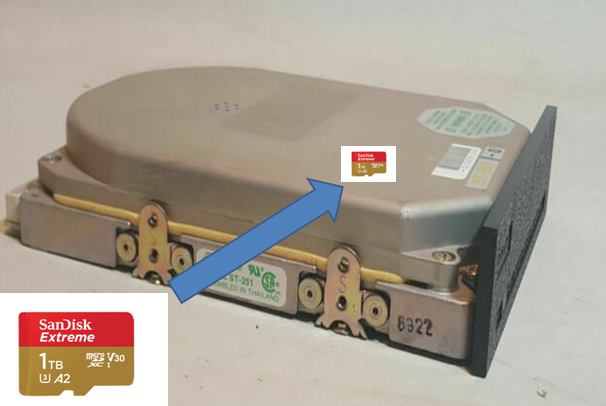
1994 Seagate 20MB ‘mechanical’ HDD typical of a 1994 Viglen, platter speed around 3600rpm and seek time around 15m/s. Sandisk 1TB micro SD card shown roughly to scale; seek time a few n/s. (access to about 500k times the storage and about 3000 times faster).

I recall from a previous business I owned in the 90’s A grade upgrades, one of the first contracts I got was to upgrade a small network of Viglen PC’s. The hard drives in them were 20MB. That was pre-internet. Now there are 1TB fingerprint sized MicroSD cards for smartphones. That’s five hundred thousand times more storage in a weight a finger will find hard to detect, compared to what was uncomfortable to hold with a big hand, and impossible for smaller ones. That’s just user side storage. Data centre storage solution improvements over the period are in a completely different league.

When we look at processing power we see phenomenal clock speeds and a graduation from 8 bit being exceptional to 64 bit being ordinary. We see transport technologies improving from PSTN and dial up internet, to IP, and later, MPLS, multiplexing, and SDWAN.  5G role out is imminent, while Wifi6 is in the wings. This is a progress story that is old, and every once in a while, new contrast elements are added. Nevertheless it is progression curve that will know no end.

What that means is a continual collapse on cost and continual increases on capacity across all aspects of computing and telecommunications whether it concerns data processing, storage, or transport. At any specific time,  some nations may be further on the curve than others,  but, it is a global phenomenon.

It is clear that whichever Nigerian MNO jumps first with an unmetered initiative will get the market kudos for the Blue Ocean product. Continually improving technology will contribute to falls in cost.

Nigerian market can be very resilient to brand disruption once a King is established. The opportunity is there to become the ‘Indomie’ of unmetered services.

Different solutions can be considered, partnering OTT, bringing MNO proprietary OTT to market, and moving the revenue stream from the data sales side to the OTT use side in a wide range of hybrids and variations that align well with current operating costs, but become more aggressive as they permit over time.

Parody hybrid of ‘Netflix’ and ‘African Magic’ – A cheeky spoof, or thought leadership on where Nigerian MNOs may go?

Once the ‘barn door’ is open on this development, it is possible that companies such as MultiChoice will have to reposition and reinvent or find partnering solutions in order to remain relevant, or go the way of the audio and video cassettes of old.

The current state of MNO Smartphone internet/data services are almost at a point in reverse of the the NIGERIA FMCG MANUFACTURING CASE further back. The MNOs have their ‘Shaped Liquid Cartons’ equivalent product in place, but they are only reaching that small proportion of Nigerian Society that patronizes ‘Modern Trade’.

Internet Access and affordable OTT are the water of the Virtual World. MNOs need to introduce their sachet product and their ‘Pure Water’.

This is my message on Enable THE MASS MARKET

THE MASS MARKET – Understand it; Respect it; Enable it.

Thank You Tekedia Mini-MBA Donors and Patrons

0

I did not know it could happen: people sending money to a school account, anonymously. We want to thank YOU for supporting our mission to democratize quality business and leadership education. I write this to feel fine that I thanked you – Thank You.


Dec 30, 2020

  • Patron/Donor
  • Tekedia General Fund
  • Tekedia Institute, USA/Nigeria

Dear Sir/Madam,

Appreciation for Your Partnership

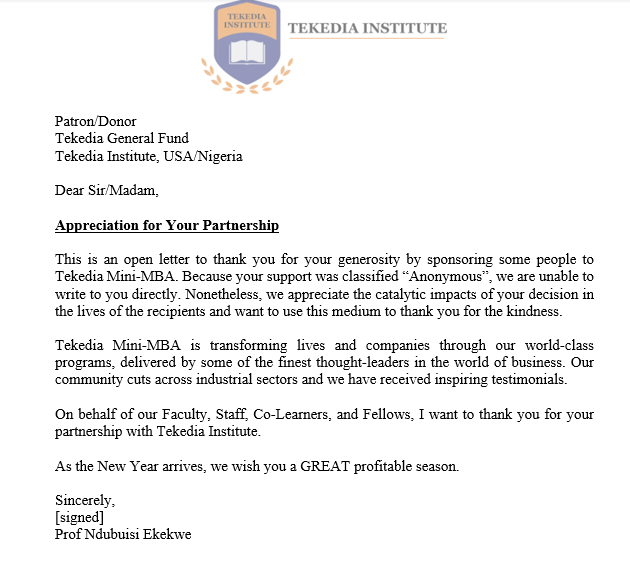
This is an open letter to thank you for your generosity by sponsoring some people to Tekedia Mini-MBA. Because your support was classified “Anonymous”, we are unable to write to you directly. Nonetheless, we appreciate the catalytic impacts of your decision in the lives of the recipients and want to use this medium to thank you for the kindness.

Tekedia Mini-MBA is transforming lives and companies through our world-class programs, delivered by some of the finest thought-leaders in the world of business. Our community cuts across industrial sectors and we have received inspiring testimonials.

On behalf of our Faculty, Staff, Co-Learners, and Fellows, I want to thank you for your partnership with Tekedia Institute.

As the New Year arrives, we wish you a GREAT profitable season.

Sincerely,

[signed]

Prof Ndubuisi Ekekwe

Lead Faculty, Tekedia Institute


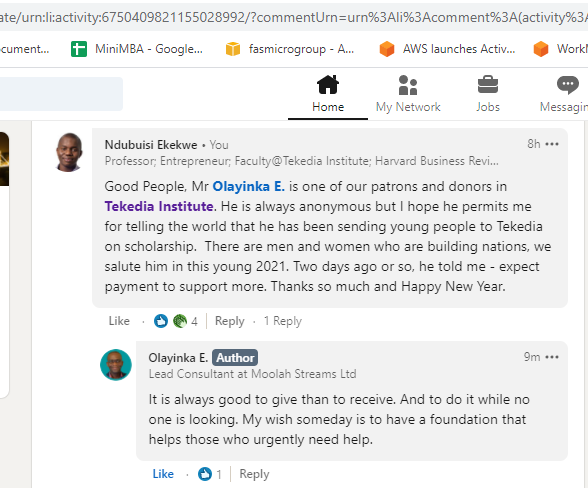
I just unmasked one donor – and I want to thank him here.

Outperforming Your Capabilities And Fixing Root Cause of Failures

0
Source: Titanium Success

Whenever you have a setback, besides looking at the outcome, spend more time on the process that leads to that failure. A student who graduated with a poor grade in a university should examine his/her actions in school. It is only by looking at that process that the student will avoid repeating poor grades in future life endeavors.

If you worked hard, gave your best and ended up with poor grades: the world has a future for you. That attitude will lead to opportunities. Do not beat yourself down!

Companies hire top graduating students not necessarily because they are the smartest BUT because being the top of the class symbolizes dedication, commitment, and focus. The implication is that if the student (now worker) commits to those principles at work, the company will win.

Simply, grades are barometers to ascertain your tenacity level: can you set a goal (here A-grade) and get it done? I was a bookworm in university: yes, the too-much reading type because I knew I was not the smartest in class. But I knew if I worked hardest, I would come on top.

That is a principle I apply in life: put extra efforts, knowing that the biggest failure is NOT fixing things that lead to failures.

This piece was culled from this article which I wrote in the past.

The Biggest Failure is NOT Fixing Things that Lead to Failures

How to Evaluate Your Turn-Taking Skills

0

January is usually a time for meeting new prospects and making new contacts. The long holiday gives people the chance to socialise and interact with old and new friends and acquaintances. Most times, these “interactions” open the door for better jobs and business deals. But then, if things turn out wrong, the opportunities could be lost. This is why it is necessary that everyone learns communication skills, especially those needed for oral communications. In this case, turn-taking is a skill needed to impress participants in a communication event.

Turn-taking is a communication skill that enables participants in a communication event to take turns with sharing the roles of listeners and speakers. This skill is very important in conversations, whether it is face-to-face interactions or the ones done through other channels (e.g. telephone). Turn-taking allows a speaker to finish up whatever he/she is saying before assuming the role of a listener. On the same hand, the skill ensures that other participants in the communication had the chance to speak. Hence, mastering turn-taking ensures that you don’t interrupt other speakers and that you don’t dominate the conversation. As a result, you need to know when to start talking and when to stop.

One of the problems people encounter is detecting when the floor is free for them to speak. A number of times, people interrupt communications thinking speakers are done with whatever they have to say. This usually creates wrong impression about the interrupter even though the interruption wasn’t deliberate. Nevertheless, one way of knowing when to speak is by being a good listener and attentively following the flow of interaction. That way, it will be easier to notice when the speaker’s voice pitch drops to signal he’s about to end his speech. Other than this, the listener should wait for an invitation to speak.

How to Detect Lack of Turn-Taking Skills

Sometimes it is difficult to determine if you have actually acquired this very important skill. In case you are unsure of yourself, observe how people react when you talk to them. If they are doing any of the underlisted, know that you are dominating the conversation.

  1. Your speech is cut off. This happens when you talk too much. In this case, other participants in the communication may begin to interrupt you rudely. Some may go as far as telling you to give others a chance to talk. It is wise to avoid this embarrassing situation and so, you need to be on the lookout for other telltale signs.
  2. Listeners begin to yawn and fidget. If you notice your listeners are stifling yawns, falling asleep, exchanging looks, snickering, or fiddling with their phones, bags, keys, and other objects, it is a telltale sign they are becoming uncomfortable with your long talk. It is also a sign of boredom. Whenever you notice any of these, roundup your speech and give others a chance to talk.
  3. Listeners drop off the conversation. If people, especially those you want to impress, begin to excuse themselves, or just walk away, when you’re talking, it’s a bad sign – the conversation is getting one-sided and, maybe, boring.
  4. Topic of discussion is abruptly changed by listeners. This always feels rude whenever it happens but it is done to recover the stage stolen by the speaker. The problem here is the speaker is hardly given a chance to participate in the conversation again.
  5. Interruptions are stopped. As referred earlier, most times people don’t realise they are interrupting speakers until their attention is drawn to it. So, if you are told “Let me/him/her finish, please,” “Hold on, please,” “I am not done yet,” “Don’t interrupt me/him/her,” and many other such expressions, it is a sign you are interrupting the speaker and it is not welcomed.

Importance of Turn-Taking

Most at times people don’t understand the reason they should wait for their turn to speak or why they should not dominate conversations. Well, mastering this skill and applying it duly give the impression that you are respectful, cooperative, observant, humble, and organised. Not observing this simple communication skill could create a wrong impression about you, which will in turn deny you of several opportunities.