The boy is focusing on what matters: he wants light to see tomorrow – and he is reaching higher. As the dawn of 2021 arrives, I want you to reach further, and send your staff and team members to an innovative business school in Africa right now. Our rating is 4.9/5 – and we lost that 0.1 because of our platform. Now, from the next edition starting Feb 8, we are moving to a new platform. Supremely amazing!
Make a great decision to begin the new year – prepare your team at Tekedia Mini-MBA.
Tekedia Institute Mini-MBA is a school where business leaders from Shell, MTN, KPMG, Flutterwave, Nigerian Breweries, Microsoft, Infoprive, Krozu, Access Bank, Schlumberger, and indeed great gloCal companies teach. Why not learn from the best? Begin here.
Tekedia Institute offers an innovation management 12-week program, optimized for business execution and growth, with digital operational overlay. It runs 100% online. The theme is Innovation, Growth & Digital Execution – Techniques for Building Category-King Companies. All contents are self-paced, recorded and archived which means participants do not have to be at any scheduled time to consume contents.
It is a sector- and firm-agnostic management program comprising videos, flash cases, challenge assignments, labs, written materials, webinars, etc by a global faculty coordinated by Prof Ndubuisi Ekekwe.
If you are a digital challenger bank, in Africa, and you have no plan to charge the typical banking fees, from customers, what is your future? Also, if your balance sheet remains small, do you not think that traditional banks can match your no-fee model with a service, and by doing that freeze your growth? Across the globe, most digital challenger banks (N26, Revolut, Monzo) are loss-making companies despite having millions of customers.
Yet, I have written on innovation hangover which makes it hard for mature/traditional companies to match the agility of startups. Another element is the cost model where a startup could technically capture value, in markets where mature firms may struggle, due to the positioning at the edges of a smiling curve. That positioning connects to cost efficiency due to the absence of legacy systems and structures in startups when compared with traditional competitors.
For example, a digital bank in Nigeria could have one office (the app/website) to serve all states in Nigeria while a commercial bank has physical branches across the nation. Those branches are cost centers, bringing inefficiencies to the allocation and utilization of factors of production.
So, on that construct, digital challenger banks have opportunities as they can through their playbooks redesign the markets by stimulating new needs in the customers. In other words, customers who bank free could be conditioned to pay for non-banking services, through the platforms, and in that process, the new banks could capture value. How? Become an operating system in the financial lives of the users: “But for the new banks, becoming central to users’ lives is the key to accessing the wealth of data needed to nudge them toward the right products, and making money in the process.” Those products include lending, wire transfer, remittance, and others.
“The important place in people’s financial lives is where the data is,” said Starling Bank CEO Anne Boden.
Partner firms plug into the apps, creating a “marketplace” of services ranging from loans and investments to insurance and energy, and paying the banks a fee whenever a customer signs up to their offering.
The banks will rely on this for income to varying degrees.
In Nigeria, that would not be that easy as you need massive scale to create value for your partners. But there is a consolation that the model could work when you examine how companies innovate and the incentives around them.
In this piece, I explain why startups win, despite the efforts of older companies who challenge them in new areas they are pioneering. The older companies can come with money, experience and technology, but most times, they are solving problems, with the wrong incentives. Consequently, they adjust the problems to accommodate their incentives and in the process, solve an entirely different problem, resulting to loss. You read it from me: African and specifically Nigerian startups, you can win and do not be bothered by the big companies. Your incentives are different and those are inherent advantages for you.
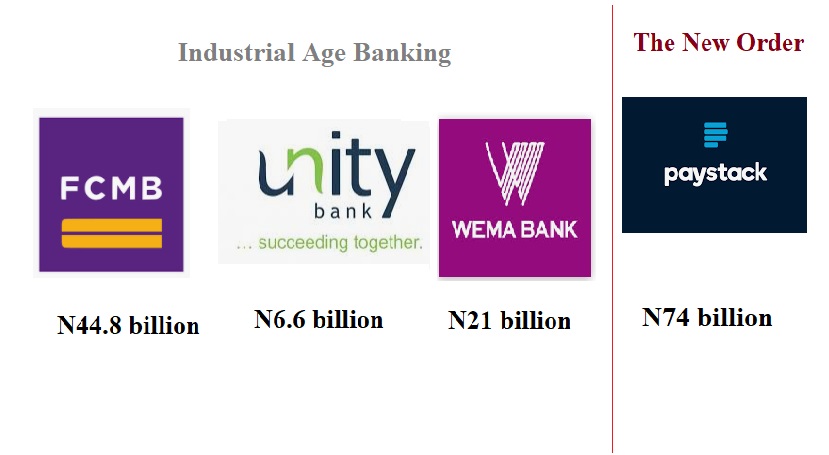
Simply, provided the challenger banks keep their incentives right, they can capture value even when the traditional competitors wake up from an innovation dilemma in the sector. While not a digital bank, Paystack demonstrated upon its acquisition, that value could come in many ways, when its market cap was put ahead of a combined market cap of Wema, Unity and FCMB in the Nigerian Stock Exchange.
The Nigerian Stock Exchange (NSE) pulled off surprising performance in the face of global economic meltdown induced by COVID-19 pandemic to rank the best in the world’s stock markets.
A Bloomberg report said Nigerian stocks are headed for their highest annual gain in seven years riding on low yields in fixed-income markets.
Nigeria’s equities benchmark index recorded its highest return, rising 45.7% this year. The report said it’s the most among 93 equity indexes tracked by Bloomberg, and makes the NSE the best performing stock market year-to-date.
The unprecedented performance was attributed to investor’s appetite for riskier assets, which have remained strong due to persistent low yield on fixed-income instruments, Bloomberg said, citing Chapel Hill Denham’s note to clients on Tuesday. It added that it has been buoyed by traders positioning for Dangote’s share buyback program which is billed to hold this week.
Denham said the equities will continue to outperform bonds in 2021 given the current overstretched fixed-income valuations.
The report said the Lagos bourse gained 0.75% to 39,092 as of 13:47 p.m local time, to reach its highest level since June 2018.
The all-share index which opened at 38,800.01, inched higher by 310.16 points or 0.80 percent to cross the 39,000 mark and close at 39,110.17.
Also, the market capitalization rose by N167 billion to close at N20.446 trillion compared with N20.279 trillion achieved on Thursday before the Christmas and Boxing Day holidays.
Year-to-date returns are currently at 45.7 percent; the best annual return since 2013.
According to analysis by TheCable, investors had booked N7.31 trillion in gains as of December 22, 2020. The rally was also supported by the dovish stand of the Central Bank of Nigeria (CBN).
The apex bank cut the base monetary policy rate by 200 basis points to 11. 5 percent, in order to boost lending, discourage savings and drive growth to counter the pandemic effect on the economy, while also keeping rates low in the fixed income market.
Excess liquidity (created by CBN’s OMO restriction), the hunt for double-digit yields and depressed pricing, helped to rekindle local interests in the equities market in 2020.
Boss of NSE
The uptrend recorded at the end of trading on Tuesday was driven by price appreciation in medium and large capitalised stocks amongst which are; BUA Cement, Zenith Bank, Access Bank, NPF Microfinance Bank and NEM Insurance.
A breakdown of the price movement chart shows that Jaiz Bank dominated the gainers’ chart in percentage terms with 10 percent, to close at 66k per share.
NEM Insurance followed with 9.56 percent to close at N1.49, while Lasaco Assurance rose by 8.82 per cent to close at 37k per share.
NPF Microfinance Bank improved by 8.39 per cent to close at N1.68, while Japaul Gold and Ventures appreciated by 8.33 per cent to close at 52k per share.
Conversely, NCR led the laggards’ chart in percentage terms, losing 9.68 per cent to close at N1.96 per share.
FTN Cocoa Processors trailed with 8.99 per cent to close at 81k, while Trans-Nationwide Express shed 8.86 per cent to close at 72k per share.
Chams shed 8.70 per cent to close at 21k, while AXA Mansard Insurance lost 4.76 per cent to close at N1 per share.
Also, the total volume of shares traded rose by 85.4 percent with an exchange of 722.57 million shares worth N4.38 billion in 5,042 deals.
This was in contrast with a total of 381.72 million shares valued at N7.97 billion exchanged in 2,925 deals on Thursday.
Transactions in the shares of AIICO Insurance topped the activity chart with 273.13 million shares valued at N326.09 million.
Oando followed with 81.45 million shares worth N323.33 million, while FBN Holdings traded 41.09 million shares valued at N294.21 million.
Access Bank traded 40.14 million shares worth N353.27 million, while Champion Breweries transacted 36.33 million shares worth N30.16 million.
In a bid to ease investors’ concern emanating from the recent antitrust probe on Alibaba and Ants Group by the Chinese government, the company is considering a holding company with regulations similar to banks. Bloomberg made the report citing sources.
Alibaba and Ant have been at the center of antimonopoly investigations by the Chinese regulators, which has impacted their stock negatively over the past weeks.
Now Ant is planning to fold its financial operations into a holding company that could be regulated more like a bank, according to people with the knowledge of the plan.
The lead figure in Ant, Jack Ma, got into trouble with the Chinese government earlier in the year, after he criticized the regulatory bodies over what he called “pawnship mentality” and not knowing the difference between supervision and regulation.
To get out of the trouble, Ant is planning to move any unit that would require a financial license into the holding company, pending regulatory approval. The people who spoke on anonymity with Bloomberg said the plan is still under discussion and subject to change.
According to the report, the operations that Ant is looking to fold into the holding company include wealth management services, consumer lending, insurance, payments and MYbank, an online lender in which Ant is the largest shareholder. But under the financial holding company structure, Ant’s businesses would likely be subject to more capital restrictions, potentially limiting its ability to lend more and expand at the pace of the last few years.
It added that the proposals suggest Ant would still be able to operate in financial services beyond its payment business, and that will ease investors’ concern about how to interpret the central bank’s directive, asking Ant to return to its root as a payment lender.
“This means China is still trying to encourage domestic consumption, and they need platforms like Ant to help with consumer loans. The key is that consumer lending shouldn’t be over-leveraged,” said Wang Zhen, a Shanghai-based analyst with UOB-Kay Hian Holdings Ltd.
It has become clear that China is not trying to break up Ant Group, but subject it to regulation, although regulators told Ant to devise a plan to overhaul its business. Under the new model, the financial segment of Ant will have to be run in harmony with the regulatory policies of China’s finance industry, but rules on how financial holding companies could be regulated are still under deliberation.
Alibaba office
The news of a possible solution has softened the tension surrounding Ant’s stocks and its investors are beginning to heave sigh of relief. Japanese conglomerate, SoftBank Group Corp, who has the largest share in Alibaba recorded a 4.5% rise, the most in over two weeks, while Alibaba shares rose 5.7% in Hong Kong.
While operating as a holding company will offer Ant a way out of the government’s grip, it will also diminish its revenue and stymie growth.
“Its growth would slow a lot. The valuation of the non-payment business, including wealth management and consumer lending, could be slashed by as much as 75%,” said Francis Chan, a Bloomberg Intelligence analyst in Hong Kong.
Ant’s IPO filing stated that it held $11 billion in cash and equivalents as of June. The company said in its prospectus in October that it would use its subsidiary Zhejiang Finance Credit Network Technology Co. to apply for the financial holdings license.
But as Bloomberg report notes, under the rules announced in November, non-financial companies which control at least two cross-sector financial institutions are required to hold a financial holding license.
Part of the new rule says the use of asset-backed securities to fund consumer loans capped at four times net asset value; loans using funding from banks and shareholders shouldn’t exceed firms’ net asset value, and regulators will have to cap interest rates charged on consumer loans.
Chan said Ant will need to inject an estimated 70 billion yuan ($11 billion) at least, as a new capital for its lending business. The calculation is based on draft rules that require Ant to co-fund 30% of loans, with a maximum asset leverage of five times.
He added that Ant’s valuation could plunge below $153 billion as a result of the changes it will undergo as a holding company. The company was above $300 billion in November, before its IPO was halted.
According to one person familiar with the matter, Ant is planning to leave its digital lifestyle business – the services that link users with food deliveries, on-demand neighborhood services and hotel bookings – out of the financial holding company. He added that Ant will still be the parent of all the operations.
However, the person explained that Ant is not planning to break up now, but it’s seeking more guidance from regulators on acceptable steps to take and may change every plan based on the feedback.
I mentioned a travel subscription in my 2021 Outlook video. Yes, the idea is that you can pay a flat subscription fee for, say Arik and Air Peace in Nigeria, and fly as much as you want locally [that does not exist in those airlines as I write]. Is that a nice idea? Some arealready on that redesign: “Costco has partnered with WheelsUp to offer a yearly private jet subscription”.
The pandemic wreaked havoc on the travel industry in 2020: international travel all but halted for many countries; airlines filed for bankruptcy protection; traditional tourist hotspots have become coldspots. In response, the travel industry has been forced to rip up big chunks of its playbook and start fresh. One idea gaining traction? Travel subscriptions. Costco has partnered with WheelsUp to offer a yearly private jet subscription for $17,499.99. Tripadvisor is launching a yearly subscription service called Tripadvisor Plus for $99, which offers access to travel deals and other perks.
The idea is not really bad. It all depends on the price. If the price is fine, many will go for it. For the airlines, they will have a more predictable revenue model, and that could be a good thing for them. Largely, even during lockdowns and pandemic, the revenue is locked for good!
Yet, there is risk for airlines: people can just buy the subscription and decide to be sleeping on air. After all, Nigeria remains the only place I know where people found peace, doing a wedding reception in a rented aircraft in the mid air, as a sign of affluence! So, some will tour if you give them an open annual subscription.
So, it comes down to the right equilibrium point. Yes, finding the optimal pricing point would be the secret sauce in this latent business model.