DD
MM
YYYY

PAGES

DD
MM
YYYY

spot_img

PAGES

Home Blog Page 5974

Key 5 Trends That Will Shape Nigerian Facilities Management Industry in 2021

0

Before 2020, many industry reports indicated that the Nigerian facilities management industry is growing at varying compound annual growth rate. Reports have also indicated that the industry cannot be immune from the impacts of global and national macroeconomic policies that would affect industries in 2021. As the year 2020 going to an end, our analyst examines the critical issues and needs that shape the industry in 2021.

One of the significant issues that players and professionals would not forget in 2020 is the emergence of Covid-19, which ravaged the world. The disease came at a time that captains of the industry and professionals are seeing some benefits of applying emergent strategies towards sustainable opportunities capturing and unlock the growth. In 2020, we have seen how the disease forced companies to redesign their processes and strategies. When the disease was hitting every sector and industry harder, our analyst noted that the players and professionals in the industry needed to make a number of critical shifts.

Intensify Social Distancing at Work and Public Places

Like what happened at the critical stage of the virus spread in 2020, people at the workplace and public places would be forced to observe social distancing in the first quarter of 2021. This will largely be connected with the new variant of the disease recently found in Osun State and other places. This is a big issue for facility managers who will manage soft and hard facilities including the critical ones, which cannot be left for hours without preventive maintenance strategies. Nigeria, like other countries where the disease is having impacting lives, has registered its interest in taking delivery of vaccines in early 2021. In this context, social distancing will be one of the significant measures. With this, social distancing is expected to be an issue for players, especially those that provide healthcare facilities management solutions. Both the players and professionals are expected to consider some strategies and protect people from contracting the disease.

Smart Processes, Execution and Monitoring

Significantly, Covid-19 changed the system thinking, process and execution approaches of many companies in 2020. As the second wave started in early December 2020, we expect more use of Internet of Things and remote control for project initiation and execution. We expect companies that have the capabilities and the needed resources to use technology driven applications for asset tagging, lighting. HVAC repair and maintenance, security, inventory management and equipment monitoring. We expect more operational disruption because the spread of the disease would force the government to make some critical decisions. In this regard, companies need to create superior processes towards the reduction of possible effects of the decisions.

More Innovative Solutions

In 2019 and 2020, Alpha Mead, Global Property and Facility Management International and some other players developed innovative solutions. These solutions have added value to the industry before the disease emerged. In 2021, these companies and emerging ones would develop new solutions and initiate projects with the intent of justifying their purpose of existence and increasing Nigeria’s recognition globally. Eliezer Workplace Management Limited, Green Facilities Limited, Global Property & Facilities International Limited, GreenKey Facility Management Services Limited and Principal Facilities that won various awards in 2020 are expected to justify the recognition bestowed on them by Business Day newspaper.
As Covid-19 Cases Surge, Nigeria Should Do All To Avoid Another Shutdown

0
Nigerian leaders

Covid-19 cases in Nigeria are surging, and that is a very big problem. Looking at the state of the economy at the moment, another lockdown would be extremely challenging for the nation. Yet, you have human lives at risk. Personally, I will not vote for another shutdown (do not attack me for writing that, see this as a debate); the cascading impacts on a shutdown will trigger an avalanche of more unemployment, extended recession and higher level of insecurity.

My proposal would be the following:

  1. Get the National Orientation Agency (NOA) to do its job and make people take Covid-19 more seriously by wearing masks, practicing social distancing, etc. That messaging should reach religious bodies, companies, tribal leaders and the whole citizenry.
  1. Enforce the covid-19 safety protocols as documented by Nigeria’s center for disease control. Do this through monetary fines and be thorough on the execution of the framework.
  2. Encourage work from home where possible; this of course is theoretical as our telcos continue to underperform on providing reliable internet services. But yet, push and encourage that as any effort helps.
  3. Safely guard the international airports. The news that Nigeria has suspended 100 passports of people who arrived from abroad, but refused to do the follow-up covid-19 tests, while extreme, should be a lesson. If that is what the playbook says, we need to enforce everything.

Sure, we can “lockdown” some sectors like sports, nightclubs and some activities which bring many people together at scale in restricted spaces. But apart from those, Nigeria needs to do all to avoid another shutdown.

Fundraising via Grants, DFIs, and Governments – Victoria Madedor, Bank of Industry ITC

0

In this Tekedia Live, Victoria Madedor,  of Bank of Industry ITC, discusses fundraising via the paths of grants, development finance institutions (DFIs), and governments. The topic is Fundraising via Grants, DFIs, and Governments.

As we welcome Tekedia Mini-MBA new class, in Feb 2021, we are creating a more streamlined system which will help members discover conversational contents in close to 200 videos in our archives.

Those videos cover any topic in modern commerce and industry, from industry veterans, practicing in five continents. We will be sharing some of these videos during the holidays in case you have free time to listen.

But the full archives will be here – https://school.tekedia.com/ . These are not our courses but webinars during live sessions in our programs.

Updated: video moved to archive in school.tekedia.com. Go there and watch.

Managers and Administrators could conveniently deal with the Moral Licensing Syndrome when they seek more knowledge – Ismail Tiamiyu

0

Ismail Tiamiyu is a new author in the block. He recently published a book on one of the less focused areas in human resource management- the Moral Licensing  Syndrome. He shares his excitement on the new book, the launch details and his future intention to contribute more to the development of quality human resource management with Rasheed Adebiyi. Here are the excerpts of the interview.

Tekedia: Could you please tell me about yourself?

Ismail Tiamiyu: I am Ismail Ayotunde Tiamiyu. I am a researcher and writer; I work as research and development officer at FarmKonnect Nigeria, one of the leading Agritech companies in Nigeria. My experience as a researcher at FarmKonnect has been quite thrilling — not only have I been exposed to the socio-political realities in the corporate setting, but I have also been afforded the opportunity to identify and solve problems, especially process related and management related problems in organizations. Therefore, my book was inspired mainly by the need to solve Human Resource Management related problems in the work economy. More so, having my first degree in sociology from the University of Ibadan has inculcated in me a motivation to always seek to understand human behaviours and appraise issues through sociological imagination. I have been taught by the best minds in the country, and I am proud of my Alma mata.

Tekedia: You recently wrote a book to be launched in the new year, what motivated you to write the book?

Ismail Tiamiyu: Well, like I have said earlier, the book is my own way of contributing to knowledge and resolving problems usually generated by Moral Licensing Syndrome in the workplace. More so, I aspire to direct the attention of administrators, employers and managers toward some organisational practises that are often taken for granted but are actually integral to promoting growth-driven processes and resolving Moral Licensing Syndrome in organizations.

Tekedia: What are the major takeaways and for whom are the book are meant?

Ismail Tiamiyu: Major takeaways from the book include how employers and managers can best deal with the issues generated by Moral Licensing in the organisation, and secondly, how employees or individuals can leverage their tendency for licensing to attain optimum efficiency rather than create deficiency in their respective vocations.

Tekedia: Tell us more about the launching?

Ismail Tiamiyu: The book will be launched on the 16th of January 2021. Launching is going to be virtual, utilizing both Zoom and Facebook. The event will be chaired by Professor Ndubuisi Ekekwe of the Tekedia Institute. Professor has contributed immensely to human capital development and the success of many businesses in the country through his pedagogical and entrepreneurial prowess. My experience under his tutelage is one of the factors that actually inspired the production of the book. The Chief Launcher for the day is Mr Azeez Oluwole, Founder and CEO, FarmKonnect Nigeria. My Boss and mentor, Mr Oluwole is another significant influence on the production of the book. And Lara Yeku, Head of HR, Flour Mills Nigeria will give a review of the book.

Tekedia: What is next after this book? Should the world expect another gift from your pen?

Ismail Tiamiyu: I hope to produce a second edition of the book, working in conjunction with interested scholars with more experience in the subject matter. I am very optimistic that 2021 is going to be a massive year, and I am prepared to give the best to my readers and also expand the pool of my audience.

Why Nigerians Should Have Patience on New CBN Remittance Dollar Policy

1

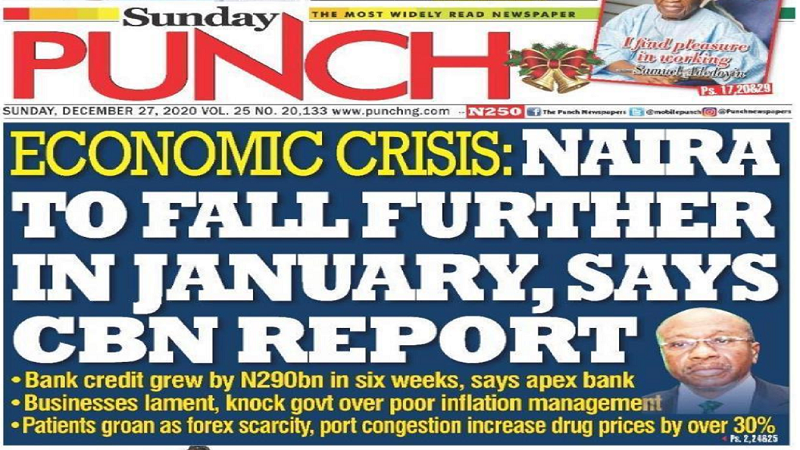
The Punch punched with a hard cover page today – “Economic Crisis: Naira to fall further in January, says CBN Report”. Largely, the Punch is correct.  I had written on Dec 4, 2020 when the new Central Bank of Nigeria (CBN) remittance policy was announced: “This new policy will attain a full steady state in late Q1 2021 as there are many backlogs for foreign currency that any immediate supply would be swallowed up quickly.”

This new policy will attain a full steady state in late Q1 2021 as there are many backlogs for foreign currency that any immediate supply would be swallowed up quickly. Also,  due to Christmas holiday coming, economic activity will slow down. But from March 2021, Naira will stabilize with the official and black rates fairly closer, provided Covid-19 does not add another shock in the crude oil market which may rattle the world oil demand. As I write, crude oil prices are hitting to close a 5th week of gain; a $50 per barrel on Brent crude is just around the corner.

Simply, markets will open after Christmas holidays, and since the CBN remittance dollar policy, the first time we would test demand supply equilibrium would be in January, not December, as the implementation was already late for importers to place global orders, before the holidays. So, what I expect to happen is this: more people will need US dollars and coupled with many backlogs, Naira will experience marginal pressure in January.

However, by the time we hit late March, those backlogs would have been served through more dollar supply, coming from the policy and that would begin to adjust the forex pricing equilibrium point. I expect Naira to stabilize to USD by late Q1, and then gain marginally from Q2 2021. But by January, it will lose marginally because demand will be huge with a flat supply base. That is fundamental economics.

Our main challenge remains inflation. Prices of some food items must stabilize and that is a more urgent policy focus for the apex bank. In short, in the last eight days, prices of some food items have started coming down with the opening of the border. I do not know if that is due to smuggling or legal imports, but prices will continue to fall as supply keeps getting into the nation via many borders.

A big challenge in Nigeria is how to fund new generation companies while managing inflation. Technically, our banks should lend at a low rate but that is not possible, as I have explained since they get the funds at around 11% from the apex bank (unlike peers in the US where the Federal Reserve ships money to commercial banks at 0.25%).

But in Nigeria, starting at 11% made it impossible for banks to match that.  Because they have to move above 17%, it creates a vicious circle which makes things harder. See it this way – at that 17%, most SMEs cannot return whatever banks have given them, setting the banks up for losses. Simply, there are few businesses in Nigeria where you can make profits when your cost of capital is 17% before taxes to repay your loans.

[…]

Yet, before we begin to criticize CBN, it has to manage inflation and because of that, it cannot lend to banks at 1% which you can get in the U.S. as Nigeria’s economy is not structurally similar to the U.S. That paradox is the risk element in Nigeria. The rates we need to unlock entrepreneurial capitalism cannot easily happen without taking inflation to a level that would destroy the economy.

Inflation is the reason why the central bank cannot lend to Nigerian banks at 0.25%. But if there is a way we can overcome that paralysis, we will have resources for SMEs (small and medium scale companies ) and startups to fund the innovations and economic opportunities of the future. 

(My position remains that Nigeria should map out $1 billion with matching funds with credible venture funds, private equity funds and banks, to invest in Nigerian companies. That is the Israeli model where the investors co-invest with the government and manage all aspects of that process. It will then make it easier for companies to have cheap capital while not affecting the apex’s bank ability to manage inflation. Simply, banks cannot efficiently fund the future Nigeria because the lending rates make no sense. But Nigeria can pick Israeli model and drop this $1 billion yearly and unlock the future in SMEs and startups. )

If we look at the Nigerian Stock Exchange, the companies established in early 1990s (GTBank, Zenith Bank, etc) remain dominant. Ideally, we ought to be creating such every five years but since that 1990 we have stalled. Interestingly, the miracle of the 1990s happened, due to the boom of finance houses, where funding was relatively in abundance, even though fraud was also rampant.

My point is this: let us have patience on this new policy; we ran it before, and it was largely positive in the economy. It has a really good chance of stabilizing the naira to US dollars, even as we plan to do the hard things which include a productive base. Managing currency without improving productivity and exports is an illusion. Diversifying our economy from crude and boosting production with exports are the core ways we can have a long-term solution to this currency paralysis. And if we achieve the targets, that desire of a $3 trillion economy will materialize.

It is very possible with the massive latent opportunities. And I want to put that in our minds as we close the 2020 chapter. Yes, Nigeria can grow to become a $3 trillion economy by 2035, from the sub-$500 billion of today. There are core critical pillars we need to pursue as a nation with dogged determination and fierce urgency of now.


The Central Bank of Nigeria (CBN) Had A Great Week On Policies