DD
MM
YYYY

PAGES

DD
MM
YYYY

spot_img

PAGES

Home Blog Page 5977

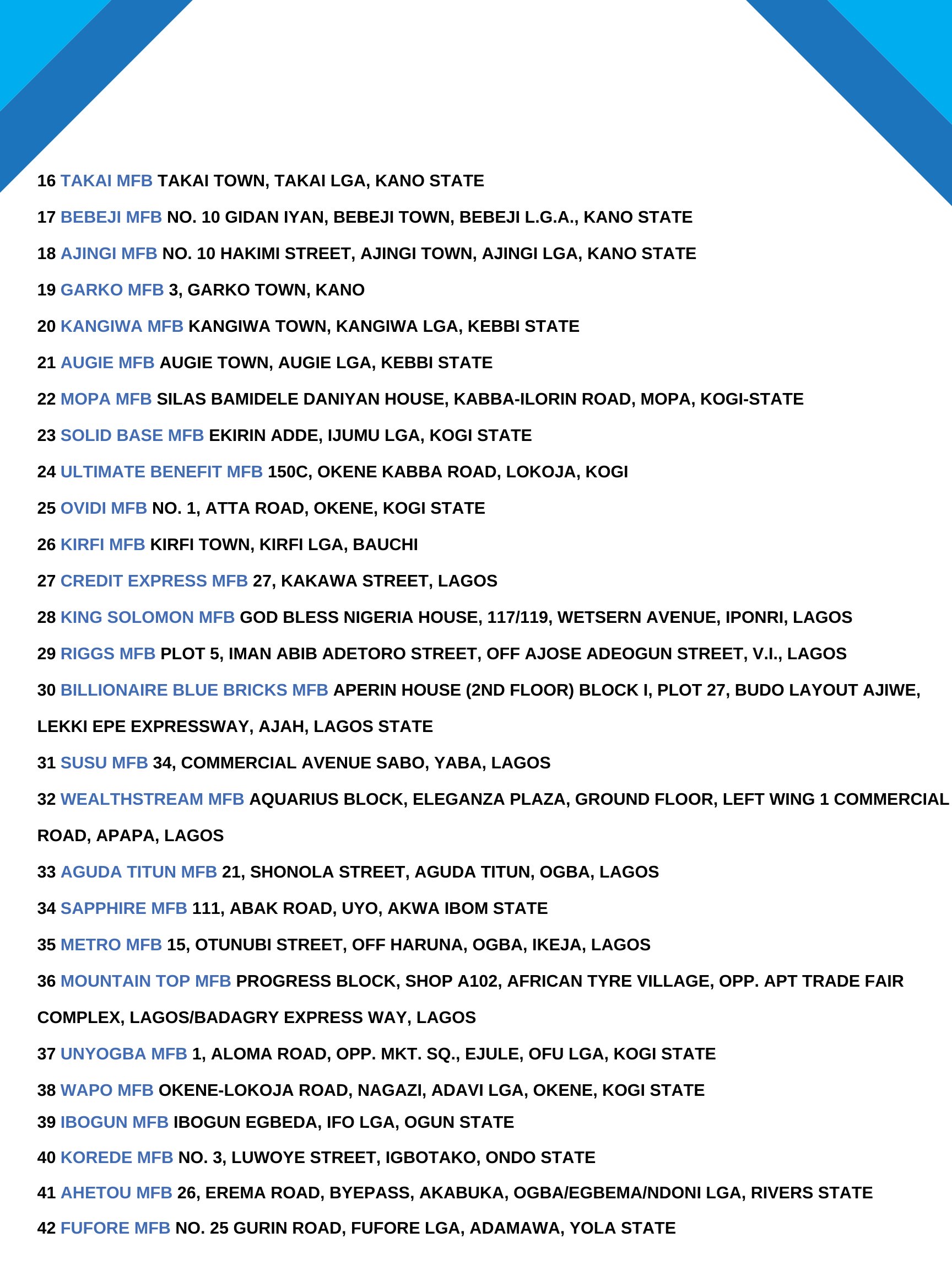
Full list of 42 Collapsed Microfinance Banks in Nigeria; Contact NDIC for Claims

0

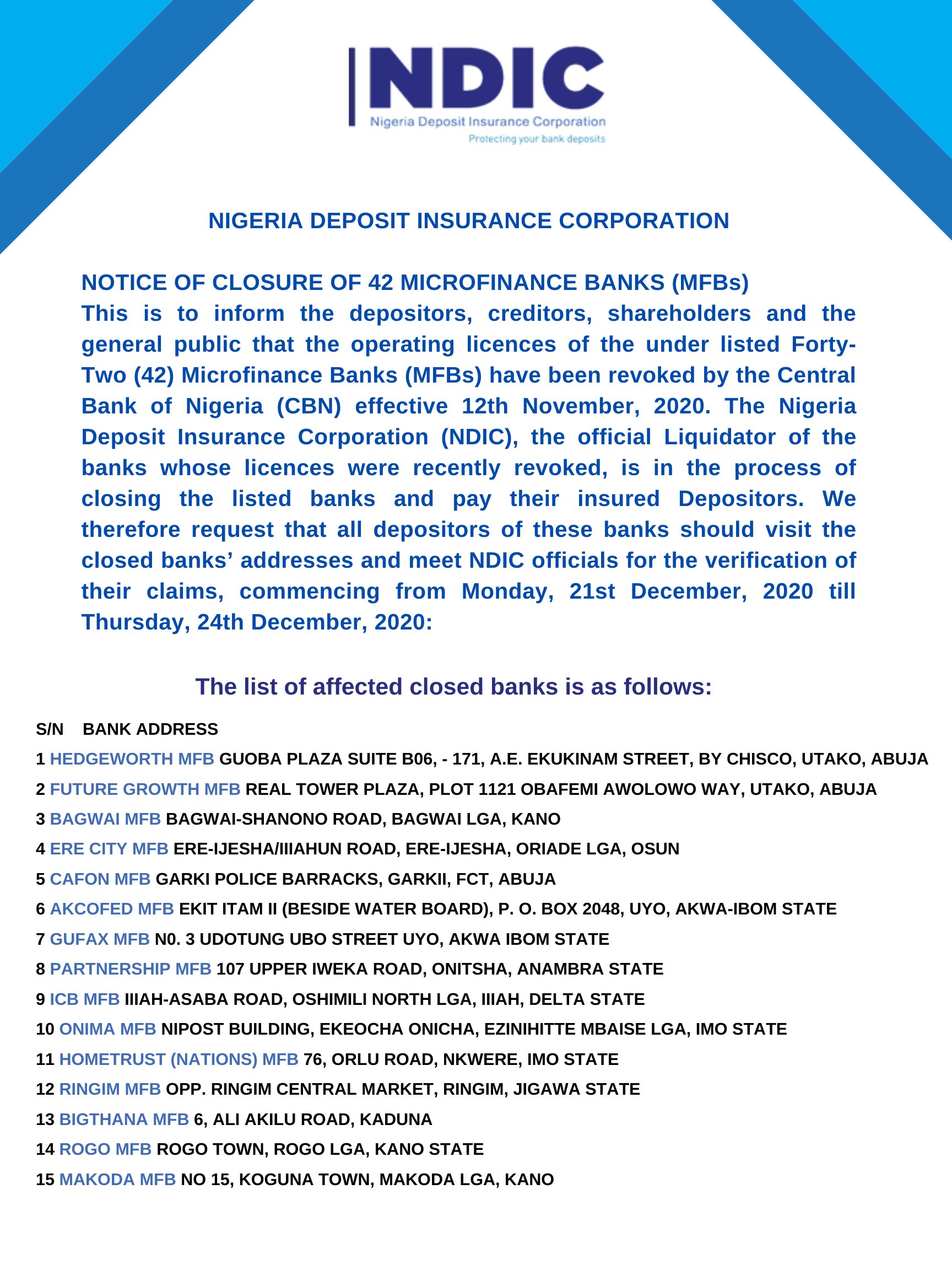
A notice from the NDIC (Nigeria Deposit Insurance Corporation) on collapsed microfinance banks in Nigeria.

  • “This is to inform the depositors, creditors, shareholders and the general public that the operating licenses of the under listed forty-two (42) Microfinance Banks (MFBs) have been revoked by the Central Bank of Nigeria (CBN), effective 12th November 2020.

  • “The Nigeria Deposit Insurance Corporation (NDIC), the Official Liquidator of the banks whose licenses were recently revoked, is in the process of closing the listed banks and pay their insured Depositors.

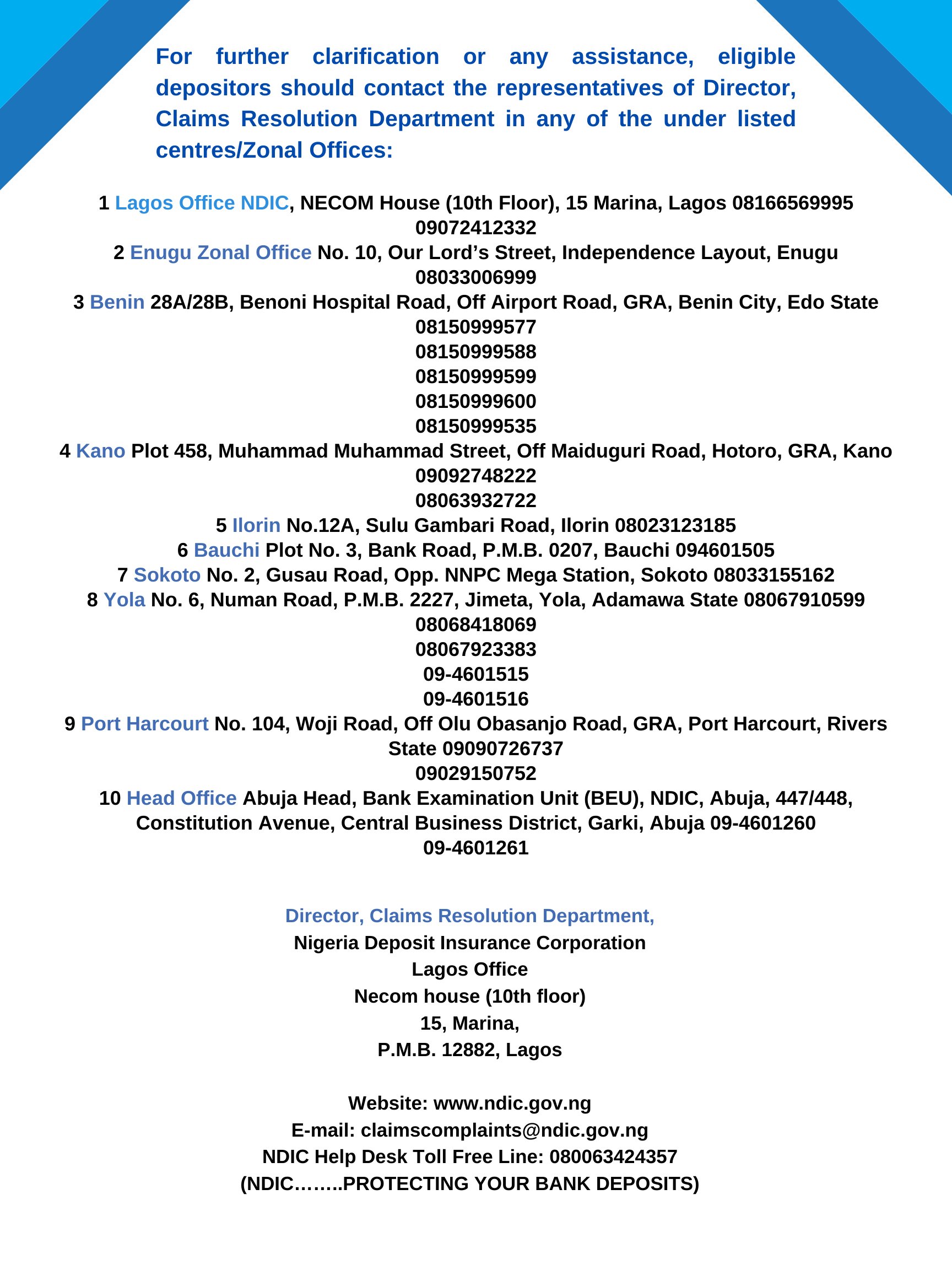
  • “We, therefore, request that all depositors of these banks should visit the closed banks’ addresses and meet NDIC officials for the verification of their claims, commencing from Monday, 21st December 2020 till Thursday, 24th December 2020.

Criticisms Trailing Kankara Boys’ Rescue: A Sign Nigerians No Longer Believe in Nigeria

0

Many Nigerians have lost hope in the country. They expect the country to fail and crumble. In fact, they await sad information about the country everyday. To them, every bad thing that happens in Nigeria is expected but the good ones are suspicious. They believe nothing good happens in Nigerian government unless the leaders want to push an agenda. And so, when news of the rescue of the Kankara boys came in, many Nigerians received it with disdain.

When information about the kidnap of hundreds of students of Government Science Secondary School, Kankara Katsina State, which took place on 11 December, 2020, filtered in, the country was thrown into mourning. People, once again, remembered how incompetent the government is and called on the leaders to act fast and rescue the children. Protests were held, especially by Katsina residents, to demand for answers from the government.

 During the heat of the matter, information filtered in that the military has located the hideouts of the kidnappers and engaged them in gun fire exchange. When Nigerians did not hear anything more regarding this, they felt they were lied to by the military. However, confirmed news of the boys’ rescue came in on Thursday, 15 December 2020. But, surprisingly, it did not receive expected jubilation.

The rescue of the Kankara boys was greeted with suspicion. All of a sudden, the wind shifted from #BringBackourBoys to #OurBoysAreBack . The sudden turn of events was unexpected. But this suddenness isn’t the only problem here. The truth is that many Nigerians became suspicious of the government, believing there were more to the stories than meets the eye.

Some people first believed the news was fake and, when it was confirmed, they began to wonder how possible it is to rescue hostages from kidnapper’s den, especially when Boko Haram is involved. Even though the government insisted that Boko Haram was not involved in the kidnapping, Nigerians refused to believe them. So, instead of rejoicing that the boys are back, Nigerians asked for clarifications.

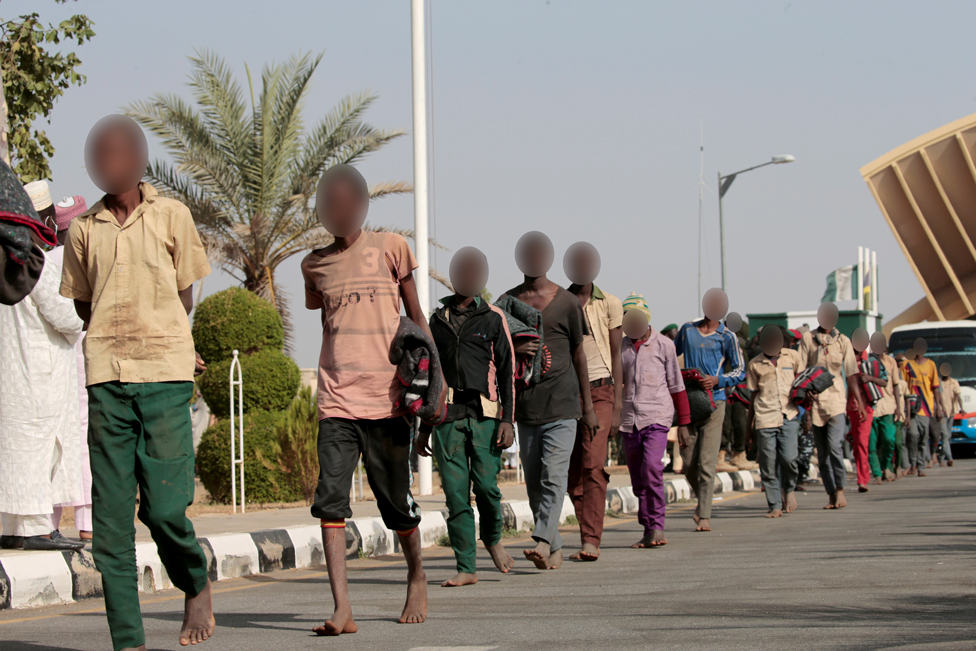
Hundreds of boys return after the attack

You might be surprised to learn that many Nigerians believe the kidnap was a hoax. While some said no kidnapping took place, others believed the government organised with the kidnappers to carry out the operation. The reason the government will engage in such a ludicrous act, according to them, is to fund insurgency, to loot public coffers, and to appear competent before the international community. It is quite alarming to see the sudden change in the behaviours of many people, who initially acted as if they wanted the boys rescued at all cost. But their behaviour pointed to one thing: they believed these boys will not and cannot be rescued.

The major thing that shocked Nigerians and caused them to doubt any kidnap happened was the fastness of the rescue. According to a friend of mine, Nigerian government is never fast in anything, so how come they acted fast here? Another person said top government officials want to prove their capability in order to restore their lost glory; hence they kidnapped those children and released them almost immediately to look professional and competent. So, whether the government acted in good faith or not does not influence the attitude of people like this. As far as they are concerned, the government has failed and will continue to fail in everything.

Note that the reaction of people towards this rescue is not because they are not happy the kidnapped boys have been rescued. For instance, if you accuse any of them of being a sadist, he will quickly remind you that he is happy the children are safe but that he is not happy they were kidnapped in the first place. If you ask him whether he would have still accused the government of staging a kidnap if these boys were not rescued on time or even at all, believe me, he will have no direct answer to provide.

Some insist the government was wrong to have negotiated with kidnappers instead of bringing them to book but they would want the government to do the same thing for them if they find themselves in Kankara boys’ condition. Others believe the government is supporting insurgency by using Miyetti Allah Cattle Breeders Association as the mediator during the negotiation process without specifically saying why. Most of the grievances and criticisms that follow the Kankara Boy’s Rescue do not hold water but Nigerians cling so hard to them. These and many more point to one important fact: Nigerians no longer believe in Nigeria.

Brexit and Covid-19: Tough Times for UK Economy

0
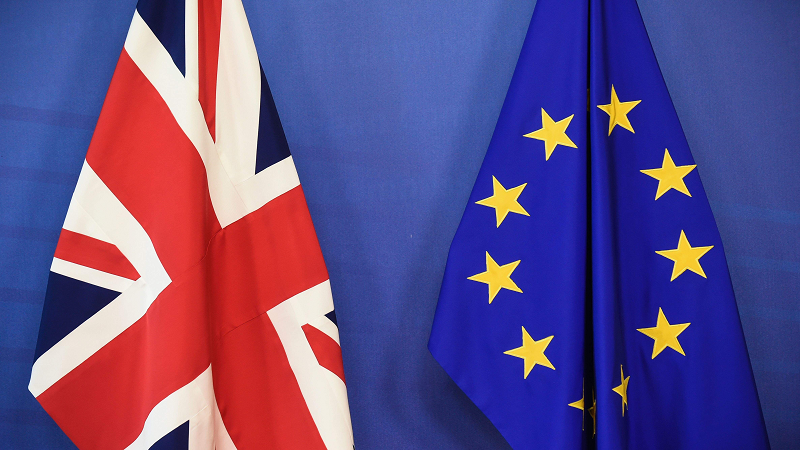
EU and UK has been policing US digital firms

As the second wave of COVID-19 hits the world, every country is fast developing measures to contain the spread of the disease. While the United States is banking on the newly approved vaccines to keep people safe, Europe is going back under keys.

The approval of the Pfizer BioNtech and Moderna vaccines offers hope of limiting the contagion of the pandemic, and a path to reopening of economies. Meanwhile, the surge in COVID-19 cases is presenting a challenge that is forcing governments to go back to the safety measures applied in the wake of the outbreak against the choice of keeping businesses running. And it comes at a time when Britain is confronting another challenge – Brexit.

The United Kingdom was the first country in Europe to administer the Pfizer vaccines, with millions of doses ordered to keep the economy from being shuttered once again. But the reality trumped the plan, forcing the government to choose lives over businesses.

On Monday, the discovery of a new strain of COVID-19, which spreads faster than others, was announced in the UK. England’s Chief Medical Officer Chris Whitty confirmed it in a statement yesterday.

“As a result of the rapid spread of the new variant, preliminary modeling data and rapidly rising incidences rates in the South East, the New emerging Respiratory Virus Threats Advisory Group (NERVTAG) now consider that the new strain can spread more quickly,” Whitty said.

Following this discovery, the British Prime Minister Boris Johnson announced tier 4 lockdown that will be broadly equivalent to November lockdown. The restriction will affect parts of Southern Britain that includes London, and will cancel the Christmas for UK residents.
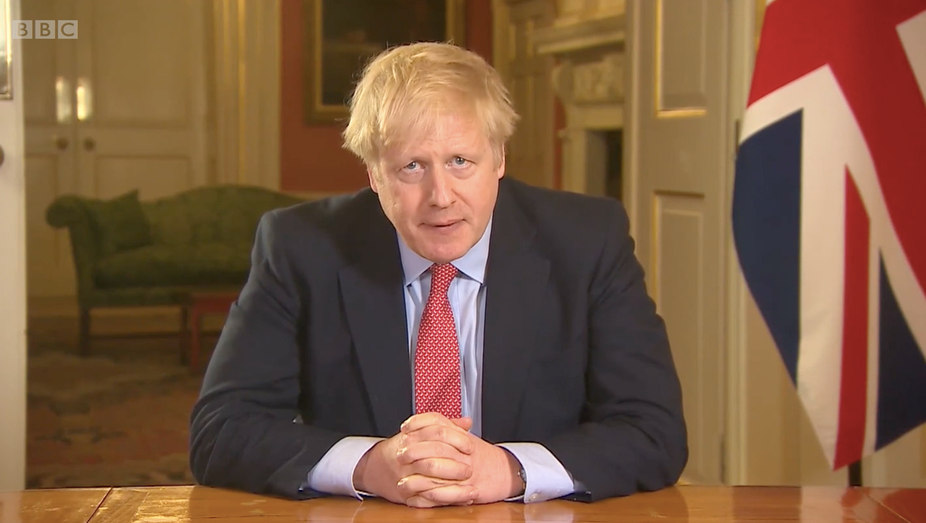
“It is with a heavy heart that I must tell you that we cannot proceed with Christmas as planned,” Johnson said.

On Sunday, the number of cases recorded in the UK surged to 35,928, resulting in 326 deaths. The rapid increase in the past seven days confirms the fears for a new strain and sends alarm across Europe. Italy, Germany, Netherlands etc. have announced flight restrictions and imposed lockdowns.

The UK is still reeling on the after effects of its recession, and the new phase of restriction is coming amidst Brexit negotiations that will have a serious impact on its economy. With less than two weeks before Britain says final goodbye to the EU, the global health crisis is stimulating a fresh situation that may stand between Britain and the EU bloc.

Both sides are on a race to safeguard almost a trillion dollars worth of trade from tariffs and quotas. Britain has been in a status quo transition period since it left Europe on January 31, and has till the end of the year to seal a deal.

The back and forth rhythm of the talks has been based on the EU’s demand for fishing right on British waters and creating a level playing ground and fair competition rules for both sides.

In October, the negotiation hung mainly on Britain’s attempt to renege on the Northern Ireland protocol, which includes keeping the border open between Northern Ireland and the Republic of Ireland, which was part of the agreement reached between Johnson’s government and Brussels last year.

As both sides moved on, the issue of migration keeps creeping in now then. The EU bloc has had it hard reaching an agreement on bailout funds due to issues relating to coronavirus restrictions, as each member state has a peculiar plan that seems offensive to the other.

While it seems that both the EU and UK’s citizens’ concern now is centered on their quashed Christmas, the newly discovered COVID-19 strain may likely prompt another migration-based demand on the negotiation table that will affect everyone.

British health minister Matt Hancock said the EU has been making unreasonable demands hindering a deal.

“We want these talks to reach a positive conclusion, of course everybody wants a deal,” he told Sky News. “Unfortunately, the EU have put in some unreasonable demands … they do not respect the result of the referendum … I am sure a deal can be done but obviously it needs movement on the side EU.”

Britain’s economic future hangs squarely on its ability to negotiate a great Brexit deal and contain the spread of coronavirus.

Presently, vaccines are falling short of the answer; the speed of the inoculation does not match the contagious speed of the virus. London has been left reeling on the choice of lockdown it has never been a fan of, but Brexit poses economic threat that is proportionately as dangerous to the UK as the pandemic.

Update Your Resume for New Roles – Remote Work Administraton [Apply]

0

Something new is in the labour market: remote work manager,  remote work administrator,  director of remote work, etc. Yes, companies are opening and hiring positions to coordinate the amalgam of professionals who are now working remotely, arising out of the massive dislocation from Covid-19.

In another sign that pandemic-induced remote work is here to stay, tech firms are taking on a new C-suite role: head of remote work. The Globe and Mail reports that Facebook just filled a director of remote work position in November, and identity and access management company Okta recently did something similar. A workplace strategist tells The Globe and Mail that “we jumped ahead a decade on how people want to work,” and he says more companies understand they’ll need someone to oversee the longer-term shift to remote work after the pandemic.

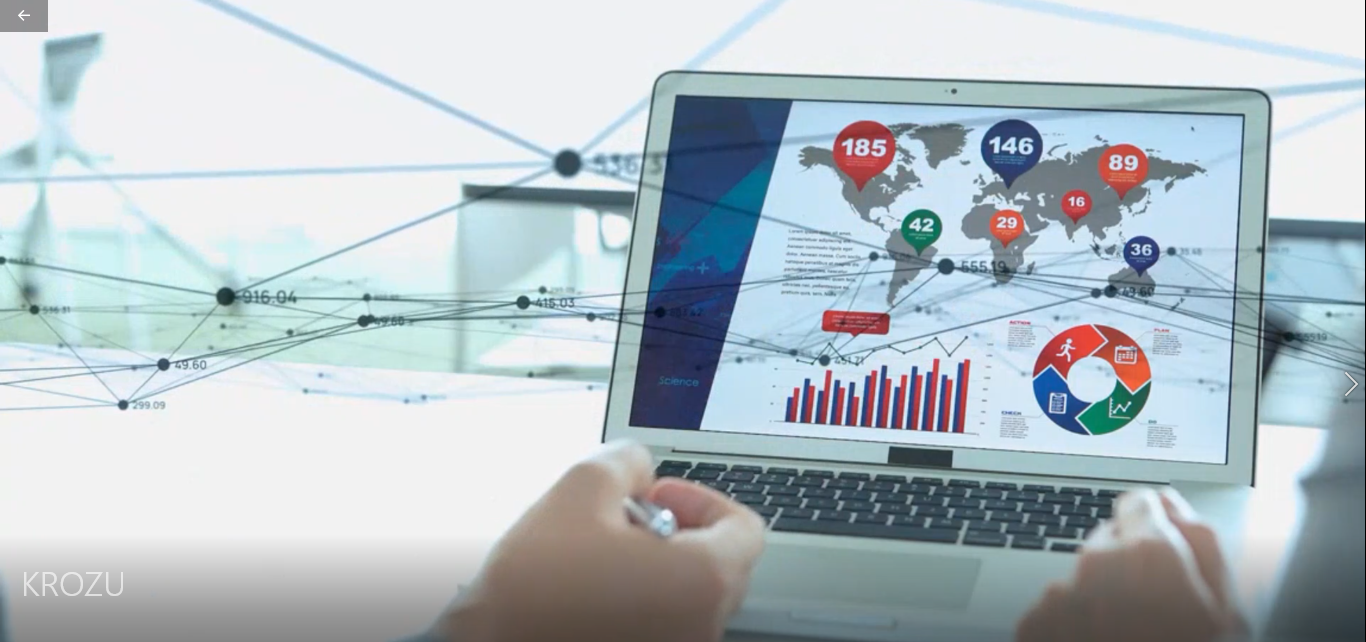
Portfolio companies like Florida-based Krozu have great opportunities to help companies prepare for that future. Among others, Krozu has an industry-leading technology designed for remote work. It is a full-level Work from home (WFH) ecosystem, supporting firms from anywhere at any time!

Krozu offers real-time synchronization of all your projects and tasks within your business regardless where each of your employees work from. Teams and the entire business gains real-time updates and notifications with collaborative tools giving them the ability to be even more productive than before. Even when employees are away from the office, projects continue to get executed, organized and completed with clear visibility in real-time.

In Q1 2021, Tekedia Institute, working with Krozu will offer a course on Remote Work Administration. Our vision is that this training will unlock opportunities for people to understand the mechanics of managing remote teams, unbounded and unconstrained by geography.

Members attending Tekedia Mini-MBA 4 are eligible to participate (you can register to join). The course will run in parallel to our regular schedule. It is 100% free but you would be required to create projects, and demonstrate competence that you can lead a team remotely, technically. My colleagues in Florida will work with you through the Institute. There would be a separate certificate awarded  (different from Tekedia Mini-MBA certificate) to those who pass the tests.

Why Central Bank of Nigeria Asked Banks To Close Naira Accounts of Money Transfer Operators

19
Central Bank Governor, Nigeria

In the last few hours, I have received questions on why the Central Bank of Nigeria (CBN) asked banks to close the naira accounts of money transfer operators (IMTOs, international money transfer operators) in Nigeria. As an investor in a new startup, M-Naira, which holds the trademark for mNaira , m-naira and similar, in Nigeria, and which just received licenses to run remittance in US and Canada, this is something of importance to me.

To some of our members at Tekedia, I have asked them to wait for our banking and finance experts like Azeez Lawal to return from the holidays to explain.

But from my understanding, this is what CBN is doing here: in the past, when you wired USD, Euro or any foreign currency from abroad to Nigeria, you were paid in Naira, determined by the CBN official exchange rate. The IMTOs maintained a special purpose naira account to work on that reconciliation between the USD, etc they had received, say in the US and UK. and the naira they have settled in Nigeria.

But under the new CBN policy, where the USD or Euro is paid in the same currency in Nigeria to the recipient, there is practically no need for IMTOs to run a naira account. In other words, they have been disintermediated in the system locally. What happens is this: it is now between CBN and IMTOs offshore offices, and CBN and local banks since one currency is involved. The IMTOs local naira accounts are now redundant and of no value.  (They can of course run the usual current and saving accounts).

This is a clear indication that CBN is committed to this policy: send the money in USD, and your recipient can pick it up in USD or have it deposited into a local USD domiciliary account. As I have noted, this is a good policy: you are essentially increasing the supply of USD in the nation and that would give naira a breathing space. 

The Central Bank of Nigeria has directed the Deposit Money Banks to close all naira accounts of International Money Transfer Operators. It disclosed this on Friday in a circular tilted ‘Receipt of diaspora remittances: Additional operational guidelines 2 addressed to all Deposit Money Banks, Payment Service Providers and International Money Transfer Operators. …

The circular read, “DMBs are to close all naira accounts for IMTOs. This is to ensure that diaspora remittances are received by beneficiaries in foreign currency only (cash and/or transfers to domiciliary accounts of recipients).

“DMBs are permitted to open new opex accounts for the purpose of the IMTO operations, such as salary payments and other operating expenses excluding diaspora remittance receipts.

“DMBs must ensure that proper audit of IMTO accounts is done to forestall further use of naira accounts for diaspora remittances purposes.”

And CBN wants to deal with the operators who continue to pay naira instead of the foreign currency: “However and regrettably, a few operators continue to pay remittances in local currency contrary to regulatory directive. The CBN frowns on this practice.” So, if you close their naira accounts, that “illegal” playbook becomes impossible.

The Central Bank of Nigeria (CBN) Had A Great Week On Policies