Nigeria reopens selected land borders with others to follow by Dec 31 2020. The four immediately affected borders are Seme (South-west), Ilela (North-west), Maitagari (North-west part ) and Mfun (South-south). Nigeria’s finance minister, Zainab Ahmed, disclosed the policy shift to newsmen after this week’s Federal Executive Council (FEC) meeting.
“So, these four land land borders will be reopened immediately while the remaining borders are directed to be reopened on or before 31st of December, 2020. Mr. President has also directed on the reopening of the borders that while others are being reopened, the ban on importation of rice, poultry and other banned products still subsists and will be implemented by border patrol team.”
I personally think that 2021 will be a great year for innovators in Nigeria; this is a good call by the government, as many of us have asked for the largely poor land border policy to be reversed. The question remains: what did Nigeria accomplish with this land border closure? We keep scoring own-goals!
The Nigerian Communications Commission (NCC) has given telecommunications operators (MTN, Glo, Airtel, 9Mobile and others) in the country two weeks to block all SIM cards that are not registered with the National Identity Numbers (NIN), the Commission has said in a statement.
The Honorable Minister of Communications and Digital Economy, Dr. Isa Ali Ibrahim (Pantami), has approved the licensing of 173 Agents and 30 State Governments/Public Sector Institutions to conduct enrolment of all persons including legal residents into the National Identity Database (NIDB) on behalf of the National Identity Management Commission (NIMC).
Pursuant to the above, find the list of all the successful firms who satisfied all the evaluation criteria as stated in the Advert for the Expression of Interest (EOI) of each of the respective categories in full. The Commission congratulates all those who have been cleared to conduct enrollment of all persons on behalf of NIMC for data capture services.(The list is huge to attach here)
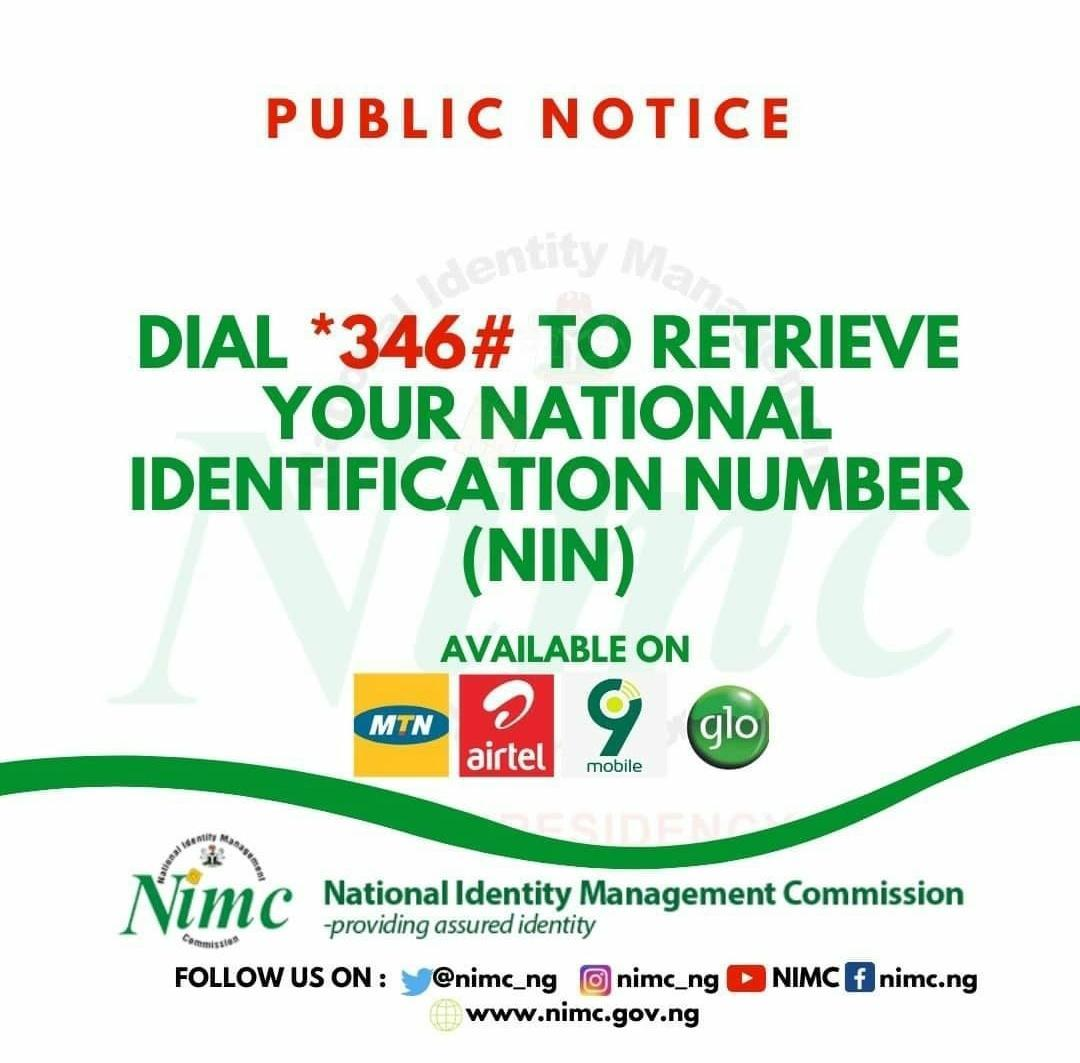
Meanwhile, if you have NIN with NIMC, and have forgotten it, you can retrieve it as follows.
The Nigerian Communication Commission (NCC) is on a new mission to link personal phone numbers to National Identification Numbers (NIN). This is part of the new rules that the commission has a directive to implement.
NCC Director of Public Affairs, Dr. Ikechukwu Adinde, disclosed the development through a statement in Abuja, on Tuesday. He said the new rule is part of the directive on the suspension of new SIM registration by network operators, given by the Minister of Communication and Digital Economy, Dr. Isa Pantami.
According to Adinde, the minister conveyed an urgent meeting of key stakeholders in the communication industry, graced by the NCC Management, the National Information Technology Development Agency (NITDA), the National Identity Management Commission (NIMC) and the CEOs of Service Providers in the telecom industry.
The meeting was based on the need to consolidate the SIM registration data of 2019 and improve the telecommunication industry.
Adinde said the stakeholders reached an agreement to do more to sanitize the telecom sector by improving the integrity and transparency of the SIM registration process.
At the end of the meeting, Mobile Network Operators were given a marching order to implement the agreements reached which include:
“Affirmation of the earlier directive to totally suspend registration of new SIMs by all operators.
“Operators to require all their subscribers to provide valid National Identification (NIN) to update SIM registration records.
“The submission of NIN by subscribers to take place within two weeks, commencing Dec. 16 and ending by Dec 30. After the deadline, all SIMs without NINs are to be blocked from the networks.
“Violations of this directive will be met by stiff sanctions, including the possibility of withdrawal of operating license,” he said.
This development has once again, stoked the controversy that has followed national identity issues in Nigeria. In the past few years, Africa’s most populous nation has gone on a campaign of identity data collection; from voter registration to Bank Verification Number to SIM registration, it has been a continuous quest to collect personal information of people living in Nigeria.
In 2017, President Buhari ordered data collecting agencies to harmonize their data with the NIMC. As part of the data harmonization campaign, the Executive Chairman of NCC, prof. Umar Garba Danbatta directed that collected data from SIM registration be released to NIMC.
In 2019, the commission ordered the deactivation of more than 2 million unregistered phone numbers, in the biggest move yet to ensure that mobile subscribers in Nigeria have face.
Following these steps taken by the NCC, Dr. Pantami announced in October this year that there is no improperly registered SIM on any network in the country since the mass deactivation in September 2019.
Therefore, it’s surprising to many when the Minister give the directive of SIM registration harmonization with NIMC, given that the directive had been issued to network operators earlier before now.
While it seems to be the right move due to increasing security concerns in the country, it has become a repetition of a process that is wearing Nigerians out.
“We use a Local Govt. Identity certificate to register for international passport, then use Int’l passport to register for Driver’s License, then use Driver’s License to register for NIN, then use NIN to register for SIMs. Nigerian government enjoys making their citizens suffer,” Danny Walter wrote on Twitter.
Disgruntled Nigerians believe that the federal government should have learnt from the Bank Verification Number (BVN) process, where the number generated through one bank account number is used to link other accounts belonging to the same person.
Moreover, the time allotted for the data harmonization seems unrealistic as only 28 million out of more than 180 million mobile subscribers in Nigerian have enrolled into the NIMC database.
In Nigeria’s rural areas, access to NIMC and SIM registration centers poses a challenge that will hinder many from obeying the directive.
With the two weeks deadline fast approaching, millions of network subscribers risk being cut off from telecom services, and it would become a big blow to the fragile economy reeling at the mercy of recession.
The telecom industry played an integral role in sustaining Nigeria’s economy at the peak of coronavirus in the country, and the wellbeing of the telecom sector is important for the sustainability of the wobbling economy.
Experts believe that the NIMC and SIM registration data harmonization will do a great deal of service to Nigeria’s lackluster citizen data situation, but it needs more time that has been given by the Ministry of Communication.
Steve Jobs, an Apple founder, was legendary for stimulating demand. He worked without surveys or focus groups. He was a genius, peerless in his generation. He saw an unborn future many years ago. He was an icon, who changed his world. He developed a good design paradigm of working at the perception of customers, beyond their needs and expectations. He found glory and Apple triumphed with iPod, iPhone, iPad and more.
As 2021 comes, what would you do differently? Toyota generated $272 billion revenue in 2019; Tesla’s was $25 billion. Yet, the market cap of Tesla is about 2x of Toyota’s. Amazon’s market cap is $1.62 trillion while Walmart is $413 billion, and yet many think they are peers, in the same business!
Those things happen for a reason: one is meeting Needs of customers; another is stimulating Perception in customers. One has customers; the other has Fans.
In 2021, you must create Fans out of customers to thrive. Meeting needs is never going to be enough: you must shift. Have a great profitable year ahead.
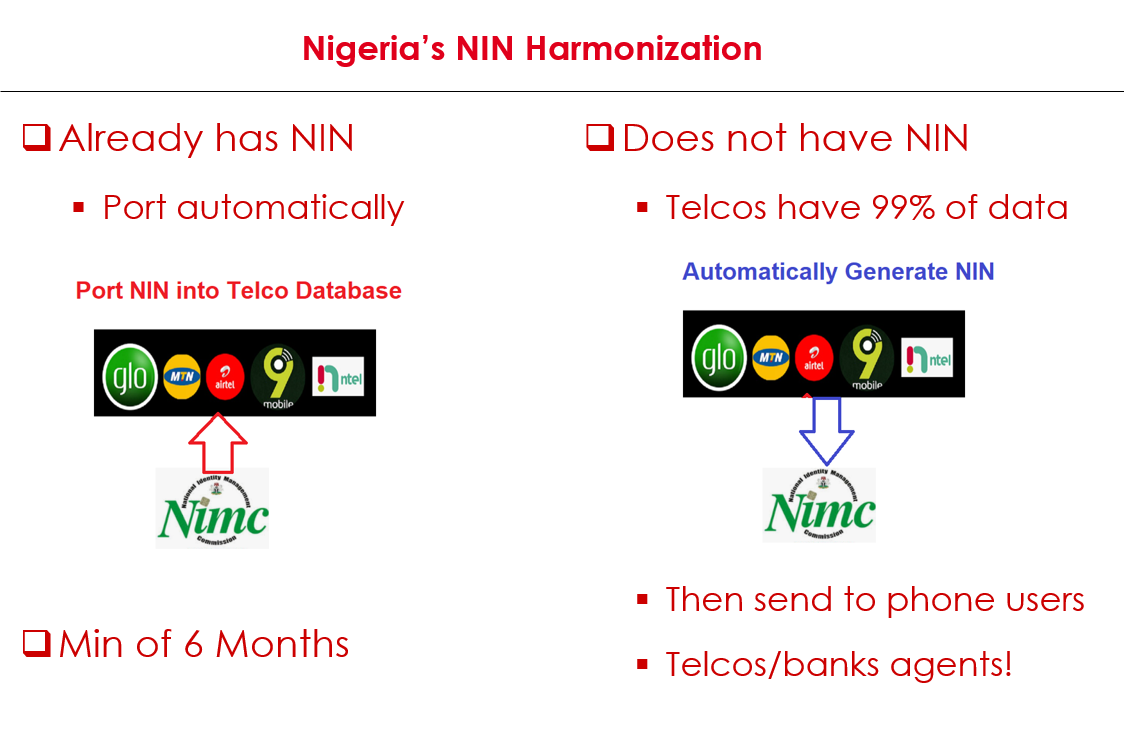
Let me begin by congratulating the Nigerian Economic Summit Group for acting very fast on our recommendations to the government. During a NES session which I coordinated with support from Jude Ayoka, ADERINOLA OLORUNTOYE and Segla Segla, along with dozens of our fellow citizens, we maintained that for e-Nigeria to happen, the citizen identification process must evolve fast. In the brief, it was emphatic: the government needs to depend on the private sector to do this job while it stays as a super-collator, making sure the ordinance is healthy: move the 2 weeks to 6 months for compliance.
Nigeria has responded: “The Nigerian Communications Commission (NCC) has given telecommunications operators (MTN, Glo, Airtel, 9Mobile and others) in the country two weeks to block all SIM cards that are not registered with the National Identity Numbers (NIN), the Commission has said in a statement.”
In our session, we maintained that instead of the government looking for money to fund NIMC, the identity agency, it can accomplish more via the private sector, even as it compensates the companies, via benefits, for assisting the government. It would not be hard for banks and telcos to be designated as conduits to help ramp up NIN (national ID number) adoption to 90% within three years.
The Nigerian Communications Commission (NCC) has given telecommunications operators (MTN, Glo, Airtel, 9Mobile and others) in the country two weeks to block all SIM cards that are not registered with the National Identity Numbers (NIN), the Commission has said in a statement.
Nigeria needs to increase the two weeks to at least 6 months as it is too short. But engaging the banks and telcos as “super-agents for NIN registration” are paths we think the nation has to follow.