DD
MM
YYYY

PAGES

DD
MM
YYYY

spot_img

PAGES

Home Blog Page 60

Coinbase Reports 19% Surge in Government and Law Enforcement Data Requests, as Myriad and Trust Wallet Announce Partnership

0

Coinbase released its latest transparency report, revealing a record-high 12,716 government and law enforcement information requests for user data during the period from October 2024 to September 2025.

This represents a 19% increase compared to the previous 12-month cycle, underscoring growing global regulatory scrutiny on cryptocurrency platforms amid rising adoption and concerns over illicit activities.

The United States accounted for 5,444 requests about 43% of the total, maintaining its position as the top source since 2022. However, non-U.S. requests rose to 53% of the overall volume—a new high—driven by a 200 basis point increase year-over-year.

This shift highlights expanding surveillance efforts beyond U.S. borders. France led the surge with 1,114 requests, a massive 111% increase from the prior year, reflecting heightened EU focus on anti-money laundering (AML) under frameworks like MiCA.

This leap positioned France as the second-largest source of such requests globally, trailing only Germany among non-U.S. jurisdictions. This marks a 111% rise from approximately 527 requests in the October 2023–September 2024 cycle.

France’s requests accounted for about 8.8% of Coinbase’s overall 12,716 global requests, contributing significantly to the 53% non-U.S. share—a record high, up 200 basis points from the previous year.

These figures reflect received requests only; Coinbase notes that not all lead to responses, as each is vetted for legal validity, with only minimal or aggregated data disclosed when required.

The increase aligns with France’s intensifying regulatory and enforcement focus on cryptocurrencies, particularly around anti-money laundering (AML) and counter-terrorism financing (CTF). France, as a MiCA frontrunner, has ramped up oversight since the regulation’s full rollout in late 2024.

MiCA mandates stricter AML screening for crypto service providers (CSPs) like Coinbase, which operates under a French entity. This has led to heightened investigations into suspicious transactions, with authorities like the Autorité de Contrôle Prudentiel et de Résolution (ACPR) and Tracfin (anti-money laundering unit) issuing more subpoenas and court orders.

The surge coincides with MiCA’s emphasis on transaction traceability, prompting a wave of data demands tied to cross-border flows. French prosecutors have escalated probes into crypto-linked illicit activities.

For instance the ongoing judicial investigations into platforms like Binance for alleged money laundering tied to drug trafficking across the EU which spilled over to broader ecosystem scrutiny.

While not directly targeting Coinbase, these cases have increased inter-agency collaboration, boosting requests to compliant exchanges like Coinbase for user transaction histories.

National efforts to combat crypto-fueled organized crime, including ransomware and sanctions evasion, with France reporting a 25% rise in crypto-related AML alerts in 2025 per Tracfin data.

The exchange faced a €21.5 million fine from Ireland’s Central Bank in November 2025 for AML failures involving over $202 billion in transactions, but France’s ACPR has similarly intensified on-site inspections of CSPs ahead of MiCA licensing renewals.

Additionally, a May 2025 Coinbase data breach exposed 69,461 users’ details with $400 million in damages may have prompted French authorities to seek verification data amid privacy concerns.

Rising crypto adoption in Europe, 17% of French adults holding digital assets per 2025 surveys has amplified illicit use cases, fueling ~95% of requests linked to criminal probes like search warrants and emergency disclosures.

This surge underscores France’s pivot toward “regulated innovation,” balancing crypto growth with robust surveillance. For Coinbase users in France and EU-wide via passporting, it means heightened compliance burdens, potentially delaying transactions or requiring enhanced KYC.

Privacy advocates warn it could deter adoption, pushing users toward decentralized alternatives, while Coinbase reiterates its “no direct access” policy and per-request reviews.

As MiCA evolves, expect France’s trend to influence other EU states, with non-U.S. requests projected to exceed 60% by 2026. Germany: 1,210 requests, down 5% year-over-year. United Kingdom: Up 16%, contributing to the top six countries U.S., Germany, UK, France, Spain, Australia that made up ~80% of all requests.

Spain: +27%. Moldova saw a 5.7x jump, while South Korea’s requests plummeted 67%. Approximately 95% were linked to criminal investigations, including subpoenas, court orders, search warrants, and emergency disclosures.

Coinbase emphasized that it reviews each request individually for validity and scope, providing only the minimum required data—often anonymized or aggregated—and does not grant governments direct system access.

This uptick occurs against a backdrop of regulatory challenges for Coinbase, including a €21.5 million fine from Ireland’s Central Bank in November 2025 for AML screening failures affecting over $202 billion in transactions, and a May 2025 data breach exposing details of 69,461 customers resulting in estimated $400 million in damages.

Despite these issues, the exchange’s Q3 2025 revenue hit $1.9 billion up 58% YoY, signaling robust business growth. The trend raises privacy concerns for crypto users, as centralized exchanges like Coinbase must comply with legal obligations to maintain licenses.

Experts note it exemplifies how user data on such platforms is “one subpoena away” from government access, potentially spurring interest in self-custody solutions. For global users, including in emerging markets like Africa, it signals spillover effects from stricter policies in major jurisdictions, impacting cross-border crypto flows.

As crypto integrates further into traditional finance, expect continued escalation in such demands unless privacy-enhancing technologies gain traction.

Myriad and Trust Wallet Announce Partnership

Myriad Markets, a leading Web3 prediction market protocol, announced a partnership with Trust Wallet, the world’s largest self-custody wallet with over 200 million users.

This collaboration introduces the first-ever native in-wallet prediction market experience, allowing users to trade on real-world events—like crypto prices, politics, sports, and more—directly within the Trust Wallet app without needing to switch to external platforms.

Users access Myriad’s markets via a new “Predictions” tab in Trust Wallet’s Swaps section. With one click, they can place “yes” or “no” positions on event outcomes using their existing assets.

The process is designed for speed—trades execute in seconds, emphasizing seamless, self-custodial access. The launch coincides with Myriad surpassing $100 million in cumulative trading volume, a 10x increase over the past three months.

This includes over 400,000 active traders, 6.3 million trades, and 7.3 million transactions, fueled by its recent deployment on BNB Chain for lower fees and broader liquidity. Trust Wallet plans to integrate additional platforms like Kalshi and Polymarket into the Predictions hub, turning it into a one-stop gateway for tokenized real-world outcomes.

Myriad will anchor initial categories, providing infrastructure and popular markets. Farokh Sarmad, President and Co-Founder of Myriad: “Myriad Markets being the first ever Prediction Market integrated natively inside of a wallet marks a huge moment for this asset class.

Trust Wallet is where tens of millions of people begin and manage their crypto experience, so bringing Myriad directly into that flow makes on-chain predictions accessible in a way the industry has never seen before. We are honoured to partner and to move this industry forward together.”

Eowyn Chen, CEO of Trust Wallet: “People shouldn’t need five apps to express what they think will happen next. Wallets are becoming the home for all kinds of trading—not just tokens, but also information, opinions, and expectations. Our vision is to unlock access safely and give users the simplest way to participate in these emerging markets.”

Ilan Hazan, COO and Co-Founder of Myriad: “Being the first platform to launch within Predictions highlights the strength of the community and ecosystem behind Myriad. We are committed to building the most accessible and transparent environment for event-driven contracts, and this integration is an important step toward that vision.”

This partnership democratizes prediction markets by embedding them into everyday crypto tools, reducing friction and boosting adoption. Myriad, which has achieved explosive growth with minimal marketing spend, positions itself as a media-rooted protocol linking markets to news and video content via partners like Decrypt and Rug Radio.

Looking ahead, expect multichain expansions, enhanced oracles for event resolution, and U.S. regulatory alignment. The crypto community on X is buzzing about it, with users highlighting the ease for sports betting and sentiment-tracking markets like “Crypto Winter Is Coming?” resolving “Yes” if BTC drops to $35K, ETH to $1K, and alts lose major cap by Feb 2026.

Early sentiment leans “No,” reflecting optimism amid the bull run. If you’re a Trust Wallet user, update your app and check the Predictions tab to dive in. This feels like a pivotal step toward mainstream Web3 trading—watch for volume spikes as word spreads.

Ethereum, DOGE, and SHIB Could All Pump—But Ozak AI Prediction Points to the Next Real 100x Winner

0

Crypto markets are coming into a renewed phase of power as capital rotates back into foremost altcoins and investor sentiment improves across the board. Ethereum, Dogecoin, and Shiba Inu are all displaying sturdy setups for potential breakouts, with technical structures, liquidity levels, and network momentum aligning for a promising rally.

Yet even as these popular assets gear up for meaningful gains, analysts widely agree that Ozak AI is the project with the steepest long-term trajectory. With early-stage pricing, deep AI-native infrastructure, and accelerating global demand, Ozak AI is increasingly viewed as the next real 100x contender of the upcoming cycle.

Ethereum Builds Toward a Strong Bullish Continuation

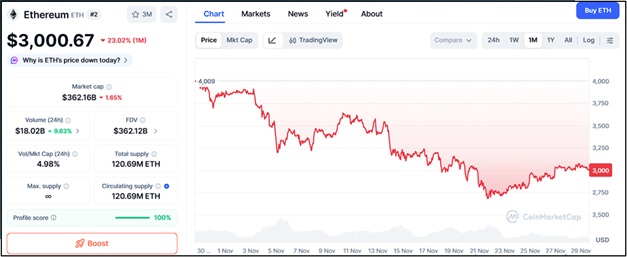
Ethereum (ETH), trading around $3,000, continues to bolster structurally as network interest rises and institutional adoption grows. ETH maintains reliable aid at $2,925, $2,785, and $2,640, zones in which buyers always acquire at some stage in market pullbacks. These levels highlight the confidence surrounding Ethereum’s function as the backbone of DeFi, tokenization, and Layer-2 scaling ecosystems.

For Ethereum to extend into its next major upside move, it must break resistance at $3,115, $3,260, and $3,410. Historically, when ETH clears these thresholds, it enters sustained, multi-week expansions driven by increasing transactional activity and rising staking demand. Ethereum is widely expected to push much higher during the next cycle, but its large market cap limits its ability to deliver anything close to a 50x–100x multiplier.

Dogecoin Shows Renewed Strength as Meme Liquidity Returns

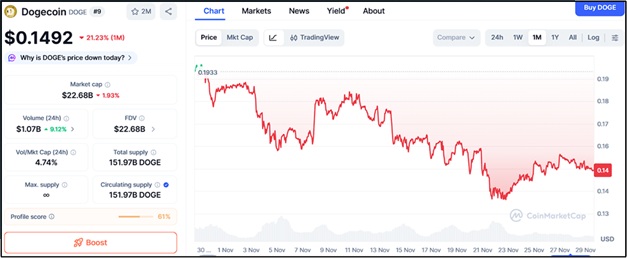
Dogecoin (DOGE), buying and selling close to $0.1492, is gaining momentum again as the meme-coin hypothesis reawakens throughout the marketplace. DOGE maintains to hold strong support at $0.1451, $0.1386, and $0.1324, levels that reflect strong network-pushed accumulation and renewed hobby within the meme coin.

For DOGE to interrupt into a deeper uptrend, it needs to push above resistance at $0.1563, $0.1641, and $0.1745. Clearing these stages has traditionally brought about fast movements fueled by way of social sentiment spikes, celeb mentions, and retail-driven inflows. While Dogecoin may supply powerful short-term pumps—probably even a multi-x rally—its dependence on sentiment and its market length obviously limit its long-term multiplier potential.

Shiba Inu Prepares for Another Upside Attempt

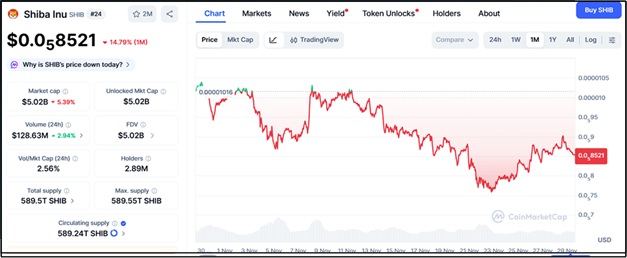
Shiba Inu (SHIB), hovering around $0.000008521, is likewise displaying renewed energy as Shibarium improvement expands and retail investors return to high-volatility property. SHIB sits firmly above aid at $0.00000826, $0.00000795, and $0.00000768, zones wherein the market continually steps in to build up.

For SHIB to accelerate into a breakout, it must clear resistance at $0.00000882, $0.00000910, and $0.00000942. Once SHIB flips these zones, it often experiences sharp, sentiment-driven expansions. Analysts believe SHIB could produce a strong rally in the next phase of the cycle—but, like DOGE, its large established valuation limits its odds of achieving exponential returns.

Ozak AI Emerges as the Most Powerful Long-Term 100x Project

While Ethereum, DOGE, and SHIB may all pump strongly, Ozak AI (OZ) is the project capturing the most attention for long-term exponential gains. Unlike meme coins or large-cap platforms, Ozak AI is built on real, scalable AI-native infrastructure designed to upgrade Web3 intelligence, trading, analysis, and automation.

Ozak AI integrates millisecond-speed prediction agents capable of real-time market scanning, cross-chain analytics engines monitoring multiple networks simultaneously, lightning-fast 30 ms trading signals via HIVE, and autonomous SINT-powered AI agents capable of executing tasks, trades, and voice-driven commands. This positions Ozak AI as a next-generation intelligence layer rather than a speculative token.

Because Ozak AI is still early-stage, with a small initial valuation and massive real-world demand, analysts believe its growth curve is far steeper than any major altcoin. It sits at the core of the rapidly accelerating AI revolution—a sector expected to become one of the defining technological forces of the decade.

Presale Momentum Confirms Ozak AI’s Explosive Potential

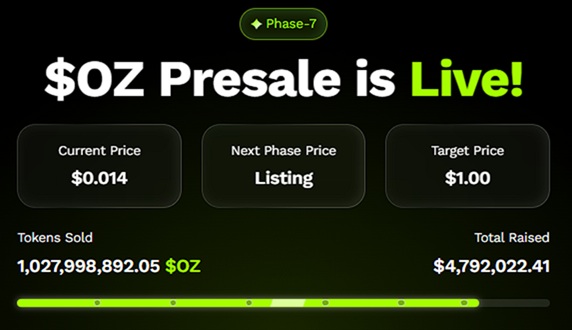
The Ozak AI presale reinforces its 100x potential, with over $4.7 million raised and more than 1 million tokens sold. This level of early global demand mirrors the early patterns of past bull-market leaders that went on to deliver extraordinary gains. Because Ozak AI offers real utility, not just hype, analysts see its multiplier potential as significantly higher than that of ETH, DOGE, and SHIB.

Ethereum, Dogecoin, and Shiba Inu are all showing strong signs of upcoming growth, supported by robust technical structures, improving sentiment, and strengthening ecosystem fundamentals. Each could deliver meaningful gains in the next cycle.

But Ozak AI stands apart as the most promising 100x candidate, driven by real AI-native utility, early-stage affordability, and explosive presale traction. As AI becomes the dominant force shaping the future of Web3, Ozak AI is emerging as one of the most compelling long-term opportunities in the entire market.

About Ozak AI

Ozak AI is a blockchain-based crypto assignment that provides a generation platform that specializes in predictive AI and superior information analytics for financial markets. Through machine gaining knowledge of algorithms and decentralized network technology, Ozak AI permits real-time, correct, and actionable insights to assist crypto fanatics and businesses in making the proper selections.


For more, visit:

Website: https://ozak.ai/

Telegram: https://t.me/OzakAGI

Twitter: https://x.com/ozakagi


Vanguard Will Allow Clients to Buy Crypto ETFs Starting Today

0

Vanguard, the world’s second-largest asset manager with over $11 trillion in assets under management, announced on December 1, 2025, that it will begin allowing its brokerage clients to trade select cryptocurrency ETFs and mutual funds starting today, December 3, 2025.

This marks a significant reversal from its long-held skepticism toward digital assets, which it previously viewed as too volatile and speculative for long-term portfolios.

Clients can now access regulated ETFs and mutual funds that primarily hold cryptocurrencies like Bitcoin (BTC), Ether (ETH), XRP, and Solana (SOL). High-risk assets, such as those tied to meme coins, remain restricted.

This applies to self-directed brokerage and IRA accounts on Vanguard’s U.S. platform, opening the door for its 50 million+ clients to invest in these products without needing to leave the ecosystem. Vanguard cited the ETFs’ performance through recent market volatility and improved operational processes as factors in the decision.

However, the firm has no plans to launch its own crypto products and will only facilitate third-party funds, similar to how it handles commodities like gold. The move comes amid strong demand for crypto ETFs, with spot Bitcoin ETFs alone amassing billions in assets since their 2024 debut.

Analysts expect this could drive tens of billions in new inflows, intensifying competition with rivals like BlackRock and Fidelity. This shift reflects broader mainstream adoption of crypto in traditional finance, potentially boosting liquidity and investor participation.

Vanguard’s policy shift, effective today, is already rippling through markets. Bitcoin surged about 6% in early U.S. trading on December 2, 2025, reflecting immediate optimism, though sentiment remains in “Fear” territory amid recent volatility.

Ethereum, XRP, and Solana also saw gains of 7-8%, but analysts caution this could be a fragile bounce, with potential retests of Bitcoin lows around $80,000 if leverage cascades trigger further liquidations.

Initial ETF inflows may be modest as Vanguard’s conservative clients often in retirement accounts place orders gradually, but even 0.1-0.2% allocation from its $11 trillion AUM could inject $11-22 billion—dwarfing the $25 billion seen in spot Bitcoin ETFs’ first month in 2024.

This move democratizes crypto access for Vanguard’s 50 million+ clients, many previously locked out due to platform restrictions. It channels “sticky” capital—retirement funds and passive allocations—into regulated products, potentially adding tens of billions in sustained demand over months.

If 0.5% of assets shift a conservative estimate for diversification, that’s $55 billion, exceeding BlackRock’s IBIT peak of $100 billion earlier this year. Crypto ETFs, tested through 2024-2025 volatility, now integrate seamlessly into traditional portfolios, akin to gold or commodities.

This could accelerate ETF approvals for other assets and draw sidelined institutions. Enhanced trading volumes reduce spreads and volatility, benefiting spot markets for BTC, ETH, XRP, and SOL. While Bitcoin captures most flows as the “commodity” play, XRP and SOL ETFs could see disproportionate gains from targeted demand, though altcoin season remains elusive.

Competitive and Strategic Shifts in FinanceVanguard’s reversal—driven by client pressure and new CEO Salim Ramji’s BlackRock background—signals TradFi’s capitulation. It pressures holdouts like State Street to follow, intensifying rivalry with BlackRock IBIT at $70-80 billion and Fidelity.

Vanguard won’t launch its own products or support meme coins/high-risk funds, focusing on third-party regulated options to align with its low-cost ethos. This hybrid model bridges crypto’s innovation with TradFi’s stability, potentially eroding direct holdings due to ETF fees of 0.2-0.5% but expanding the pie overall.

Fresh inflows could fuel rallies, but a macro downturn (e.g., U.S. debt expansion or tariff risks) might trigger outsized sell-offs from new, less experienced investors. Aligns with Fed stablecoin rules and QT’s end, but lingering uncertainties persist.

ETF issuers like BlackRock win big on AUM; direct crypto holders may face relative underperformance; traditional bonds could see outflows. This cements crypto’s evolution from speculative fringe to core asset class, unlocking structural inflows that compound over years.

Monitor ETF flow data this week for early signals—expect Bitcoin to lead, with alts following if sentiment flips to “Greed.”

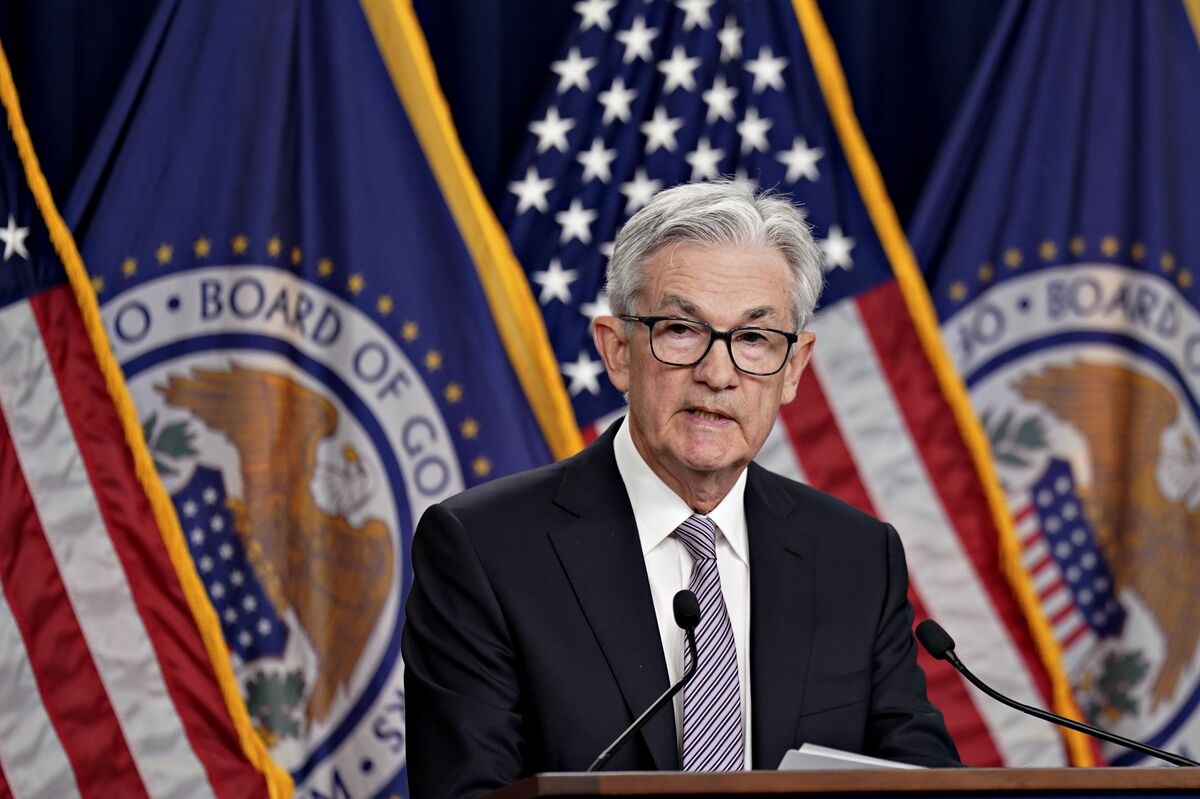
US Federal Reserve Ending Quantitative Tightening Is A Liquidity Pivot

0

The U.S. Federal Reserve officially concluded its Quantitative Tightening (QT) program, which began in June 2022 and involved allowing up to $95 billion in securities to mature each month without reinvestment, effectively draining approximately $2.4 trillion from the financial system.

This marked the end of the largest balance-sheet reduction in the Fed’s history, freezing its holdings at around $6.57 trillion.

The decision, broadly supported by FOMC members with one dissenter calling for an immediate halt, was driven by emerging liquidity strains in money markets, including rising short-term borrowing costs and depleting bank reserves now hovering at about $3 trillion roughly 10% of U.S. GDP.

To stabilize the system, the Fed shifted to rolling over maturing Treasuries capping reductions at $5 billion monthly while maintaining $35 billion in mortgage-backed securities runoff, but reinvesting MBS proceeds into Treasury bills.

This pivot comes amid dovish signals: Markets now price in an 87% chance of a 25 basis-point rate cut at the December 10-11 FOMC meeting, with cumulative easing expected into 2026.

On December 2, the Fed injected $13.5 billion via overnight repurchase agreements—the second-largest liquidity boost since COVID—highlighting acute short-term funding demand that exceeded Dot-Com bubble levels.

Ending QT halts liquidity contraction, potentially easing fiscal pressures and supporting risk assets. Historically, similar pauses (e.g., 2019) preceded crypto rallies, with analysts forecasting Bitcoin highs by late January 2026 amid M2 growth and ETF inflows.

However, elevated bank unrealized losses and the Bank of Japan’s 81% odds of a December hike could introduce volatility. On X, sentiment echoes this: Users note the injection as an “early easing” signal, boosting hopes for crypto expansion.

SEC Chair Paul Atkins Signals Crypto “Innovation Exemption” for January 2026

In a December 2, 2025, CNBC interview, incoming SEC Chair Paul Atkins announced the agency will launch a landmark “Innovation Exemption” for crypto firms in January 2026, allowing pilot launches of on-chain products like tokenized assets, DeFi tools, and blockchain settlements without full securities registration.

Atkins emphasized the SEC has “sufficient authority” to proceed without congressional approval, framing it as an end to four years of “repression” under prior leadership that drove innovation overseas.

First proposed in July 2025, the exemption—delayed by a federal shutdown—provides temporary regulatory relief under SEC oversight, categorizing assets as digital commodities, collectibles, tools, or tokenized securities once decentralization is proven.

It builds on Bitcoin ETF approvals, aiming to boost IPOs and token issuances while coordinating with the CFTC on areas like prediction markets. This could spark a “new bull run” by enabling faster capital raises and reducing enforcement fears, potentially accelerating the $18.4 billion tokenized asset market.

Atkins’ pro-innovation stance contrasts sharply with Gary Gensler’s era, positioning the U.S. for leadership in blockchain. X discussions highlight excitement, with users calling it the “biggest green light since ETFs” for ICOs and DeFi.

These developments align with a pro-risk policy thaw under the incoming Trump administration, where Atkins a crypto advocate was nominated in November 2025. Combined with QT’s end, they signal surging liquidity for high-beta assets like crypto—potentially mirroring 2021’s rally but with institutional guardrails.

Watch December’s rate decision for confirmation, as cross-agency coordination (SEC-CFTC) will shape 2026’s “Regulation Crypto” rollout. While optimistic, risks like geopolitical tensions or BOJ hikes persist; diversified positioning remains prudent.

Global Markets Steady After Japan-Fueled Sell-Off, Bitcoin Slides as Investors Brace for Rate Shifts

0

Stocks made modest gains on Tuesday while global government bonds and cryptocurrencies steadied, offering a pause after the sharp sell-off that swept through markets on Monday as investors braced for a looming interest rate hike in Japan.

S&P 500 futures were flat following overnight declines on Wall Street, and equities in both Europe and Asia edged slightly higher.

Sentiment improved somewhat after a solid auction of Japanese government bonds eased pressure on a market that has been rattled for weeks. Japanese 10-year and 30-year yields slipped by about one basis point each, a small but notable cooling after their dramatic climb. The surge in yields has been driven by concerns about Japan’s worsening fiscal position and rising expectations that the Bank of Japan is preparing to lift rates, pushing 10-year yields to a 17-year high and 30-year yields to their highest level on record.

Monday’s turmoil in Japanese debt markets quickly spilled into global fixed income. The U.S. 10-year Treasury yield jumped nearly 8 basis points, while the German 10-year Bund yield rose almost 6 basis points, helping drag equities lower. The calm in JGBs on Tuesday translated into steadier global bonds. The 10-year Treasury yield hovered at 4.09%, unchanged on the day, while the Bund yield held at 2.75%.

Cryptocurrencies mirrored the relative calm but remained under pressure. Bitcoin inched higher on Tuesday after tumbling 5.2% the day before, trading at about $87,000. It has now fallen roughly 30% from its October peak, deepening a weeks-long slump that has alarmed digital-asset traders. Some market participants see bitcoin as an early barometer for broader risk appetite, though traditional investors appear mostly unfazed.

“Things are pretty stable currently. We’re closing this year with few—touching wood—negative surprises,” said Samy Chaar, chief economist at Lombard Odier. “Yesterday was mainly a non-event except for crypto assets. We’ve had a huge rout in bitcoin in recent weeks, and frankly the impact on global markets has been limited.”

Sentiment within the crypto industry, however, is noticeably darker. Jehan Chu, founder of blockchain venture firm Kenetic Capital, said trading desks are shifting into defensive mode.

“The mood in cryptocurrencies is ranging between fearful and resigned,” he said. “The latest drop caught investors by surprise. The next couple months are crucial, but even the most bullish may be settling in to hibernate for the winter.”

In currency markets, the Japanese yen softened slightly, with the dollar rising 0.35% to around 156 yen and the euro gaining by a similar margin. Monday’s rebound in the yen had eased concerns that the Bank of Japan would intervene to support the currency, which has been battered for much of the year. The dollar was broadly steady after weakness on Monday briefly lifted the euro above $1.165; it last traded around $1.1605.

Expectations of diverging policy paths are quietly reshaping currency bets. Investors increasingly anticipate that Japan will tighten rates while the U.S. Federal Reserve moves toward deeper and faster cuts. Fresh U.S. data on Monday reinforced expectations of a December rate cut after manufacturing contracted for a ninth straight month in November, even as consumers defied forecasts by spending $23.6 billion in online holiday shopping.

Gold slipped 1% to fall back below $4,200 an ounce, though it remains only about 4% shy of its all-time high reached in October. Silver dropped nearly 2%. Oil prices, which climbed earlier after drone strikes hit Russian energy infrastructure, were stable. Brent crude traded at $63.10 a barrel and U.S. crude at $59.21.

Markets now head into the final stretch of the year balancing two competing forces: Japan’s long-awaited rate shift, which could upend global bond dynamics, and the likelihood of U.S. monetary easing, which could weaken the dollar and reshape risk sentiment heading into 2026.