Notes: Welcome back after the Career Week Tekedia LIVE Wed | 7pm-8pm | Risk Management – Akeem Rasaq, Head of Risk Management, Chapel Hill Denham | Zoom link Thursday | 7pm-8pm | Decentralized Finance in Africa, General – Franklin Peters (CEO, Bitfxt); Ndubuisi Ekekwe | Zoom Link Saturday | 12noon -1 pm | Capital Markets […]
Why are Nigerians Big on Bitcoin and Its cousins?
People, what is happening in the world of Bitcoin. Is it time for the Central Bank of Nigeria (CBN) to come out clearly on a roadmap? This thing can “eat” the naira. Yes, one wise man wrote that software would eat the world! I saw the volume of crypto transactions in Nigeria, and could not believe what is going on there. I think this has entered a new level in the nation. Why are Nigerians big on Bitcoin and its cousins? I put this position in 2017.
My position remains that we do not need Bitcoin but Nigeria needs a digital currency tied to the Naira that will enable the efficient functioning of the blockchain infrastructure which I expect to evolve in coming years in the nation. If the Central Bank blesses such a plan, we will experience a virtuoso innovation system in redesigning the architecture of some of our industrial sectors and make them more efficient even while being cost-efficient. As I noted in my entry on Blockchain Africa, blockchain has a promise for Africa. Nigeria just have to find a way to lead in that promise at least in West Africa where its impact is huge. As Goldman Sachs goes closer to Bitcoin and digital currency, we may be too slow that very soon, it becomes an entirely foreign imports to Nigeria.
Disclosure: Not really a big fan of coins; I have never bought any coin ever. But in this post, I must disclose that I took equities on a crypto exchange and crypto paytech last month (the double play strategy!). That is all for disclosure.
Now, let us have a conversation – why are Nigerians going big on Bitcoin and likes?
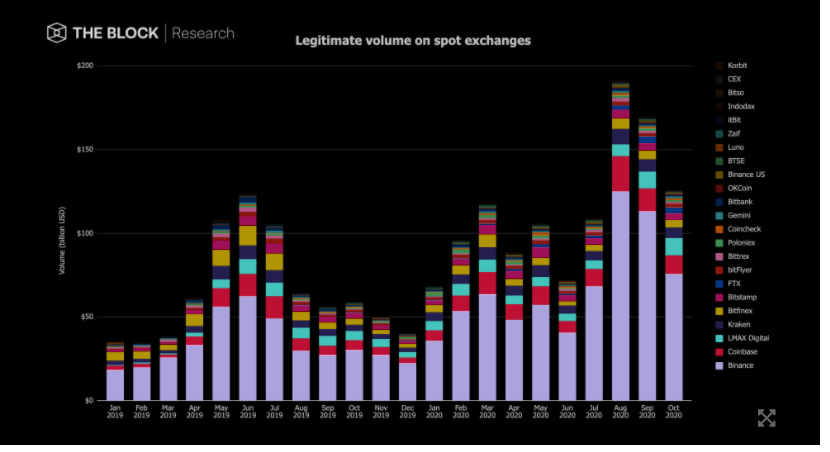
Yet, note this: The Block reports that volume of crypto trading fell to $126 billion in October from $170 billion in September. That is a significant number to capture despite the rise of the value of the asset.
Africa Needs to Kill Disinformation, Misinformation Before They Cause Civil Wars –A Conversation with Mustapha Muhammed Jamiu, a Russia Based Don
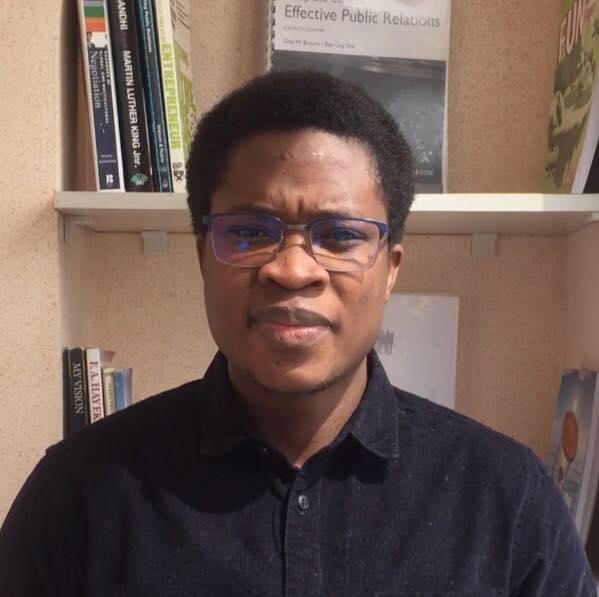
In this interview, our analyst speaks with Mustapha Muhammed Jamiu, a Development Communication and International Public Relations Specialist and Convener of African Media Guide on Combating Media Infodemic for Sustainable Democracy on the positives and negatives of new media in Africa. Mr Jamiu, who also teaches at the Mass Communications Department, Faculty of Philology, RUDN University of Russia, believes that stakeholders in the continent need to take actions towards its negativity on governance and development.
Excerpt
Tekedia: In the last decade, we have witnessed the emergence of varied products from businesses for information dissemination across the world, how would you describe the positive and negative outcomes of the products so far?
Mustapha: Thank you, it is well known of a thing that everything has its ups and downs. And the evolvement of new media tools is not left out in this. The reality is, we have all been enjoying lots from the polarization of new media tools and opportunities that come with it. For governance and politics, freedom of speech and active usage during political campaigns. For businesses, to sell ideas, product or services. For education with online virtual learning and more. The new tools have dominated every aspect of our lives that very few among us will deny the benefits. However, the price of its negativity is becoming more alarming and tend to be costing us beyond imagination. Today we have more than enough information, but unfortunately, lots of that information are polluted.
Tekedia: Now, let us examine the impacts on political discourse around the world, especially in Africa. There is no doubt Africa has had a share of the two consequences. What can you say regarding how the new media are being used for information dissemination?
Mustapha: Of course, Africa is not an exception when it comes to the impacts of the new information tools, negative or positive. As we all are benefiting from the good side of the new information tool, Unfortunately, all most everyone is somehow perpetrators in using it for negative things. Politicians, businessmen and women, religious leaders, citizens and every member almost every member of the society are intentionally or unintentionally using and sharing misleading information. Looking at the problems the information disorder is already creating across the world, even among the first world countries, African leaders and all stakeholders need to be more careful and take necessary action considering our heterogeneous culture, multitribal nature and religions as a region.
Tekedia: In some African countries, attempts have been made to regulate social media use based on some of the negative outcomes you identified earlier. How do you think virtual sphere can be regulated without necessarily denying people their fundamental human rights?
Mustapha: In as much as there is a need for combating toxic and polluted information, governments need to be extra careful in the process as not to tamper with a dividend of democracy and the basic human rights of the people. Access to Information and freedom of speech are the bedrock of democracy. In many developed nations that are currently doing something to combat information pollution are not shutting the mouths of the citizens. They are rather looking at necessary means to help their citizens grow in discerning appropriate media contents and be responsible.
The truth is technology has come to stay. We are the one to learn how to oversee it, not the other way round. For this reason, African governments and legislatures should prioritize educating citizens on information and media literacy.
While I’m closing on this, the following questions are what keeps rolling on my head as we are still looking way to combat information disorder; What happened to the ‘digital literacy’ programme sponsored by UNESCO that supposed to cut across our learning institutions? What about the work of the National Communication Commission as a watchdog? And the National Orientation Agency to work from grassroots in educating citizens? What steps are the government taking to regulate how the owners of the social media organizations operate within our country like other developed nations are doing? These are the questions we need to find answers to, as to mount pressures on the appropriate existing institutions in making sure the system works for, and not against the people.
Tekedia: We learnt that your organisation, which operates in Russia and Nigeria, is planning a global seminar for Africans and other nationals to understand misinformation, disinformation, and propaganda during protests. Can you walk us through the programme?
Mustapha: Thank you. Looking at recent protests across some African countries including the one in Nigeria with a popular #EndSARS and issues generated as a result of information management, our organization, Center for Research on Development of African Media, Governance, and Society (CEREDEMS) in partnership with institutions in Russian Federation and some African countries, feels it is high time to bring together stakeholders from media, government, academia, and the youth (protesters) in Africa to deliberate on the theme: “Narratives around Protest and Information Disorder Ecology in Africa. The virtual event which is going take place on zoom webinar is scheduled for Saturday 14th November 2020.
For proper impact, we have segmented the event into four sessions. We will be having keynote speaking session, where Professor Ayobami Ojebode, an erudite scholar from the University of Ibadan, Professor Ayobami Ojebode, will give his speech on protest and information disorder in Africa. The panel session will be chaired by an award-winning journalist and publishers Mr Dayo Olorunyomi, The Publisher/Editor-in-chief & Executive Director @Premium Times & Premium Times Centre for Investigative Journalism.
Apart from these key sessions, we also have a workshop session. With this, we want Africans and friends of Africa to understand how to detect disinformation, misinformation and propaganda during protests and other crises. This segment would be handled by the leading experts from key fact-checking organizations in Africa; Africa Check and DUBWA. Professor Victor Barabash of RUDN University of Russian; and the Vice-Chancellor, Crescent University, Abeokuta, Nigeria, Professor Ibrahim Gbajabiamila will deliver goodwill messages. We are imploring Africans to join our zoom channel for the event.
Tekedia: What do you think would be the impact of the programme in Africa?
Mustapha: With the structure of the event, from keynote presentation to workshop for participants and open discussion among the stakeholders on the issue of protest and information disorder across the continent, this event will go a long way to mitigate the effects of information disorder and to gear proactive actions of necessary stakeholder in combating it. Also, as a research centre, CEREDEMS-AFRICA’ s goal for organizing this event is not to only bring people together, but to transfer the discussion into research work and design recommendations for stakeholders to use for tackling information pollution in Africa.
For Nigeria To Feel The Good American Morning
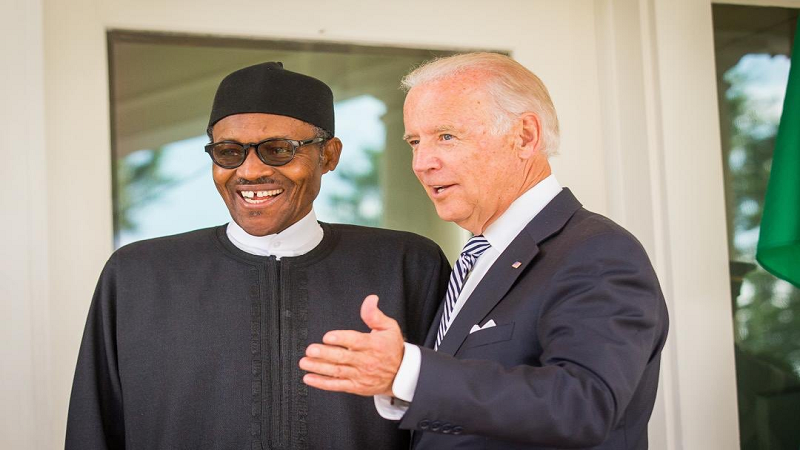
The sun rose beautifully from the horizon this morning. The energy of immigrants is back, and the admirations for the America they love. An amazing land where sojourners come and become legends, out of decency, hardwork and service. That spirit is back – I can feel it here, at the downtown, because it is a Good Morning in America. The sounds of the nightingales, the melodies of the crickets, the shouts of joy, and the horns of cars, celebrating a new chapter, night and day, are here.
As America returns back to the mountaintop to lead the world with Strength, yet with humility, I yearn for the day where Nigeria can also rise. Across our nation, we have been unable to replace people who have underperformed on their jobs. And without those checks and balances, the soul of a nation goes.
Nigeria, we need electoral reforms. There is no future without it. We cannot celebrate the good morning in America without asking, “Why can’t our elections make it possible to replace those who fail to do their jobs well in Nigeria”?
Congratulations to US President-Elect Joe Biden on his election at a time of uncertainty and fear in world affairs. His election is a reminder that democracy is the best form of government because it offers the people the opportunity to change their government by peaceful means. pic.twitter.com/srv3PP6LBz
— Muhammadu Buhari (@MBuhari) November 7, 2020
Mr. President, your biggest legacy will be fixing the broken electoral system in Nigeria. Without it, we cannot make progress. We need the dews to drop, the Nigerian electoral system needs to be revolutionized and evolutionized at the same time, because right now, it is broken. America let go Trump but Kogi state was not lucky with its own smaller version! Nigeria needs to feel the good American morning with good electoral system.
LinkedIn Comment on Feed
You are right. We need an incisive and decisive electoral reforms in Nigeria.
In the just “concluding” election in US, there was no centralized umpire. The people were the umpire. As people voted, they observed the transparent processes, and as a winner emerged, the people, through the media, announced unto themselves the winner. They never waited for a state-controlled “INEC”. The job of the “INEC” will be to ratify and endorse the people’s choice.
It has once again, confirmed the place of the media in enthroning and sustaining democracy. It’s our hope that one day, Nigeria will come to terms with the reality that: power belongs to the people.
It Is A Good Morning in America – The Ascension of Joe Biden
Americans Have Elected Presidents from These States Than Other States
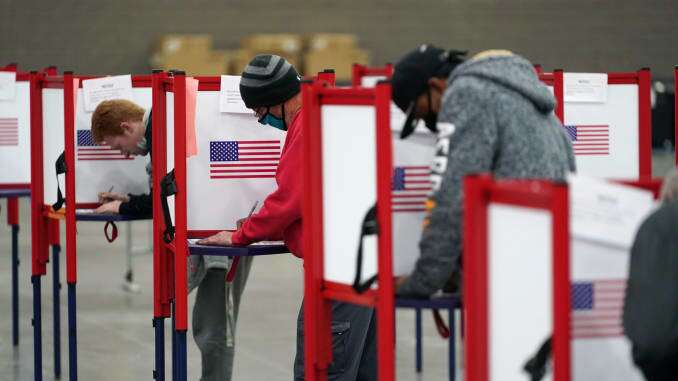
As people and governments across the world celebrate the election of Joe Biden as the 46th President of the United States of America, analysis has shown that Americans have elected their Presidents mostly from five states. Our analysis indicates that Virginia, Ohio, New York, Massachusetts and Texas are the states. Eight Presidents have been from Virginia while Ohio has had 7 out of 46 Presidents. New York, Massachusetts and Texas have also had significant number of Presidents.
President Thomas Jefferson was the first person elected from Virginia state. He was also third president of the country. President James Madison was also from the state. President Ulysses S. Grant was the first person from Ohio State, followed by Rutherford B. Hayes. These two presidents were elected at age 57, while President James Monroe, the third person from the state, was elected when he was 58 years.
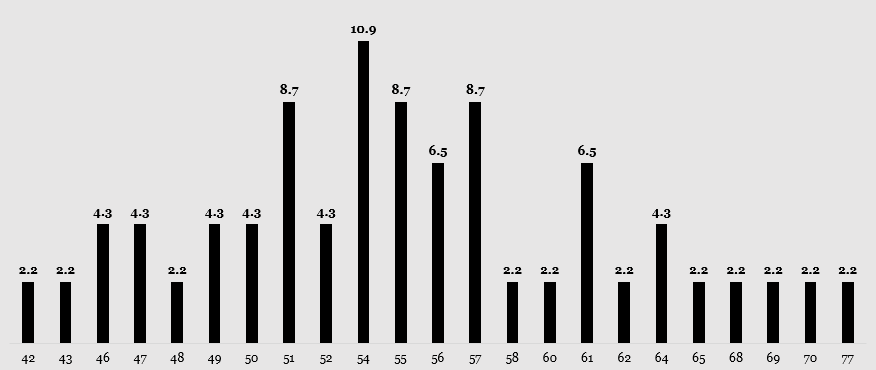
Joe Biden, the President-elect, is the first person from Delaware State and first oldest American President elected during election periods. He is 77 years. Our analysis shows that more than 10% have been elected at age 54, 8.7% were elected at age 51, 55, and 57. The average age of all the Presidents during election times was 54 years.
Exhibit 1: State of Origin of Presidents
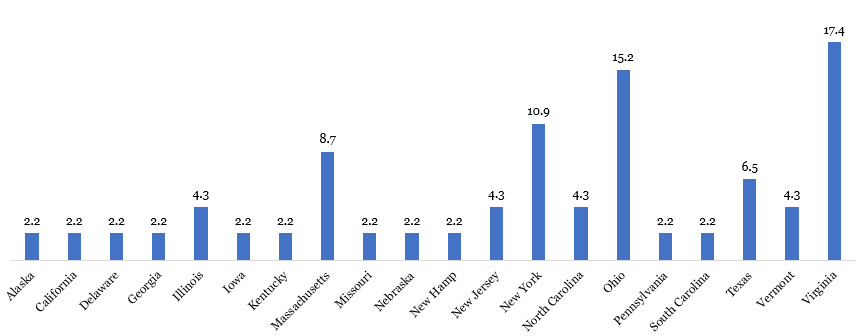
Exhibit 2: Age at Election Periods